Table grape storage: three ways to prevent spoilage
When the harvest comes in from the Bekaa Valley — those tight, sugar-laden bunches that our growers have coaxed through a long Mediterranean summer — the clock starts ticking immediately.
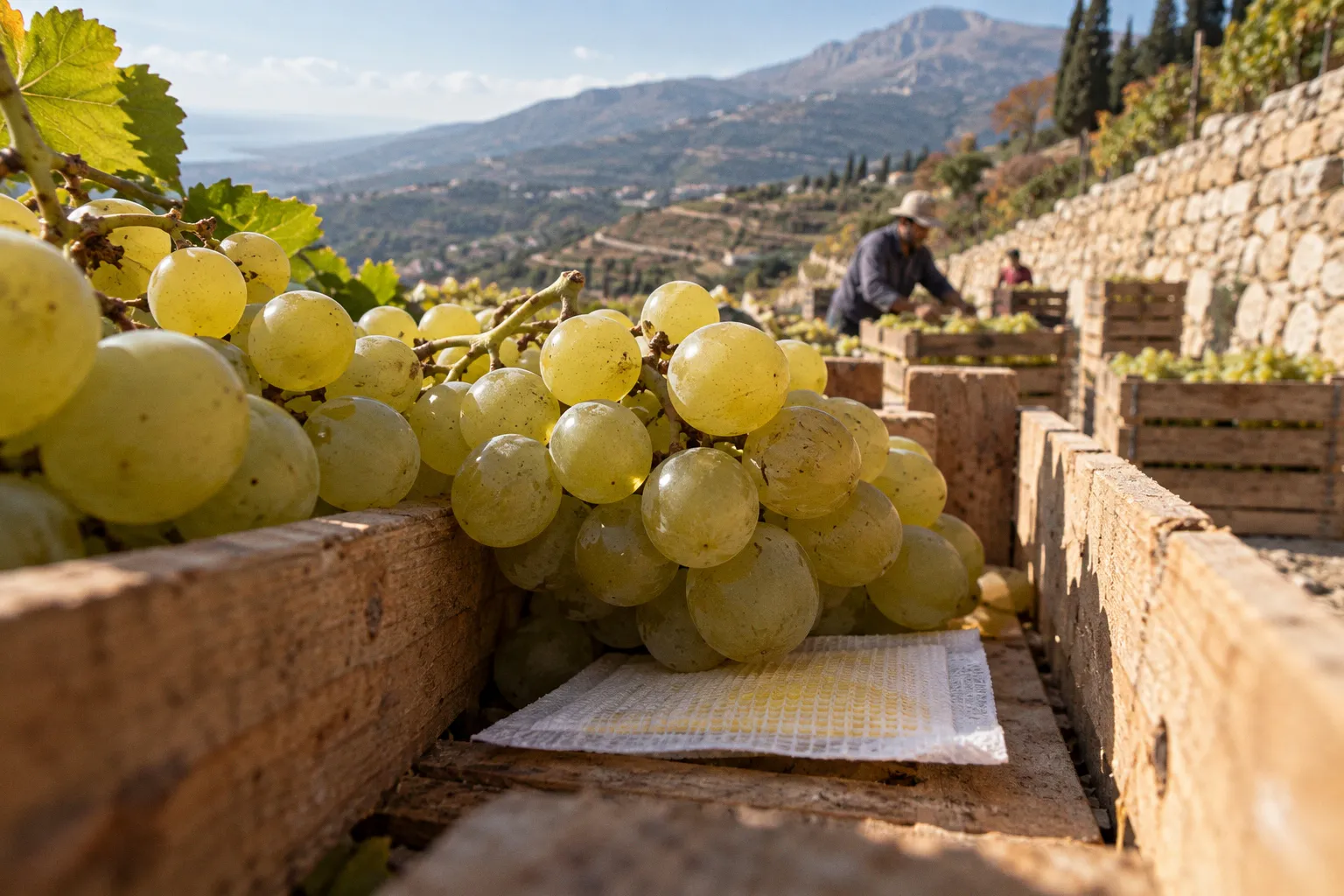
Table grapes are non-climacteric fruit, which is a quiet way of saying they will not get any sweeter, any softer, or any riper once they leave the vine. Whatever quality we capture at harvest is the quality we ship. And without proper handling in the hours that follow, we can watch that quality slip away: stems browning, berries shriveling, gray mold spreading cluster to cluster. Industry figures put losses without intervention at up to 30%, a number our cooperatives cannot afford to absorb.
The good news is that this is one of the most studied post-harvest challenges in fresh produce, and the tools that work at industrial scale can be adapted — thoughtfully, collectively — for the small and mid-sized vineyards that make up the backbone of Lebanese grape growing. Below, I want to walk through three proven methods for keeping our grapes market-ready: precision cold chain management, sulfur dioxide generating pads, and modified atmosphere packaging enhanced with natural antimicrobials. Each addresses a different failure mode, and together they form a layered defense that any organized cooperative can put into practice.
The non-climacteric challenge: why immediate cooling is non-negotiable
The first thing every member of our cooperative needs to internalize is that table grapes do not behave like the climacteric fruits we may be more familiar with — bananas, apples, tomatoes. Those fruits continue to ripen after harvest, drawing on stored starches and generating their own ethylene. Grapes do neither. Once the bunch is cut from the cane, sugar content is essentially fixed, and the fruit begins a slow, irreversible decline driven by water loss, respiration, and microbial invasion.
This biology dictates our entire storage strategy. The window between harvest and the first cooling intervention should be measured in hours, not days. Field reports and packing-house experience consistently show that grapes left at ambient temperature for even a few hours after picking develop faster shriveling and higher decay rates than those moved quickly into controlled conditions. For a small vineyard in the Bekaa, that means the picking schedule must be coordinated with cold storage capacity — not the other way around. We pick what we can cool, not what we hope to cool later.
A useful framing for the cooperative is to think of harvest day as the start of a controlled countdown. The bunches are no longer improving. Every decision from this point forward either preserves quality or surrenders it.
Table grapes do not ripen after harvest. The moment they leave the vine, we are in the preservation business — and that business rewards speed, cold air, and humidity.
Precision cold chain: managing temperature and humidity to prevent stem browning
Rapid cold storage with high relative humidity is the foundation of every other intervention we will discuss. The effective band for table grapes sits just above the freezing thresholds of the fruit itself: comfortably above the -1.0°C mark where the unprotected rachis begins to freeze, and above the -2.0°C to -3.0°C range where the berry tissue starts to ice. In practice, that means a working storage temperature near 0°C and relative humidity high enough — generally in the 90% to 95% range — to keep the berries from losing water through their skins and turning dull and limp on the shelf.
Cold tolerance is not infinite, however, and our growers should know those freezing thresholds by heart. The unprotected rachis freezes below -1.0°C, while the berry itself can tolerate slightly colder conditions, freezing somewhere between -2.0°C and -3.0°C. The margin is narrow, especially for older or poorly calibrated cold rooms where temperature swings of a degree or two are common. A reliable digital probe placed among the boxes — not at the room's edge, where the reading is always kinder than reality — is the cheapest insurance a cooperative can buy.
Humidity is the second pillar. Grape berries lose water readily through their skin, and the visible symptom — shriveling, dull surface, soft berries, brittle stems — is what buyers downgrade first. High relative humidity in the cold room keeps the berries turgid and the stems supple and green. If the same room doubles as the packing area, the humidity discipline applies there too: grapes should never sit in dry, moving air for long, and the packed cartons should move into the cold room without delay.
For a small cooperative, the practical pathway is to map the journey from vine to cold room and tighten each step. Pick in the cool hours of early morning, move harvested lugs into shade within minutes, and load the pre-cooled room as quickly as possible. Several of our growers in the northern Bekaa use a simple staging step: harvested containers go into a shaded, ventilated area with wet burlap covers, which buys critical time during peak harvest when cold room space is at a premium. None of this requires new technology — only a willingness to choreograph the harvest around the cold room rather than the other way around.
Sulfur dioxide protocols: using SO2 generating pads to inhibit Botrytis
Even with a careful cold chain, Botrytis cinerea — gray mold — remains the single most damaging post-harvest threat to table grapes. The fungus can be present as a latent infection at harvest, invisible in the field, and then erupt during storage and transit. Cold slows it; cold alone does not stop it.
Sulfur dioxide generating pads are the workhorse intervention for this problem, and they are well within reach of any cooperative. The technology is straightforward: a paper sheet impregnated with sodium metabisulfite is placed inside the grape carton. When the pad encounters moisture from the fruit and the surrounding air, it begins releasing SO2 gas in two stages — a fast initial burst to kill surface spores, followed by a slower, sustained release that inhibits new fungal growth throughout the storage period.
The effective dose has been worked out carefully over decades of commercial use. A concentration of 100 ppm of SO2 gas, sustained for one hour, is sufficient to disinfest the grapes and knock back surface fungal growth. In controlled post-harvest studies, SO2-generating pads have reduced fungal decay rates by up to 85% compared to untreated fruit. That is the difference between a pallet that arrives in good condition and one that arrives as a write-off — and over a season, that single percentage point shapes whether a cooperative ends the year in the black or the red.
For our cooperatives, the key implementation points are these:
- Use only food-grade pads designed specifically for table grapes, and follow the manufacturer's loading rate per box — no improvising.
- Make sure grapes are at the correct storage temperature before pads are activated. SO2 release is triggered by moisture, and warm fruit condenses more readily on its surface, which can both over-dose the gas and cause bleaching injury on the berry skin.
- Ventilate the cold room adequately during the initial SO2 release phase so the gas distributes evenly rather than concentrating around the first pallets loaded.
- Train every picker and packer on pad handling. A pad placed upside down, or one that gets wet before the box is sealed, behaves unpredictably, and so does the shipment.
It is worth being honest about the limits. SO2 pads are excellent at preventing surface Botrytis from taking hold and at inhibiting new spore germination, but they cannot reverse latent infections that began during flowering in the vineyard. That is why pre-harvest canopy management and field fungicide programs remain part of the picture; the post-harvest side simply finishes the job.
Advanced packaging: extending shelf life with antimicrobial-infused MAP
The third layer is packaging, and it is where some of the longest gains in shelf life are being recorded right now. Modified atmosphere packaging — MAP, as it is known in the trade — works by altering the gas composition inside the sealed package: typically reduced oxygen, elevated carbon dioxide, and a balance of nitrogen. The grapes themselves continue to respire, but the modified atmosphere slows that respiration, suppresses many spoilage organisms, and extends the marketable window well beyond what cold storage alone can achieve.
Recent research has gone a step further by infusing the packaging film or the internal atmosphere with natural antimicrobials — compounds like eugenol, drawn from clove oil; thymol, drawn from thyme; and menthol, drawn from mint. In controlled trials, this antimicrobial-enhanced MAP extended the shelf life of table grapes by approximately three weeks compared to conventional MAP alone. For a cooperative shipping to distant markets, three additional weeks is not a small number. It can be the difference between a successful export program and a cancelled contract, between a load that lands at full quality and one that lands on the reject pile.
The practical reality is that antimicrobial-infused MAP is currently more accessible to larger packers with established film suppliers. But our cooperatives should not treat it as a distant option. Several regional packaging suppliers now stock MAP liners suitable for grape cartons, and a cooperative that consolidates volume can negotiate access. Even standard MAP, without the antimicrobial enhancement, delivers meaningful gains when paired with a disciplined cold chain. The point is to start where the supply chain allows, and to upgrade as relationships and volume grow.
When evaluating MAP, our growers should weigh the following:
- Film permeability specifications matched to the expected transit duration, so the modified atmosphere develops correctly rather than drifting into anaerobic territory.
- Seal integrity — a poorly sealed MAP bag is just an expensive plastic sleeve, and the gas mix inside it will drift toward ambient air within days.
- Compatibility with SO2 pads; some film structures interact with the gas in ways that reduce efficacy or trap it where it can damage the fruit.
- Disposal and recyclability, which increasingly matters to our European buyers and to the cooperatives that want to claim responsible sourcing in their marketing.
How the three methods compare
The three approaches are not interchangeable. They protect against different failure modes, and they layer naturally rather than competing.
| Failure mode | Cold chain | SO2 generating pads | Antimicrobial MAP |
|---|---|---|---|
| Berry shrivel and weight loss | Primary defense | No direct effect | Supports by slowing water loss |
| Stem (rachis) browning | Primary defense | Indirect support | Indirect support |
| Surface Botrytis (gray mold) | Slows growth | Primary defense | Secondary defense |
| Latent Botrytis from flowering | No effect | No effect | No effect — must be handled pre-harvest |
| Typical shelf life contribution | Days up to roughly two weeks on its own | Adds days to weeks on top of cold | Adds up to three weeks vs. plain MAP |
| Capital cost for a small cooperative | Shared cold room is the main investment | Low, per-box consumable | Higher; depends on film supply |
The table makes the layering visible. Cold chain is the foundation — without it, the other two are working uphill. SO2 pads handle the fungal pressure that cold alone cannot. MAP buys the time that distance and shelf life demand. None of the three substitutes for the others, and a cooperative that can combine even two of them meaningfully shifts the economics of the season.
Operational best practices for small-scale vineyard management
Knowing the science is one thing. Running a post-harvest program across thirty or fifty member farms is another. What I have seen work, in our own context and in cooperatives I have visited, is the discipline of treating post-harvest handling as a shared responsibility rather than an individual one. The grapes in a buyer's box do not carry a farm name; they carry a cooperative name.
A workable framework for our cooperatives looks like this:
1. Centralize the cold chain. Even a modest shared cold room, properly maintained and calibrated, outperforms a dozen improvised setups. Cooperatives that have invested in shared infrastructure consistently report lower rejection rates than those where each farm manages its own.
2. Standardize the picking protocol. Decide as a cooperative on cut time, lug type, shade handling, and transport timing to the cold room. Publish it. Train to it. Audit it at peak harvest, when the pressure to cut corners is highest.
3. Pre-cool before you pack. Loading warm grapes into a cold room taxes the refrigeration system, raises humidity unevenly, and condenses moisture on the fruit — exactly the conditions that favor Botrytis. A dedicated pre-cooling step of even two to four hours makes the cold room more effective and the berries more resilient.
4. Make SO2 pads standard, not optional. Include them in the packing protocol for every box that will be in storage longer than a few days. The cost per box is modest; the loss avoided is significant.
5. Match packaging to market. Short-haul wholesale to Beirut or domestic retailers can run on cold chain alone. Export shipments — by sea or by air — should incorporate MAP at minimum, and antimicrobial-enhanced MAP where the buyer requires longer transit.
6. Keep records. Date of harvest, time to cold room, lot code, SO2 pad batch, cold room temperature log. When something goes wrong, the record tells us where. When things go right, the record lets us prove it to buyers who increasingly ask for traceability.
The point of these steps is not bureaucracy. It is that the buyer in Rotterdam, or in the Gulf, or in our local wholesale markets cannot tell at a glance which cooperative handled its grapes with care. They can tell when they open the box. Our shared reputation is built one opened carton at a time, and that reputation — once lost — is slow to rebuild.
The grapes do not know which farm they came from. They only know how they were handled. Our job, together, is to make sure the answer is the same for every bunch.
A cooperative path forward
We are working with a fruit that gives us no second chances after harvest. It will not ripen on the truck. It will not improve in storage. But it will keep — beautifully, profitably — if we meet its three basic needs: cold, clean air, and humidity. The methods above are not exotic, and they do not require a research budget. They require coordination, shared equipment, and a willingness to treat post-harvest care as a collective craft rather than a per-farm afterthought.
The Lebanese table grape has the flavor, the color, and the heritage to hold its own in any market. Our growers have always known how to coax a good bunch from the vine. The next chapter is about coaxing that same quality through the days and weeks that follow. With a layered approach — cold chain first, SO2 second, advanced packaging third — we can keep our losses well below that 30% line and deliver, consistently, what our buyers are asking for. That is how a cooperative turns a good harvest into a good year, and a good year into a sustainable future for the families who depend on the crop.