Bekaa Valley Potato Harvest: From Soil to Wholesale Market
In the Bekaa Valley, our growers don't get one harvest a year — they get two, and the calendar never gives them much breathing room between them.
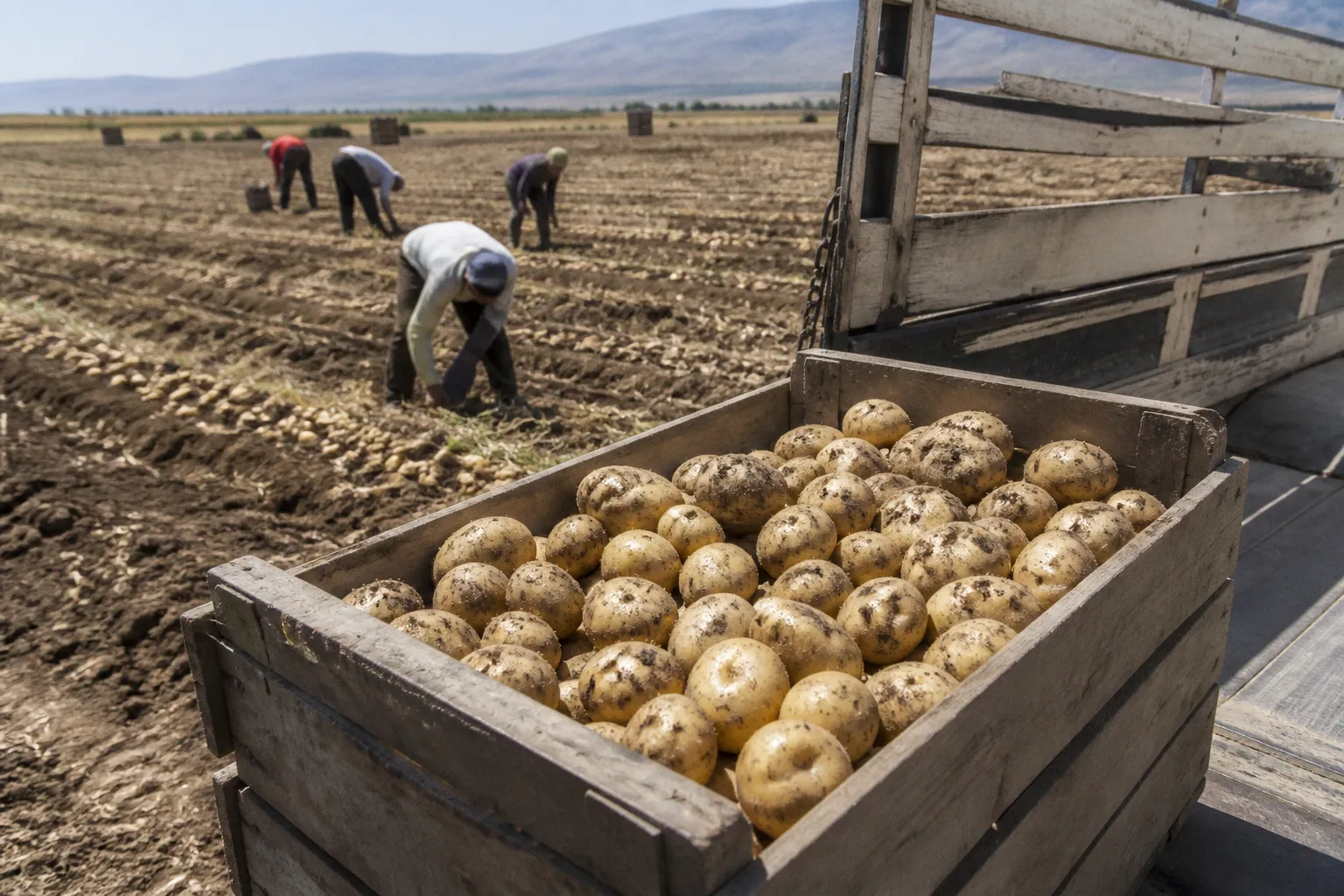
Spring tubers come out of the ground in June and July, just as the autumn crop is already being prepared for July and August planting. That double rhythm defines everything about how our cooperatives plan labor, storage, and sales: the person sorting Spunta on a hot July morning may well be the same person walking behind a plough in October. When a single valley produces between 65% and 70% of an entire country's potato volume, the whole community lives inside that tempo.
A potato harvest is not a moment. It's a partnership between two seasons, two plantings, and the people who refuse to let either one of them down.
The Dual-Cycle Rhythm: Two Plantings, Two Windows, One Valley
The Bekaa's agricultural calendar runs on a simple but demanding principle: keep the soil working. The spring planting begins in February and March, when the soil has warmed enough to push seed potatoes into the ground and the frost risk has retreated from the plains around Zahle and Qab Elias. Those tubers spend roughly four months developing underground, and by June the harvest begins in earnest, running through July. The valley then turns over almost immediately: in late July and August, farmers plant the autumn crop, which matures through the cooler months and comes out of the field from October into November.
That second cycle is what gives Lebanese potatoes their year-round presence on domestic shelves and their resilience in the export calendar. Average yields across the country sit around 23 tons per hectare, but the early-season Bekaa crop under the right conditions can reach up to 68 tons per hectare — figures that only make sense when the cooperative's planting schedules, irrigation channels, and labor rotations are stitched together across dozens of small farms.
For our growers, the dual cycle isn't just agronomic; it's logistical. Storage facilities in the valley are sized for the spring surge, then emptied and refilled as the autumn harvest comes in. Buyers at the wholesale market adjust their procurement rhythms twice a year. Even the school calendars of farming families bend around the two windows. Coordinating all of that is a collective responsibility, and the cooperatives that handle it well treat it as core business, not as an afterthought.
| Cycle | Planting Window | Harvest Window | Key Pressure Points |
|---|---|---|---|
| Spring | February – March | June – July | Peak labor demand, fast turnover to autumn planting |
| Autumn | July – August | October – November | Cooler handling, longer storage bridge to spring |
Cultivating Spunta and Agria: What Our Growers Choose and Why
Two varieties anchor Bekaa potato production, and the choice between them isn't casual — it reflects market access, water availability, and the contract terms our cooperatives can negotiate. Spunta, the drought-resistant workhorse, dominates plantings across the valley. It tolerates the dry stretches that define Mediterranean summers, produces elongated tubers that traders in regional Arab and Gulf markets prefer, and recovers reasonably well from the irrigation gaps that plague smaller farms. Agria occupies a different niche: rounder, denser, and favored for processing into fries and flakes, it tends to fetch higher margins when a cooperative has secured a relationship with a chip manufacturer or a peeling line.
Our growers learn to read the soil before they choose. The lighter alluvial soils around the central Bekaa reward Spunta's vigor, while heavier plots with better moisture retention allow Agria to size up more uniformly. Seed quality matters enormously — cooperatives that pool resources to buy certified seed each season consistently outperform those that replant saved tubers, both in yield and in the share of blemish-free potatoes that make export grade.
Practical day-to-day decisions matter just as much. Plant spacing, ridging height, and the depth at which tubers set all influence how cleanly the potatoes come out of the ground later. That last detail isn't cosmetic — it determines how much hand labor goes into the lifting process, which we'll come back to in the sorting workflow.
From Field to Market: The Manual Sorting and Grading Workflow
Harvest in the Bekaa is still a hands-on affair. A plough opens the furrow and lifts the plants, exposing the tubers, but the actual collection is done by agricultural workers who follow the implement, handpicking potatoes into crates or sacks. This is where the sorting process begins, often before the potatoes even leave the row.
The first cut is visual and immediate. Field workers separate out the obvious rejects: tubers cut by the plough, green shoulders exposed to the sun, soft or rotten specimens, and stones that snuck past the ridger. What remains goes into field crates that move quickly to a sorting shed or to the edge of the plot, where a second pass happens under better light. There the categories tighten up:
- Export-grade table potatoes — uniform size, smooth skin, no greening, no mechanical damage, no common scab above cosmetic thresholds.
- Domestic premium — slightly less rigid on size uniformity but still clean, firm, and well-shaped.
- Processing grade — sent to Agria buyers or to local peeling lines; size and shape are secondary to dry matter and fry color.
- Animal feed or cull — anything that doesn't make the cut above, which still has value as livestock feed and shouldn't be wasted.
Most sorting across the valley is still manual labor, and that detail matters both for the workforce it sustains and for the quality judgments only a trained hand can make. Optical sorting exists in some larger operations, but in our cooperative context the human eye remains the most flexible and the most employable tool we have.
After grading, potatoes are packed into ventilated containers — typically 10kg, 20kg, 25kg, or 50kg mesh bags or jute sacks — chosen to allow air circulation and prevent the moisture buildup that turns a clean tuber into a spoiled one during transit.
The grading table is where the field meets the market. Every tuber that crosses it has already passed through at least three pairs of hands.
The Qab Elias Hub: Where the Valley's Potatoes Become a Wholesale Market
The town of Qab Elias, in the Zahle district, hosts the largest vegetable wholesale market in Lebanon — a site spanning more than 35,000 square meters where the Bekaa's harvest becomes a tradable commodity. For our growers, this is where the cooperative's work transitions from agronomy to commerce.
At Qab Elias, transactions happen fast. Wholesalers from Beirut, from the northern regions, and from cross-border buyers walk the lanes in the pre-dawn hours, evaluating the morning's arrivals by feel and by eye. A cooperative's reputation at this market is built over seasons, not transactions: a truck that consistently delivers what its invoice promises, in the size grade it claims, becomes a preferred supplier. One bad load can undo months of careful work in the field.
For cooperatives that want to grow beyond the domestic floor, the Qab Elias market also functions as a training ground. Pricing signals here reflect what's happening on regional export routes — when Gulf demand softens, the wholesale price dips within days. When a quality complaint comes back from an importer, the same correction ripples through the market almost immediately. Our growers who treat Qab Elias as a learning environment rather than just a sales floor tend to make better decisions about which share of their harvest to commit to export channels and which to keep in the local rotation.
Storage, transport, and cold-chain decisions all converge at this hub. A cooperative planning its season needs to know not only how much it will produce but how it will move — whether it has access to refrigerated trucks for longer hauls, whether its packaging will survive a multi-day journey, and whether its documentation is in order for the border crossing.
Navigating EU Phytosanitary Standards and Export Logistics
When our cooperatives talk about "the export question," they usually mean one specific destination: the European Union. Lebanese potato exports to the EU operate under a tight regulatory frame, anchored by Commission Implementing Decision (EU) 2019/1614, prolonged by Regulation (EU) 2023/1572. At the heart of that frame is a phytosanitary requirement: proof that the potatoes originate from areas free of the ring rot pathogen Clavibacter michiganensis ssp. sepedonicus. For a Bekaa cooperative, that translates into field-level record-keeping, traceability of seed sources, and inspection documentation that follows each lot from the field to the port.
The practical consequences shape the whole operation. Seed potatoes must be certified and traceable. Fields must be mapped, and rotations must be documented so inspectors can verify that ring rot has not been detected in the production zone. Harvested lots must be identifiable by field, date, and variety, and that identification has to survive the journey through the sorting shed, the wholesale market, and the export pack-house. None of this is optional, and none of it works without a cooperative structure that can hold the paperwork on behalf of its members.
Export-grade packaging reinforces the same discipline. The 10kg, 20kg, 25kg, and 50kg ventilated mesh bags and jute sacks are not interchangeable with domestic sacks — they carry specific labeling requirements, lot codes, and sometimes producer marks that allow traceability all the way back to the field. For our cooperatives, building that muscle is an investment that pays back in market access.
The export value tells the story. Lebanon's potato exports peaked at USD 48 million in 2014, and in the years since they have averaged between USD 14 million and USD 20.7 million annually. Most of that volume, it's worth being clear, goes to regional Arab and Gulf destinations rather than to Europe — but the EU remains the most demanding standard on the menu, and meeting it opens doors to other premium markets as well.
A cooperative that wants to compete in those channels has to coordinate at least five moving parts: seed sourcing, field-level traceability, post-harvest handling, packaging compliance, and the documentation chain that links them. That's not a single farmer's job. It's the work the cooperative was built for.
Putting It Together: A Cooperative Roadmap for the Season
The Bekaa potato season isn't a sequence of independent tasks — it's a relay, and each hand-off has to be clean. The way our most reliable cooperatives structure the year looks something like this:
- Pre-season (January–February): Confirm seed orders collectively to negotiate volume pricing on certified Spunta and Agria. Review last season's phytosanitary records and update field maps. Plan labor rotations for the two harvest windows.
- Spring cycle (February–July): Plant, irrigate, scout for pests and disease, and prepare the lifting equipment. The June–July harvest is the bigger labor event; sorting capacity, packaging supply, and transport must be reserved in advance.
- Autumn cycle (July–November): Plant the second crop as soon as the spring fields are cleared. October–November brings the second harvest, often with cooler conditions that favor longer storage and steadier handling.
- Post-season review (December): Reconcile yield data, export documentation, and quality complaints. Adjust seed sourcing, packaging specifications, and buyer commitments for the year ahead.
When that rhythm is honored, the cooperative holds its place at Qab Elias, keeps its documentation current for the EU frame, and earns the kind of buyer trust that turns one-off contracts into multi-season relationships. When any link in the chain slips — when a sorting pass is rushed, when a field record goes missing, when a packaging order arrives late — the cost shows up immediately in price, in rejected loads, or in lost market access.
The Bekaa potato harvest is, in the end, a portrait of collective discipline. The soil gives what it gives, the seasons move when they move, and the rest is our growers and their cooperatives showing up, season after season, to do the work that turns a tuber into a livelihood.