Bekaa Valley potato harvest: four steps to minimize storage loss
The Bekaa Valley supplies approximately 65–70% of Lebanon’s potato production, spread across two annual harvest cycles.
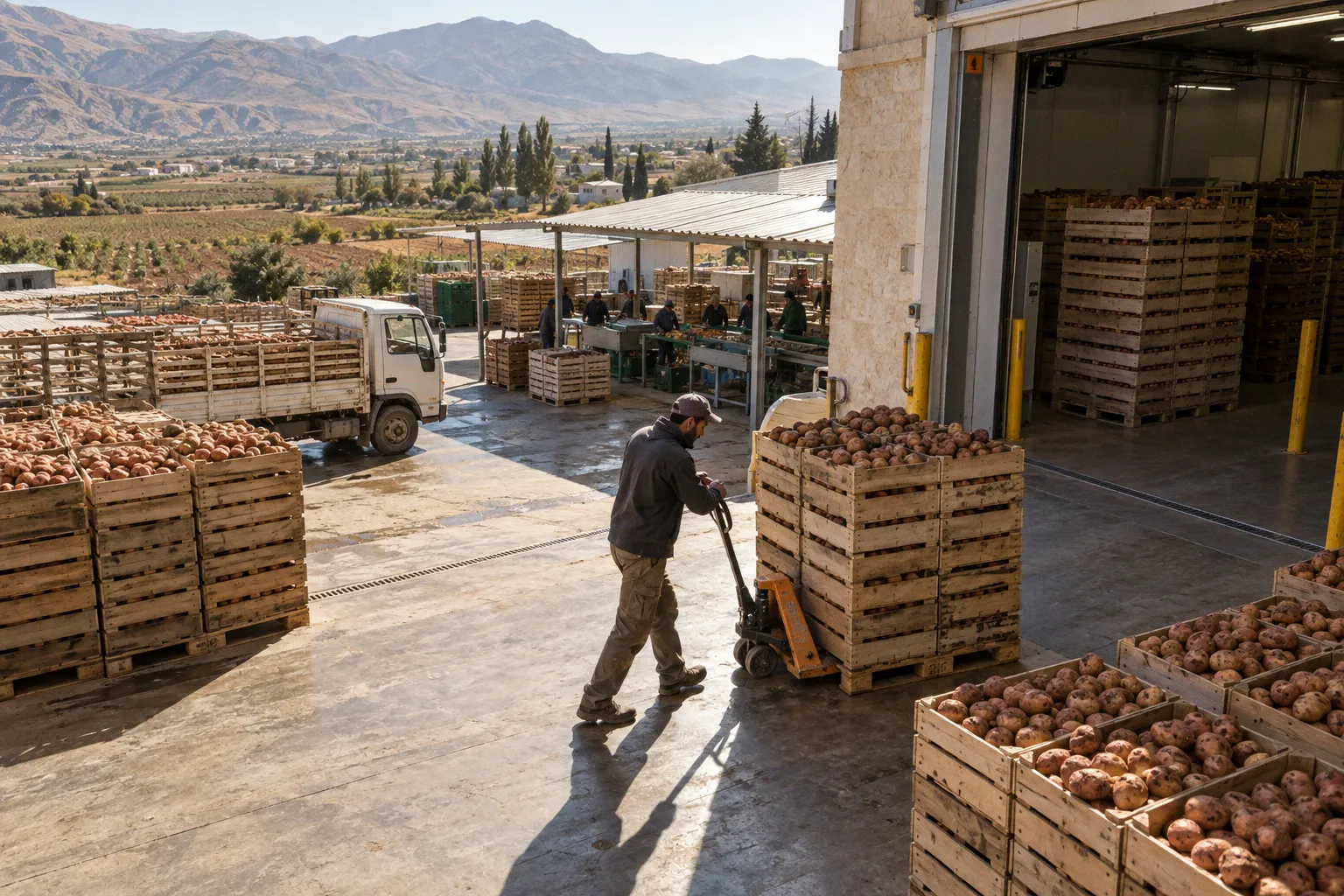
That scale gives our growers an important advantage in the market, but it also means that small post-harvest weaknesses can become collective losses: a damaged skin here, an infected tuber there, a poorly sealed store that exchanges warm daytime air with the crop, and suddenly a marketable lot is losing weight, quality, and value before it ever reaches the buyer.
The most reliable Bekaa Valley potato harvest storage techniques do not begin inside the storage building. They begin in the field, before the harvester enters. A strong storage program is a sequence: allow the skin to set, handle and sort the crop gently, give wounds time to heal through suberization, then manage airflow so the pile cools without drying out. Each step protects the one that follows.
This is not a system reserved for large exporters. It is a shared discipline that cooperatives can organize across farms, harvest crews, collection points, and storage facilities. When our growers use the same language and the same thresholds, quality becomes something we build together rather than something we hope to discover at loading time.
1. Begin with vine desiccation, not with digging
Potatoes harvested too soon are vulnerable before they leave the field. Their skins may still be tender, and mechanical movement during lifting, grading, loading, and transport can remove that protective layer. These wounds are not merely cosmetic. They create entry points for infection and increase the amount of exposed tissue that must later be managed in storage.
For the Bekaa Valley potato harvest, vine desiccation or topkill should generally take place two to three weeks before harvest. This interval allows the tuber skin to complete its set while the crop remains in the ground. A well-set skin is more resistant to skinning and bruising, and it gives the lot a stronger starting position for the potato curing process for Lebanese farms.
The practical mistake is to treat vine desiccation as a single event rather than as the opening move in a harvest plan. Our growers should be asking:
- Has the vine been desiccated evenly enough for the crop to mature consistently?
- Is the planned harvest date allowing the skin to set fully?
- Will the soil be workable without forcing the machinery to handle wet, clinging tubers?
- Are disease symptoms present in the field that should change the sorting and storage decision?
The purpose is not simply to make the field look ready. It is to reduce mechanical skinning and limit the risk that spores in the soil will be washed or rubbed into fresh injuries during digging. If the crop is lifted while the skin is still fragile, no later storage adjustment can fully restore that lost protection.
Reading the crop before harvest
Field readiness should be assessed at the lot level, not only by walking the edge of a field. A cooperative can make this more consistent by assigning a small harvest-readiness team to inspect representative areas and record the condition of the vines, soil, tuber skin, and visible disease.
That shared observation is particularly valuable when several farms are sending potatoes to the same storage building. A store manager needs to know whether the incoming crop is uniform or whether lots with different maturity and disease risks are being mixed. Mixed lots are not automatically unusable, but they demand more careful separation and airflow management.
Harvest crews also need clear instructions before the first load is lifted. Belts, bins, trailers, and loading points should be checked for sharp edges and unnecessary drops. A crop with a well-set skin can still be damaged by rough equipment. The strongest field preparation is undermined when potatoes fall hard onto metal, are thrown into overfilled containers, or are repeatedly moved because the collection point is not organized.
Storage loss is often decided before the potatoes enter storage: a firm skin and a gentle harvest give the crop room to withstand the weeks ahead.
2. Sort in the field before infection travels through the lot
Storage cannot improve a diseased or badly damaged potato. It can only slow the deterioration of sound tubers and contain the consequences of what enters the building. That is why field sorting is one of the most important stages in Bekaa Valley potato post-harvest handling.
Potatoes with late blight, rot, open wounds, severe bruising, or obvious decay should be removed before they join the main storage lot. Recommendations indicate that potatoes should not be stored when more than 5% of the lot shows late blight or rot. This threshold is not a substitute for judgment, but it gives cooperatives a practical point at which to stop treating a problematic load as ordinary storage material.
The key is to sort before the potatoes are tightly piled. Once infected tubers are buried inside a dense heap, inspection becomes difficult and localized deterioration can spread unnoticed. A single decaying area may also increase moisture and create conditions that make neighboring potatoes more vulnerable.
A cooperative sorting protocol
A useful protocol does not need to be complicated, but it must be agreed in advance. Every person handling the crop should understand what happens to:
1. Sound, marketable tubers — directed into the main lot with as little dropping and rehandling as possible.
2. Tubers with minor soil contact but no visible injury — kept separate if the cooperative’s grading system requires it, then assessed after initial handling.
3. Cut, crushed, badly bruised, or exposed potatoes — removed from long-term storage and directed to an appropriate short-term market or processing use where possible.
4. Potatoes showing late blight or rot — excluded from the storage lot and kept away from clean produce.
5. Uncertain tubers — placed in a clearly marked inspection group rather than mixed into the sound crop by default.
The last category deserves more respect than it usually receives. When harvest pressure is high, an uncertain potato is often allowed into the pile because separating it feels inefficient. Yet a few minutes of careful judgment at the collection point may prevent much longer work later, when a store must be opened, a pile examined, and a deteriorating section removed.
Sorting also protects the cooperative’s relationships. If every farm follows a different standard, one grower’s careful crop can be exposed to another lot carrying preventable disease. Shared sorting rules are therefore not an administrative burden; they are a form of mutual protection.
Handling is part of sorting
The condition of a tuber can change during the sorting process. Rough handling creates injuries even when the potato looked sound at lifting. Our growers should reduce unnecessary drops, avoid overfilling bags and bins, and keep transfer points aligned so the crop moves rather than falls.
When equipment is used, the most damaging points are often predictable: the end of a conveyor, the edge of a trailer, a narrow loading chute, or a place where a full container is tipped onto a hard surface. These points should be inspected during the first loads, not only after bruising appears in the store.
A clean, blemish-free appearance is valuable in the market, but the deeper goal is tissue protection. Every intact skin is a barrier. Every open wound is a storage decision.
3. Give the crop time to cure through suberization
After harvest, potatoes carry small wounds even when the work has been done well. The skin may have been scraped, the tuber may have been bruised lightly, or a cut may have occurred during lifting. Before long-term storage cooling begins, these wounds need time to heal through suberization, often called curing.
Suberization is the potato’s natural wound-healing phase. Under suitable temperature and humidity control, damaged tissue develops a protective layer that reduces water loss and helps limit the movement of pathogens into the tuber. This is why the potato curing process for Lebanese farms should be treated as a distinct stage rather than as an informal pause between harvest and storage.
The store should not be filled and immediately cooled as if all potatoes arrive in their final storage condition. Nor should the crop be left in an uncontrolled environment, where excessive warmth, dryness, or poor air movement can increase weight loss and disease risk. Curing needs a managed environment, even when the facility is modest.
What a good curing phase requires
The exact settings will vary with crop condition, harvest season, facility design, and local weather. Since there is no single precise temperature regime used by every small-scale Bekaa cooperative, the safer approach is to manage the principles consistently:
- Keep the crop protected from direct heat and strong drying airflow.
- Maintain high relative humidity so wounds do not lose moisture too quickly.
- Allow enough ventilation to remove excess moisture and heat from the pile.
- Avoid sealing a wet, diseased, or overheated crop into a stagnant space.
- Inspect the crop during curing rather than assuming the whole lot is healing uniformly.
- Delay long-term cooling until the wound-healing stage has had a proper opportunity to work.
A well-sealed and insulated storage building can help maintain roughly 90–100% relative humidity while limiting uncontrolled air exchange. The value of insulation is not only energy efficiency. It helps the facility hold a more stable environment, reducing the repeated expansion and contraction of conditions that can dry the crop or encourage condensation.
The balance is delicate. High humidity supports weight retention and wound healing, but stagnant, moisture-laden air can create trouble. Ventilation should move air through the pile in a controlled way rather than blasting the surface and leaving the interior warm. Where possible, the cooperative should use temperature and humidity measurements at several points, including inside the pile, not only near the door or ceiling.
Keep lots identifiable during curing
A storage facility is easier to manage when the crop remains traceable. Loads from different farms, harvest dates, or field conditions should be marked clearly. Even a simple record of grower, field, harvest date, disease observations, and intended market can guide later decisions.
This matters because not every lot will cure at the same pace. A clean, carefully harvested crop may be ready for the next stage before a lot with more wounds or higher field moisture. If everything is mixed immediately, the more vulnerable potatoes can determine the conditions for the entire store.
For cooperative managers, this is where shared infrastructure becomes genuinely powerful. One person may oversee the building, another may record incoming lots, and harvest teams may perform first sorting at the field edge. The system works when these responsibilities connect, not when one storage operator is expected to repair every weakness at the end.
4. Use ventilation to cool the pile without drying it out
Once curing has been managed, ventilation becomes the practical tool for reducing field heat and moving the crop toward longer storage. This is also the stage where many facilities face their biggest environmental challenge: daytime air in the Bekaa can be too warm to cool the pile effectively, especially during hot harvest periods.
That is why night-time ambient air flushing can be a useful, lower-cost method for Bekaa storage facilities. When outdoor temperatures fall, cooler air can be introduced to reduce the heat held within the potato pile. The approach uses the local daily temperature pattern instead of fighting it continuously with energy-intensive cooling.
Night flushing is not a magic substitute for proper building design or supplementary cooling. Daytime ambient air alone should not be treated as sufficient for maintaining optimal cool conditions during hot harvests. But when the store is insulated and reasonably well sealed, and when airflow is controlled, cooler night air can make a meaningful contribution.
The ventilation rhythm
A practical ventilation rhythm follows the crop rather than the clock alone:
1. Measure conditions inside and outside the store. Opening vents simply because it is nighttime is not enough; the outside air must be suitable for the condition of the pile.
2. Flush during the cooler part of the night. The aim is to exchange warmer internal air with cooler ambient air while avoiding unnecessary moisture loss.
3. Move air through the pile evenly. Surface cooling can create a misleading impression of progress if the center remains warm.
4. Close or reduce ventilation when outside conditions become warmer or drier. Uncontrolled daytime exchange can increase weight loss and bring heat back into the store.
5. Recheck the crop after ventilation. Watch for condensation, wet areas, unusual odors, softening, or rising temperature inside the pile.
6. Use supplementary cooling when the weather and crop condition require it. Night-time flushing is one tool within the system, not the entire system.
The objective is stable, gradual cooling. Rapid changes can stress the crop, while insufficient airflow leaves heat trapped in the pile. Good ventilation also helps manage moisture produced by respiration and limits the local conditions in which rot can advance.
Building preparation matters as much as the fan
Ventilation performance is shaped by the storage building. Gaps around doors, damaged insulation, poorly fitted vents, and unplanned air leaks make it difficult to control the environment. Air will follow the easiest path, which may mean that one section of the pile receives too much airflow while another receives almost none.
Before the harvest season, cooperatives can inspect:
- door seals and loading entrances;
- insulation on walls and the roof;
- drainage and floor condition;
- ventilation openings and screens;
- fan operation, duct alignment, and electrical safety;
- access routes for inspection and removal of suspect potatoes;
- the position of thermometers and humidity sensors.
This work is not glamorous, but it protects the crop more reliably than last-minute adjustments after a problem appears. A storage building should allow people to inspect the pile, separate lots, remove damaged potatoes, and adjust airflow without disturbing the entire crop.
Bringing the four steps into one cooperative system
The four stages are often discussed separately, yet their strength comes from their order. Vine desiccation protects the skin. Field sorting removes the most dangerous sources of disease. Suberization gives minor wounds a chance to heal. Ventilation then helps the cured crop move toward stable storage conditions.
If one stage is skipped, the next stage carries a heavier burden. A store cannot ventilate away damage caused by premature harvest. Curing cannot make a rotten potato safe. High humidity cannot compensate for poor sorting. Night cooling cannot correct a building that exchanges uncontrolled air all day.
A cooperative can turn this sequence into a shared harvest plan with a small number of defined responsibilities:
| Stage | Main responsibility | What should be recorded | Decision point |
|---|---|---|---|
| Vine desiccation and skin set | Grower and field team | Desiccation date, planned harvest date, field condition | Is the skin sufficiently set for gentle lifting? |
| Field sorting | Harvest and collection team | Visible rot, late blight, bruising, damaged tubers | Does the lot meet the storage standard, including the 5% disease threshold? |
| Suberization | Storage manager | Lot identity, wound condition, humidity, internal temperature | Has the crop had a controlled healing phase before long-term cooling? |
| Ventilation and cooling | Storage manager and cooperative committee | Indoor and outdoor conditions, airflow periods, pile observations | Is night flushing helping without excessive drying or condensation? |
This kind of record does not need to become a thick administrative file. A clear sheet, shared logbook, or simple digital record is enough if everyone uses it. The purpose is to help the next person understand what happened before the crop arrived at their part of the process.
Planning around the two annual harvest cycles
Because the Bekaa Valley’s potato production is distributed across two annual harvest cycles, storage planning cannot rely on one fixed seasonal routine. Weather, soil condition, crop maturity, and disease pressure may differ between cycles. The same building may also be asked to receive potatoes at different times of year, under very different ventilation conditions.
For each cycle, the cooperative should revisit the practical questions:
- Will harvest coincide with warm days that limit daytime ambient cooling?
- Is the building prepared for night-time air flushing?
- Are sorting teams available when the crop begins arriving?
- Can lots be held separately during curing?
- Are the ventilation and inspection points accessible after the store is filled?
- Is there a clear route for removing infected or deteriorating potatoes?
- Are growers, drivers, graders, and storage staff working to the same handling standard?
The answer does not need to be perfect before harvest begins, but it must be honest. If a facility cannot provide controlled long-term conditions for a particular lot, the cooperative may need to shorten storage, prioritize an earlier market, or keep that lot separate from potatoes with stronger storage potential.
This is where collective planning protects individual growers. A single farm may not be able to improve a storage building, organize night ventilation, or maintain a trained sorting team alone. A cooperative can distribute those tasks, invest in the weakest point, and create a system in which better handling benefits everyone.
The cooperative advantage is not only shared storage space; it is shared judgment about which potatoes are ready, which need protection, and which should never enter the pile.
What minimizing storage loss really means
Minimizing loss does not mean promising that every potato will remain perfect. No storage system can erase the effects of disease, injury, field moisture, or difficult weather. The realistic goal is to prevent avoidable deterioration and preserve the quality the crop already has.
For our growers, that means treating a crisp, sound tuber as the result of many connected decisions:
- harvest after proper skin set;
- lift and transfer with care;
- remove rot and late blight before storage;
- allow wounds to heal under controlled curing conditions;
- keep humidity high enough to protect weight without creating stagnant wetness;
- use cooler night air intelligently;
- inspect the pile and respond before a small problem becomes a large one.
The Bekaa Valley already has the production base and farming knowledge to supply demanding markets. The next gains will come from coordination: a harvest crew that understands why timing matters, a collection point that sorts before mixing, a storage manager who records conditions, and a cooperative committee willing to invest in insulation, measurement, and training.
When these four steps become routine, storage stops being a final gamble after harvest. It becomes part of crop quality itself—an organized continuation of the grower’s work from the field to the buyer. That is how our collective effort protects yield, preserves market value, and gives Lebanese potatoes the stronger, cleaner journey they deserve.