Potato storage rot: 5 proven methods for Bekaa farms
For a Bekaa potato farm, storage rot is rarely a problem that begins inside the store.
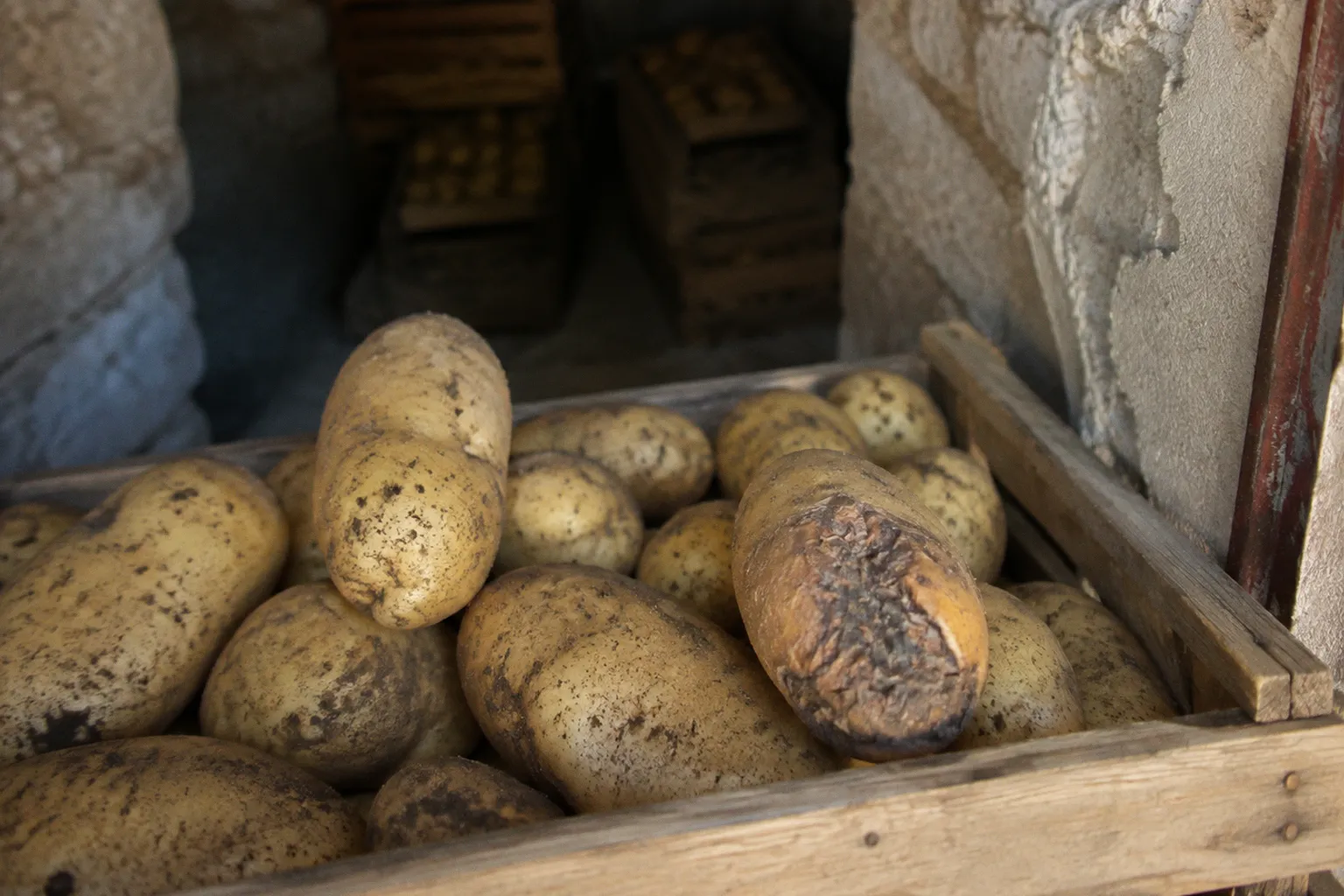
The Economic Impact of Storage Rot on Bekaa Potato Yields
It usually begins earlier, with immature skin, bruising at harvest, wet soil, delayed cooling, or a lot that entered the building with infected tubers already mixed through it. By the time soft rot or dry rot becomes visible in the pile, the original mistake may be several weeks old.
That delay makes storage losses particularly expensive. A field loss can be seen and measured at lifting. Storage loss appears gradually: a few wet tubers around a ventilation channel, a sour smell near the floor, a darkened patch in one section of the pile, then a larger grading loss when the crop is finally prepared for market. The crop has already absorbed the costs of seed, irrigation, field operations, harvesting, sorting and transport. Rot removes value after most of those costs have been paid.
The Bekaa’s two main potato production windows create different storage pressures. Spring and early-summer crops may arrive at the store during warm weather, when field heat is difficult to remove quickly. Autumn crops can arrive cooler, but wet soil and condensation become more serious risks when the crop is lifted after rain or moved between colder nights and warmer indoor air. The correct storage programme therefore cannot be reduced to one temperature setting. It has to follow the condition of the tubers entering the building.
Several types of rot can be present in the same lot:
- Fusarium dry rot commonly enters through cuts, abrasions and bruises. It develops gradually and is favoured by damaged tubers, poor curing and unsuitable temperature management.
- Bacterial soft rot is strongly associated with free water, damaged tissue, poor ventilation and oxygen-poor pockets within the pile. It can spread rapidly once wet conditions are established.
- Late-blight-related tuber decay begins with infected tubers brought in from the field. These tubers are a particular risk when they are stored with healthy produce and surface moisture is not controlled.
The controls overlap, but they are not interchangeable. Ventilation cannot repair immature skin. A good curing room cannot make a diseased lot suitable for six months of storage. Sanitisation cannot compensate for condensation inside a bulk pile. The practical objective is to reduce the number of wounds, dry the crop without dehydrating it, heal the wounds, prevent surface water and keep visibly diseased tubers out of long-term storage.
| Risk entering the store | What it looks like in practice | Main control |
|---|---|---|
| Immature or easily damaged skin | Skin rubs off during handling; tubers show fresh abrasions | Allow adequate skin-set before lifting |
| Wet crop and free water | Soil adheres to tubers; surfaces remain damp after intake | Lift in suitable conditions and remove surface moisture |
| Open wounds | Cuts, bruises and impact marks appear after grading | Reduce drop heights and handle the crop gently |
| Condensation | Wet patches form on tubers, walls, ducts or the underside of the roof | Match air temperature and humidity during cooling |
| Diseased tubers in the bulk | Soft, leaking or discoloured tubers appear at intake or in hot spots | Inspect, segregate and reject unsuitable lots |
Storage rot is a chain problem. The store can protect a sound crop, but it cannot turn a poorly handled or diseased crop into a sound one.
1. Optimizing Harvest Timing: The Role of Skin-Set and Vine Desiccation
The first storage decision is made before the harvester enters the field. A potato tuber with a well-set skin tolerates handling far better than one lifted while the periderm is still immature. Skin-set is not cosmetic. It is the first physical barrier against water loss, abrasion and infection.
After vine desiccation, the crop needs time for the skin to mature. In many commercial programmes, a period of roughly two to three weeks is used between topkill and lifting, although the correct interval depends on variety, soil conditions, weather and the condition of the crop. The calendar alone is not enough. A tuber should be checked in the field: if the skin slips easily when rubbed with a thumb, the crop is not ready for rough harvesting and long storage.
Desiccation may be chemical or mechanical, but the objective is the same: stop active vine growth and allow the tuber skin to become more resistant. Uneven desiccation creates an uneven lot. Some tubers may have acceptable skin-set while others remain vulnerable, especially where the canopy was dense, disease pressure was high or irrigation continued late into the cycle.
Harvest conditions matter just as much as the date of topkill.
What to control before lifting
1. Do not lift directly after desiccation unless the crop has clearly matured. A short harvest schedule may protect an immediate delivery programme, but it is a poor trade for a crop intended to remain in storage.
2. Avoid lifting into wet soil whenever possible. Wet soil adheres to the tuber, blocks ventilation around the surface and carries moisture into the store. It also increases the force needed to separate soil from the crop, which can increase abrasion during cleaning.
3. Handle warm tubers carefully. Warm potatoes are not automatically unsuitable for storage, but they respire more actively and can create a significant heat load in the pile. They need prompt inspection and a managed cooling programme rather than being sealed into a poorly ventilated room.
4. Keep impact points under control. Drop height is only one part of the problem. Conveyor speed, full or empty transfer points, hard metal surfaces and overloaded grading lines can all create bruises. A tuber may look acceptable at intake while carrying an impact injury that becomes a rot entry point later.
5. Separate lots by field and condition. Mixing a wet or damaged section of a field with a clean, well-matured lot makes later diagnosis difficult and can expose the better crop to the weaker one. Traceability begins at the harvester, not at the storage ledger.
The receiving team should record the harvest date, field, variety, condition of the soil, visible damage and the approximate temperature of the incoming crop. These records do not need to be elaborate to be useful. Their purpose is to explain why one lot cures quickly while another develops wet pockets or excessive weight loss.
A simple skin-set check can be more informative than an assumption based on the number of days since desiccation. Sample tubers from different parts of the load, including the top and bottom of trailers and areas harvested from different soil conditions. If skin rubs off easily in only part of the sample, treat the lot as uneven and adjust handling and storage expectations accordingly.
2. Mastering the Curing Phase: Suberization for Wound Healing
Harvest inevitably creates wounds. Even careful equipment produces small cuts and abrasions, and larger bruises may not be visible until the tubers have warmed or begun to cure. The curing phase gives the tuber time to seal these injuries through suberization: the formation of a protective, cork-like layer over the wound.
Curing is not the same as drying. The objective is to heal wounds while keeping the tuber from losing excessive moisture. A room that is too dry can harden the surface before the wound has properly healed. A room that is too humid without adequate air movement can leave free water on the skin and create favourable conditions for bacterial decay.
A commonly used curing regime for potatoes is around 10–12°C, with high relative humidity, often in the region of 90–95%, and enough air movement to remove heat and moisture without stripping the tubers. The curing period is commonly about 10–14 days, but it should be treated as a condition-based stage rather than a timer. A heavily bruised lot, a lot arriving warm, or a lot with uneven temperature through the pile may require a slower transition.
The three key controls must be read together:
- Temperature supports wound healing and controls respiration. Excessive heat increases respiration and can accelerate some forms of decay. Excessive cooling during the healing stage can slow or interrupt the process.
- Relative humidity limits weight loss and prevents the wound from drying too quickly. Very high humidity becomes dangerous when moisture condenses on the tuber surface.
- Air movement removes heat and equalises conditions through the pile. It should not be confused with simply running fans at maximum speed.
During curing, fans should be used to move air through the crop and to equalise temperature. The air should not create a strong drying current at the surface. Operators should look for uniformity: the top, centre and bottom of the pile should not behave as separate climates.
| Curing parameter | Practical objective | Warning sign |
|---|---|---|
| Temperature | Keep the crop in a stable healing range and avoid abrupt cooling | Wounds remain fresh, or the pile develops excessive heat |
| Relative humidity | Limit weight loss while keeping surfaces free of liquid water | Shriveled tubers, cracked wounds or wet skins |
| Air movement | Remove heat and moisture from the bulk without excessive drying | Warm pockets, stale air or damp patches |
| Time | Allow wounds to close before long-term holding | Storage temperature is lowered while damage is still visible |
Instrumentation is essential, but a sensor is useful only if its position represents the crop. One probe near the doorway cannot describe a large bulk pile. Temperature and humidity sensors should be placed at several heights and locations, especially near the air entry point, the centre of the pile and the exhaust side. Readings should be compared over time rather than checked once and forgotten.
Probe placement also matters because air temperature in a duct may differ from the temperature inside the potatoes. A reading taken immediately in front of a fan can make a room look uniform when the centre of the pile remains warm. Manual checks, such as probing multiple points and examining suspect areas, should support the fixed sensors.
Curing should end only when the crop has stabilised: the main wounds are dry and closing, the pile is not building heat, and no persistent condensation is visible. The store can then move gradually toward its long-term holding conditions. A sudden temperature change may save time on the control panel while creating a moisture problem inside the pile.
3. Forced Ventilation to Control Condensation
Condensation is one of the most underestimated causes of storage rot in a potato store. It does not require the room to be visibly wet. A thin film of water on the tuber surface may be enough to keep wounds wet and create conditions for bacterial decay.
The risk rises during temperature changes. Cold air holds less moisture than warm air. When a warmer, humid air mass meets a colder tuber, wall or duct surface, water can condense. The same process can occur inside the pile when the outer layer cools while the centre remains warm. In a Bekaa store, large differences between daytime and night-time conditions can make this transition particularly difficult if the ventilation system is operated without reference to actual crop temperature.
Forced ventilation helps by moving air through the bulk, removing respiration heat and reducing localised humidity. It is not a substitute for good building design or sensible cooling. Moving damp air from one part of the store to another does not solve condensation; the system needs a planned path for air entry, passage through the crop and exhaust.
There is no single airflow number that can be applied safely to every store. Required airflow depends on pile depth, potato temperature, storage method, duct design, fan pressure, crop condition, outside-air humidity and the heat load in the room. For this reason, a fan should be selected against the resistance of the complete system, not simply by its nominal volume rating.
As a general industry reference, ventilation rates for bulk potato storage are often discussed in the range of about 0.05–0.1 cubic metres per second per tonne during active cooling and drying, with the lower end more appropriate to maintenance or holding conditions. These figures are starting points rather than a guarantee. A system that delivers a stated volume at free air may deliver much less once air must pass through ducts, grilles and a deep pile. The actual performance should be checked at the plenum and, where possible, across the crop.
A practical ventilation programme
- At intake, use ventilation to remove field heat and surface moisture. Do not seal a warm, wet load and expect the refrigeration system to correct it later.
- During curing, run air often enough to equalise the pile. The aim is consistent conditions, not aggressive drying.
- During the cooling transition, reduce temperature gradually. The air entering the store should not create a large temperature shock at the pile surface.
- During holding, ventilate according to crop temperature and humidity. Timer-only operation can miss a developing hot spot, while continuous operation in dry conditions can cause unnecessary weight loss.
- Inspect air channels and plenums between loads. A blocked grille or damaged duct can create a small area of poor airflow that later becomes a large rot pocket.
Airflow should be verified in practice. Operators can compare temperatures at different depths, inspect the crop for wet surfaces and look for repeated warm or damp locations. If the same area shows a problem after each fan cycle, the issue may be distribution rather than total fan capacity.
Reversible airflow can be useful in some store designs because it helps reduce persistent dead zones. It is not essential in every building, and reversing fans without considering duct pressure or crop condition may simply move the problem. The principle is straightforward: every part of the pile needs access to moving air, and moisture must have somewhere to go.
Naturally ventilated stores can work for shorter holding periods or suitable crop conditions, but passive vents provide limited control when the pile is warm, wet or deep. They also depend heavily on outside weather. A cool, dry night may help; a humid night can add moisture instead. For long storage, operators should be able to measure and control the air path rather than rely on the building to ventilate itself.
The useful question is not how powerful the fan sounds. It is whether the centre of the pile is receiving enough dry, well-directed air to stay within the same storage conditions as the surface.
4. Managing Temperature and Humidity Through Long-Term Holding
Once the crop has cured, long-term storage is a balancing exercise between disease control, weight loss, sprouting and market requirements. Potatoes for processing, fresh sale and seed do not always share the same ideal regime. The final temperature should therefore be linked to the intended market rather than chosen as a universal number.
For many ware potatoes, a cool holding range around 7–9°C may be appropriate, provided the crop has completed curing and the facility can prevent condensation. Processing potatoes may require warmer conditions to limit cold-induced sugar accumulation, while seed potatoes follow a different programme again. The important point for rot prevention is not a single setpoint but stability: rapid changes and poorly controlled gradients create more risk than a carefully managed temperature that is slightly different from the textbook target.
Temperature should be lowered in stages after curing. Before each adjustment, operators should check:
- whether the pile is uniform from top to bottom;
- whether wounds have dried and begun to heal;
- whether the store has any visible condensation;
- whether the ventilation system is moving air through all sections;
- whether the incoming air is dry enough to remove moisture rather than add it.
Relative humidity should be high enough to limit shrinkage but not so high that surfaces remain wet. The room may display an acceptable humidity reading while individual tubers are wet because of a cold surface, a thermal bridge, a blocked air channel or air leaking around the pile. This is why visual inspection remains necessary even in an instrumented store.
The store should be checked systematically rather than only when a smell appears. Walk the same route, inspect the same points and compare readings with the previous visit. A rising temperature in one section, a sudden increase in humidity, a change in fan sound or a small wet patch can be an early warning. The response is easier when the affected lot and location are known.
Avoid sealing the pile with plastic or other materials that restrict air movement unless the system has been designed for it. Covering the surface may reduce moisture loss in some circumstances, but it can also trap heat and humidity. Any covering should be considered as part of the ventilation design, not as a quick repair for poor humidity control.
Long-term storage also requires restraint in handling. Every movement creates another opportunity for bruising. If the crop must be regraded, use the lowest practical drop heights, keep transfer points cushioned and avoid running empty belts at high speed. The store cannot heal a second round of mechanical damage as easily as it heals the wounds from harvest.
5. Sanitization, Intake Grading and the Five-Percent Decision
Environmental control works best when the crop entering the building is suitable for storage. Intake grading is therefore not a formality. It is the point at which the cooperative decides whether a lot belongs in long-term storage, short-term marketing or immediate processing.
A five-percent disease threshold can be used as a practical rejection rule for long-term storage, but it should not be treated as a biological switch. Rot risk does not suddenly change from safe to impossible at one exact percentage. The threshold is an operating decision: once a lot contains too many affected tubers, the cost and risk of storing it may exceed its likely value, especially if the defects are active, wet or likely to spread.
The threshold should be applied with judgement to the type of defect. A dry, superficial injury is not equivalent to a leaking soft-rot tuber. A late-blight lesion is not equivalent to harmless soil staining. Any lot with active soft rot, a strong sour smell, widespread wetness or rapidly worsening symptoms deserves immediate segregation, even if a small sample appears to fall below a numerical limit.
A workable intake procedure includes:
1. Sample across the load. Do not inspect only the first trailer or the most accessible part of the hopper. Take samples from different points and from fields or sections kept separate in the harvest records.
2. Inspect externally and internally. Look for soft spots, sunken lesions, wet patches, discolouration, cuts and abnormal smell. Cut suspicious tubers to distinguish surface soil or bruising from internal decay.
3. Record the decision. Log the field, variety, harvest date, visible defect, sample result, crop temperature and destination. The purpose is accountability and traceability, not paperwork for its own sake.
4. Separate unsuitable lots immediately. A rejected storage lot should not remain beside the intake stream while the cooperative decides what to do with it. Route it to prompt sale or processing where appropriate, subject to the condition and market.
5. Keep lots physically identifiable. Mixing a marginal lot with a clean lot makes both harder to manage and can conceal the source of later spoilage.
The five-percent figure should also trigger closer monitoring, not complacency. A lot just below the threshold may still be unsuitable if the defects are active or if the store lacks the airflow and cooling capacity needed to manage it. Conversely, a lot with a small number of dry, isolated defects may be handled differently from a visibly wet lot. The decision belongs to the receiving team, but it should be based on condition, not only on a percentage written in the ledger.
Sanitation protects the next crop from the previous one. Organic residue, soil and decomposing tubers can remain on floors, walls, conveyors, grading tables, ducts and plenums. Cleaning should remove this material before a disinfectant is applied. A chemical treatment cannot reliably work through a layer of soil or plant residue.
Between storage cycles:
- remove all remaining potatoes and waste from the building;
- dry-clean soil and organic material from floors, corners, belts and machinery;
- wash surfaces with an approved product according to its label;
- allow the store and equipment to dry fully before loading;
- inspect and clean air ducts, grilles and plenum areas;
- sanitise shared handling equipment between lots when practical;
- record the cleaning date, product used and areas completed.
The exact disinfectant and concentration should follow the product label and local approval requirements. Quaternary ammonium and peracetic-acid products are used in food-handling environments, but they are not interchangeable and should not be treated as generic solutions. Worker safety, residue control, compatibility with equipment and required contact time all matter.
A swab programme can help a larger cooperative verify that cleaning is being carried out consistently, but a clean swab does not replace crop inspection or moisture control. The most valuable sanitation result is often visible: no old tubers in the plenum, no residue behind the grading line, no standing water and no inaccessible pocket that cannot be cleaned between seasons.
Putting the Five Methods Together
The five methods work as a sequence:
1. Build skin-set before lifting.
2. Reduce bruising and keep wet, damaged crop under control at intake.
3. Cure the wounds under stable temperature, humidity and airflow.
4. Cool and hold the crop without creating condensation or dead zones.
5. Reject or redirect unsuitable lots and clean the facility before the next load.
None of these steps is a substitute for the others. Better fans cannot compensate for a lot lifted too early. A strict intake rule cannot repair wounds caused by excessive drops. A clean building cannot prevent rot if the pile is cooled too quickly and covered with condensation.
The economics should also be assessed locally. Refrigeration, fans, ductwork, sensors, power supply, maintenance and labour all carry different costs from one Bekaa cooperative to another. The value of reducing storage rot depends on the crop’s market, the length of holding, the price at release and the share of the crop that would otherwise be downgraded. There is no universal payback period or fixed revenue gain that can be promised without those figures.
A cooperative can still make a useful investment decision by measuring its own losses. Record the condition of every incoming lot, the weight placed into storage, the weight removed, the quantity rejected, the reason for rejection and the duration of storage. Pair those records with temperature and humidity data from the pile. After several cycles, the cooperative can see whether its main weakness is field maturity, mechanical damage, curing, ventilation, sanitation or intake discipline.
That evidence is more valuable than a borrowed specification. One store may need better air distribution; another may need a roof repair, a cleaner intake area or a slower harvesting schedule. The proven principle is consistent: protect the tuber before it is wounded, heal the wound before long-term holding, keep the surface dry, and do not use scarce storage space for a lot that has already demonstrated that it cannot hold.
For Bekaa farms, potato tuber rot prevention is therefore less about finding one powerful treatment than about keeping the entire chain under control. Good storage begins in the field and ends with a clean, traceable, carefully monitored lot leaving the store.