Bekaa Valley cooperative cold storage: a four-stage project
In the Bekaa Valley, a cooperative can grow excellent fruit and still lose its market before the produce reaches the buyer. Heat builds in harvested peaches, cherries, apples, and vegetables while crates wait for collection.
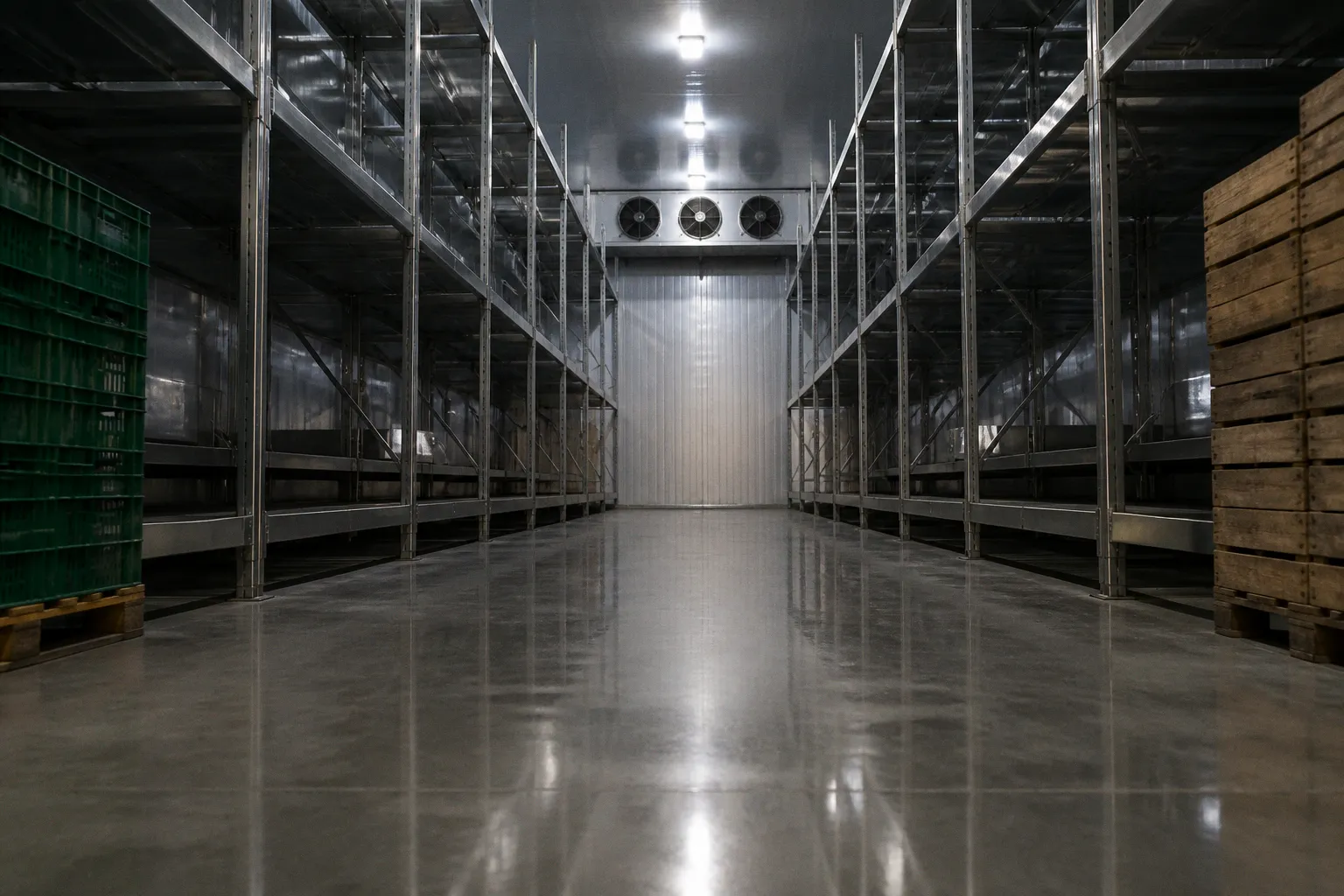
A delayed pre-cooling cycle becomes a quality problem; an unstable power supply becomes a logistics problem; an incomplete record becomes an export problem.
This is why Bekaa Valley cooperative cold storage setup should not begin with a building or a refrigeration unit. It should begin with the crop, the route to market, and the amount of time the produce must remain saleable. Bekaa contains 42% of Lebanon’s cold storage houses and produces approximately 55% of the country’s fruit and vegetable exports. That concentration makes the region central to the national cold chain—but it also means that a poorly designed facility can affect many growers at once.
The practical question is not simply whether a cooperative can keep produce cold. It is whether the cooperative can remove field heat quickly, maintain stable conditions through storage and transport, preserve traceability, and keep the system operating when the electricity supply is unreliable.
The four stages below are a planning framework for a cooperative project. They are not a single official blueprint adopted by every cooperative. The correct sequence and scale will depend on the crops, harvest calendar, available finance, and export route.
Stage one: design around the harvest, not the building
Cold storage is often treated as a construction project. Agronomically, it is a crop-flow project.
Before selecting a site or ordering equipment, the cooperative needs a clear picture of what will enter the facility and when. A room designed for apples will not automatically serve cherries, peaches, leafy vegetables, and tomatoes well. Each crop arrives with a different field temperature, respiration rate, sensitivity to humidity, tolerance for handling, and expected storage period.
A useful starting inventory should describe:
- the main crops and varieties delivered by members;
- the weekly harvest volume during peak periods;
- the time between picking and arrival at the facility;
- the preferred market for each crop;
- whether produce is sold fresh, graded, packed, or processed;
- the minimum shelf life required after storage and transport;
- the packaging formats used by buyers;
- the percentage of produce likely to be rejected during sorting.
This last point is important. A cooperative should not size its cold rooms only according to the total quantity harvested. The facility must also accommodate receiving, inspection, washing where appropriate, grading, packing, dispatch, and temporary holding. If all crates enter one room before they are sorted, the refrigeration system may be carrying unnecessary biological load, while staff struggle to identify damaged or overripe produce.
A sound layout separates the movement of warm incoming produce from the movement of cooled, packed produce. The sequence should be physically obvious:
1. receiving and weighing;
2. pre-washing or washing, where the crop and market require it;
3. pre-grading and manual inspection;
4. diameter or length grading;
5. hydrocooling or another crop-appropriate pre-cooling method;
6. drying;
7. packing and labelling;
8. cold storage;
9. refrigerated dispatch.
Not every crop needs every operation. Washing can be unsuitable for some fruit if water quality, drying, or disease control is not properly managed. Hydrocooling can be highly effective for suitable produce, but it requires reliable water management and careful control of sanitation. The point is not to install the longest possible processing line. It is to remove the bottleneck that currently shortens market life.
A cold room does not repair poor harvest handling. It preserves the quality that the cooperative managed to protect before storage.
Separate pre-cooling from long-term storage
Pre-cooling and storage perform different jobs.
Pre-cooling removes field heat soon after harvest. Storage then maintains the crop at a stable temperature and humidity. If warm produce is placed directly into a full storage room, it can raise the room temperature, increase condensation, and expose already cooled batches to uneven conditions. In a cooperative facility receiving crops from many farms, this risk is amplified because deliveries may arrive throughout the day.
The design should therefore consider a dedicated receiving or pre-cooling zone rather than relying on one large cold room to perform every function. For sensitive stone fruits, pome fruits, and vegetables, controlled atmosphere rooms may provide an additional management tool. A controlled atmosphere system changes the balance of oxygen and carbon dioxide around the produce to slow physiological ageing. It is not a universal upgrade: it requires crop-specific settings, trained operation, gas monitoring, and disciplined loading practices.
For a smallholder cooperative, the question is whether the expected storage period and market value justify that complexity. A CA room may be appropriate for a defined crop programme with predictable volumes. It is less useful if the cooperative lacks the records, technical support, or reliable energy needed to operate it safely.
Stage two: choose the cold-chain architecture
Once the crop flow is understood, the cooperative can decide what kind of infrastructure it actually needs. In Bekaa, this usually means combining standard cold rooms with more specialized systems rather than treating every product as if it required identical conditions.
A practical facility may include:
- a receiving area protected from direct sun and rain;
- a pre-cooling system sized for peak harvest rather than average harvest;
- standard cold rooms for short- or medium-term holding;
- controlled atmosphere rooms for selected crops with a clear storage case;
- humidity management suited to the produce;
- a packing and grading line;
- loading bays that limit warm-air entry;
- temperature monitoring inside rooms and during dispatch;
- space for rejected, damaged, or downgraded produce so it does not contaminate the main flow.
The cooperative also needs to decide how members will use the facility. There is a major difference between a service model in which farmers bring graded produce for immediate dispatch and a storage model in which the cooperative holds produce on behalf of members for days or weeks. The second model demands stronger inventory control. Each lot must be identifiable by grower, crop, variety, harvest date, treatment history where relevant, grade, and destination.
That information is not administrative decoration. Export buyers and certification systems increasingly require evidence that a product can be traced through the supply chain. A cooperative that cannot connect a pallet to its source field may have difficulty responding to a residue question, quality complaint, or border inspection.
Compare the main storage functions
| Facility function | What it solves | Main operational demand | Best suited to |
|---|---|---|---|
| Receiving and inspection | Prevents damaged or unsuitable produce from entering the main cold chain | Trained staff, scales, lot identification, shade | All cooperative harvests |
| Pre-cooling | Removes field heat quickly after harvest | Adequate refrigeration capacity and disciplined scheduling | Warm-arriving fruit and vegetables |
| Standard cold room | Maintains temperature and humidity after cooling | Stable power, correct loading density, monitoring | Short- and medium-term storage |
| Controlled atmosphere room | Slows ageing for selected crops during longer storage | Gas control, technical management, sealed rooms, reliable energy | Defined pome-fruit and other suitable programmes |
| Packing and grading line | Creates consistent grades and export-ready units | Water management, calibration, labour, packaging supply | Cooperatives selling into formal markets |
| Refrigerated dispatch | Protects quality between storage and transport | Loading discipline, temperature records, route planning | Domestic and export distribution |
A common mistake is to invest heavily in the storage room while leaving the packing line, loading area, or transport interface unresolved. Cold-chain failure often occurs at the transitions: the delay between picking and receiving, the wait beside an open loading door, or the period when packed cartons sit without refrigeration before departure.
Stage three: build energy resilience into the first design
In Lebanon, refrigeration cannot be designed around an assumption of uninterrupted grid power. The energy system is part of the post-harvest system, not an auxiliary service added after construction.
Large cooperative facilities may require a hybrid arrangement combining solar generation with diesel backup. A documented example of the scale involved is a 1.5 MW solar photovoltaic installation paired with dual generators rated at 600 KVA and 400 KVA. That configuration is not a universal specification for Bekaa facilities. It illustrates the level of infrastructure that may be considered where the cooling load is substantial and grid reliability is insufficient.
The energy design should begin with a load profile:
- compressors and condenser units;
- fans and pumps;
- hydrocooling equipment;
- washing and drying equipment;
- sorting and packing machinery;
- lighting and office systems;
- monitoring and communications;
- water pumping and treatment;
- generator starting and switching requirements.
The greatest load may occur precisely when the harvest is most valuable and the facility is busiest. A system sized from an annual average can fail during peak intake. The cooperative should model the hottest operating period, the heaviest receiving day, and the maximum number of rooms operating simultaneously.
Solar power can reduce dependence on diesel during daylight hours, but it does not remove the need for storage planning or backup generation. Produce may need cooling at night, during dusty or cloudy conditions, and during periods when the facility is full. Batteries may be part of the design, but their inclusion must be matched to the refrigeration load, replacement cost, maintenance capacity, and local technical support.
Diesel generators also require more than a nameplate rating. The cooperative needs fuel storage, preventive maintenance, spare parts, trained operators, safe ventilation, and a clear priority list for critical loads. In an emergency, the system should keep pre-cooling, storage-room controls, monitoring, and essential pumps running before non-essential equipment.
Use a power hierarchy
A simple operating hierarchy helps prevent confusion during an outage:
1. Protect the crop first. Keep the active cold rooms, temperature controls, and circulation fans operating.
2. Maintain water and sanitation functions. If washing or hydrocooling is in progress, prevent unsafe interruption or isolate the line cleanly.
3. Preserve monitoring and records. Temperature logging should not disappear when the lights do.
4. Delay non-essential processing. Packing or grading can be rescheduled more easily than a warming storage room can be recovered.
5. Communicate quickly with transport operators. A delayed truck can turn a manageable energy event into a quality loss.
Energy resilience also affects export certification. If a cooperative cannot demonstrate that the cold chain remained within the required conditions, the existence of a solar array or generator will not by itself satisfy a buyer. Records matter: operating hours, room temperatures, alarms, generator use, and corrective actions should be retained in a form that staff can actually maintain.
Stage four: connect storage to export and cooperative finance
A cold store earns its value only when it improves the route from harvest to buyer. In the Bekaa Valley, this route has become more demanding because transport patterns can change abruptly.
Following disruptions to overland transit routes and regional trade bans, some Lebanese cooperatives shifted fruit exports from a historical six-day land transit model to sea shipping that required approximately fourteen days. That change is not a simple matter of booking a different vehicle. It extends the period during which temperature, humidity, packaging strength, port handling, and documentation must remain under control.
A cooperative preparing for sea freight should ask:
- Can the crop tolerate the longer journey after the planned storage period?
- Is pre-cooling completed before container loading?
- Are cartons designed for stacked, humid conditions?
- Can the port provide adequate refrigeration and power?
- Are temperature records available for the buyer?
- Is there a contingency if the vessel is delayed?
- Does the product grade justify the added cold-chain cost?
For some crops, the answer may be to store longer. For others, the more practical response is to harvest at a different maturity stage, shorten the holding period, change packaging, or redirect part of the crop to a nearer market. Cold storage is not automatically a route to export. It is one component of a route that must be evaluated crop by crop.
Funding should follow the bottleneck
Agricultural funding in Lebanon often arrives through development grants and technical assistance, particularly for post-harvest equipment and facility upgrades. Bekaa food cooperatives also show high female participation, with women making up as much as 75% of membership in some cooperatives. That participation should be reflected in governance, training schedules, procurement decisions, and paid operational roles—not treated as a statistic attached to a funding proposal.
Grant applications are stronger when they connect infrastructure to a measurable operational problem. Instead of presenting a cold room as a general symbol of rural development, the cooperative can define the specific loss it intends to reduce:
- harvest arrives too warm for the existing storage capacity;
- grading is inconsistent across member farms;
- produce waits without shade before transport;
- power interruptions threaten stored inventory;
- buyers require traceability that paper records cannot support;
- the move from land to sea freight has extended the required shelf life.
This approach also helps prevent overbuilding. A facility that is too large creates its own costs: empty-room refrigeration, unused controlled atmosphere capacity, maintenance obligations, and a need to recruit operators with skills the cooperative may not yet have. A phased investment can be more resilient.
The first phase may focus on receiving, shade, pre-cooling, monitoring, and one or more standard cold rooms. A later phase can add improved grading, packing, solar generation, or controlled atmosphere capacity once the cooperative has reliable throughput and records. The correct sequence depends on the crop mix, but the principle is consistent: build the operating discipline before adding the most complex equipment.
The export standard begins at the cooperative gate. A buyer sees the final carton; the cold chain records everything that happened before it.
The operating details that determine whether the system works
Infrastructure only performs when people use it consistently. Cooperative cold storage creates a new set of routines for members, intake staff, technicians, and managers.
Harvest timing
Fruit picked during the cooler part of the day generally enters the cold chain with a lower heat load than fruit left in the field through the hottest hours. That does not remove the need for pre-cooling, but it gives the facility more room to work. Harvest instructions should specify picking windows, crate handling, maximum waiting time in the field, and protection from direct sun.
Crate and pallet discipline
Overfilled crates damage produce and restrict airflow. Mixed lots create traceability problems. Pallets loaded too tightly against evaporators or walls can produce uneven cooling. The cooperative should establish crate dimensions, maximum fill levels, pallet patterns, and a rule for separating varieties and maturity classes.
Temperature monitoring
One sensor in the cold room is not enough to describe the temperature of the crop. Air temperature can look acceptable while the centre of a dense pallet remains warm. Monitoring should be positioned to reveal the slowest-cooling locations and should be checked during receiving, storage, and dispatch.
The purpose is not to create a complicated data system that staff ignore. It is to create a record that answers practical questions: when did the lot arrive, when did cooling begin, how long did it take, what alarms occurred, and when was the product loaded?
Sanitation and water
Washing and hydrocooling introduce water into a system handling food. Water quality, cleaning schedules, drainage, equipment surfaces, and worker hygiene need to be designed together. A clean-looking line can still spread decay if organic material accumulates in difficult-to-reach areas or if water management is inconsistent.
Staff capability
A cooperative facility needs at least three forms of competence:
- crop knowledge, so staff can distinguish normal variation from quality deterioration;
- refrigeration and energy knowledge, so alarms and equipment faults receive a rapid response;
- record-keeping discipline, so each lot can be traced and each corrective action documented.
Technical assistance is especially valuable during commissioning. The first season reveals whether the receiving schedule matches the compressor capacity, whether the grading line causes delays, and whether members are delivering produce in the condition agreed by the cooperative.
A seasonal transition plan
A cooperative does not need to wait for a perfect industrial facility before improving the cold chain. The transition can be staged across one production year, provided each step is tied to the next harvest.
Before the main harvest
Map the crops, volumes, harvest windows, buyer requirements, and existing energy supply. Identify which products require rapid pre-cooling and which can move through short-term storage. Measure the available building, loading access, water supply, drainage, and generator location. At this stage, the goal is to find the first bottleneck rather than to select equipment from a catalogue.
Four to six months before construction or installation
Confirm the facility layout and operating model. Decide whether the cooperative will charge by crate, pallet, kilogram, storage day, or service package. Agree on member requirements for harvest timing, crate condition, lot labels, and delivery appointments. Seek technical review of the refrigeration, electrical, solar, and backup systems as one integrated design.
During installation and commissioning
Test the empty rooms, but do not stop there. Test the full operating sequence with representative loads: receiving, sorting, pre-cooling, packing, storage, alarm response, generator changeover, and dispatch. Staff need to practise the sequence before the harvest pressure begins.
During the first harvest season
Track the time from picking to arrival, arrival to pre-cooling, pre-cooling to storage, and storage to dispatch. Record rejected lots, temperature alarms, energy interruptions, packaging failures, and waiting time at loading bays. These observations will show whether the cooperative needs more room, more labour, a faster intake schedule, or better crop handling—not necessarily a larger refrigeration plant.
After the season
Review performance by crop and by member delivery pattern. A room that performs well for apples may be poorly suited to a short, intense stone-fruit harvest. Compare the cost of energy, labour, packaging, maintenance, and transport with the value of the product sold. Then decide whether the next investment should be additional pre-cooling, a packing upgrade, solar capacity, a CA room, or better refrigerated transport.
This seasonal approach is particularly useful when funding is limited. It creates evidence for the next funding request and prevents the cooperative from claiming benefits that have not yet been measured.
The project’s real measure of success
The success of Bekaa Valley cooperative cold storage should not be judged by the size of the building or the number of machines installed. It should be judged by whether growers can deliver consistent lots, whether the facility maintains product quality through interruptions, and whether buyers receive produce with the documentation and shelf life they require.
The strongest projects join four systems that are often planned separately:
- crop physiology and harvest practice;
- refrigeration, water, and energy infrastructure;
- cooperative governance and member scheduling;
- export logistics and certification records.
Leave out any one of them and the facility becomes fragile. A modern cold room cannot compensate for warm field handling. Solar panels cannot compensate for poor maintenance. A full warehouse cannot compensate for missing traceability. A grant-funded processing line cannot create a market that the crop and transport route cannot support.
For Lebanese agricultural cooperatives, particularly those serving the Bekaa’s export-oriented fruit and vegetable sector, the practical path is therefore clear: define the crop flow, protect the first hours after harvest, design for energy interruptions, and build the records that connect the cooperative gate to the final buyer. Begin with the bottleneck that shortens shelf life today. Expand only when the cooperative has the throughput, skills, and market demand to operate the next layer well.
Cold storage is not a warehouse waiting for produce. It is a living part of the farm system—one that begins in the field, depends on soil and crop timing, and ends only when the buyer receives a stable, traceable product.