Reefer temperature tracking: a Gulf transit setup plan
A 2°C temperature spike can reduce the shelf life of soft fruit by up to 50%. That is a larger operational risk than the difference between a well-configured reefer shipment and a nominally…
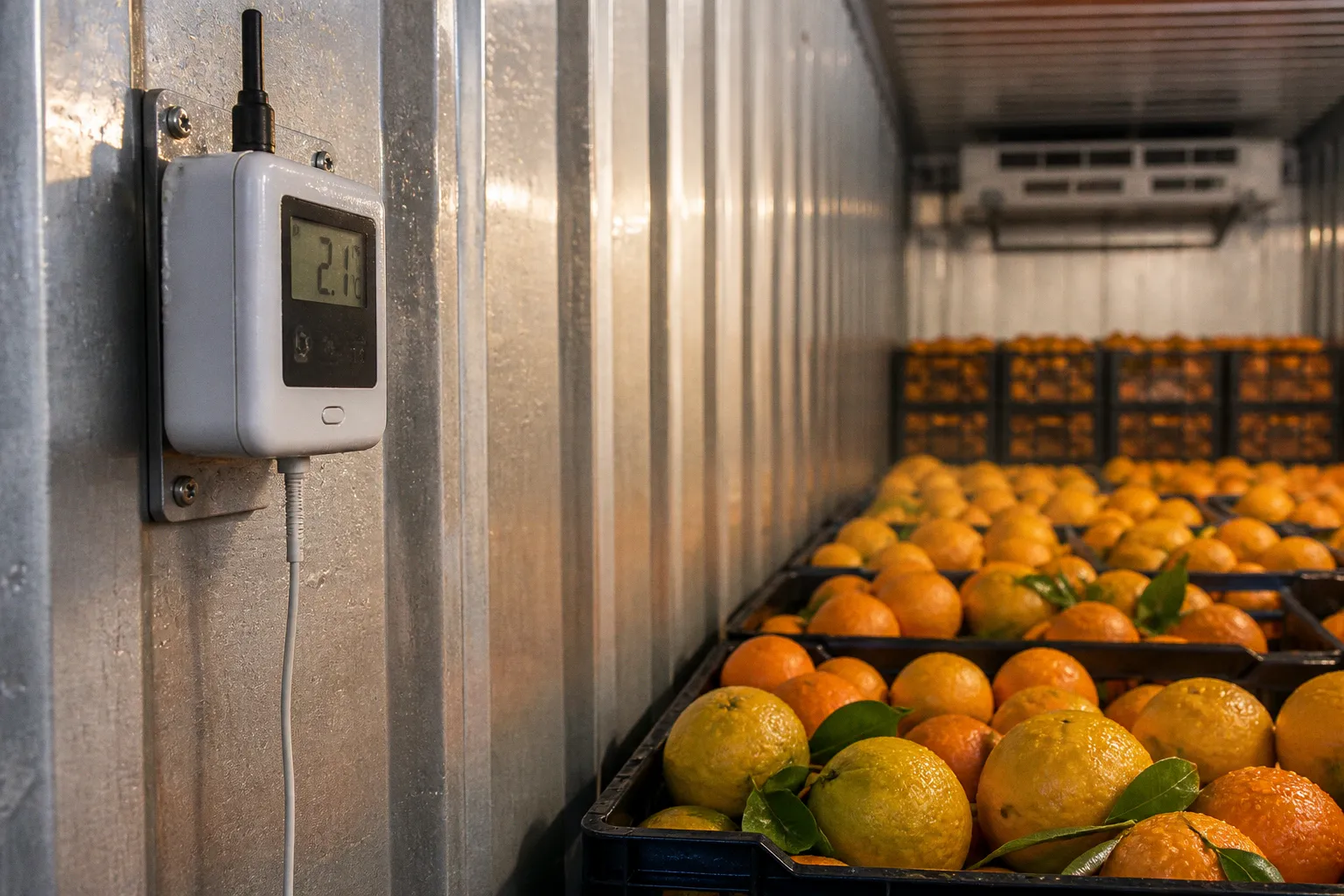
A 2°C temperature spike can reduce the shelf life of soft fruit by up to 50%. That is a larger operational risk than the difference between a well-configured reefer shipment and a nominally refrigerated one, because the refrigeration unit does not control the entire thermal system. It controls the container air. The produce enters the system with its own field heat, packaging restricts airflow, border delays extend exposure time, and Gulf summer conditions can exceed 45°C along transit corridors.
For Lebanese agricultural exporters, reefer temperature tracking is therefore not a single device purchase. It is a sequence of controls: product pre-cooling, correct cargo zoning, air exchange, sensor placement, live data transmission, alarm response, and documentation that remains credible when the shipment reaches customs or the buyer’s receiving dock.
The technical objective is straightforward: keep the cargo within its required thermal range without creating condensation, freezing injury, ventilation failure, or a data record too weak to support a quality claim.
The cold chain begins before the container
A reefer container is not a substitute for pre-cooling. Its refrigeration unit is designed to maintain the temperature of cargo that has already been brought close to its transport condition. If warm produce is loaded directly into the container, the system must remove field heat while also maintaining airflow through a densely packed load. That creates two predictable problems: the air near the evaporator may reach the set point while the centre of the pallet remains warmer, and the refrigeration unit may operate continuously without producing a uniform product temperature.
This distinction matters particularly for soft fruit, leafy vegetables, table grapes, stone fruit, and other products whose respiration rate changes quickly with temperature. A shipment can show an acceptable return-air reading while the cargo core remains outside the intended range. The result is a clean-looking digital record with a deteriorating product.
The pre-loading protocol should establish a measurable baseline rather than rely on the reefer display alone:
1. Measure product temperature before loading. Use a calibrated probe on representative cartons or pallets, including material from different positions in the harvest lot. Surface temperature is not a reliable substitute for pulp or core temperature.
2. Define the target by commodity. Chilled fruits and vegetables commonly travel between 0°C and 4°C, but not every agricultural product belongs in that zone. Some cargo requires controlled ambient conditions between +15°C and +25°C. The transport instruction must be tied to the specific commodity, maturity stage, packaging format, and buyer specification.
3. Pre-cool using an appropriate method. Forced-air cooling, hydrocooling, room cooling, or another validated process may be suitable depending on the produce. The relevant metric is not the name of the method but the reduction in product field heat before loading.
4. Record the loading baseline. The shipment file should contain the date and time of pre-cooling, product temperature readings, reefer set point, ventilation setting, sensor identifiers, and the seal number once the container is closed.
5. Reject thermal ambiguity. If the exporter cannot state the target product temperature and the acceptable deviation window, the reefer setup is incomplete. A set point without a cargo specification is an equipment instruction, not a cold-chain protocol.
The most expensive failure in this stage is usually not a broken compressor. It is loading product that was never thermally prepared and then expecting the container to compensate.
A reefer maintains a thermal condition; it does not create one. The shipment must enter the container already close to its transport range.
Selecting the temperature zone: chilled is not controlled ambient
The first configuration decision is the cargo temperature zone. Treating all Lebanese produce as chilled cargo is operationally incorrect and can damage products that are sensitive to low temperatures. The reefer unit may be capable of maintaining a broad operating range from approximately -25°C to +25°C, with specialised super-freezer systems reaching lower temperatures, but equipment capability does not determine commodity suitability.
The shipment specification should separate four variables:
- Product temperature: the temperature inside the produce or package.
- Container air set point: the value programmed into the reefer controller.
- Ventilation rate: the fresh-air exchange required to remove respiration gases.
- Alarm threshold: the deviation level that triggers an investigation or intervention.
For chilled agricultural goods, a target range of 0°C to 4°C is common. For controlled ambient cargo, the operating zone may instead be +15°C to +25°C, with continuous ventilation required to clear ethylene and carbon dioxide generated by respiration. These are not interchangeable settings. A low temperature can slow degradation in one product while causing chilling injury in another; insufficient ventilation can accelerate quality loss even when the temperature record appears stable.
A practical configuration matrix
| Cargo condition | Typical temperature zone | Primary control risk | Required monitoring emphasis |
|---|---|---|---|
| Chilled fresh produce | 0°C to 4°C | Product warming, freezing injury, uneven airflow | Product-core readings, supply and return air, alarm response |
| Controlled ambient produce | +15°C to +25°C | Respiration gases, overheating, inadequate air exchange | Temperature trend, ventilation setting, ethylene and CO₂ management |
| Frozen cargo | Below the chilled range; product-specific | Thawing, temperature recovery after door opening | Continuous temperature logging and excursion duration |
| Mixed or incompatible cargo | No single safe default | Conflicting temperature and ventilation requirements | Segregation or separate equipment rather than compromise |
The table is a planning instrument, not a universal cargo specification. Commodity-specific requirements should take precedence over a generic zone. The exporter should also confirm that packaging allows air to reach the intended load path. Cartons with blocked vents, pallets pushed against the front wall, or excessive compression can create thermal pockets that the container’s controller cannot identify.
Reefer container setup for Gulf transit
High-ambient Gulf transit changes the margin for error. When outside temperatures exceed 45°C, the refrigeration unit must reject a substantial heat load while the container may also be exposed to direct solar gain, tarmac heat, port congestion, border queues, and repeated handling. The system must be configured for the route’s environmental conditions, not for the temperature inside the packing facility.
The setup should be completed in phases.
Phase one: establish the cargo specification
Before the reefer is assigned, create a shipment instruction that states:
- commodity and variety;
- harvest and packing date;
- target product temperature;
- acceptable temperature range;
- ventilation requirement;
- packaging and pallet configuration;
- maximum planned door-open exposure;
- sensor locations;
- escalation contacts for the exporter, carrier, freight forwarder, and receiver.
This document should follow the cargo from the packing station to the receiving point. A temperature logger without a declared target is only a storage device. It records deviation but cannot define whether the deviation is commercially significant.
Phase two: inspect and prepare the reefer
The container should be checked for cleanliness, odour, structural damage, door-gasket condition, drain condition, and evidence of previous cargo contamination. The refrigeration unit should be powered and allowed to reach the required operating condition before loading. A pre-trip inspection should verify the controller, alarms, power supply, and data interface.
The floor and T-shaped deck must remain clear enough to support the intended airflow pattern. Pallets should not obstruct the return-air path or exceed the loading line. Air must circulate through the cargo rather than pass around it. A cold front that moves through an empty channel is not evidence that the pallet core is protected.
The reefer set point should be entered only after the cargo instruction has been approved. Setting the unit to an artificially low temperature in an attempt to accelerate cooling can create freezing injury, condensation, or product damage without solving uneven heat removal.
Phase three: load for airflow, not maximum volume
Cargo density is a thermal decision. The highest possible pallet count is not necessarily the highest-value loading plan if it prevents air circulation or complicates inspection. Packaging should include aligned ventilation openings where required by the product and box design. Pallets should be stable, but not wrapped or positioned in a way that seals off the airflow route.
The loading team should minimise the time between opening the reefer doors and closing them. Door-open duration should be recorded where the logger supports it, particularly for shipments that pass through multiple handling points. The final inspection should confirm that:
- the load line has not been exceeded;
- the return-air path remains open;
- pallets are not pressed against the container walls;
- cartons are not blocking the evaporator or air channels;
- sensor probes are not attached only to the coldest airflow position;
- the seal is applied after the data logger and GPS unit are active.
Phase four: verify the first thermal trend
The first period after loading is diagnostically important. A functioning reefer does not necessarily produce an acceptable cargo profile immediately. The monitoring dashboard should show whether supply air, return air, and cargo sensors are converging toward the target range. A persistent gap between supply and cargo temperature may indicate warm product, blocked airflow, excessive load density, or incorrect sensor placement.
The exporter should define an intervention rule before dispatch. For example, a temperature alarm may require a call to the carrier, a reefer inspection, or a review of the cargo condition at the next controlled stop. The specific threshold must be set by the commodity and buyer requirement. The principle is universal: an alarm that nobody is authorised to act on is not a control.
Precision calibration and sensor placement
Modern reefer units may offer control precision around 0.1°C, but controller precision is not the same as cargo measurement accuracy. A display can report a stable set point while the sensor is positioned in a location that does not represent the pallet core. The monitoring architecture should therefore combine the reefer’s own telemetry with independent loggers placed inside the load.
A practical sensor array can include:
- one sensor near the supply-air path;
- one sensor near the return-air path;
- one sensor in a warm-risk location, such as the rear or centre of the load;
- one sensor near the door or upper section if solar exposure and loading geometry make that area vulnerable;
- product probes used during pre-cooling and receiving checks.
The exact number depends on the cargo volume, pallet layout, value of the shipment, and risk tolerance. The important point is spatial coverage. One logger placed beside the evaporator may document equipment performance while missing the thermal behaviour of the cargo.
Calibration should be managed as part of the export record. The exporter needs to know:
- when each sensor was last calibrated;
- the stated accuracy across the operating range;
- whether the device has enough battery life for the full journey plus a contingency period;
- whether readings are transmitted continuously or uploaded later;
- how the unit behaves when network coverage is interrupted;
- whether the timestamps are synchronised;
- how data is exported for the receiver, insurer, or customs file.
A logger that loses its data during a communications outage is inferior to one that stores readings locally and uploads them once the connection returns. Gulf transit routes may include areas where cellular coverage is inconsistent. Live monitoring is valuable, but local memory is the minimum continuity requirement.
The data points that matter
Continuous temperature records are most useful when they show both the value and the duration of a deviation. A brief excursion during a controlled door opening is not equivalent to a sustained rise during a refrigeration failure. The monitoring platform should therefore preserve:
- timestamped temperature readings;
- sensor identity and location;
- GPS position;
- reefer power status where available;
- set point and actual readings;
- door-open events;
- alarm activation and acknowledgement;
- corrective action notes;
- final receiving temperature.
This converts the data from a graph into an auditable chain-of-custody record. It also supports root-cause analysis. If the return-air temperature rises while the supply-air temperature remains stable, the issue may concern cargo heat or airflow. If both rise together and power status is lost, the investigation moves toward the refrigeration or electrical system. If only one internal sensor diverges, the likely cause may be placement, local obstruction, or a thermal pocket.
IoT monitoring: what the investment actually changes
For Lebanese agricultural export cold chains, the return on investment in IoT monitoring is not limited to preventing spoilage. The system changes the timing of decisions. Without live data, the exporter often learns about a thermal excursion when the receiver opens the container. At that point, the cargo has already crossed the commercial decision boundary, and the available responses are limited to a claim, discount, rejection, or disposal.
With real-time reefer temperature tracking, the operating sequence changes:
1. The logger detects a deviation.
2. The platform identifies the container and location.
3. The responsible operator assesses duration and severity.
4. The carrier or driver receives an instruction.
5. The next controlled stop becomes an inspection point rather than a passive waypoint.
6. The action is recorded against the same shipment file.
This is where the technology produces value. A sensor that only reports deterioration has limited operational effect. A sensor linked to a response process can reduce the duration of the excursion, protect the most vulnerable cargo, and preserve evidence for a later commercial decision.
The investment should be evaluated against the failure modes it can actually control.
| Investment component | It can control | It cannot control |
|---|---|---|
| Independent temperature loggers | Measurement of cargo-zone conditions and excursion duration | Poor pre-cooling or unsuitable commodity settings |
| GPS tracking | Container location, route visibility, and delay context | Border policy, congestion, or physical access to the cargo |
| Reefer telemetry integration | Set point, unit status, and selected equipment alarms | Thermal pockets that sensors do not cover |
| Cloud dashboard and alerts | Speed of detection and escalation | Lack of staff authority or an absent response plan |
| Calibration and data retention | Credibility and continuity of the temperature record | Product damage that occurred before the logger was installed |
| Receiving inspection | Confirmation of final condition and claim evidence | Recovery of shelf life already lost in transit |
This is a capital expenditure question, but the calculation should not begin with hardware price. It should begin with the value of the cargo, the probability and consequence of a thermal excursion, the cost of a rejected shipment, and the contractual importance of documented temperature history. A low-value cargo with tolerant handling requirements may justify a simpler system. High-value soft fruit or time-sensitive produce moving through extreme heat has a different risk profile.
The monitoring platform also has an indirect return: it identifies recurring process defects. If several shipments show elevated temperatures during loading, the pre-cooling protocol is inadequate. If deviations occur at the same handling point, the issue may be a power interruption or door-opening practice. If the centre sensor repeatedly remains warm while the supply-air reading is normal, the pallet pattern or packaging ventilation requires redesign.
That information is more valuable than a post-incident conclusion that the produce was simply delicate.
The useful output of an IoT logger is not the temperature graph. It is the reduction in time between deviation, diagnosis, and intervention.
Ventilation and gas management
Temperature tracking cannot be separated from ventilation. Fresh produce continues to respire after harvest, generating heat, carbon dioxide, and ethylene. Controlled ambient cargo may require continuous fresh-air exchange to remove these gases. A closed container with an apparently correct temperature can still develop an unsuitable atmosphere if the ventilation setting does not match the commodity and packaging system.
Ventilation is a balancing problem. Too little fresh air allows gases and heat to accumulate. Excessive exchange can increase the refrigeration load and make it harder to maintain the target temperature under high ambient conditions. The correct setting depends on produce type, maturity, expected respiration rate, packaging, and the technical instructions attached to the shipment.
For loading teams, the practical controls are specific:
- confirm that the reefer’s fresh-air setting is enabled where required;
- verify that carton vents align with the intended airflow path;
- avoid plastic wrapping that seals the pallet against the packaging design;
- keep return-air channels unobstructed;
- do not assume that a chilled set point removes the need for gas exchange;
- record the ventilation setting with the temperature configuration;
- inspect the receiving condition for condensation, odour, softening, and signs of restricted airflow.
This is also why mixed loads create disproportionate complexity. Two products may tolerate the same temperature but require different ventilation rates or generate different levels of ethylene sensitivity. A shared container can become a compromise system in which neither cargo receives its proper environment. Segregation is often a stronger control than adding another sensor.
Building the export documentation package
A technically sound cold chain still needs a documentation path that can survive commercial and regulatory review. Lebanese agricultural exports to Gulf states require phytosanitary certificates issued by the Lebanese Ministry of Agriculture, commercial documentation endorsed by local Chambers of Commerce, and clearance through Lebanese Customs. These documents are not interchangeable with the reefer temperature record. Each addresses a different part of the export risk.
The shipment file should be assembled before dispatch and linked to the container number and seal:
- commercial invoice and packing documentation;
- certificate of origin or chamber-endorsed commercial documents where required;
- phytosanitary certificate;
- Lebanese Customs clearance records;
- commodity and packaging specification;
- pre-cooling record;
- reefer pre-trip inspection;
- set point and ventilation instruction;
- sensor calibration information;
- logger and GPS identifiers;
- live temperature and location data;
- alarm history and corrective action notes;
- receiving inspection and final temperature record.
The purpose is not administrative volume. It is traceability. If a receiver disputes quality, the exporter should be able to identify the condition of the cargo at loading, the temperature path during transit, the location and duration of any excursion, and the condition at delivery.
Documentation also exposes weak process design. If the phytosanitary certificate is complete but the temperature record begins only after the container leaves the packing site, the cold chain has a blind section. If the data exists but cannot be linked to a container seal, the evidence is difficult to defend. If the reefer record shows the set point but not independent cargo-zone temperatures, the file documents equipment intention rather than product exposure.
A staged implementation plan for cooperatives and exporters
Not every Lebanese cooperative needs to build a full control tower on the first shipment. The implementation can be staged, provided that each stage closes a defined operational gap.
Stage one: baseline control
Start with commodity-specific transport instructions, calibrated handheld probes, pre-cooling records, reefer inspection, and independent temperature loggers. This stage establishes whether the basic process is functioning. It should also reveal the difference between product temperature at loading and container air temperature after dispatch.
Stage two: live visibility
Add cellular or satellite-enabled telemetry with GPS location, configurable alerts, local data storage, and a named response operator. The objective is not more dashboards. It is earlier intervention when a shipment is delayed, disconnected from power, or outside its target zone.
Stage three: integrated analysis
Link temperature records with loading time, route events, border delays, receiving condition, and commercial outcome. Over several shipments, the cooperative can identify whether losses originate in harvesting, packing, pre-cooling, loading density, carrier performance, or destination handling.
Stage four: contractual and route optimisation
Use the evidence to negotiate handling requirements with carriers, define acceptable excursion rules with buyers, and compare sea reefer and land-trucking options without pretending that transit duration is the only variable. Route selection should include thermal exposure, border uncertainty, power continuity, inspection points, and recovery options.
A cooperative can also centralise this infrastructure. Sensor procurement, calibration records, dashboard administration, and document archiving are often more efficient when managed across multiple growers, while commodity-specific settings remain separate. The system should standardise data governance without standardising temperatures that are not biologically equivalent.
The operating verdict
For Lebanese produce moving toward Gulf markets, the minimum credible reefer setup has five components: pre-cooled cargo, a commodity-specific temperature zone, unobstructed airflow and correct ventilation, independent multi-point monitoring, and an export file that connects the data to the shipment identity.
The numerical case is decisive. Chilled cargo commonly operates in the 0°C to 4°C range; controlled ambient produce may require +15°C to +25°C; Gulf summer exposure can exceed 45°C; and a 2°C deviation can reduce soft-fruit shelf life by up to 50%. Those values leave no rational basis for treating the reefer display as the complete cold-chain record.
The most efficient technology investment is not necessarily the most sophisticated sensor array. It is the system that converts a temperature deviation into an intervention before the receiver converts it into a rejection. For cooperatives and exporters, that means funding measurement, pre-cooling, response authority, and documentation as one operating unit.
A reefer container protects cargo only when the thermal specification is correct, the product enters the system prepared, the air can move through the load, and the data is acted upon. Anything less is refrigerated transport by appearance rather than by control.