Lebanese Produce Exports: The Shift from Land to Sea
Walk through the packing sheds of a cooperative in the northern Bekaa during stone fruit season and you will see the same pressure concentrated in every corner: crates of apricots and peaches stacked…
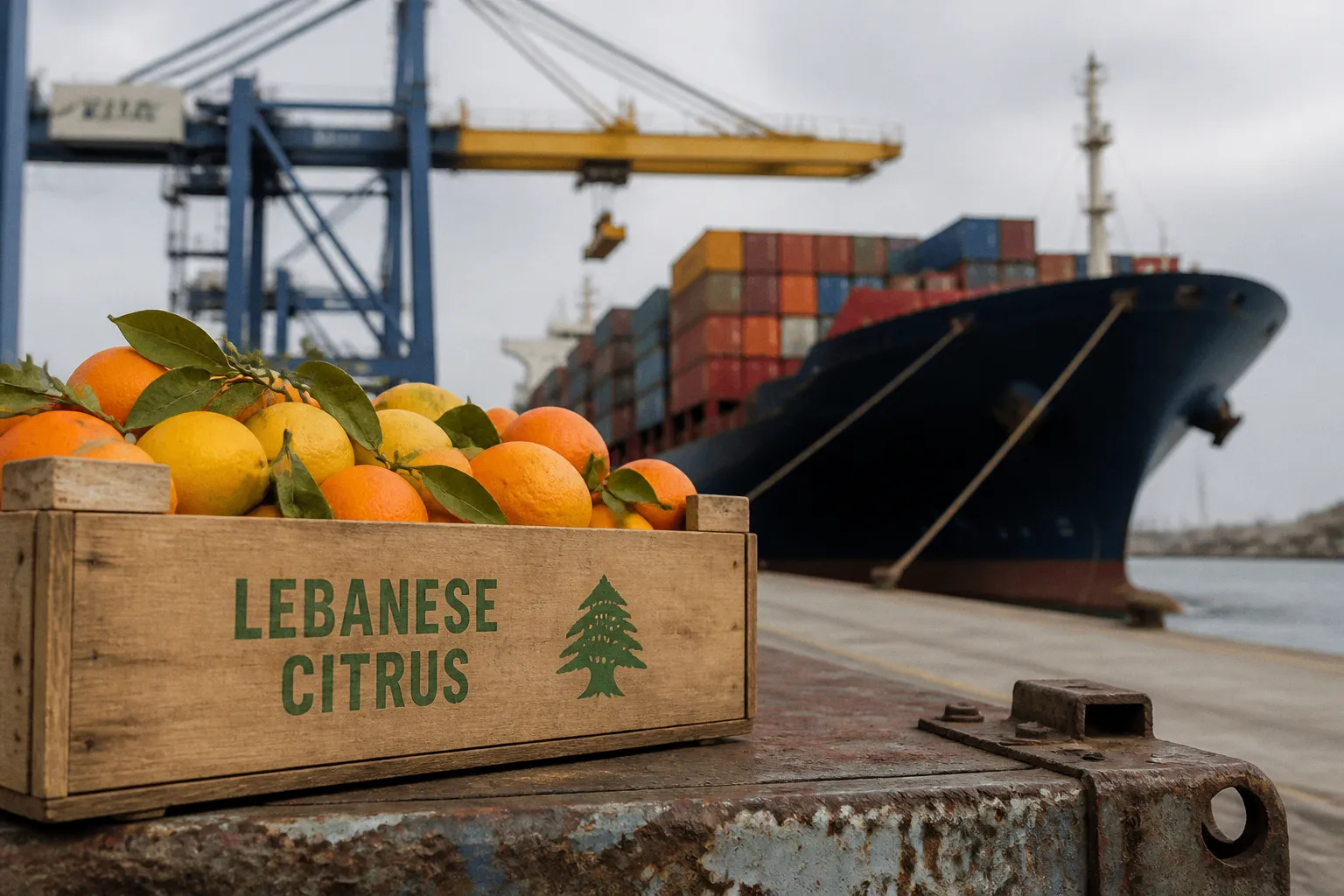
Walk through the packing sheds of a cooperative in the northern Bekaa during stone fruit season and you will see the same pressure concentrated in every corner: crates of apricots and peaches stacked to the ceiling, refrigeration units humming on backup generators, and a logistics coordinator on the phone trying to confirm a container slot at Beirut port. Five years ago, that coordinator would have been booking a truck through Masnaa. The apricots would have been in Riyadh in roughly six days. Today, the same fruit faces a fourteen-day sea voyage — if a vessel is available, if the cold room held temperature overnight, and if the Red Sea corridor is not rerouting traffic around the Cape of Good Hope again.
That shift — from land artery to maritime dependency — is the defining logistics story of Lebanese agricultural exports in the 2020s. The Saudi import ban, imposed in April 2021 after customs officers discovered more than 5.3 million Captagon pills hidden inside a pomegranate shipment, did not simply close one market. It dismantled the overland transit architecture that connected Lebanese cooperatives to Jordan, Iraq, Syria, and the Gulf states. When the ban was officially lifted on June 11, 2026, exporters did not return to a familiar landscape. They returned to a fundamentally altered one: higher costs, weaker infrastructure, disrupted buyer relationships, and a supply chain that had spent five years adapting to the sea.
Understanding what comes next requires looking beyond the port. The question is not only whether Lebanese produce can reach the Gulf. It is whether it can arrive with enough quality, documentation, and margin left to make the journey worthwhile.
The Legacy of the Masnaa Artery: Why Land Transit Dominated
The Masnaa border crossing between Lebanon and Syria was, for decades, the single most important piece of export infrastructure in the country. More than 90 percent of Lebanon’s agricultural exports destined for Jordan, Iraq, Syria, and the Gulf states moved through that one checkpoint. The reason was straightforward: time and cost.
A refrigerated truck leaving Beirut for Riyadh via Syria and Jordan covers the distance in roughly six days. For produce such as stone fruit, table grapes, and leafy greens — crops whose biological shelf life is measured in days rather than weeks — that transit window matched the product. A peach harvested at optimal firmness in the Bekaa has perhaps ten to twelve days before texture breakdown becomes irreversible. Six days on a temperature-controlled truck left a usable margin for customs, unloading, wholesale distribution, and retail handling in Riyadh or Dubai.
That margin was not generous. It was simply workable. A delay at one border could already affect the final selling price. But the overland route kept the number of handoffs relatively limited and allowed exporters to coordinate delivery around a known timetable. The truck did not have to wait for a vessel rotation, a container release, or a loading window at the port. Once loaded, it was moving toward the buyer.
The infrastructure matured around that predictability. Trucking companies calibrated refrigeration units for the route duration. Drivers and logistics managers understood the border sequence. Customs brokers developed practical knowledge of the paperwork. Cooperatives scheduled harvests around specific delivery windows, coordinating with Gulf buyers on predictable weekly rotations. Even the packing process was shaped by the road: produce could be harvested, graded, loaded, and dispatched within a tight sequence instead of being held for an uncertain port departure.
It was not elegant, and it depended heavily on political stability in Syria. The route could be interrupted by border closures, security incidents, or administrative delays. Yet, when it was operating, it aligned the commercial and biological clocks of fresh produce. A container shipped overland to Jebel Ali cost approximately $3,000.
The Masnaa corridor was not just a road. It was an integrated delivery system — harvest schedules, trucking rotations, border protocols, and buyer expectations calibrated to the biological clock of fresh produce.
That $3,000 figure matters because it set the economic baseline for Lebanese agricultural exports. At that price point, cooperatives exporting potatoes, onions, citrus, and stone fruit could cover costs and remain competitive in Gulf wholesale markets. The calculation was embedded in planting decisions, harvest volumes, and informal agreements with buyers. A cooperative did not need to reinvent its logistics model for every shipment. It could build a season around a route that, despite its political risks, was commercially familiar.
The route also supported smaller producers indirectly. Cooperatives could consolidate output from several farms, fill trucks efficiently, and offer buyers a consistent supply rather than a series of isolated farm-gate lots. That consolidation is especially important for Gulf importers, who generally want reliable grades, quantities, and delivery windows. When the route disappeared, the loss was therefore larger than the loss of a cheap freight option. It weakened the operating system that made fragmented Lebanese production exportable.
The 2021–2026 Disruption: How the Saudi Ban Forced a Maritime Pivot
The Captagon seizure in April 2021 was a watershed. Saudi Arabia imposed a complete ban on Lebanese agricultural imports, a prohibition that would hold for five years. The immediate consequence was not only the loss of Saudi buyers, significant as that was. It was the collapse of the transit corridor’s economic logic.
Trucks running from Beirut to Riyadh in continuous rotation lost their primary destination. The feeder routes through Syria and Jordan, which had depended on Saudi-bound volume, became economically unviable for many carriers. Exporters who had built relationships with wholesalers over several seasons had to redirect cargo, reduce production, or search for buyers able to absorb the additional transport risk.
The disruption also affected planning. Fresh produce is not an industrial component that can sit in a warehouse until the market improves. Harvest windows arrive whether freight contracts are ready or not. A cooperative may have only a short period in which apricots reach exportable firmness, while citrus and root vegetables follow different storage and pricing cycles. Once the familiar land route became unavailable, each crop required a new calculation: whether it could survive a sea journey, whether the buyer would accept the additional transit time, and whether the final price would cover the added handling.
Lebanese exporters had one principal alternative: maritime freight through Beirut port. But this was not a lateral switch. It was a fundamental change in logistics architecture.
The port of Beirut was still recovering from the August 2020 explosion, which had damaged terminal capacity and warehouse infrastructure. Cold storage facilities were operating below pre-blast capacity. Freight schedules were unreliable. Exporters who had previously treated the port as one stage in a broader supply chain now had to depend on it as the central gateway for goods that were highly sensitive to delay.
The cost structure was immediately punishing. Shipping the same container by sea cost approximately $7,000 — more than double the land route — with transit times stretching to a minimum of two weeks to reach Dammam port. The nominal difference was already difficult enough. The operational difference was greater because a sea shipment introduced additional waiting periods before and after the voyage: packing, inland transfer, port entry, container handling, vessel loading, discharge, and final customs procedures.
Then, in late 2023, the situation deteriorated sharply. Houthi maritime attacks in the Red Sea forced major shipping lines to reroute vessels around the Cape of Good Hope, adding thousands of nautical miles and weeks to standard transit times. Shipping costs tripled. Container availability at Beirut port became unpredictable. Hundreds of tons of Lebanese produce — including citrus, apples, and potatoes — accumulated in port warehouses while exporters waited for vessel slots that grew scarcer by the month.
For perishable goods, a three-day delay in a port warehouse is not a scheduling inconvenience. It is a potential spoilage event. A container can remain technically refrigerated and still arrive with a commercial problem: uneven ripening, bruising, dehydration, weakened stems, or a shorter remaining shelf life than the buyer contracted for. The cold chain preserves temperature, but it cannot restore time that has already been lost.
The maritime pivot therefore changed the meaning of reliability. On the land route, reliability meant the likelihood that a truck would cross several borders within the expected window. By sea, it also meant the availability of equipment, the stability of port operations, the sailing schedule, and the security of the maritime corridor. Every additional dependency created another place where a cooperative could lose control of the shipment.
Economic Realities: Comparing the $3,000 Land Route to $7,000 Sea Freight
The financial differential between land and sea transit for Lebanese agricultural exports is not a marginal adjustment. It is a structural gap that reshapes the viability of entire crop categories and determines which cooperatives can afford to export at all.
| Parameter | Land Route via Masnaa | Sea Route through Beirut Port |
|---|---|---|
| Cost per container to the Gulf | Approximately $3,000 | Approximately $7,000 |
| Transit time to Saudi Arabia | Roughly six days | Fourteen days or more |
| Temperature-control profile | Shorter chain with fewer extended waits | Longer chain with greater port and vessel exposure |
| Main operational risk | Border closure or customs disruption | Vessel availability, port congestion, and maritime rerouting |
| Main infrastructure dependency | Roads, trucks, and border procedures | Port terminals, containers, shipping lines, and inland cold storage |
| Best commercial fit | Time-sensitive, higher-value fresh produce | Longer-shelf-life or less time-sensitive cargo |
The $4,000-per-container gap does not disappear into thin air. It moves through the supply chain. Either the cooperative absorbs the loss — which many cannot do on thin seasonal margins — or the price at the Gulf wholesale market rises, making Lebanese produce less competitive against Egyptian, Jordanian, or Turkish alternatives.
For lower-value crops such as potatoes and onions, the maritime premium can make an entire export category economically unviable. These products may tolerate longer transit better than peaches or leafy greens, but their selling price often leaves less room for freight inflation. A lower spoilage rate does not automatically mean a profitable shipment. If the shipping and handling bill consumes too much of the final sale, durability becomes irrelevant.
Stone fruit presents the opposite problem. Its value may justify a more expensive route in principle, but its quality deteriorates faster. The cooperative may pay for a premium freight solution and still face rejection if the fruit arrives soft or unevenly ripened. Higher-value produce can therefore carry greater downside exposure: more money is tied up in each shipment, and the commercial penalty for a quality failure is sharper.
The cost comparison also needs to include expenses that do not appear in the headline freight quote:
- Additional electricity or diesel consumption while produce waits for loading.
- Packaging designed to withstand longer handling and a longer voyage.
- Inspection, documentation, and customs-related delays at the port.
- Insurance exposure during a more complicated route.
- Repacking or discounting when the shipment arrives outside the buyer’s preferred quality window.
- Working capital tied up while payment waits for delivery and acceptance.
Time compounds the financial pressure. Every additional day in transit means higher refrigeration energy consumption, greater spoilage risk, and a narrower window for quality inspection at the destination. International buyers — particularly Gulf retail chains operating on tightly managed inventory cycles — require deliveries within contractual freshness windows. A container that arrives two days late because of congestion in Beirut may still be saleable, but not at the price originally negotiated.
This is why the land-versus-sea comparison cannot be reduced to a simple transport quote. The land route was cheaper because it was faster and because the surrounding system had been organized around it. Sea freight is not merely a longer version of the same trip. It changes the product specification, the cash-flow cycle, the risk allocation, and the bargaining position of the exporter.
The practical consequence is painful triage. Lebanese cooperatives have to decide which crops can survive fourteen days, which buyers will absorb a higher landed price, and which shipments can be consolidated enough to use a container efficiently. They also have to decide whether a new market is genuinely viable or merely available on paper. A buyer who accepts Lebanese produce once is not necessarily a buyer who will continue ordering if the next three containers arrive late or fail inspection.
The maritime shift did not only make Lebanese produce more expensive. It made every weakness upstream of the port visible in the final selling price.
Infrastructure Bottlenecks: The Cold Chain Crisis and Energy Costs
The shipping cost problem appears on invoices and gets discussed in trade meetings. The cold chain problem is quieter, but it is arguably more damaging to Lebanon’s export credibility.
Lebanon’s domestic cold-storage infrastructure has been deteriorating under the weight of two compounding crises: chronic underinvestment in agricultural infrastructure and the country’s severe electricity deficit. Frequent, prolonged power outages mean that cold-storage facilities — the first link in the export chain, where produce is held between harvest and container loading — operate intermittently.
A cold room that cycles on and off every six hours is not maintaining a stable temperature. It is creating fluctuations that accelerate ripening, promote fungal growth, and degrade texture. The damage may not be obvious when the produce is loaded. It becomes visible later, when a buyer opens a pallet after the container has spent days at sea.
The numbers tell the story. Up to 25 percent of perishable goods in Lebanon are lost annually because of cold-chain failures before they ever reach a container. That is one-quarter of a cooperative’s harvest gone not because of poor field quality or a lack of buyers, but because the electricity system cannot sustain the refrigeration that post-harvest physiology demands.
Energy costs have compounded the crisis. In 2023, electricity and fuel expenses accounted for more than 30 percent of total cold-chain logistics costs in Lebanon. For cooperatives running diesel generators during grid outages — and grid outages are daily in most agricultural regions — the energy bill can rival or exceed the transport bill. A cooperative harvesting fifty tons of stone fruit in a two-week window faces a concentrated cold-storage cost precisely when the produce is most vulnerable and the sales window is shortest.
This creates a difficult investment problem. A cooperative may know that better refrigeration will reduce losses, but it cannot treat cold storage as a normal year-round facility if the harvest arrives in a narrow seasonal peak. Shared infrastructure can improve utilization, yet it also requires agreement among farms on loading priorities, maintenance, temperature protocols, and cost allocation. The challenge is not simply purchasing a larger room. It is operating that room consistently when the grid is unreliable and cash flow is tight.
The same principle applies to generators. Backup power is necessary, but a generator is not a complete cold-chain strategy. Fuel quality, maintenance, transfer time, and staff training all affect whether refrigeration continues without a damaging interruption. A temperature log that records only the intended setting, rather than the actual product and room temperature over time, gives the exporter little protection when a buyer disputes quality.
This infrastructure deficit has direct consequences for export certification. LIBNOR, Lebanon’s national standards institution, publishes standards such as NL 819:2024 for treated-water reuse in irrigation. The Ministry of Agriculture issues certificates of conformity for exported agricultural products. International buyers require documented temperature logs from the point of harvest through final delivery.
These requirements do not replace physical handling. A certificate cannot compensate for produce that has been held in an unstable cold room, and a clean-looking shipment cannot erase missing records. The documentation is valuable precisely because it demonstrates that the physical process was controlled. If the records show a gap, the buyer has a reason to question the entire load.
A cold-chain break at the cooperative level — even a few hours of temperature excursion in a Lebanese warehouse — can void an entire shipment’s compliance documentation. It can also affect future orders. Buyers tend to remember repeated uncertainty more clearly than a single successful delivery.
You cannot certify a cold chain that does not exist. Lebanon’s export credibility rests not only on what it grows, but on whether it can keep that produce at temperature from field to port.
For cooperatives targeting the reopened Saudi market, this is the threshold question. Saudi import requirements — including phytosanitary certificates, documented cold-chain compliance, and product traceability — are strict, and they are enforced at the border. A cooperative that cannot demonstrate unbroken temperature control from harvest to handoff will not clear Saudi customs simply because the apricots look attractive at the loading point.
The cold chain also begins earlier than many export plans assume. Harvest timing, field heat removal, grading, crate ventilation, washing practices, and the interval between packing and loading all influence the final result. If fruit enters a cold room hot from the field, the room must remove that heat before the container leaves. If loading takes place during the warmest part of the day, the process may undo part of the work completed overnight. These are operational details, but they determine whether a maritime route is commercially possible.
Post-Ban Strategy: Rebuilding Supply Chains in a Volatile Region
The lifting of the Saudi ban on June 11, 2026 opens a genuine opportunity, but the landscape exporters return to is not the one they left. Syrian infrastructure along the Masnaa-to-Jordan corridor has been degraded. Border-security protocols have changed. Buyer relationships have weakened. Cooperatives themselves have been reshaped by five years of operating under maritime constraints, often at reduced export volumes.
Rebuilding is not a matter of reopening old trucking routes and resuming where things stopped. It requires a phased approach that accounts for what has changed in infrastructure, buyer expectations, documentation, and regional risk.
Start with reconnaissance, not volume
During summer and autumn 2026, cooperatives with existing Gulf buyer relationships should send small, carefully documented land-route consignments through Masnaa. The purpose is not to maximize tonnage. It is to rebuild operating knowledge.
A reconnaissance shipment should establish:
- How long each border and transfer stage actually takes.
- Which documents are requested in practice, rather than only listed in the formal procedure.
- Whether refrigerated trucks can maintain the required temperature across the full route.
- How produce quality changes between loading in the Bekaa and delivery to the buyer.
- Which costs have increased since the corridor was last used at scale.
The first shipments should be treated as commercial tests with a clear record of what happened. A route that looks viable on a map may fail under current border procedures, truck availability, or documentation requirements. The goal is to replace assumptions with measured transit times and verified handoffs before the cooperative commits the season’s main volume.
Audit the cold chain before scaling the route
During winter 2026–2027, every cooperative planning Gulf exports should audit its domestic cold storage against Saudi phytosanitary and buyer requirements. That audit should cover calibrated temperature-logging equipment, generator backup capacity, loading procedures, product traceability, and staff understanding of temperature excursions.
It should also follow the product backward. The question is not only whether the final cold room works. It is whether the cooperative can document the interval from harvest to pre-cooling, from pre-cooling to grading, and from grading to container loading. Gaps in those intervals are where quality loss often begins.
The cost of an audit and a targeted equipment upgrade is a fraction of the cost of a rejected shipment at the Saudi border. But the audit must lead to operational changes. A temperature logger that nobody checks, a generator with no maintenance schedule, or a written procedure that harvest teams do not follow is paperwork without control.
Use hybrid routing by crop and market
By the 2027 growing season, cooperatives should be working with routing matrices rather than default assumptions. Not every crop belongs on the same corridor, and not every Gulf destination presents the same commercial calculation.
High-value, short-shelf-life products — stone fruits, table grapes, and fresh herbs — are natural candidates for land transit where the six-day window can protect quality. Lower-value, longer-shelf-life products — potatoes, onions, and some dried goods — may remain viable on sea routes, particularly for destinations where the freight premium can be spread across a more predictable sales program.
A hybrid model also protects against the next disruption. Returning entirely to the land route would recreate the concentration risk that the ban exposed. Remaining entirely dependent on maritime freight would preserve the cost and timing problems that have weakened fresh-produce exports. The more resilient approach is to match route to crop while maintaining enough alternative capacity to shift when a border or shipping lane becomes unusable.
That requires closer coordination between growers, cooperative managers, freight forwarders, and buyers. A shipment should be planned from the expected arrival window backward: the buyer’s receiving schedule, the destination shelf-life requirement, the route’s transit time, the cooling period, and finally the harvest date. The old practice of harvesting first and solving transport afterward is too expensive when every delay can erase the margin.
Treat energy resilience as export infrastructure
Solar-powered cold storage should be considered as a proposed investment for Lebanese cooperatives, not as an already completed solution. Shared solar cold rooms in the Bekaa Valley could reduce dependence on the grid and diesel generation, lower exposure to fuel-price volatility, and make temperature control more consistent during harvest peaks. Their value would need to be demonstrated through properly managed installations, transparent operating costs, maintenance plans, and documented reductions in temperature excursions and product loss.
The investment case is strongest where several member farms can share the facility and keep it active across different harvest periods. It is weaker when equipment is purchased without a plan for staffing, repairs, battery replacement, or access during peak demand. Solar power can address part of the energy problem; it cannot replace good post-harvest handling or reliable management.
For federations and cooperatives, the practical question is therefore not whether solar technology sounds promising. It is whether a shared facility can deliver measurable cold-chain continuity at a cost that improves the economics of the crops being exported. That is a proposal worth testing, but it should be evaluated as infrastructure rather than advertised as a completed success.
The Route Ahead
The reopening of the Saudi market does not restore the old export model. It creates a second chance to build something less dependent on a single route, a single port, or a single assumption about regional stability.
The Masnaa artery will remain important because fresh produce benefits from speed, and because the cost difference between roughly $3,000 by land and roughly $7,000 by sea is too large to ignore. But the route should return as one component of a broader system, not as the only system. Maritime shipping will remain necessary for some crops and destinations, even if its cost and timing make it a poor substitute for every shipment.
The exporters most likely to succeed in this volatile landscape are not those who rush back to old patterns. They are the ones who treat the five-year disruption as a forced diagnostic — revealing where the infrastructure was weakest, where costs were hidden, and where the next vulnerability could emerge.
The soil has not changed. The apricots still ripen in Baalbek in June, and the citrus still colors in the groves of the south. What has changed is the path those crops must travel. The margin for error along that path is thinner than it was before 2021, but the response is not to choose between land and sea as if one route will solve the problem. It is to build a supply chain that can use both intelligently.
Cooperatives that invest in cold-chain resilience, route diversification, reliable records, and buyer-level planning will not simply re-enter the Gulf market. They will enter it with a clearer understanding of what the shipment costs, what can go wrong, and which parts of the process they must control themselves. In a region where borders close and shipping lanes become conflict zones with little warning, that knowledge is not an administrative advantage. It is the difference between having produce to sell and having a shipment that arrives in time to be sold.