Air freight for Lebanese produce: a Gulf export plan
On June 10, 2026, Riyadh officially lifted the five-year import ban on Lebanese goods — a ban that had severed your single largest Gulf market overnight. Before April 2021, Saudi Arabia absorbed roughly 60,000 tons of Lebanese agricultural produce every year.
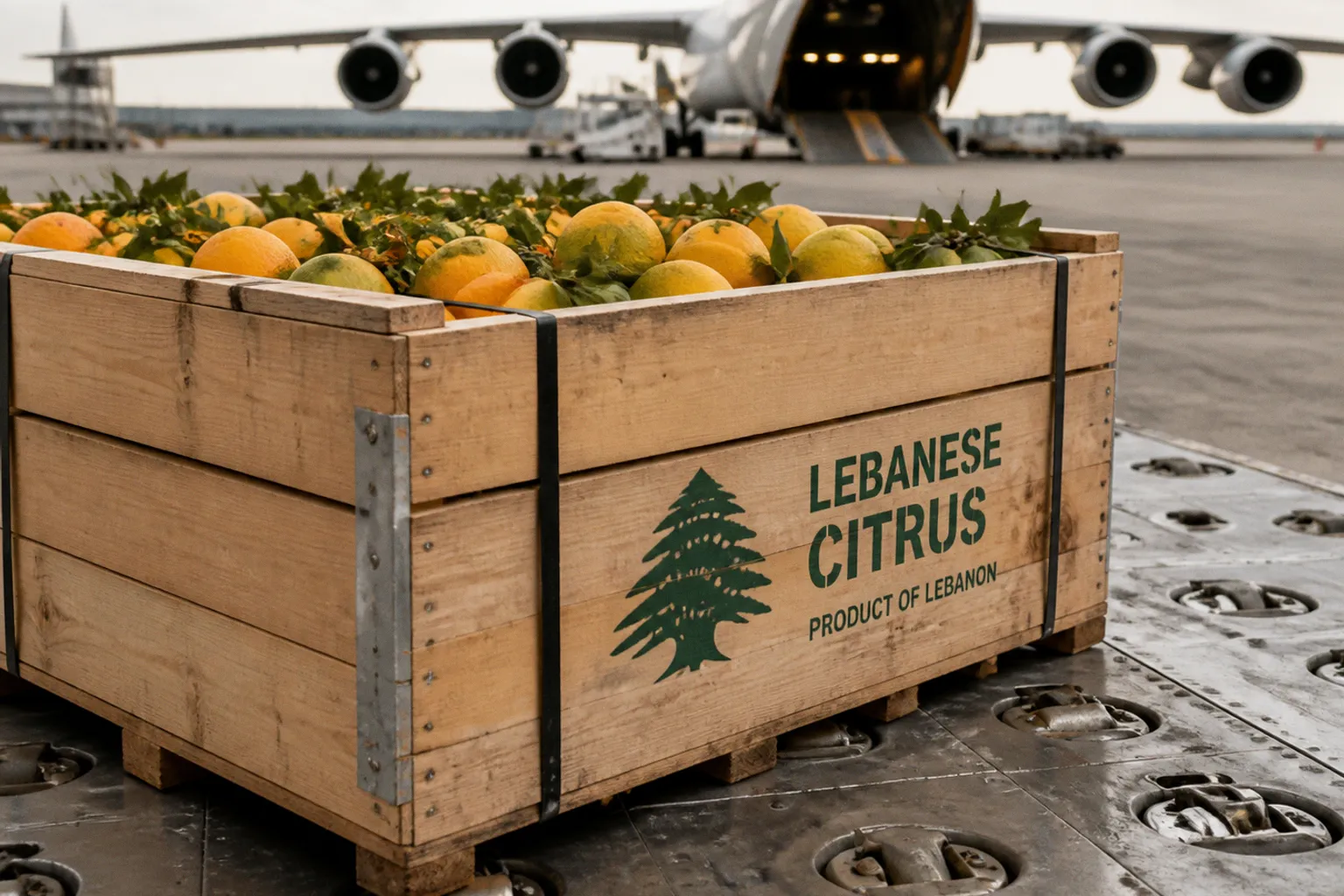
Saudi Arabia's door is open again. Your window to act is narrow.
GCC states collectively took in 45% of all Lebanese ag exports — approximately 200,000 tons annually. After the ban, total Gulf-bound shipments collapsed to 77,000 tons. The math is brutal: you lost over 60% of your most valuable overnight transit market in one policy decision.
Now the market is back. Projected annual export revenue sits at $500 million, with estimates climbing to $1–1.5 billion over the next three years. But here's the operational reality nobody in the boardroom wants to hear: the overland corridor through Syria that once fed your Gulf pipeline is still unreliable. The Nasib border crossing between Syria and Jordan — the artery that carried your trucks eastward — has been intermittently choked since its closure in April 2015. You cannot plan a cold chain around an intermittent border.
Air freight from Beirut International Airport is your fastest, most controllable route into the Gulf. If you're exporting high-value perishables — cherries, stone fruit, table grapes, fresh herbs — and you don't have an air cargo protocol in place right now, you are already behind.
Post-Ban Market Recovery: What the Numbers Actually Mean
Let's kill the optimism bias first. Lifting the ban does not mean 60,000 tons start flowing to Saudi Arabia next quarter. Turkish exporters have spent five years locking in shelf space, relationships, and pricing. Chinese suppliers have aggressively expanded cold chain capacity into the Gulf. You are re-entering a market where your competitors have been entrenched since 2021.
What the data does tell you:
- GCC demand for fresh produce has grown, not shrunk, during the ban years. Gulf food imports rose consistently year-over-year — your market didn't disappear, it was filled by others.
- Lebanese produce carries a brand premium in Saudi and UAE retail, especially for stone fruit, citrus, and table grapes. Heritage varieties command shelf presence that commodity Turkish exports cannot replicate.
- Revenue projections assume full pipeline restoration within 36 months — which means aggressive, protocol-driven exporters who move first will capture the highest-value contracts.
The cooperatives and exporters who treat this as a logistics problem — not a market opportunity headline — will win. You need cold chain specs locked, phyto certificates aligned to Libnor standards, and transit windows mapped to flight schedules before you pitch a single buyer.
The exporters who move air cargo protocols into place now — not after their first spoiled shipment — will own the premium Gulf accounts for the next decade.
Air Transit Times: Your Competitive Advantage on the Tarmac
Here is why air freight is non-negotiable for your high-value SKUs. Transit times from Beirut International Airport to Gulf hubs are measured in hours, not days:
| Destination | Flight Time | Baseline Rate (500–1,000 kg) |
|---|---|---|
| Riyadh | 2 hours 15 minutes | ~$0.95/kg |
| Dammam | 2 hours 30 minutes | ~$1.00–$1.05/kg |
| Jeddah | 3 hours 05 minutes | ~$0.95/kg |
| Dubai | 3 hours 10 minutes | ~$1.00–$1.05/kg |
Compare that to maritime: Beirut to Jebel Ali by sea takes 5–7 days under ideal scheduling. Add port congestion, customs delays at both ends, and the unpredictable wait for vessel space — you're looking at 10–14 days door-to-door for a reefer container. For cherries, apricots, or any produce with a 7–10 day post-harvest shelf life, sea freight is not a fallback. It's a write-off.
If your product window is under 96 hours from harvest to retail shelf, air is your only viable mode. That's not a preference — it's cold chain physics.
Rate volatility: plan for it, don't complain about it
The baseline rates in the table above are historical reference points, not fixed quotes. In late 2026, actual per-kilogram costs are subject to:
- Fuel surcharges — fluctuating monthly based on global jet fuel indices
- War risk premiums — regional conflict in the Levant corridor triggers surcharge spikes with zero notice
- Seasonal demand swings — peak Ramadan and Eid periods compress belly cargo space as passenger demand absorbs capacity
Build a 15–20% rate buffer into your cost models. If your margin evaporates at $1.20/kg instead of $0.95/kg, you do not have a viable export product. Fix the margin first, then book the cargo.
Cold Chain Infrastructure at Beirut Airport: What's Actually There
Beirut International Airport has invested in perishable handling — but you need to know exactly what exists and what doesn't before you commit volume.
What's operational:
- Cargomaster and ELC Transport Services provide specialized cold chain handling for agricultural cargo. Both operate temperature-controlled trucking from farm collection points to airport tarmac. Both work outside standard business hours — critical when your harvest window is dawn to mid-morning and your flight departs at 14:00.
- DHL Express opened a 2,000-square-meter bonded warehouse near the airport in 2023, specifically designed for temperature-controlled shipping with accelerated customs clearance. If you're running smaller, high-value shipments (500–1,000 kg lots), this facility cuts dwell time significantly.
- Phytosanitary inspection points are integrated into the cargo processing flow — your Libnor-aligned certificates get checked before loading, not after arrival in the Gulf.
What you must verify yourself:
- Exact current air cargo capacity allocated to fresh produce in 2026 — post-ban demand surge may exceed available belly cargo space on certain routes
- Reefer truck availability during peak harvest months (June–September for stone fruit)
- Whether your cooperative has a standing booking arrangement or is fighting for ad hoc space against commercial freight forwarders
Air cargo infrastructure at Beirut is built. But capacity is not infinite — cooperatives without pre-booked transit windows will get squeezed out by commercial shippers who planned three months ahead.
Freight Rates and Operational Logistics: The If-Then Protocol
Stop thinking in terms of "shipping arrangements." Start thinking in operational protocols. Here's the framework:
If you're exporting 500–1,000 kg lots of premium stone fruit or herbs → then book belly cargo space on scheduled passenger flights via DHL Express or equivalent handler. Leverage the bonded warehouse for customs pre-clearance. Target same-day transit: harvest at dawn, truck to airport by 09:00, flight by 14:00, on Gulf retail shelf by next morning.
If you're coordinating cooperative-level volumes (2,000–5,000 kg) → then negotiate dedicated freighter slots or consolidated charter loads. This is where Cargomaster and ELC Transport's after-hours operations become critical — you need a handler who can receive bulk loads at 05:00 and have them palletized and temp-controlled by 08:00.
If you're pricing your product for the Saudi retail market → then build your landed cost backward from the shelf price. Saudi buyers benchmark against Turkish imports delivered at $0.60–$0.75/kg by sea. Your air freight cost is 40–70% higher per kilogram — which means your product must command a 2–3x price premium to justify the mode. Varieties like Lebanese Bing cherries, white table grapes, and wild za'atar can sustain that premium. Commodity citrus cannot.
What to lock before your first shipment
1. Phytosanitary certificates aligned to Saudi SFDA import requirements — not just Libnor export standards. They are not the same document.
2. Cold chain temperature logs from harvest to airport — Saudi customs increasingly require continuous temperature data, not just a reefer container set point.
3. Standing cargo booking agreements with at least two handlers — single-provider dependency is a single point of failure.
4. Insurance coverage that accounts for war risk surcharges and spoilage — standard cargo policies often exclude conflict-zone transit.
5. Payment terms with Gulf buyers — LC-backed or prepayment. You are re-entering a market where your negotiating leverage is unproven post-ban.
Strategic Alternatives: Why Overland Still Can't Be Your Primary Plan
The Nasib crossing reopened intermittently after 2018, but reliability remains the core problem. Here's the comparison:
| Factor | Air Freight (Beirut → Gulf) | Overland (Beirut → Syria → Jordan → Gulf) | Maritime (Beirut → Jebel Ali) |
|---|---|---|---|
| Transit time | 2–3 hours flight + 6–12 hours handling | 18–36 hours if border open, unpredictable | 5–7 days sailing + port handling |
| Reliability | High (scheduled flights) | Low (border closures, security checks) | Medium (port congestion, vessel schedules) |
| Cost per kg | $0.95–$1.05 baseline | $0.30–$0.50 when operational | $0.15–$0.30 for reefer containers |
| Best for | High-value perishables, <96hr shelf life | Bulk commodities when corridor is stable | Long-shelf-life products, cost-sensitive exports |
| Risk profile | Rate volatility, capacity limits | Border closure, cargo seizure, security | Spoilage on long transit, port delays |
Overland is cheaper when it works. Maritime is cheapest per kilogram. But "when it works" and "cheapest per kilogram" are not how you build a reliable export pipeline into a market you're trying to reclaim.
Your optimal strategy is a split-mode approach:
- Air freight for your highest-margin, shortest-shelf-life SKUs — the products that build your brand and secure premium retail accounts in Riyadh, Jeddah, and Dubai.
- Maritime reefer for volume products with 14+ day shelf life — citrus, potatoes, onions — once you've locked stable buyer relationships.
- Overland only as contingency, never as primary. The moment you build a delivery schedule around a border crossing that might close with 48 hours' notice, you've already lost the account.
The Operational Reality
The Saudi ban lasted five years. The competitive gap is real. Turkish and Chinese suppliers did not wait for you — they optimized, expanded, and locked in. You are re-entering on the back foot, and the only way to close that gap is through operational superiority: faster cold chain, tighter transit windows, better phyto documentation, and zero tolerance for spoilage.
Air freight from Beirut is not a luxury — it's your structural advantage. Two hours and fifteen minutes to Riyadh. That's the fastest farm-to-shelf pipeline any Lebanese exporter has ever had into Saudi Arabia. Use it or lose the market again — this time to competitors who won't give it back.
The cooperatives that invest in air cargo protocols, pre-booked transit windows, and Gulf-aligned phytosanitary compliance will capture the $500 million opportunity. The ones that wait for "normalization" will watch from the Bekaa while Turkish cherries fill Saudi supermarket shelves for another five years.
Move now.