Lebanese table grape harvest: a five-stage export project
Some problems in agriculture announce themselves with a single number. For Lebanese table grapes, the number is 27.
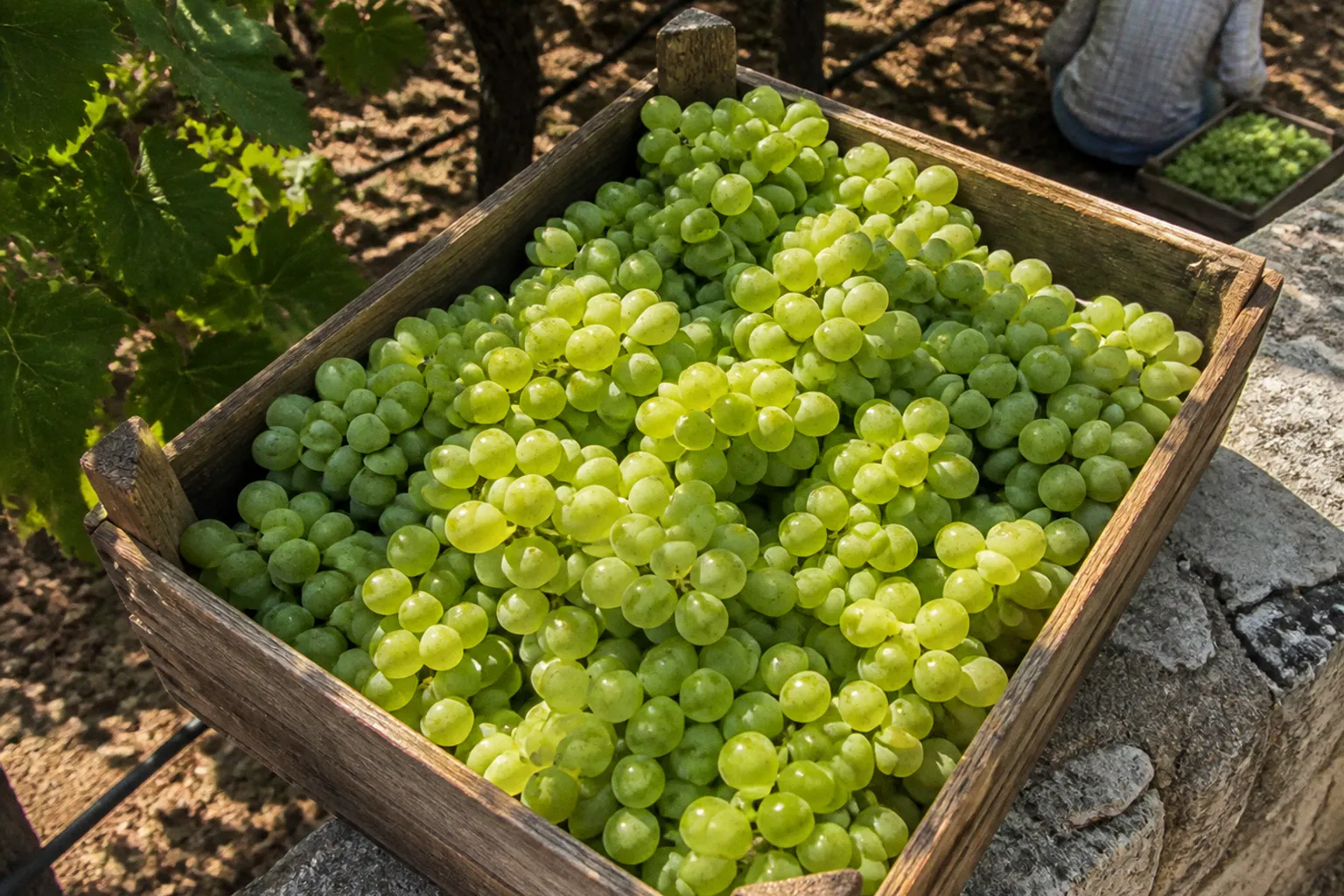
That's the air temperature above which the Ministry of Agriculture's technical guidelines tell growers to stop harvesting — not because the vines cannot tolerate the heat, but because the fruit itself, once picked, loses its grip on shelf life. Below that threshold, the berries hold their bloom and their internal chemistry. Above it, the days of cool storage quietly shrink. Walk into a Bekaa Valley vineyard at five in the morning during peak July, and you see the protocol in action: workers moving quickly through the rows while the air is still cool, lugs filling before the sun climbs.
The harvest itself — which runs from June through February — is only the visible part of a much longer arc. The grapes that end up in a refrigerated container bound for Rotterdam or Dubai have already passed through a sequence of decisions that begins in the field and ends at a customs checkpoint. The export numbers reflect this: from USD 6.7 million in 2012 to USD 47.3 million in 2022, with 61,603 tons crossing the border in that year alone. Behind each ton is a chain of small, often invisible choices that determine whether a bunch arrives crisp or collapsed.
This is not a formal "five-stage export project" with a standardized name. It is a working sequence that comes up again and again when you walk through packing houses and read the export guidelines — harvesting, field transport, sorting and grading, packaging and pre-cooling, and the cold-chain-plus-documentation stage that gets the fruit to its destination. The rest of this piece walks through each step and the questions worth asking about it.
The harvest window: why June to February matters
Lebanon's table grape season is unusually long compared to its European competitors. The harvest begins in June in the warmer lowland and coastal pockets, moves through the Bekaa Valley at peak summer, and stretches well into late autumn and early winter thanks to late-ripening varieties and the cooler highland sites. The total production footprint is meaningful: 6,836 hectares under table grape cultivation in 2021, yielding 59,221 tons that year.
This long window is more than a curiosity. It is a strategic feature. Between December and February, when European table grape supply has largely wound down, Lebanese grapes — particularly those from late-ripening varieties in the upper Bekaa and Akkar — still arrive at port. For buyers in the Netherlands and the UK, this fills a gap that would otherwise be expensive to bridge. The primary Gulf and regional buyers — UAE, Oman, Kuwait, Egypt, and Iraq — are year-round, but the late-season window is where the European premium lives.
The seasonal complementarity is what makes the export pipeline valuable. It is also what makes the harvest itself unforgiving. Once the bunch is cut, the clock is running.
The variety map
Before walking through the stages, it helps to know what is being harvested. The Lebanese export mix is dominated by internationally recognized seedless varieties, but traditional local varieties still occupy a meaningful share of the vineyard and the regional market.
| Variety | Type | Typical market window | Notes |
|---|---|---|---|
| Thompson Seedless | Seedless, white-green | Early to mid-season | Workhorse variety for Gulf and European buyers |
| Flame Seedless | Seedless, red | Early to mid-season | High sugar, popular in regional markets |
| Early Superior Seedless | Seedless, white-green | Early season | Drives the June start of the export calendar |
| Black Pearl | Seedless, dark | Mid-season | Niche premium interest in European markets |
| Red Globe | Seeded, large red | Late season | Anchors the December-to-February European window |
| Baytamouni | Local, seeded | Mid-season | Strong regional demand, limited export |
| Tfeifihi | Local, seeded | Mid-season | Domestic and regional, traditional holiday consumption |
The variety mix shapes the harvest rhythm. Early-ripening varieties drive the June start; late-season varieties carry the premium winter window and the highest per-kilo returns.
Stage 1: Harvesting — the 27°C rule and the wet-morning problem
The first decision begins in the vineyard, and it has nothing to do with ripeness in the conventional sense. The Ministry of Agriculture's technical export guidelines specify two conditions under which harvest should pause: when ambient air temperature exceeds 27°C, and during wet morning conditions. Both are about post-harvest behavior, not picking ease.
Fresh table grapes are non-climacteric — they do not continue to ripen after harvest. Whatever sugar, acid balance, and stem condition the bunch has at the moment of cutting is roughly what it will have at the destination. Heat at harvest accelerates water loss, weakens the stem's grip on the berry, and shortens the window before fungal pressure (Botrytis, in particular) takes hold. A wet morning adds free moisture to the bloom, the pale powdery coating that protects the berry surface. Disturb that bloom and the natural defense thins.
The practical pattern this produces is familiar to anyone who has worked a Lebanese vineyard in summer. Picking starts at first light, often around 4:30 or 5:00 a.m., and wraps before the air temperature climbs through the mid-twenties. The crew returns in the late afternoon only if the day's harvest target was not met, and then with added caution about berry temperature as it enters the lugs. Varieties move in sequence: Early Superior and Flame Seedless first, Thompson Seedless through the peak, Red Globe carrying the late-season tail.
Stage 2: Field transport — the first temperature decision
The next decision is distance. Table grapes are typically moved from the vine to the packing house within a window of a few hours, often less. The lugs and field crates are designed to allow airflow underneath and around the bunches, and field crews are instructed to keep the fruit shaded as it travels.
What looks like simple logistics is actually a thermal decision. The temperature of the fruit at the moment it enters the packing house sets the load on the cooling system that comes next. If grapes arrive at the dock at 25°C, the pre-cooling room has to remove a lot of heat before the berries reach the near-0°C range where their metabolism slows enough for the cold chain to do its job. If the fruit arrives at 18°C, the cooling system has a much easier shift.
This is why packing houses are typically built close to the vineyards they serve, and why the geography of the Bekaa — relatively flat, with a concentration of vineyards within a short drive of well-sited facilities — matters commercially. The field-transport stage is short by design, and the temperature margin is preserved by habit.
The cold chain does not start at the port. It starts in the packing house, hours before the container is sealed.
Stage 3: Sorting and grading — where the human eye still rules
This is the stage that most directly determines export value. Lebanese table grape packing houses, like most of their Mediterranean counterparts, still rely on a heavily manual sorting process. A trained crew moves the bunches along a line, removes defective berries, trims damaged stems, and assigns grades based on size, color, uniformity, and the condition of the bloom. Mechanical sizers and optical sorters exist, but for premium export grades — the kind that fetch prices in European supermarkets — the human eye remains the standard.
The criteria are not arbitrary. Bunches heading to long-distance markets must be loose enough to allow airflow between berries, which prevents condensation pockets later in the cold chain. Bleached, split, or moldy berries are removed because they will not improve over time and will accelerate the deterioration of neighboring fruit. The stem must be green and pliable, not brittle; a brittle stem is a sign that the bunch has been off the vine too long, or was harvested at the wrong temperature.
What gets sorted out is as important as what gets through. The cull, depending on the day's harvest, goes to local fresh markets, to juice processors, or to livestock feed. The economics of the export pipeline depend on this bifurcation: the premium bunch that ends up in a clamshell in Abu Dhabi, and the rest that feeds the domestic market. The proportion is not standardized industry-wide, and it varies with variety, season, and the specific buyer contract.
For packing houses aiming at the strictest export destinations, the sorting line is also where GlobalGAP requirements show up in practice. Lebanon has around 40 GlobalGAP-certified table grape farms, and the certification sets cleaning protocols, traceability documentation, and worker-safety standards that the sorting line either delivers or does not. A clean sort is easier to defend at audit; a sloppy one is not.
Stage 4: Packaging and pre-cooling — the engineering of shelf life
Sorted bunches move into packaging, and packaging is where shelf life is engineered. Two things have to happen in quick succession: the fruit has to be packed into its final shipping configuration, and it has to be brought down to a temperature that holds its metabolism in check.
The standard format for export is a clamshell or a small carton — typically 5 kg for international shipments — with a liner that limits moisture loss. Some varieties tolerate modified-atmosphere packaging better than others; Red Globe, with its thick skin, holds up well in standard liners, while thinner-skinned varieties benefit from liners that manage gas exchange more carefully. The choice of liner, like the choice of variety, is a small decision with a large downstream effect.
Pre-cooling is the technical step that makes the cold chain possible. The goal is to remove field heat and bring the fruit pulp temperature down to roughly 0°C within hours of packing. Hydro-cooling and forced-air cooling are the two common approaches; the choice depends on the packing house's equipment and the variety. The faster the fruit reaches near-0°C, the longer the effective shelf life at the destination — a roughly linear relationship that translates directly into how long the grapes can sit in a Rotterdam wholesale market before they need to be sold.
Putting stage 3 and stage 4 side by side, the link becomes obvious. The cleaner the sort, the easier the pre-cooling. A bunch with hidden moisture pockets or damaged berries will not cool evenly, and the cold chain will inherit the problem. This is why leading packing houses treat sorting and pre-cooling as a single integrated loop, not two separate rooms.
Stage 5: Cold chain and documentation — the last mile, written down
The final stage is the one that links the whole sequence to a buyer. After pre-cooling, the packed fruit is loaded into refrigerated containers, typically at 0°C with controlled humidity, and the documentation chain begins.
The Lebanese Ministry of Agriculture requires every export applicant to file a prior notice at the border control center before the consignment is packed. The notice includes the exporter, the importer, the quantity, the packing center, the export date, and the transport mode. This is not a procedural formality; it is the moment when the consignment is registered in the export tracking system, and when any phytosanitary requirements attached to the destination come into focus.
Destination requirements vary. The Gulf countries — UAE, Oman, Kuwait — and the regional buyers Egypt and Iraq have their own sets of standards, often aligned with Gulf Standardization Organization rules. European buyers — the Netherlands and the UK among them — operate under EU phytosanitary regulations, which include specific monitoring for pesticide residues and for the absence of certain pests. The packing house's documentation stack reflects this: separate certificates, separate residue test results, separate origin documentation.
The container itself is not passive. Modern refrigerated containers carry temperature loggers that record the journey, and the data is typically shared with the buyer on arrival. A reading that drifts above the agreed threshold can trigger a rejection or a price renegotiation at the destination. The cold chain is therefore monitored twice — once by the exporter, once by the importer — and the logger is the shared record.
A practical seasonal timeline for the cooperative
For a cooperative grower working with the export pipeline, the year is not a single harvest but a series of overlapping decisions. A rough seasonal calendar, based on the June-to-February harvest window and the typical post-harvest cycle:
- Late winter to early spring (February to April): Pruning decisions that determine the upcoming season's yield and variety mix. This is also when soil inputs and irrigation systems are calibrated for the year.
- Spring (April to June): Flowering, fruit set, and the first canopy management passes. Early varieties begin their ripening curve in late spring.
- Early summer (June to July): The first harvest begins — early-ripening varieties from warmer sites. The packing house is prepared; pre-cooling equipment is serviced. This is when the export documentation templates are reviewed and buyer contracts are finalized.
- Peak summer (July to September): Bulk of the harvest in the Bekaa Valley. Thompson Seedless, Flame Seedless, and Early Superior Seedless dominate the volume. The 27°C rule governs picking hours. Pre-cooling and cold-chain logistics run at full capacity.
- Autumn (October to November): Mid- and late-season varieties come off the vine. Red Globe becomes a larger share of the mix. The first European off-season shipments begin.
- Winter (December to February): Late-ripening varieties from cooler highland sites and Akkar feed the European December-to-February window, when supply from Spain, Italy, and Greece has largely ended. This is the premium export window and the year's most price-sensitive leg.
The seasonal calendar is the scaffolding. The actual decisions — which variety to expand, which buyer to prioritize, which packing house to use — are made against the constraint of the 27°C rule and the January cold-chain reality.
Where the next constraint will appear
The export record tells a clear story of growth: tenfold increase in value over a decade, to USD 47.3 million in 2022, with 61,603 tons of fruit crossing the border. That growth has come from a combination of varietal selection, packhouse investment, and the seasonal complementarity that Lebanon's geography offers.
The vulnerabilities are also clear. The harvest is timing-sensitive in a way that climate variability makes more fragile each year. The 27°C threshold is not a moving target, but the days on which it is exceeded are. The sorting and grading stage still depends on trained labor, and the seasonal labor pool is not infinite. The cold-chain infrastructure is improving but remains uneven across the country, and a single power interruption during pre-cooling can erase hours of careful work.
For the cooperative, the practical question is not whether the five-stage sequence works — it works, demonstrably, in the numbers — but where the next constraint will appear. Usually it is the stage that does not photograph well: the moment in the sorting line when a tired worker misses a damaged berry, the hours-long delay in pre-cooling after a power dip, the packing house that does not have a backup generator for the August heat. These are the points where the export pipeline either holds or breaks.
The numbers say it held, in 2022, for 61,603 tons of fruit. The same sequence will be tested again this season, beginning in June, when the first early-ripening bunches come off the vine.