Export packaging for Lebanese produce: how to choose
The clock runs out on January 1, 2030. That is when the EU's Packaging and Packaging Waste Regulation (PPWR) makes single-use plastic packaging for fresh produce under 1.5 kg illegal at the point of entry.
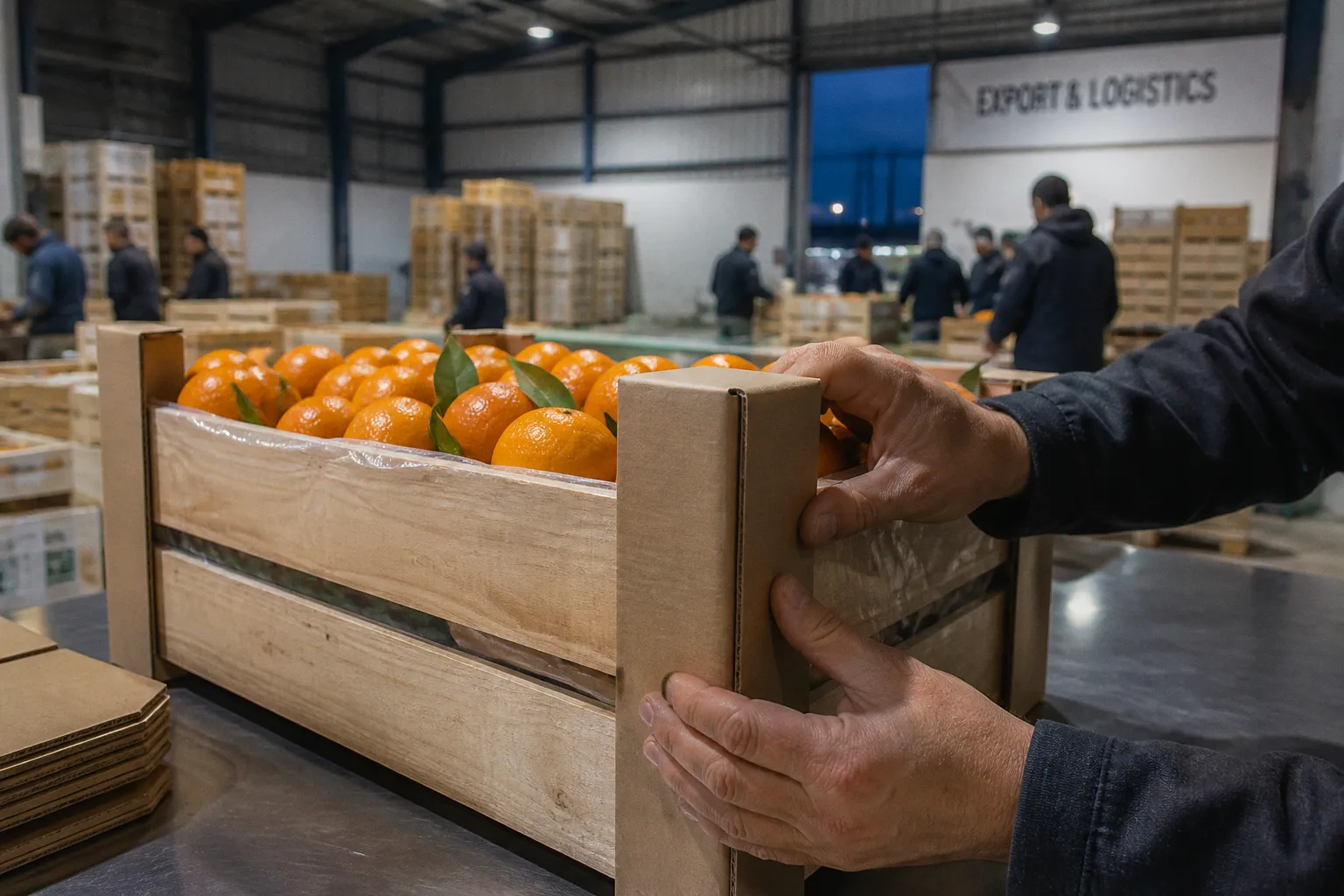
For a Lebanese exporter shipping cherries to Marseille or citrus through the Port of Beirut to Rotterdam, the deadline is already a logistics problem, not a regulatory footnote. If your current line operates on polystyrene clamshells or thin plastic crates, you have roughly four shipping seasons to swap substrates—or watch your cargo bounce at customs.
The Lebanon-specific layer complicates this further. Decision No 1/358 (1997) and its amendment Decision No 1/2 (2000) from the Ministry of Agriculture already prohibit polystyrene containers for fresh fruits and vegetables leaving Lebanese borders. Most export operations think they are compliant because they switched away from foam years ago. The actual problem is wider: wooden boxes made from gum trees, repurposed crates, and any wrapper that alters the taste of the produce sit on the rejection list. And the EU's 2030 threshold does not care what you used last season.
Pick the substrate four years before the deadline. Retrofitting a cold chain in the second half of 2029 costs three times what it costs in 2026.
Navigating the Ministry of Agriculture's Prohibited Materials
Three pieces of legislation govern what you can put your produce in inside Lebanon. Get any of them wrong, and your shipment sits at the port while the inspector issues a non-conformity.
Decision No 1/358 (1997) and Decision No 1/2 (2000): Polystyrene containers are banned for the export of fresh fruits and vegetables. No exceptions for short-sea shipments, no exceptions for airfreight. If your cooperative is still running foam trays for tomatoes or table grapes, the supply chain leadership needs to liquidate that stock this quarter.
Decision No 1/474: Boxes that emit strong odors get rejected at the packing house. The regulation specifically names wooden boxes made from gum trees, but the rule applies broadly. Any wooden crate carrying a residual scent from previous contents, fungicide treatment, or raw timber is a liability. Wrapping materials that alter the taste of the produce fall under the same prohibition. That kills off newspaper wraps, certain recycled kraft papers with heavy ink loads, and any film that leaches flavor compounds under cold-chain humidity.
Decision No 1/88 (2014): Reused containers must be thoroughly cleaned and sterilized before they touch fresh produce. A crate that last held fertilizer or waste cannot enter your pack-house line, even if it looks clean. Documented sterilization or single-use—that is the choice.
| Packaging option | Legal status under Lebanese MoA | Risk profile |
|---|---|---|
| Polystyrene clamshells and trays | Banned (Dec 1/2, 2000) | Hard rejection at port |
| Wooden boxes, gum tree | Banned (Dec 1/474) | Odor transfer, rejection |
| Reused crates without sterilization | Restricted (Dec 1/88) | Contamination finding |
| New corrugated cardboard | Compliant | Lowest regulatory risk |
| Sterilized reusable plastic crates | Compliant with record-keeping | Medium (cleaning protocol) |
| Paper-based wraps with heavy ink | Restricted | Taste alteration risk |
The Shift to Corrugated Cardboard: Lessons from the Banana Sector
This transition has already happened once. UNIPAK, the Lebanese packaging manufacturer, introduced corrugated packaging to the local banana sector in 1995 and fully converted the supply chain by 2003. Plastic crates disappeared from that harvest line. The result was a 14 kg capacity corrugated board tray that stacks cleanly, prints cleanly, and exports cleanly.
The banana case study is the playbook. A cooperative that wants to dump polystyrene does not need to wait for a state-led program. The math is straightforward: a single line conversion, sourced locally, financed through one harvest cycle, and the per-kilo packaging cost stabilizes within two seasons. The harder problem is the label print, the ink, and the adhesives—those need to be food-contact-grade, validated against LIBNOR Standard 656.
If you operate a large-volume citrus or pome fruit line, run the same playbook:
- Audit the current substrate against Decision No 1/2 and Decision No 1/474.
- Source corrugated alternatives rated for your cold chain (-0.5°C to 8°C range).
- Validate the adhesive and ink certificates against LIBNOR Standard 656 for food contact.
- Pilot one container load before full conversion.
- Lock the substrate with a six-month supply contract to hedge pulp price swings.
If you operate a small-volume specialty line (cherries, avocados, table grapes), the calculus changes. Corrugated is still the answer, but the per-unit cost runs higher. A reusable plastic crate program with documented sterilization protocols can carry you, especially for short-haul Gulf routes where EU PPWR does not apply.
Labeling Requirements and the Prohibition of Restricted Markets
The packaging itself is half the problem. The label is the other half, and the Ministry of Agriculture is not lenient here.
Every export label for Lebanese agricultural goods must carry:
- Net weight
- Manufacturer or packer details
- Production date
- Expiry date
- Ingredients (or single-ingredient product declaration)
- Country of origin
Languages permitted: Arabic, English, or French. Print in any one of these, and you clear the language gate. Print in all three, and you clear the language gate for re-export hubs and free-zone trans-shipment.
Hebrew labeling is prohibited. This is not a market-preference nuance. This is a hard line. Any label, secondary packaging, or pallet wrap containing Hebrew text triggers a rejection at the border. If your buyer in the Gulf requests Hebrew for trans-shipment documentation, that conversation ends before it starts.
| Market channel | Language options | Operational watch-outs |
|---|---|---|
| EU (direct) | AR / EN / FR | Add 2030 PPWR code per SKU |
| Gulf (direct) | AR / EN / FR | Phytosanitary certificate stamp |
| North America | AR / EN / FR | FDA Food Safety Modernization Act registration |
| Israel (trans-shipment via third country) | Prohibited | No Hebrew text anywhere on pack |
Secondary requirements hide in the fine print. The production date must use the same calendar convention as the destination market. The expiry date must reflect actual shelf life under your chosen cold chain, not a marketing claim. If your label states "shelf life 21 days" and the produce arrives at 18 days, you have a commercial dispute risk and a claim on the cargo.
Preparing for the EU's 2030 Packaging and Packaging Waste Regulation
The 2030 PPWR is the cliff every exporter should be measuring against now. Three rules matter for fresh produce:
1. Single-use plastic packaging for fresh produce under 1.5 kg is banned starting January 1, 2030.
2. Paper-based packaging must contain no more than 5% plastic by weight (films, laminates, coatings).
3. All packaging must be recyclable by 2030, with specific design-for-recycling criteria.
Translate this into operational specs:
- A 1 kg cherry punnet cannot ship in a plastic clamshell.
- A 1 kg grape basket cannot ship in a thermoformed plastic tray.
- A 14 kg citrus carton lined with a polyethylene bag fails the 5% rule and fails the recyclability rule.
If your buyer is in Germany, France, or the Netherlands, the deadline is binding. If your buyer is in the UK, Switzerland, or the Gulf, the deadline is not legally binding but the buyer pressure is real—retail chains have already begun sourcing compliant-only lines.
Run this sequence:
- Now to Q4 2026: Validate two corrugated SKUs per product line. Run cold-chain simulation. Confirm 5% plastic content with the supplier.
- 2027 to Q2 2028: Run a parallel line with the compliant substrate on a single buyer contract. Track rejection rates, transit humidity performance, and arrival quality.
- Q3 2028 to Q4 2029: Cut over the entire export volume to PPWR-compliant substrate. Maintain legacy stock as a fallback for non-EU markets only.
By Q4 2029, your entire export volume should be on substrate three—paper, pulp, or certified reusable—that clears PPWR. If you are still negotiating with a supplier in November 2029, you have already missed the cycle.
Collaborating with LibanPack for International Certification
LIBNOR is the national standards body. The Ministry of Agriculture is the conformity authority for agricultural products. These two facts trip up half the cooperatives in the sector because both touch the export file, and the division of labor is not obvious until you sit in the certification room.
LibanPack—officially the Lebanese Packaging Center, established in November 2008—sits between you and both. The center works with LIBNOR to align your packaging, labeling, and food safety protocols with international standards, including LIBNOR Standard 605 for fresh produce handling and LIBNOR Standard 656 for food-contact packaging. The export certificate of conformity still comes from the Ministry of Agriculture, but LibanPack preps the technical file so you do not lose three weeks at the testing stage.
Engage LibanPack early. The cycle from intake to certification runs longer than you expect, especially for first-time export SKUs. If you wait until your buyer in Marseille asks for a Certificate of Conformity, you are already late.
What to bring to the first meeting:
- Current substrate specifications (gauge, burst strength, food-contact certifications).
- Label artwork with all six mandatory fields populated.
- Cold-chain temperature profile for the target transit window.
- Phytosanitary treatment history for the past three shipment cycles.
- Destination market list with PPWR applicability flags.
Compliance checklist for the export operations lead
- Audit current packaging substrate against Decision No 1/2 and Decision No 1/474.
- Eliminate polystyrene inventory this quarter.
- Source corrugated alternatives rated for the cold chain temperature range.
- Validate label language and content against Ministry of Agriculture requirements.
- Remove all Hebrew text from pack, secondary pack, and pallet wrap.
- Pilot one container load on compliant substrate before full conversion.
- Engage LibanPack for LIBNOR Standard 605 and 656 alignment.
- Run a 2027 parallel line for EU PPWR compliance.
- Lock in 2030-ready substrate by Q4 2029.
- Document sterilization protocol for every reusable crate in the line.
Get the substrate right in 2026. The 2030 deadline does not negotiate, and the Lebanese regulations do not bend for short-term margin.