Export documentation: 6 common errors stalling Lebanese cargo
Every shipping season, Lebanese fresh produce moves through a documentation gauntlet that catches even veteran exporters flat-footed.
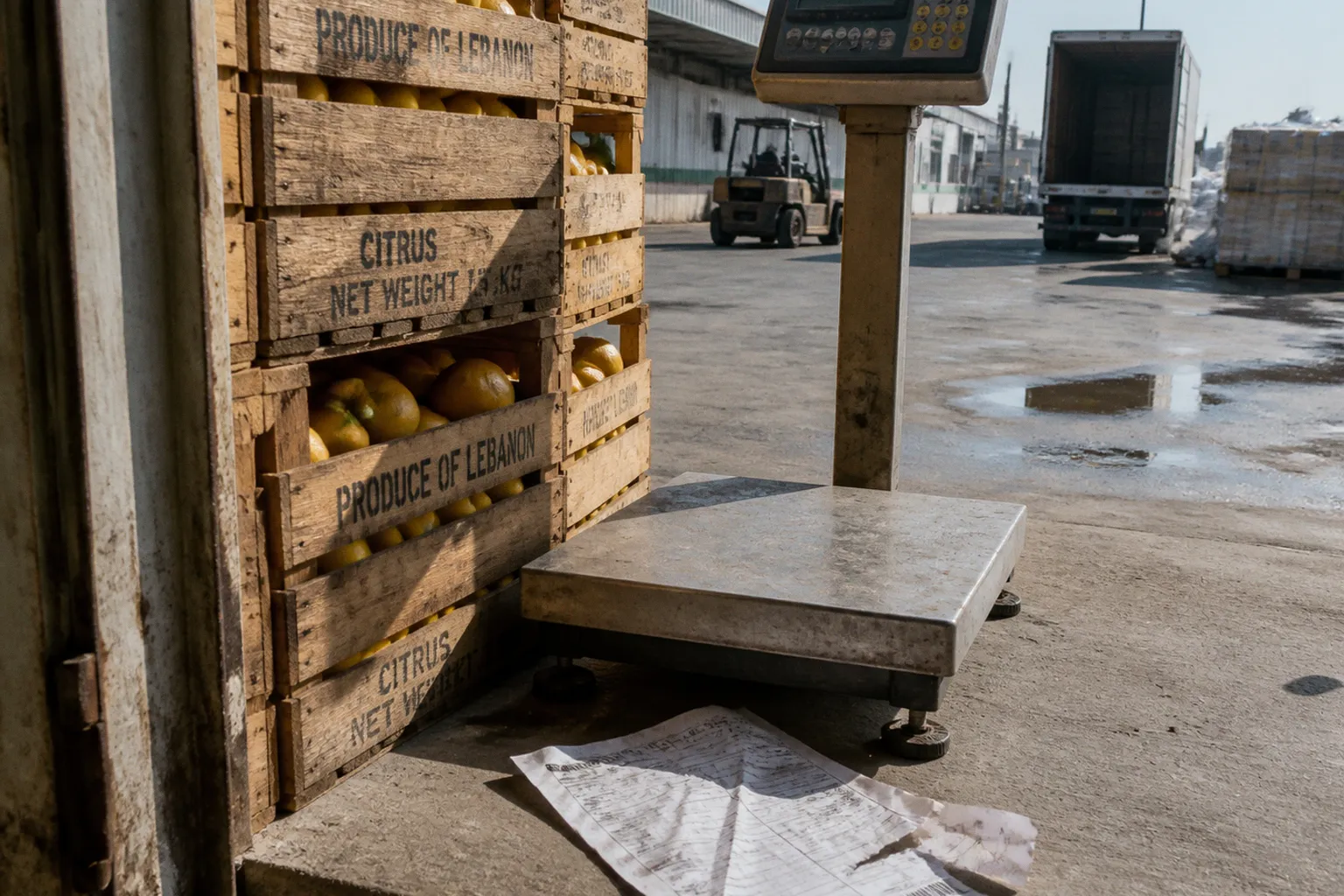
The volumes make the stakes concrete: 180,000 to 200,000 metric tons of apples roll out of Lebanon annually, with historically around 70% of that harvest crossing borders to Gulf, EU, and regional markets. When a single Certificate of Origin misaligns with the packing list, that reefer container doesn't leave the port. When an LARI test reference number is mistyped on the phytosanitary application, the load sits. Paperwork errors are the silent drag on the cold chain, and they cost more than a single spoiled pallet — they cost the entire transit window for the harvest your cooperative spent a season producing.
This is the operational protocol you run before your next container hits Beirut Port. Below: the six errors I see stalling Lebanese agricultural cargo at customs, the pre-shipment chain that catches most of them upstream, and the document stack that needs to align to the digit before customs even opens your SAD form.
Lock the MoA pre-shipment application before you pack
Stop here first. The Ministry of Agriculture requires every exporter of fresh fruits and vegetables to file a formal application with the border control centers before packing begins. This is not a post-loading formality and not something the customs broker can backfill at clearance. It must include exporter identification and registration details, destination country and intended route, product type and variety, quantities per consignment, and the designated packing center.
If you pack first and document second, you've already broken the compliance chain. Customs and MoA inspectors cross-reference the pre-shipment application against what physically shows up at the port, against the LARI test report, and against the phytosanitary certificate when it gets issued. Mismatches at this stage trigger holds that stretch into days while lab samples are re-pulled, re-tested, and the chain is rebuilt from the middle.
The operational fix: assign one person on your team the sole responsibility of filing the MoA application 72 hours before packing starts. Stamp it, log it, file the reference number with your shipment master file. That reference becomes your retrieval key when the inevitable query lands from the broker or from customs.
"If your packaging stencil doesn't read identically to your invoice, your container sits."
Build the document stack in the right order
Customs export processing in Lebanon runs on a five-document minimum for commercial entities, plus one clearance certificate that catches more new exporters than any technical error. Stack them in this order, and never submit them piecemeal to the broker:
1. Single Administrative Document (SAD) — the declaration form itself, completed in full
2. Original commercial invoice — signed, stamped, dated, with HS codes per line item
3. Packing list — line-by-line reconciliation against the invoice, including net and gross weight per SKU
4. Export order — the underlying purchase contract or letter of credit reference
5. Certificate of Origin — issued through the Chamber of Commerce, Industry, and Agriculture
On top of these, for any commercial entity, you need a valid Quietus statement from the Social Security Office proving your end-of-service and contribution obligations are current. No Quietus, no export clearance. This single document delays more first-time shippers than any HS code dispute.
"Your documentation stack is one atomic file. If one changes, all change. If one is missing, customs holds everything."
Treat these six documents as a single object. If the buyer changes a quantity, every document regenerates. If a stamp is faint, the whole set gets re-issued. Partial submissions create reconciliation work at the broker's desk and at the customs counter, and that work eats your cold-chain margin.
The phytosanitary certificate is downstream of LARI — sequence it right
Here's where the chain breaks most often and where exporters lose the most transit days. A phytosanitary certificate is not a standalone document — it is issued by the Ministry of Agriculture only after the Lebanese Agricultural Research Institute (LARI) has run laboratory tests on your specific batch. The LARI test results get submitted alongside your phytosanitary application. No LARI report on file, no certificate.
The sequence is fixed and non-negotiable:
1. Pull representative samples from the packed consignment at the designated packing center
2. Submit samples to LARI for the relevant analysis — pesticide residues, pathogen screening, varietal verification as required by the destination market
3. Receive LARI test report with a unique reference number
4. File phytosanitary certificate application with MoA, attaching the LARI report and the LARI reference number
5. MoA issues the phytosanitary certificate citing the LARI reference
The recurring error pattern: exporters request the phytosanitary certificate before LARI results are back, then scramble to insert the reference number later. This creates certificate revisions, stamp mismatches, and inspector queries at the port — each one a delay event. Schedule LARI sampling at least 5–7 working days before your intended loading date and build slack into the timeline. The certificate is not the bottleneck. The lab turnaround is. Plan for it.
Six errors that stall cargo at the port
These are the discrepancies that turn a 48-hour customs transit into a two-week hold, and in some cases trigger full re-inspection or rejection at destination under Protocol Number 4 rules governing EU-Lebanon trade. Run each line item against your shipment file before the truck rolls to the port.
| Error | Where it shows up | Operational fix |
|---|---|---|
| HS code misclassification | SAD form, commercial invoice | Verify HS code per destination country's tariff schedule; for apples, HS 08.08.10 is the baseline under Lebanese export framework |
| Weight or quantity mismatch between invoice and packing list | Invoice vs. packing list reconciliation | Match net weight, gross weight, and unit count to the kilogram; one decimal drift triggers a re-weigh at the port |
| Faint or illegible inspector stamps on certificates | Certificate of Origin, phytosanitary certificate, LIBNOR NL mark | Re-issue documents with clear, dark stamps; never scan and reuse a stamped certificate |
| Missing or expired MoA exporter health registration | Customs pre-clearance check | Renew MoA registration annually; carry the original certificate in the shipment file, not a photocopy |
| Packaging stencil data not matching shipping documents | Physical cargo bags or cartons vs. invoice, packing list, CoO, phytosanitary | Standardize the stencil template; one source of truth for batch numbers, weights, origin |
| Quietus statement absent or outdated | Social Security Office clearance check | Pull a fresh Quietus within 30 days of shipment date |
One of these errors doesn't just slow your shipment. Under Protocol Number 4, documentation discrepancies can trigger full re-inspection, additional lab sampling at destination, and in worst cases, cargo rejection and return at the importer's cost. Fix them at origin or pay for them at destination — there is no neutral ground.
LIBNOR is a quality mark, not a customs pass
LIBNOR (Lebanese Standards Institution), established by law on July 23, 1962, grants the NL conformity mark for products meeting Lebanese national standards. Useful. Not sufficient for export clearance on its own.
Holding an NL mark does not bypass phytosanitary clearance, does not replace the MoA exporter health registration, does not substitute for LARI batch analysis, and does not waive Certificate of Origin requirements. Export compliance is a layered stack, and LIBNOR sits as one layer among several — the layer that proves product standard compliance, not shipment-level customs compliance.
The misread I see most often at the cooperative level: a producer group gets LIBNOR-certified, assumes the export lane is open, and skips the MoA pre-shipment filing or the LARI batch test. Result: the container rolls to Beirut Port and sits while the missing application is processed, the lab samples are pulled from the cargo, and the cold-chain clock runs out. LIBNOR proves the apples meet grade. Customs and MoA clearance prove the shipment can leave the country. Different jobs, both mandatory.
Final protocol: the pre-loading checklist
Run this before the container is sealed at the packing center:
- MoA pre-shipment application filed, reference number logged in the shipment master file
- LARI lab samples submitted, test report reference number on file
- Phytosanitary certificate application filed with LARI reference attached
- SAD form completed, HS codes verified against destination country's tariff schedule
- Commercial invoice, packing list, and Certificate of Origin reconciled line-by-line
- Packaging stencil data matches all shipping documents exactly
- Quietus statement pulled within the last 30 days
- MoA exporter health registration current, original copy in the shipment file
- LIBNOR NL mark certificate included if relevant to the product category
- Cold-chain temperature log started at packing and continuous through container loading
Any gap on this list is a port-side delay waiting to happen. Documentation errors don't stall a single container — they burn the transit window for the entire harvest cycle the shipment represents, and they put the next load at risk of intensified inspection. Fix them upstream at the packing center, and the export lane runs clean from Beirut Port to the destination market. The paperwork is not the product, but it is the gate. Treat it like the gate it is.