Lebanese vegetable storage: 5 ways to avoid spoilage
In the Bekaa Valley and the coastal plains, a substantial share of fresh fruit and vegetable volume never reaches a paying buyer.
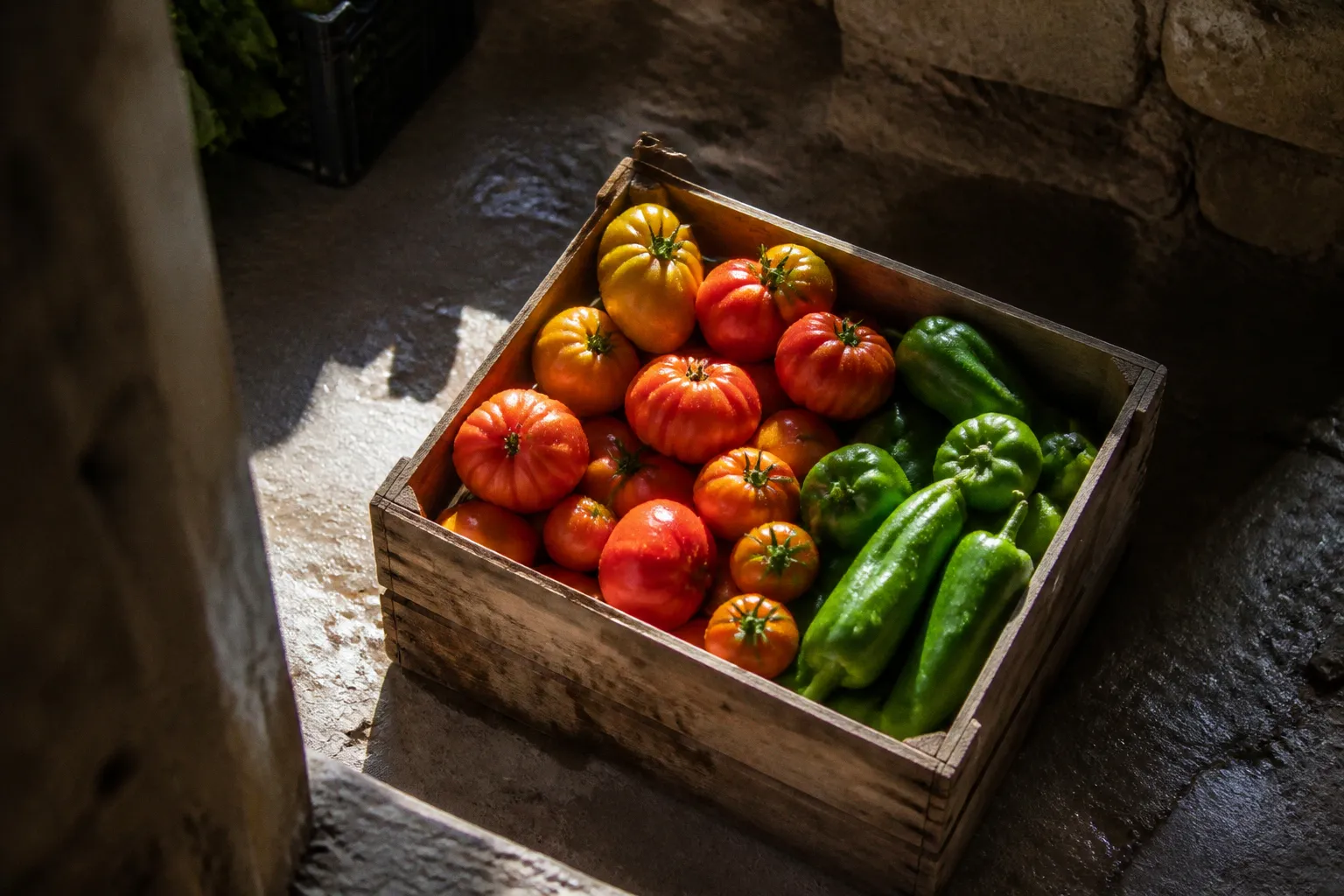
Supply-chain assessments commonly place Lebanese post-harvest losses in the 30% to 40% range, compared with a lower regional baseline often estimated at 20% to 30% across MENA markets. The exact percentage varies by crop, season, handling method, and route to market, but the direction is consistent: too much value is lost after harvest and before sale.
The causes are equally familiar. Refrigeration is uneven, electricity is unreliable, individual farms handle volumes too small to justify dedicated cold rooms, and produce is often left in the field or packed area while the next logistical step is arranged. Lebanese vegetable storage is therefore not one technical problem with one technical answer. It is a sequence of decisions: reduce heat exposure, move produce into a controlled environment, share the cost of infrastructure, preserve what cannot be sold fresh, and keep basic handling discipline from collapsing under harvest pressure.
The five methods below are best understood as layers. Some require capital. Others require little more than shade, clean containers, and a rule that somebody follows every day.
The real cost of post-harvest loss in Lebanon
A baseline calculation makes the economics visible. Suppose a Bekaa cooperative handles 1,000 tonnes of tomatoes, cucumbers, and leafy greens during a harvest period, at an illustrative average farm-gate value of $0.80 per kilogram. The gross potential revenue would be approximately $800,000.
If the cooperative loses 35% of that volume, using the midpoint of the commonly cited 30%–40% loss range as a planning assumption, roughly 350 tonnes would fail to become marketable product. At the same illustrative price, the notional value of the lost volume would be $280,000.
That is not a forecast or a universal Lebanese loss calculation. It is a sensitivity model. A cooperative should replace the assumed price, volume, and loss rate with its own records. The value of the exercise is that it shows where to look: a loss rate that sounds like an agricultural inconvenience becomes a major working-capital problem when applied to a full harvest movement.
The loss is not created by one dramatic failure. It accumulates through several smaller ones:
- Produce is harvested warm and left exposed to sun or hot air.
- Crates are overfilled, causing compression damage at the bottom.
- Leafy greens are packed while wet, creating conditions for decay.
- Tomatoes and ethylene-sensitive vegetables are stored together without a plan.
- The cold room is opened repeatedly, or loaded before it has recovered from a previous delivery.
- Inventory has no dispatch order, so the newest crop is sold while older crates remain in the back.
Temperature is the first variable to control, but not the only one. A cold room cannot reverse bruising, repair torn leaves, or make wet vegetables safe to store. It can slow deterioration after good harvesting and packing practices have already done their part.
Five practical ways to reduce spoilage
1. Remove field heat quickly. Keep harvested vegetables shaded, ventilated, and protected from direct sun while they wait for sorting or transport. The goal is not to create a sophisticated cooling system on every farm; it is to prevent the crop from gaining more heat before it reaches one.
2. Separate produce by temperature and ethylene sensitivity. Tomatoes, cucumbers, leafy greens, stone fruit, and other crops do not share the same storage requirements. Mixed storage may be unavoidable, but it should be managed rather than treated as neutral.
3. Use cooperative cold storage instead of isolated farm assets. Shared infrastructure can keep a room occupied across the harvest calendar, spreading maintenance and energy costs over more product and more users.
4. Turn the unsellable-fresh fraction into mouneh. Fermentation, drying, and oil preservation can redirect sound but cosmetically imperfect vegetables away from the waste stream.
5. Standardize the small routines. FIFO rotation, dry handling, clean crates, shade, inspection logs, and clear dispatch times often prevent more loss than an expensive piece of equipment used without a process.
Cold storage preserves good handling; it does not compensate for bad handling carried into the room.
Solar-powered cold chain: working around electricity constraints
For Lebanese cooperatives, refrigeration is inseparable from the electricity question. A cold room that cannot maintain a stable operating schedule is not a reliable cold chain, even if the room itself is properly insulated. Grid supply, private generation, fuel availability, and equipment maintenance all affect whether the compressor can run when the crop needs it.
Solar power can reduce dependence on diesel generation, particularly when paired with batteries and a hybrid inverter. But the correct design is site-specific. A system sized for one crop mix, room volume, loading pattern, and ambient profile may be poorly matched to another. Solar should therefore be treated as an engineering and operating project, not as a universal claim that one technology is always the cheapest.
A planning reference for a mid-sized cooperative might look like this:
| Component | Illustrative specification | Illustrative capital range |
|---|---|---|
| PV array | 15–20 kWp mono-Si, subject to site assessment | $18,000–$24,000 |
| Battery bank | 30–60 kWh lithium iron phosphate | $15,000–$27,000 |
| Cold room | 20 m³ walk-in room, designed for the target crop mix | $8,000–$12,000 |
| Hybrid inverter and controls | Around 10 kW continuous, subject to load calculation | $4,000–$6,000 |
| Illustrative installed total | — | $45,000–$69,000 |
These figures are planning assumptions, not a quotation or a guaranteed project budget. Installation conditions, insulation quality, civil works, import costs, battery sizing, and the condition of existing equipment can move the final number substantially.
The same caution applies to payback. A cooperative processing 8–12 tonnes of mixed vegetables per week might use that throughput as one input in a financial model, but throughput alone cannot establish a payback period. The result also depends on:
- how much diesel or grid electricity is actually displaced;
- how often the room is full rather than partially loaded;
- the value assigned to product that would otherwise be lost;
- maintenance, battery replacement, and financing costs;
- seasonal changes in both harvest volume and electricity demand;
- the fee charged to farmers using the facility.
A project may prove attractive under one set of assumptions and weak under another. The responsible approach is to model several cases rather than publish a single precise recovery period. A cooperative should calculate a conservative case with lower utilization and modest spoilage reduction, a central case based on measured demand, and an upside case that assumes stronger membership and fuller rooms.
Design the system around the crop, not the brochure
A refrigeration system for leafy greens is not automatically the right system for tomatoes or cucumbers. The room must be sized around the actual commodity mix, packaging, loading rate, and desired holding period. Heat entering through doors, warm product arriving from the field, and the time required to pull that heat down can matter as much as the nameplate capacity of the compressor.
Before purchasing equipment, a cooperative should record:
- the volume arriving on the busiest harvest days;
- the approximate temperature of product at intake;
- the number and duration of door openings;
- the target temperature and humidity for each major crop;
- the hours when grid power or generator power is available;
- the number of days produce is expected to remain in storage;
- the proportion of the room likely to be occupied in each season.
The first step is an audit, not an order. A basic log of compressor duty, room temperature, ambient conditions, loading, and generator use can reveal whether the problem is insufficient cooling capacity, poor insulation, careless door management, or simply a mismatch between the room and the harvest schedule.
A staged installation can also reduce operational risk. The cooperative may begin with monitoring and insulation improvements, then integrate solar generation, then add batteries or upgrade refrigeration once the measured load is understood. This is less dramatic than installing the largest possible system, but it produces a more defensible capital decision.
The role of agricultural aggregators in centralized storage
Centralized post-harvest facilities address the scale problem that prevents many smallholders from investing alone. A farmer producing a limited seasonal volume cannot easily keep a cold room occupied, maintain a refrigeration system, pay for backup power, and manage dispatch. A cooperative or aggregator can combine those volumes and make the same asset useful across more of the year.
The Agricultural Aggregator at the Baalbek Community Farm, established by the Lebanese Organization for Studies and Training (LOST), provides a reference model for this kind of service. The relevant value is not a claim that every aggregator offers the same package. It is the logic of bringing several post-harvest functions into one operating point:
- sorting and grading by size and visible defect;
- cold storage for crops that require temperature control;
- dry storage for products with different moisture requirements;
- coordinated collection and dispatch;
- records linking a lot to its farmer, harvest date, grade, and destination.
The draft claim that aggregation automatically creates palletized loads meeting export standards goes too far unless the facility’s actual procedures and certifications establish it. An aggregator can improve consistency and make larger, better-organized shipments possible; it does not make a load export-compliant by description alone. Export preparation still depends on packaging, traceability, residue controls, buyer specifications, documentation, and the relevant market’s rules.
The economic logic remains strong. A shared cold room used by 40 farmers can spread the asset across a much larger volume than a room owned by one farmer. The saving is not simply the purchase price divided by the number of members. Utilization, collection schedules, maintenance, staffing, losses during loading, and membership retention all determine whether the shared model works.
A useful cooperative agreement should state:
- who owns the room and equipment;
- who pays for electricity, fuel, repairs, and insurance;
- how storage space is allocated during peak harvest;
- whether fees are charged by crate, kilogram, pallet, day, or membership;
- who bears the loss when a farmer delivers damaged or contaminated produce;
- what happens when a member fails to collect product on time;
- how temperature records and inventory records are kept;
- whether the facility handles only storage or also sorting, packing, and sales coordination.
Aggregation does not remove risk. It makes risk visible, assignable, and potentially cheaper to manage.
The same node can support traceability. Documentation for GlobalG.A.P. or other buyer requirements is difficult to build when every farmer records information differently, or not at all. A central facility can create a consistent intake record and connect it to storage and dispatch. That does not replace certification, but it gives a cooperative the administrative foundation required for a serious certification process and for buyers who need more than a verbal assurance about origin.
Traditional mouneh: preservation without a cold room
Mouneh is not a nostalgic alternative to modern logistics. It is a practical preservation system for the portion of the harvest that cannot be sold fresh at the right time. Its value is especially clear when a cooperative has a temporary glut, cosmetic rejects, or produce that is sound but approaching the end of its fresh-market window.
The key distinction is between cosmetic damage and microbiological spoilage. A tomato with an unusual shape may be suitable for processing. A vegetable with active rot, mold, an off odor, or uncertain contamination is not rescued by adding salt or oil. Sorting must happen before preservation.
1. Lactic fermentation
Cucumbers, turnips, and cabbage are commonly preserved in brine. Salt concentration, temperature, cleanliness, oxygen exposure, and fermentation time all influence the result. A brine in the 3% to 5% range by weight can serve as a planning reference for some vegetable preparations, but the correct process should be validated for the specific recipe and container.
Lactic-acid bacteria gradually acidify the product. The preservation effect comes from the controlled fermentation and the resulting acidity, not from salt alone. A cooperative processing at scale needs clean food-contact surfaces, consistent weights, protected vessels, and a way to verify acidity rather than relying only on appearance or taste. Finished products should be kept under conditions appropriate to the recipe and packaging.
2. Sun-drying
Tomatoes, okra, and eggplant can be dried on raised, clean screens where air can circulate and animals, dust, and ground moisture are kept away. Drying reduces available water and slows microbial activity. The exact endpoint depends on the product, slice thickness, weather, and packaging. Water activity below 0.6 is often used as a technical reference for suppressing microbial growth, but a cooperative should measure or validate the finished product rather than assume that a particular number of drying hours achieves it.
Drying also changes the product’s market. It may extend the selling window, but it requires packaging that prevents moisture reabsorption. A product dried correctly and then stored in a humid, poorly sealed container can lose much of the benefit.
3. Oil preservation
Makdous and similar preparations combine several controls: preparation, salting or fermentation, acidity, and the oil layer. Oil limits oxygen exposure, but oil by itself is not a guarantee of safety. The preparation must be controlled, and the product must be packed and stored according to a validated food-safety process.
For a cooperative, mouneh production is most useful when it is treated as a separate line rather than as an improvised destination for whatever cannot be sold. The line needs clean water, washable work surfaces, suitable vessels, pest control, batch records, and a decision about packaging and market. It can use the same aggregation point as cold storage while operating on a different schedule.
Mouneh methods at a glance
| Method | Suitable produce | Main control | Practical benefit |
|---|---|---|---|
| Lactic fermentation | Cucumber, turnip, cabbage | Controlled brine, acidity, clean vessels | Extends the selling window from days or weeks to a much longer preserved-product cycle |
| Sun-drying | Tomato, okra, eggplant | Adequate drying, hygienic screens, moisture-proof packaging | Converts seasonal surplus into a lightweight, shelf-stable product |
| Oil preservation | Makdous and similar preparations | Correct preparation, acidity, oil coverage, hygienic packing | Creates a higher-value preserved product from selected fresh produce |
The financial case should be built from actual yields. The proportion of a harvest that can be redirected into mouneh is not a fixed national percentage. It depends on crop, grade, labor, recipe, packaging, and demand. A cooperative should measure the weight entering the line, the weight of finished product, labor hours, packaging costs, and the percentage rejected during sorting.
AUB-recommended best practices for small-scale farmers
The most affordable loss reduction often comes before refrigeration. Handling practices associated with food-safety guidance, including the kind of baseline protocols promoted in agricultural training, are especially important for farmers who cannot rely on continuous grid power.
Rotate inventory by age
First in, first out is simple, but it only works when crates are dated and the storage layout makes the oldest product easy to reach. The rule should be visible at intake, not remembered later. Harvest date, farmer, crop, grade, and intended destination can be written on a durable label or entered into a basic log.
FIFO should not be described as producing a guaranteed percentage reduction in storage time. Its effect depends on whether the previous system was disorganized, how often product is dispatched, and whether buyers accept older lots. The benefit is operational: it prevents avoidable ageing and makes a problem easier to identify before it spreads.
Keep leafy greens dry
Surface moisture is a major contributor to decay in leafy vegetables. Greens should be handled gently, cooled when possible, and protected from condensation. Washing immediately before storage may leave free water on the leaves and in the container. When the market allows, washing is often better deferred until distribution or sale, provided the produce remains clean and the handling process is hygienic.
This is not a reason to ignore sanitation. Dirty crates, contaminated water, damaged leaves, and unclean work surfaces create a different risk. “Keep it dry” means controlling unnecessary surface moisture, not reducing hygiene.
Separate ethylene-sensitive crops
Ethylene management is often discussed as if every mixed load requires a laboratory. In practice, the first improvement is to avoid storing obvious high-ethylene producers directly beside sensitive crops when the room layout allows it. Tomatoes and some fruit should not be treated as interchangeable with leafy greens. Ventilation, packaging, temperature, and storage duration all influence the outcome.
A small farm may not have separate chambers. It can still use separate zones, staggered intake, ventilated crates, or short holding periods. The purpose is to reduce avoidable exposure, not to promise a uniform shelf-life extension for every crop.
Use shade as the first form of cooling
Shade is not refrigeration, and its effect depends on roof material, airflow, humidity, orientation, and the temperature of the surrounding air. Claims that a shaded structure always runs a specific number of degrees below an unshaded one, or that it adds a fixed number of days to cucumber or zucchini shelf life, should be treated as local measurements to be tested rather than general rules.
The practical value is still immediate. A shaded, ventilated loading area prevents direct solar gain while crates wait for transport. Raised pallets or slatted surfaces keep produce away from hot ground. Light-colored roofing, cross-ventilation, and shorter waiting times can all reduce the heat entering the cold chain.
Inspect crates and loading patterns
The container is part of storage. Cracked crates can catch leaves and fruit, sharp edges create wounds, and overfilled containers increase compression. Produce should not be packed so tightly that air cannot move, especially when the room relies on forced-air cooling. At intake, workers should remove obviously damaged items rather than allowing one leaking or moldy unit to contaminate an entire crate.
A practical intake record can include:
- harvest date and approximate harvest time;
- crop and variety where relevant;
- field or farmer identification;
- visible damage or disease;
- temperature at receipt when a thermometer is available;
- crate count and approximate weight;
- destination and dispatch priority.
The record does not need to be elaborate to be useful. It creates a basis for comparing loss by crop, farmer, packaging type, and storage duration.
Making the cooperative numbers honest
A survey of small-scale Bekaa Valley farmers found strong concern about post-harvest losses, and reported willingness among many respondents to pay $21 to $30 per month for access to collective refrigeration. That is useful evidence of demand, but willingness to pay is not the same as collected revenue. A financial model must account for vacancies, late payments, seasonal membership, operating costs, and the difference between a subscription and a charge for actual use.
The payback calculation needs particular care. If a facility costs $45,000 to $69,000 and all 40 farmers pay $21 to $30 per month, subscription revenue would range from:
- $840 to $1,200 per month;
- $10,080 to $14,400 per year;
- approximately 3.1 to 6.8 years of gross subscription revenue to match the capital cost, before operating expenses and assuming every member pays continuously.
That is a simple arithmetic comparison, not a project payback forecast. Once maintenance, energy, staffing, financing, insurance, and downtime are included, the recovery period would be longer. If farmers pay according to stored volume rather than a flat subscription, the result may be different again. The point is not that cooperative cold storage fails the test. The point is that the fee structure has to be designed around the real cost of operating the room.
A cooperative should separate three financial questions:
1. Can the facility be built? This is the capital question.
2. Can it operate through the season? This is the energy, maintenance, staffing, and utilization question.
3. Can the members pay for it consistently? This is the revenue and governance question.
Spoilage reduction is an additional benefit, but it should not be counted as guaranteed revenue until the cooperative has measured its baseline and confirmed that the recovered product can actually be sold. A lower loss rate is valuable only when the product reaches a buyer at a price that covers the costs of getting it there.
A capital-allocation sequence for Lebanese fresh produce storage
The five methods are not competing ideologies. They are different points on the same post-harvest chain.
1. Start with handling discipline. Shade, clean crates, gentle loading, dry storage for appropriate crops, intake records, and FIFO require limited capital and can be introduced during the next harvest cycle.
2. Add a preservation route. Fermentation, drying, or oil preservation can absorb selected produce that is sound but unlikely to sell fresh in time. The process must be hygienic, validated, and connected to a market.
3. Measure the cold-room requirement. Before purchasing equipment, record volumes, temperatures, holding times, electricity availability, and the crop mix. Use the data to size the room and the energy system.
4. Build shared infrastructure where utilization supports it. A cooperative cold room makes more sense when members coordinate harvest, delivery, payment, and dispatch. Ownership without operating rules simply relocates the problem.
5. Use the aggregator as a traceability and sales node. Centralized records can support grading, buyer communication, and future certification work, but they do not replace the standards and audits required by export markets.
The strongest case for Lebanese vegetable storage is therefore not a single promised percentage reduction or a universal payback period. It is the cumulative effect of removing avoidable losses at several points: less heat before intake, fewer damaged crates, better separation, more reliable refrigeration, a controlled route for preserved products, and records that show where the system is failing.
A cooperative that begins with these basics can make a later investment in solar-powered cold storage more credible. It will know how much product arrives, how long it waits, which crops fail first, how much space members actually need, and what they can realistically pay. That is the difference between buying equipment and building a cold chain.
In Lebanon, spoilage prevention is ultimately a coordination problem expressed through agricultural infrastructure. The answer is not to wait for perfect electricity, perfect roads, or perfect market conditions. It is to make each stage less fragile, share the expensive stages where possible, and preserve the value that farmers have already spent a season producing.