Bekaa Valley potato storage: a low-cost ventilation plan
The Bekaa Valley produces approximately 65–70% of Lebanon’s potato volume, distributed across two annual harvest cycles.
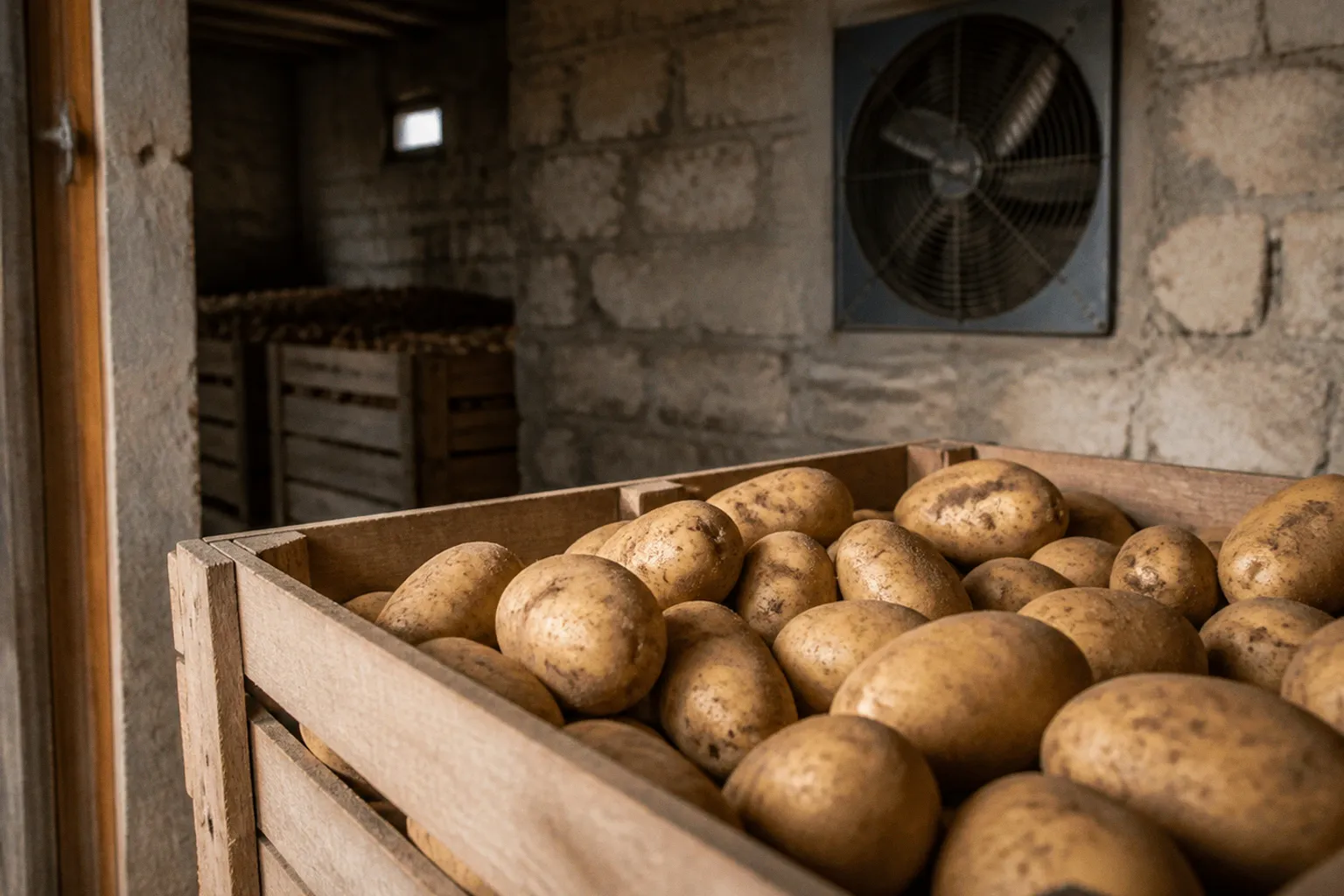
That concentration creates a storage problem with a narrow margin for error: a ventilation failure after harvest can damage a substantial share of the national crop, while a refrigeration-heavy solution can impose capital and operating costs that cooperatives cannot easily absorb.
A practical bekaa valley potato storage ventilation setup does not begin with a larger refrigeration unit. It begins with airflow management, sealing, insulation, and a control sequence matched to the biological condition of the tubers. The objective is not to force the crop to one temperature immediately. The objective is to move it through three distinct states: wound healing, controlled cooling, and long-term storage.
For Bekaa cooperatives, the most economical design is usually a retrofitted structure with above-floor ducts, positive-pressure fans, night-time ambient-air flushing, basic sensor arrays, and supplementary cooling only when outdoor conditions cannot deliver the required storage temperature. This is a systems problem rather than an equipment-shopping exercise.
The lowest-cost storage system is not the one with the cheapest fan. It is the one that removes heat and moisture at the correct stage without paying to refrigerate air that the building cannot retain.
Managing the dual harvest cycle
The storage calendar is determined by the Bekaa Valley’s two potato seasons:
- Spring potatoes are generally planted during February–March and harvested in June–July.
- Autumn potatoes are planted during July–August and harvested in October–November.
These harvests do not present identical storage conditions. Spring potatoes arrive during a period when daytime temperatures can remain too high for ambient ventilation alone to provide reliable cooling. Autumn potatoes arrive under more favorable outdoor conditions, but the storage structure still needs to manage field heat, respiration, humidity, and condensation.
The first operational error is treating harvest as a single temperature target. Freshly lifted potatoes have wounds and abrasions caused by harvesting, loading, grading, and transport. During the initial wound-healing phase, known as suberization, the crop requires approximately 10–12°C, high oxygen availability, and elevated relative humidity. The purpose of this phase is to allow damaged skin to repair before long-term storage conditions are imposed.
Cooling too aggressively during suberization can slow wound healing. Holding the crop in warm, stagnant, oxygen-poor air creates a different failure mode: soft rot pathogens gain favorable conditions around damaged tubers, particularly where wet pockets form inside the pile.
A cooperative should therefore define a storage protocol by phase rather than operating the fan continuously at one setting.
Phase 1: receiving and inspection
Before potatoes enter the store, the structure should be checked for standing water, damaged roof panels, blocked drainage routes, loose wall joints, and surfaces that can shed dust or debris onto the crop. This is basic infrastructure work, but it has a direct effect on the ventilation system. Airflow cannot compensate for water entering through a roof or for condensation forming on an uninsulated wall.
The receiving process should also separate visibly damaged, cut, wet, or diseased potatoes from the main storage mass. A low-cost ventilation system has limited ability to correct a high biological load introduced at the start. Its job is to stabilize a sound crop, not to reverse deterioration that has already begun.
Record a baseline for each lot:
- Harvest date and field of origin.
- Approximate pile location within the structure.
- Initial tuber temperature.
- Visible wetness or damage.
- Storage depth and estimated volume.
- Outside air temperature and relative humidity at receiving.
The purpose of these records is not administrative completeness. It is to distinguish a crop-quality problem from a ventilation problem later in the cycle.
Phase 2: suberization
During wound healing, maintain the storage environment around 10–12°C with strong air exchange through the pile and high relative humidity. The air must reach the tubers, not merely circulate above them. A fan pointed across the room can create a perception of movement while leaving the center of a bulk pile under-ventilated.
Positive duct airflow is more effective because the fan pushes air into a distribution network positioned below or alongside the stored potatoes. Air then moves through the pile, carrying heat and excess moisture away from the tubers. The exact duct geometry depends on the building and pile arrangement, but the engineering principle remains constant: pressure must be created where the crop is located.
The suberization period should be monitored for temperature gradients. A single sensor near the door is not a storage control system. At minimum, measurements should represent the air entering the pile, the center of the bulk, the upper layer, and the return or exhaust zone. If the center is warmer than the inlet by a persistent margin, the system is not delivering sufficient air through the pile, regardless of how loudly the fan operates.
Phase 3: controlled cooling and long-term storage
After wound healing, the crop can be brought toward long-term storage conditions. Potatoes intended for extended storage generally require air temperatures around 4–5°C and relative humidity of approximately 90–95%. These conditions limit water loss, reduce respiration-related weight reduction, and slow sprouting.
The transition should be gradual enough to avoid condensation and excessive stress on the tubers. A sudden temperature difference between cold air and warm, moist produce can create surface moisture, especially when the building envelope is poorly sealed. Condensation is not a minor housekeeping issue. It increases the risk of rot and indicates that the air, crop, or wall surface is crossing a dew-point threshold that the structure cannot manage.
For this reason, temperature and relative humidity should be read together. A controller that responds only to temperature may introduce air that is cooler but too wet, or too dry, depending on outdoor conditions.
Designing above-floor duct systems for retrofitted facilities
Above-floor duct systems are suitable for multi-purpose buildings because they can be installed without constructing a permanent plenum beneath the floor. They also make the airflow path visible and adjustable, which is useful when a cooperative is adapting an existing storage room rather than building a dedicated potato warehouse.
The design has four functional components:
1. Air intake and filtration
2. Fan and positive-pressure chamber
3. Distribution ducts
4. Exhaust or return-air path
The intake should draw from a protected exterior location, away from dust-producing activities, vehicle exhaust, waste areas, and standing water. A simple screen or filter prevents leaves and larger particles from entering the fan and ducts. It will not solve every air-quality problem, but it reduces maintenance and protects the distribution system.
The fan should feed a pressure side rather than simply stir the room. Ducts then distribute air along the base or sides of the potato pile. The system must be arranged so that air cannot bypass the crop through large open gaps. If the easiest path is around the pile, the airflow will take it. This is a physical property of the system, not a matter of operator discipline.
Duct materials and layout
Retrofitted cooperatives may use commercially manufactured ducting or locally fabricated channels, provided that the materials are structurally stable, cleanable, and resistant to moisture. PVC, sheet-metal channels, or properly supported agricultural duct materials may be considered according to local availability. Bamboo or other low-cost components can be used only where they can be kept clean, dry, and mechanically secure; a flexible material that collapses under pressure or creates uncontrolled openings will compromise the system.
Duct openings should be distributed along the length of the pile rather than concentrated near the fan. The purpose is to avoid a high-velocity zone at the inlet and a stagnant zone at the far end. A pressure imbalance produces uneven cooling, so the pile may contain both over-dried potatoes and warm, humid pockets at the same time.
The system should also permit cleaning and inspection. Potato storage creates dust, soil particles, and organic residue. Ducts that cannot be opened or flushed will eventually become part of the contamination problem. Low capital expenditure is justified only when it does not create unmanageable maintenance expenditure.
Pile geometry
Bulk storage piles are commonly limited to approximately 3–5 meters in height for ventilation applications. The upper limit should not be treated as a universal operating target. Pile height affects static pressure, airflow resistance, loading damage, and the ability to remove heat from the center of the mass.
A taller pile increases the distance air must travel through the potatoes. It also increases the probability that air will form channels through the least resistant areas, leaving other sections under-ventilated. If the fan selection is based only on room volume and not on pile resistance, the system may appear correctly sized while failing at the crop interface.
For a low-cost facility, a slightly lower pile with more uniform airflow is often a better capital allocation than a taller pile supported by a larger fan. The correct comparison is not cubic meters stored. It is saleable kilograms preserved per unit of installed and operating cost.
Optimizing airflow and night-time flushing
The Bekaa Valley’s outdoor air can be useful for potato post-harvest cooling, but only when it is applied according to the temperature and humidity conditions available. Ambient ventilation alone cannot be assumed to maintain 4°C during peak July daytime temperatures. Spring harvest storage therefore requires a control strategy that uses cooler night air and accepts that supplementary cooling may still be necessary.
Night-time flushing is a simple operating method:
1. Measure indoor and outdoor temperature and relative humidity.
2. Open the intake and exhaust path only when outside air can reduce the crop’s heat load without creating a condensation risk.
3. Run the fan long enough to replace the warm internal air and move cooler air through the pile.
4. Close or reduce the intake during the warmest daytime period.
5. Repeat measurements at the center and upper layers of the pile rather than relying on the room entrance.
The word “flushing” should not be interpreted as unrestricted air exchange. The system should not draw humid outside air into a cooler storage room merely because the outdoor temperature appears favorable. Relative humidity and dew point determine whether the operation will dry the crop, stabilize it, or add moisture to surfaces.
A simple control hierarchy is more robust than a complicated automation package:
- First priority: protect the tubers from condensation and overheating.
- Second priority: use ambient night air when it improves the internal temperature profile.
- Third priority: activate supplementary cooling when outside conditions cannot achieve the required range.
- Fourth priority: reduce fan operation when additional airflow no longer improves the crop condition.
This hierarchy prevents a common technology failure: operating equipment continuously because it is installed, rather than because the measured conditions require it.
Sensor placement and baseline metrics
The minimum useful sensor array should show the difference between the air entering the pile and the air leaving it. Additional probes should be placed in the pile’s center and upper section, where heat and moisture can accumulate. A room-mounted sensor near the door is insufficient because it measures the easiest location, not the highest-risk location.
Track the following values over each harvest cycle:
- Inlet-air temperature.
- Center-pile temperature.
- Upper-pile temperature.
- Exhaust or return-air temperature.
- Relative humidity at the inlet and inside the pile.
- Outdoor temperature and relative humidity.
- Fan operating hours.
- Refrigeration operating hours, if supplementary cooling is installed.
- Visible condensation, wet spots, sprouting, or softening.
These metrics create a basic performance model. If the center-pile temperature remains elevated while the inlet is within the target range, the problem may be insufficient airflow, excessive pile resistance, blocked duct openings, or a bypass route. If all probe locations remain warm, the issue may be inadequate cooling capacity or excessive heat entering through the building envelope. Without distributed measurements, operators tend to increase fan speed indiscriminately, which can raise energy use without correcting the underlying constraint.
Airflow is only an input. The performance metric is the temperature and humidity profile inside the potato pile.
Maintaining humidity without creating rot conditions
Long-term storage requires relative humidity around 90–95%. This range is high because potatoes lose mass through water loss, and excessive drying reduces quality and marketable weight. However, high humidity must be paired with air movement and a sealed, insulated structure. Humidity without circulation produces stagnant zones; circulation without humidity control produces unnecessary dehydration.
A well-sealed and insulated storage facility can help maintain approximately 90–100% relative humidity around the stored crop while reducing the water loss associated with uncontrolled air exchange. It also reduces condensation caused by daily outdoor temperature shifts. The building envelope is therefore part of the ventilation system. Fans cannot compensate indefinitely for heat entering through a thin roof, open joints, or unsealed doors.
The practical approach is to identify the dominant moisture pathway:
- If moisture is entering through wet floors or roof leaks, repair the structure before modifying the fan controls.
- If the crop is losing weight rapidly, inspect for excessive dry-air exchange, over-ventilation, or low relative humidity at the inlet.
- If condensation appears on walls or ceilings, compare surface temperature with room air and review night-time flushing conditions.
- If wet pockets occur inside the pile, inspect duct distribution and pile loading rather than increasing general room circulation.
Humidity control should not be based on a single room average. A room can show acceptable relative humidity while the pile center contains a wet, warm pocket. The potato mass has its own microclimate, created by respiration, restricted airflow, and local differences in packing density.
Air exchange versus refrigeration
Refrigeration removes heat, but it does not automatically correct poor air distribution. A cold room with weak circulation can still contain warm areas in the pile. Conversely, a well-designed ventilation system can reduce the refrigeration load by using favorable outdoor conditions during the night and by preventing heat accumulation.
The investment sequence should normally be:
1. Seal major air leaks and repair water ingress.
2. Add basic insulation to the roof and walls where heat gain is highest.
3. Install positive-pressure ducting.
4. Add sensor coverage at the inlet, center, upper pile, and exhaust.
5. Establish a night-flushing control routine.
6. Use supplementary refrigeration for the remaining heat load.
This sequence has a direct capital expenditure logic. Insulation and duct distribution reduce the thermal and airflow burden before the cooperative purchases more cooling capacity. Installing a larger refrigeration unit in a leaky structure is an inefficient allocation of capital: the equipment must continuously remove heat that the building immediately permits to return.
Structural insulation and operational limits
Low-cost ventilation is not a complete substitute for professional insulation in an uninsulated brick structure. Masonry walls can moderate temperature changes, but they do not provide a controlled thermal envelope by themselves. Roof heat gain, open doors, unsealed joints, and daily temperature swings can still destabilize the internal environment.
The building should be assessed in terms of three losses:
- Heat gain through the envelope, especially the roof and sun-exposed walls.
- Uncontrolled air exchange through doors, gaps, and vents.
- Airflow bypass around the pile, which reduces the useful effect of the fan.
The first two increase the cooling requirement. The third makes the installed cooling and ventilation capacity less effective. They are separate problems and should not be addressed with one oversized fan.
Doors deserve particular attention. A storage door that remains open during loading can introduce warm, humid air and disturb the temperature profile. The solution need not be expensive: define loading windows, close the door between movements, and place the sensor that controls ventilation away from the immediate door zone. A control system that reacts to local drafts will produce unstable fan cycles.
The pile itself should be loaded consistently. Variations in density change the resistance to airflow. A compacted section can behave as a barrier while a loose section becomes a bypass channel. Mechanical damage also increases where potatoes are dropped from excessive height or compressed against hard surfaces. Ventilation cannot repair bruising; it can only influence the environmental conditions under which damaged tubers deteriorate.
A practical cooperative implementation plan
A cooperative can stage the work across one harvest rather than treating storage improvement as a single construction project.
Stage one: map the existing facility
Measure the room dimensions, door positions, roof condition, wall exposure, floor drainage, and available electrical supply. Mark likely pile locations and identify where air currently enters and exits. Record the temperature and relative humidity at several points during a normal day, before installing equipment.
The output should be a baseline map, not a shopping list. It should show where the room is warmest, where condensation occurs, and whether the existing structure has a natural night-cooling advantage.
Stage two: correct structural defects
Repair roof leaks, close large uncontrolled gaps, improve door seals, and address drainage. Add insulation where the roof receives the greatest solar load or where internal surfaces show repeated condensation. The intention is not to convert every cooperative facility into a refrigerated warehouse. It is to stop the most expensive losses before the ventilation system is commissioned.
Stage three: install positive-pressure distribution
Place the fan and intake so that air is pushed through ducts serving the pile. Use a layout that can be inspected and cleaned. Avoid a design in which the fan discharges into open room space and relies on general circulation to reach the potatoes.
Keep the pile within the practical 3–5 meter height range for bulk ventilation storage, adjusting downward when the duct system or fan cannot overcome the added resistance. The operating limit should be established by measured temperature uniformity, not by the maximum volume the room can physically contain.
Stage four: commission the sensor array
Install probes at the inlet, center, upper layer, and exhaust or return-air location. Compare readings during fan operation and during shutdown. This identifies whether the fan is changing the crop environment or merely moving air through the room.
Create a simple daily record during the first harvest cycle. The record should include sensor values, fan hours, outside conditions, and observations of wetness or sprouting. These data are sufficient to refine the operating schedule without requiring a complex building-management platform.
Stage five: operate by season
For the June–July spring harvest, use night-time ambient-air flushing where conditions permit and plan for supplementary cooling during hot daytime periods. Do not represent ambient ventilation as a full replacement for cooling at those temperatures.
For the October–November autumn harvest, take advantage of cooler outdoor conditions while still controlling humidity and condensation. The lower outdoor heat load may reduce refrigeration demand, but the same principles remain: air must pass through the pile, the structure must retain the desired conditions, and the center of the crop must be measured.
Cost-benefit logic for a low-cost design
The financial case should be built around avoided losses and operating hours, not around the number of components installed. A low-cost system creates value in four ways:
- It reduces the amount of refrigeration required during favorable night-time conditions.
- It lowers weight loss by maintaining high relative humidity.
- It limits localized rot by improving oxygen supply and removing heat from the pile.
- It allows a cooperative to use an existing multi-purpose structure instead of constructing a dedicated facility immediately.
The main cost categories are straightforward:
| Cost category | Function | Failure if omitted |
|---|---|---|
| Structural sealing and repairs | Limits uncontrolled heat and moisture exchange | Fans and cooling operate against a continuously unstable envelope |
| Insulation | Reduces heat gain and surface condensation | Daytime temperatures rise rapidly; condensation risk increases |
| Fan and positive-pressure chamber | Moves air through the crop | Room air circulates without adequately ventilating the pile |
| Above-floor ducts | Distributes air across the storage mass | Near-inlet cooling and stagnant far-end zones |
| Sensor array | Shows actual conditions inside the pile | Operators adjust equipment using misleading room averages |
| Supplementary refrigeration | Handles heat loads ambient air cannot remove | Spring harvest cannot reliably reach 4–5°C |
| Cleaning and access provisions | Preserves airflow performance over time | Dust and residue reduce effective distribution |
The missing numbers in this calculation are local hardware prices, fan efficiency, electricity tariffs, crop value, and the proportion of produce intended for short- versus long-term storage. These should be measured or quoted locally rather than filled with generic market assumptions. The ROI model is only credible when the cooperative uses its actual tariff, actual operating hours, and actual sale price by grade.
A useful comparison is not “ventilation versus refrigeration.” It is:
- uncontrolled storage;
- sealed and ducted ventilation;
- sealed, ducted ventilation with supplementary refrigeration.
The second option usually offers the lowest technical complexity. The third offers the greatest control but also the highest capital and operating burden. The correct choice depends on the duration of storage and the value of preserving the crop beyond the immediate harvest window.
The operating verdict
A Bekaa Valley potato storage facility does not need to begin as a high-spec cold store. It does need to behave like a controlled thermal system.
The minimum credible design is a sealed and reasonably insulated structure, positive-pressure above-floor ducts, a fan capable of moving air through the pile, sensor coverage beyond the doorway, and a night-flushing schedule that uses outdoor conditions selectively. During suberization, the target is approximately 10–12°C with high oxygen availability and elevated humidity. During long-term storage, the target shifts toward 4–5°C and 90–95% relative humidity. The transition between those states must be managed rather than assumed.
The Bekaa’s dual harvest cycle makes seasonal control unavoidable. June–July storage cannot rely on daytime ambient air to maintain long-term temperatures. October–November storage may require less mechanical cooling, but it still depends on distribution, sealing, and humidity control. Pile height should remain within the practical 3–5 meter range unless measured airflow performance supports a different operating limit.
The numerical verdict is therefore clear: for a cooperative handling a region responsible for 65–70% of Lebanon’s potato volume, the first investment should be in airflow distribution and baseline measurement, not in refrigeration capacity alone. Ducts, insulation, and sensors reduce the amount of work demanded from the cooling system. Supplementary refrigeration then becomes a controlled final layer rather than an attempt to compensate for structural and ventilation defects.