Irrigation System Selection for Bekaa Valley Farms
The Bekaa Valley holds 42% of Lebanon's cultivated land and over 70% of its potato acreage. Sixty-five percent of that irrigation runs on groundwater. Groundwater levels in parts of the valley have dropped more than 15 meters in five years.
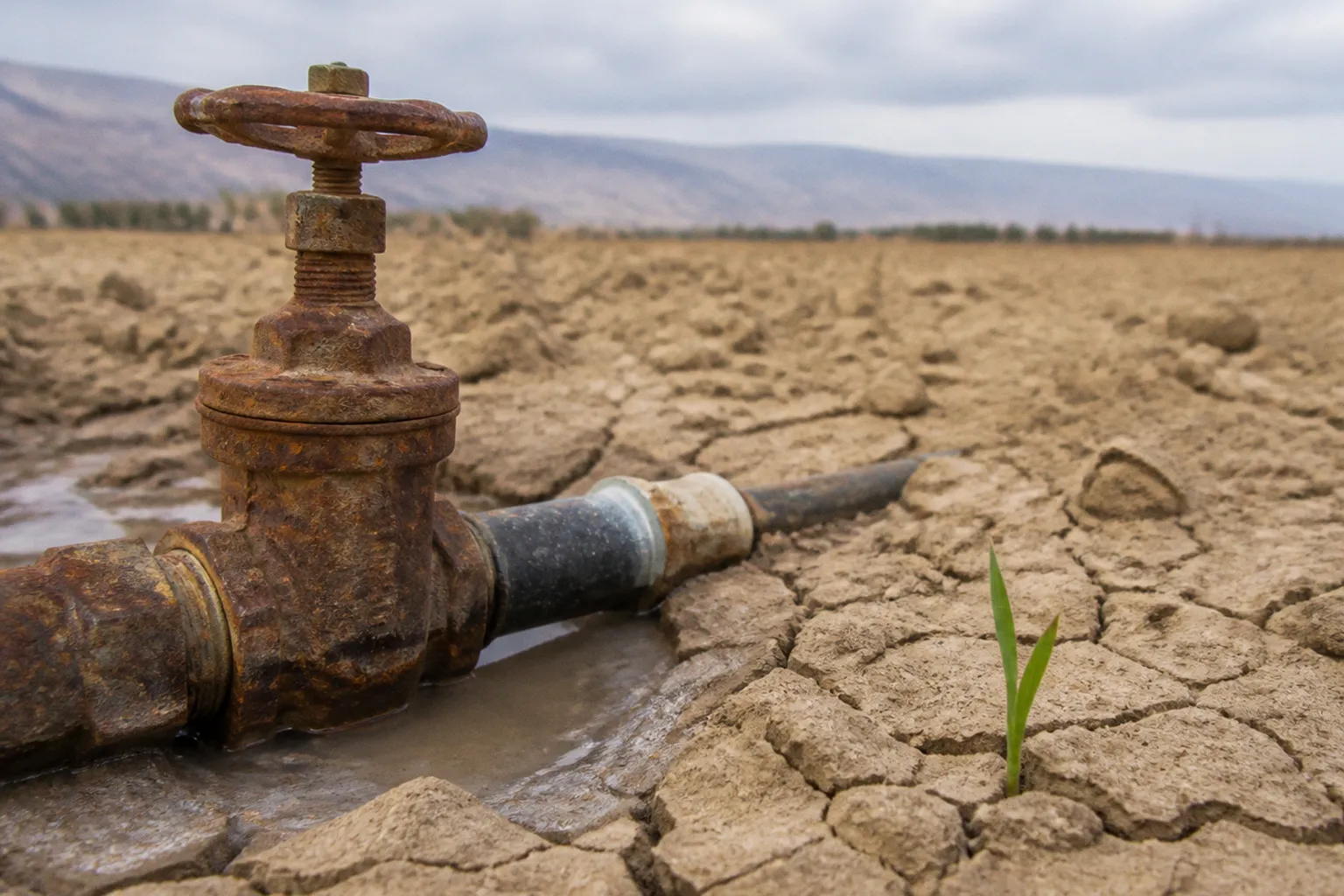
Fifteen meters down in five years. That's your aquifer falling.
Historical surveys have placed the number of private, unlicensed wells on the Bekaa Plain at over 18,000 — most diesel-powered — and while the current active count is uncertain, the extraction pressure they represent hasn't eased.
If you farm, source, or export out of the Bekaa, water is your single largest supply-chain risk. Not phytosanitary holds. Not transit windows. Water. The aquifer doesn't care about your packing house throughput. It's emptying. And every cubic meter you pull without precision is a cubic meter your neighbor's well won't have next season.
Fifteen meters of drawdown over five years. Your well is not a reservoir — it's a countdown timer.
The Groundwater Crisis: Quantifying the Extraction Problem
You can't fix what you haven't measured. Here's the math the Bekaa runs on:
- 42% of Lebanon's total cultivated area sits in the Bekaa Valley.
- >70% of national potato cultivation acreage is here.
- 65% of regional irrigation water comes from groundwater.
- >15 m drop in groundwater levels in some sub-regions over the last five years.
- Tens of thousands of private irrigation wells, the majority unlicensed and diesel-powered — a legacy of decades of unregulated expansion.
The aquifer is overdrafted. Recharge cannot keep pace with extraction under current methods. Climate-driven reductions in snowpack and rainfall have tightened the supply side, while delivery inefficiency has kept demand stubbornly high. The bottleneck is not yield — it's the volume of water moving through inefficient delivery systems: surface flood and ordinary impact sprinklers that lose 30–50% of pumped water to evaporation and wind drift before it hits the root zone.
When your cooperative's well output drops, your shipping calendar slips. When your shipping calendar slips, your cold chain breaks and your buyer in the GCC or EU docks you on arrival quality. This is a logistics problem wearing an agronomy costume.
If you operate a potato block in the Bekaa Plain, you are drawing from a depleting reserve — one that climate trends are compounding. The longer you stay on traditional sprinkler + flood methods, the faster the well fails, and the higher your pump hours (and diesel cost) climb. Diesel hours are a hidden margin killer — they don't show up on a P&L until the well is dying.
Transitioning from Sprinklers to Micro-Irrigation: The Efficiency Lever
The single largest operational lever you have is the irrigation hardware itself. Field data from the Bekaa and comparable semi-arid environments confirms it: switching from surface flood and ordinary sprinklers to micro-irrigation (drip systems and mini-sprinklers) can reduce irrigation water consumption by up to 40%, and often improves crop yields in the process.
That's not theory. Up to 40% less water pumped translates, proportionally, to meaningful reductions in pump hours, diesel consumption, and aquifer draw — with a yield uplift on top. The exact savings at any given operation will vary with well depth, pump efficiency, crop, and delivery hardware, but the direction is consistent: less water in, same or more crop out. The hardware cost is the primary friction.
If your cooperative is locked into flood or impact sprinklers, run the cost-of-transition case against the diesel savings alone. Depending on pump depth, energy source, and block size, many potato operations can recover a meaningful share of the conversion cost within one to two seasons through reduced energy consumption — before you count yield gains, quality premiums, or any future water-pricing regulation. The payback window is not universal; it depends on your specific cost structure, but the economics favor conversion in most Bekaa scenarios.
| Parameter | Flood / Impact Sprinkler | Micro-Irrigation (Drip / Mini-Sprinkler) |
|---|---|---|
| Water application efficiency | 50–65% | 85–95% |
| Typical water savings vs. baseline | 0% (baseline) | Up to 40% |
| Evaporative loss in Bekaa summer | High | Low (targeted delivery) |
| Pump hours per hectare per season | Highest | Substantially lower |
| Diesel/electricity cost trajectory | Rising as aquifer drops | Flat or falling |
| Suitability for potato canopy cooling | Limited | Strong (mini-sprinkler option) |
| Yield response | Baseline | Positive |
| CapEx payback window | — | Often 1–2 seasons (diesel savings, site-dependent) |
The transition isn't a sustainability lifestyle choice. It's a margin protection protocol.
Technical Specifications: Drip vs. Mini-Sprinkler Implementation
You don't pick one and call it done. You match hardware to crop, soil, and topography. Two configurations run reliably in the Bekaa:
Mini-sprinklers (for open-field potato and row crops)
- Operating pressure: 1.5 bar
- Flow rate: 150–300 L/h per emitter
- Function: delivers a low-elevation spray pattern that induces a water-cooling canopy effect — critical during Bekaa summer heat spikes when potato tuber bulking stalls above 30°C. You're paying for the canopy cooling, not just the water delivery.
Drip systems
- Soil cultivation (potato, onion, field vegetables): 4 L/h non-pressure-compensated (NPC) drippers
- Soilless cultivation (greenhouses, high-value protected agriculture): 2 L/h pressure-compensated (PC) drippers
- Function: sub-surface or surface drip line delivering water directly to the root zone with minimal evaporative loss and uniform distribution along long lateral runs.
If you grow potato in open fields, the recommended configuration in the Bekaa is mini-sprinkler at 1.5 bar, 150–300 L/h. Most open-field potato growers in the region still rely on surface flood or ordinary impact sprinklers — that's the baseline you're upgrading from. Mini-sprinkler is the upgrade target: the 30°C tuber-bulking threshold is real, and once you cross it, sizing and skin finish drop, and your export grade takes the hit. The canopy-cooling effect of a properly set mini-sprinkler system is what protects your tuber quality during heat events that would otherwise stall bulking for days. If you grow in protected or soilless systems, switch to 2 L/h PC drippers and you'll hold uniform output across elevation changes that would shred an NPC run.
Pressure regulation is non-negotiable. Running a drip system below spec pressure creates non-uniform emitter output — wet on one end of the block, dry on the other. Running a mini-sprinkler above 1.5 bar increases drift loss and defeats the canopy cooling. Put a pressure regulator on every block, and check it quarterly.
AgSAT: Precision Scheduling at 10-Meter Resolution
Hardware is half the equation. The other half is when you turn it on. The American University of Beirut (AUB) developed AgSAT — a smart irrigation mobile and web application built on Google Earth Engine, Sentinel-2 satellite imagery, and integrated weather data. It calculates daily crop water requirements (ETc) at a 10-meter resolution.
That means your cooperative can pull a field-level irrigation prescription down to a 10×10 meter cell, every day, calibrated to actual crop stage and current weather. Not last month's regional average. Not the neighbor's schedule. Your block, today.
If you're still scheduling on visual inspection or a fixed calendar, you're either over-watering — burning aquifer and diesel — or under-watering — losing tuber weight, skin finish, and export grade. Both outcomes hit your shipping spec, just from different directions.
The operational protocol with AgSAT:
1. Pull the daily crop water requirement (ETc) for your block via the web or mobile app.
2. Cross-check against your mini-sprinkler or drip delivery rate (L/h per emitter × emitter count per block).
3. Run the irrigation set for the calculated duration only — not longer, not shorter.
4. Log actual application volume against AgSAT's recommendation weekly.
5. Adjust the next cycle based on the deviation trend.
This is the loop that takes micro-irrigation from "we saved water" to "we hit target yield with minimum draw." If you adopt drip and mini-sprinkler without a scheduling tool, you're still guessing. You're just guessing with better pipes.
Micro-irrigation cuts water draw by up to 40%. AgSAT cuts it further by killing schedule waste. Run both, and you're farming inside a budget your aquifer can actually sustain.
Sustainable Potato Cultivation in the Bekaa Plain: The Integrated Playbook
Potato is the highest-volume fresh export out of the Bekaa, and it's the most water-sensitive of the major row crops. Tuber quality, size grading, and skin finish all depend on consistent moisture during the bulking stage — typically 50–80 days after planting, depending on variety. Miss the moisture window, lose the grade. Here's the integrated sequence for a potato cooperative operating on depleting groundwater under a changing climate:
1. Audit your current delivery system. Surface flood or impact sprinkler? Map the percentage of pumped water that actually reaches the root zone. If it's under 70%, you've already lost efficiency before the season starts.
2. Prioritize mini-sprinkler conversion first for open-field potato blocks. Spec: 1.5 bar, 150–300 L/h. This delivers the canopy-cooling effect that protects tuber bulking during Bekaa heat events above 30°C — a yield-protecting move, not just a water-saving move.
3. Reserve drip (4 L/h NPC) for soil-grown vegetables and rotation crops. Drip doesn't cool the canopy the way mini-sprinkler does, so for open-field potato, mini-sprinkler wins on agronomy. Drip wins for onion, legumes, and high-density vegetable rows.
4. Adopt AgSAT for scheduling. 10-meter daily resolution prescriptions. Calculate set-time, log actuals, iterate weekly.
5. Track diesel hours per hectare per season. This is your proxy metric for aquifer dependency. If hours are flat or falling season-over-season, your conversion is working. If hours are climbing, you're still over-pumping — usually a sign of worn pump impellers or uncalibrated emitters.
6. Phase out unlicensed well reliance in favor of licensed metered extraction where possible. Compliance is becoming a buyer requirement, not just a regulatory one. Export documentation chains in the EU increasingly ask for water source provenance, and "unlicensed well" is the wrong answer to that question.
7. Factor climate projections into capital planning. The Bekaa's water stress is not purely an extraction problem. Snowpack decline, shifting rainfall patterns, and rising temperatures are tightening the supply side of the equation year over year. Irrigation infrastructure decisions you make today need to hold up under a drier baseline five to ten years from now. That's another argument for micro-irrigation and precision scheduling: they're not just optimizing for current conditions — they're building resilience against the next decrement in available water.
Operational Checklist Before You Commit
- Current delivery system efficiency mapped (target: >85% with micro-irrigation).
- Mini-sprinkler block: 1.5 bar operating pressure verified per zone, regulator checked quarterly.
- Mini-sprinkler emitter spec: 150–300 L/h matched to crop, spacing, and heat-load profile.
- Drip block (soil): 4 L/h NPC drippers on vegetable and rotation crops.
- Drip block (soilless): 2 L/h PC drippers with pressure regulation across long lateral runs.
- AgSAT daily ETc prescription integrated into irrigation scheduling — not advisory, operational.
- Diesel hours per hectare per season tracked as the primary aquifer dependency metric.
- Water source provenance documented for buyer compliance (licensed vs. unlicensed well status recorded per block).
- Pump maintenance schedule enforced — worn impellers waste 15–20% of draw without showing up on the gauge.
The Bekaa is losing water on two fronts: a delivery system that bleeds half of every pumped cubic meter before it reaches the root zone, and a climate trajectory that is steadily reducing what the sky gives back. Overextraction and climate stress are not competing explanations — they're compounding pressures on the same aquifer. Fix the delivery, fix the schedule, and the aquifer stops being a countdown timer. Ignore either side of the problem, and no amount of pump horsepower will keep your export spec whole. That's the only water strategy the valley has left.