Automated fertigation: Bekaa farm yields before and after
In the Bekaa Valley, the cost of irrigation is no longer measured only in diesel, electricity, or labour.
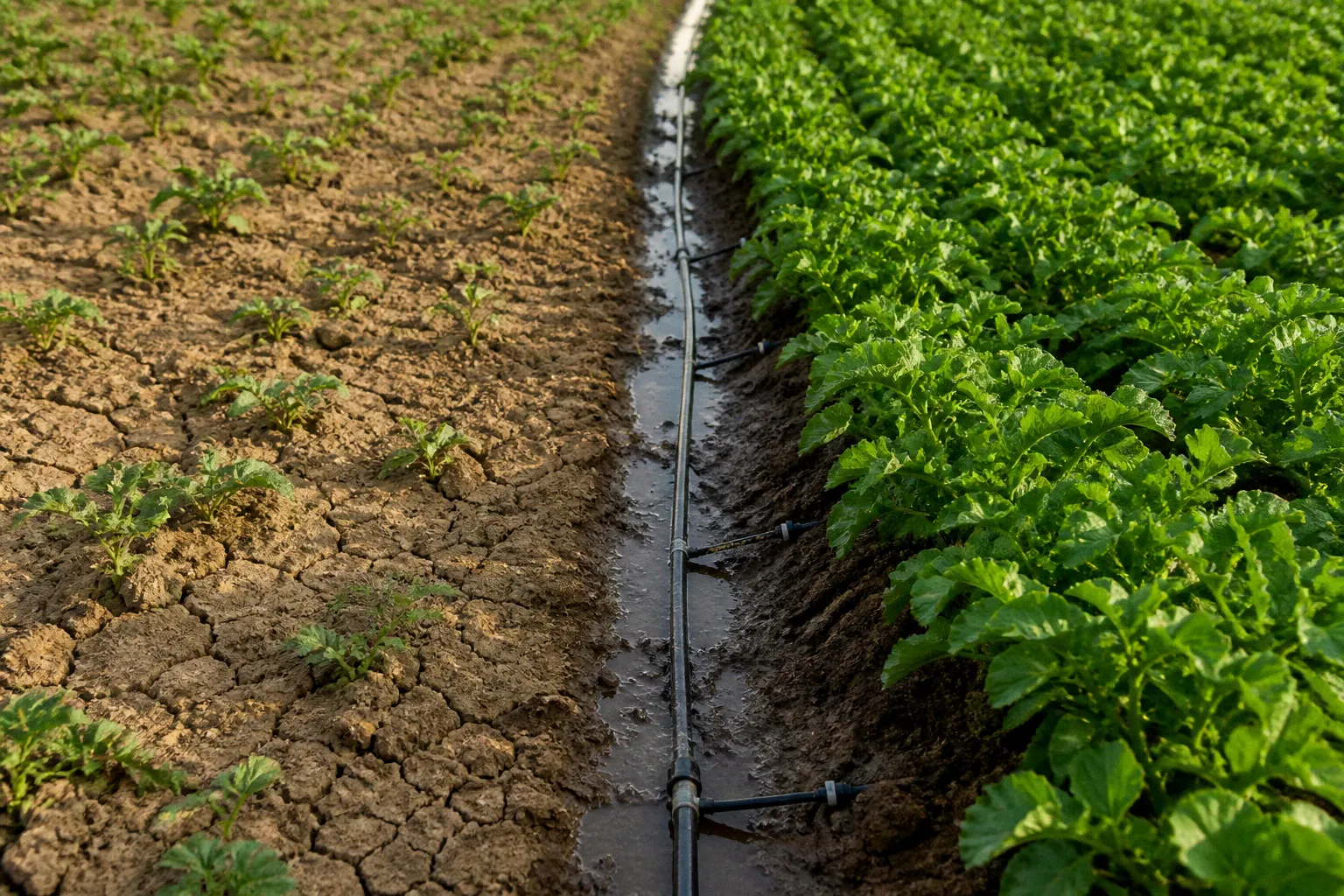
It is also measured in the depth of the groundwater table and in how much fertilizer passes through a field without reaching the crop.
This is especially visible in potato production. The Bekaa holds approximately 42% of Lebanon’s cultivated land and more than 70% of the country’s potato acreage. Yet around 65% of irrigation in the valley depends on groundwater, much of it pumped through private diesel-powered wells. In parts of the region, groundwater levels have fallen by more than 15 metres over five years.
That is the background for the automated fertigation transition in Bekaa farms. The change is not simply a matter of replacing a manual fertilizer tank with an automated fertilizer injector system. It is a shift from irrigation by habit to irrigation based on soil moisture, crop demand, weather, and measured nutrient concentration.
The early Lebanese pilot results are significant: sensor-based irrigation and digital soil testing reduced water use by roughly 22% to 40%, while fertilizer consumption fell by as much as two-thirds. Crop yields and quality also improved in the pilot farms, although the exact gain varied by crop, soil condition, and production system.
The useful question is not whether smart fertigation sounds modern. It is whether the system can deliver the right amount of water and nutrients to a crop whose root zone, weather, and growth stage are changing every week.
The unsustainable cost of traditional Bekaa irrigation
Traditional irrigation in the Bekaa is often governed by a simple rule: run the pump for a set number of hours, then repeat the routine throughout the season. Under common sprinkler practices, potato farmers may irrigate for 8–12 hours per week regardless of crop development stage or short-term weather conditions.
That approach is understandable. Farmers are working with uncertain electricity supplies, expensive diesel, limited technical support, and production schedules that leave little room for experimentation. A fixed routine offers predictability. The problem is that the crop is not fixed.
A potato plant does not need the same amount of water during establishment, canopy development, tuber initiation, and final bulking. Soil texture also changes the result. A sandy field may lose water below the root zone quickly, while a heavier soil can remain wet long after the upper surface appears dry. Sprinklers add another layer of variation through evaporation, wind drift, and uneven distribution.
Fertilizer is frequently applied according to a seasonal recipe rather than a measurement of what remains available in the soil. In the Bekaa, potato farmers commonly apply up to 1,700 kilograms per hectare of compound NPK fertilizer, equivalent to approximately 300 kilograms of nitrogen per hectare under the cited traditional practice.
Some of that nutrient supports crop growth. Some is immobilised in the soil. Some remains after harvest. Some can move below the root zone with excess irrigation and contribute to nitrate contamination. The farmer pays for all of it.
A field can be irrigated for many hours and still leave the crop under stress if the water is delivered at the wrong time, in the wrong volume, or with the wrong nutrient balance.
Groundwater depletion makes this inefficiency harder to ignore. Historical estimates indicate more than 18,000 private, unlicensed irrigation wells across the Bekaa Plain. The issue is not that every well operates in the same way, or that automation can resolve a regional groundwater problem by itself. The issue is that every unnecessary pumping hour adds pressure to an already stressed system.
For a cooperative, this creates a second concern beyond individual farm costs. Buyers in export markets increasingly expect reliable records for irrigation, fertilizer application, crop protection, and harvest handling. A field managed through memory and variable manual dosing is difficult to document consistently. An automated system creates a digital trail, provided the farm actually maintains the records and calibrates the equipment.
That link between ecological health and market access matters. Soil degradation is not only an environmental concern. It can reduce uniformity, increase rejection risk, complicate residue management, and weaken a cooperative’s ability to supply a buyer on a predictable schedule.
What changes when fertigation becomes sensor-driven
Fertigation combines irrigation and nutrient delivery. In a basic drip system, fertilizer is injected into the irrigation line and distributed through emitters. Automation adds measurement and decision rules to the process.
A practical system usually includes:
- Soil-moisture sensors placed within the active root zone rather than only at the soil surface.
- A controller that receives sensor readings and activates irrigation according to defined thresholds.
- A fertilizer injector or dosing pump that introduces nutrients into the irrigation stream.
- Flow meters and pressure gauges to reveal blocked lines, leaks, or uneven delivery.
- Digital soil tests that establish nutrient conditions before the season and during key crop stages.
- Electrical conductivity and pH monitoring where the system and operator can support it.
- A record-keeping platform that stores irrigation events, fertilizer doses, and sensor readings.
The technology is only useful if the measurements are connected to agronomic decisions. A sensor that reports moisture without a defined response is an expensive thermometer. The farmer still needs to decide what the reading means for the crop, soil, irrigation method, and weather forecast.
In a well-managed transition, the system answers several practical questions:
1. Is the root zone genuinely dry, or is the surface merely dry?
2. Has enough water moved through the profile to support the current crop stage?
3. Is the soil holding nutrients, or are repeated irrigation events pushing them below the roots?
4. Is the irrigation network delivering the same volume across the field?
5. Does the crop need more nitrogen, or is the apparent weakness caused by poor root health, salinity, compaction, or disease?
6. Can the next irrigation event be delayed because rainfall or cooler conditions have reduced demand?
This is the difference between a timer and a decision-support platform. A timer repeats an instruction. A sensor-based system can help the grower revise the instruction as field conditions change.
Manual scheduling versus automated fertigation
| Field practice | Traditional manual approach | Sensor-driven fertigation |
|---|---|---|
| Irrigation timing | Often based on a weekly routine or fixed pump hours | Adjusted using soil moisture, crop stage, and field conditions |
| Fertilizer dosing | Large applications made according to a seasonal programme | Smaller, more targeted doses delivered through irrigation |
| Water distribution | Sprinkler or drip operation may continue despite uneven pressure or changing demand | Flow and pressure data help identify faults and delivery problems |
| Nutrient decisions | Based heavily on habit, visual symptoms, or a general crop recipe | Supported by digital soil tests and, where available, EC and pH readings |
| Record keeping | Manual notes may be incomplete or inconsistent | Irrigation and dosing events can be logged automatically |
| Export readiness | Difficult to demonstrate consistent input management | More practical to document applications and trace field operations |
| Main risk | Over-irrigation, nutrient loss, and unnecessary pumping | Poor calibration, sensor failure, or incorrect decision thresholds |
The automated system does not remove the need for field observation. It changes the quality of that observation. A grower can still inspect leaves, roots, soil structure, and irrigation lines, but those observations are combined with data rather than replacing it.
The before-and-after result: less input, better control
The strongest case for automated fertigation in Lebanon is not a promise of spectacular yield increases. It is the combination of resource savings, crop consistency, and improved control.
Across pilot farms in Akkar and the Bekaa, sensor-based irrigation and digital soil testing produced water reductions of approximately 22% to 40%. Fertilizer use fell by up to two-thirds in the reported pilots, alongside improvements in crop yield and quality.
Those figures should be read as a range of observed outcomes, not as a universal farm calculation. A well-drained open field will respond differently from a compacted field. A greenhouse crop has a different water demand from potatoes grown under open-field conditions. A farmer who already operates efficient drip irrigation has less waste available to remove than a farmer using a long, fixed sprinkler schedule.
Still, the direction of the change is clear. The system reduces the need to treat the entire field as if every square metre and every day were identical.
Water savings come from timing, not just volume
Many growers first think of water efficiency as applying less water. In practice, the larger gain often comes from applying water at a more useful time.
If irrigation begins only after the root-zone moisture reaches a defined lower threshold, the farm avoids watering simply because a calendar says it is time. If the system stops after the required amount has passed through the active root zone, it reduces deep percolation. If irrigation is divided into shorter events during periods of high demand, the crop can receive water without creating prolonged saturation.
This matters for root health. Roots need water, but they also need oxygen. A permanently wet root zone can limit oxygen availability, encourage disease, and weaken the plant’s ability to take up nutrients. An efficient irrigation schedule is therefore not merely a water-saving schedule. It is a way of managing the physical and biological conditions around the roots.
The same logic applies to fertigation. Nutrients delivered in smaller, stage-specific applications are more closely aligned with crop uptake than one large dose applied before the crop can use it.
Fertilizer savings come from reducing excess
The two-thirds reduction in fertilizer consumption reported in the pilots is particularly important because fertilizer is often treated as insurance. If plants appear weak, adding more nitrogen can feel safer than investigating the root cause.
But excess nitrogen does not correct every problem. Poor drainage, compacted soil, salinity, low organic matter, disease, and uneven irrigation can all produce weak or irregular growth. Additional fertilizer may then increase cost without solving the underlying constraint.
A sensor-guided fertigation programme begins with a more disciplined question: what is already in the soil, what can the crop access, and what does the crop need at this stage?
That requires a baseline. Digital soil testing is not a decorative add-on; it establishes the starting condition for the field. Without that starting point, automation can simply deliver the wrong recipe more accurately.
The nutrient programme should then be divided around crop development. Early growth may require support for canopy and root establishment. Later stages may require a different balance as the crop moves toward tuber development or fruit production. The exact formulation depends on the crop, soil analysis, water quality, and farm target. A generic NPK schedule is not a substitute for a nutrient budget.
Lessons from Almarj and the Lebanese pilot farms
The ILO BOUZOUR project, funded by Sida, deployed sensor-based irrigation and fertigation systems across fifteen pilot farms in the Akkar and Bekaa regions. The purpose was practical: optimise water consumption, reduce operating expenses, and improve crop quality.
The value of these pilots lies in their setting. They were not conducted in an abstract laboratory environment with unlimited power, perfectly uniform plots, or ideal infrastructure. They were introduced into Lebanese farming systems where growers must manage groundwater dependence, variable energy costs, ageing equipment, and uneven access to agronomic services.
SmartLand, a Lebanese agrotech startup, developed an auto-controlled smart irrigation and fertigation system powered by renewable energy. Its demonstration farm in Almarj, in the West Bekaa, regulates water and nutrient dosing according to real-time plant needs.
The renewable-energy component is not a separate innovation floating above the irrigation problem. It is part of the infrastructure question. Automation requires reliable power for sensors, controllers, valves, pumps, and communications. Where electricity is unstable and diesel is expensive, a solar-powered irrigation system can make the control layer more dependable, although the system still requires correct sizing, battery or backup planning, maintenance, and safe pump operation.
The Almarj example also points to an important principle: automation works best when it is designed around the farm’s actual hydraulic network. A sophisticated controller cannot compensate for a pump that cannot maintain pressure, a filter that is blocked, emitters that are badly spaced, or pipes that leak.
Before a cooperative invests in sensors, it should understand the existing irrigation system as a physical system:
- Pump capacity and operating pressure.
- Water source reliability and seasonal changes in well output.
- Filtration quality and cleaning frequency.
- Field slope and pressure variation.
- Dripline spacing and emitter discharge.
- Tank volume and fertilizer mixing arrangements.
- Availability of spare valves, filters, connectors, and technical support.
- Mobile connectivity or another method for transmitting data.
This is where many technology projects become less glamorous but more useful. A farmer may not need the most advanced dashboard. The farm may first need a pressure regulator, a clean filter, a calibrated injector, and a technician who can return during the growing season.
The best smart-farming system is not the one with the most sensors. It is the one that turns a reliable measurement into a reliable field action.
Building an automated fertigation transition in a working farm
The transition should be staged. Installing the entire system across a cooperative’s acreage at once creates technical and financial risk, especially when the baseline irrigation schedule has never been measured.
A practical first phase is a single representative plot. It should not be the easiest field on the farm. Choose a plot that reflects the cooperative’s real constraints: typical soil, common crop, normal water source, and ordinary labour conditions.
Phase one: establish the baseline
Before automation begins, record how the field is currently managed.
Measure or document:
- Pump operating hours and fuel or electricity use.
- Irrigation duration and frequency.
- Fertilizer products, quantities, and application dates.
- Soil texture, compaction, drainage, and visible salinity.
- Crop establishment, plant population, and signs of uneven growth.
- Water quality, particularly where salinity or bicarbonate may affect irrigation.
- Harvest quantity and quality by plot rather than relying only on the farm-wide total.
The aim is not to create a perfect scientific trial. It is to create a credible before-and-after comparison. If the farm cannot describe its starting point, it will not know whether the new system is improving performance.
Phase two: repair the hydraulic foundation
Sensors cannot repair poor water distribution. Before installing control equipment, check the network from the pump to the last emitter.
Flush the lines. Clean or replace filters. Confirm pressure at the beginning and end of representative laterals. Inspect for leaks and blocked emitters. Test the injector so that the intended fertilizer concentration is actually entering the irrigation line.
This work may produce immediate savings, even before automation. It also prevents a common mistake: blaming the software when the real problem is uneven delivery.
Phase three: install sensors where decisions are made
A soil-moisture sensor should represent the root zone, not an arbitrary convenient location beside the pump or at the edge of the field. In a variable field, one sensor may not be enough. Differences in soil texture, slope, planting date, or irrigation zones can produce different moisture behaviour.
The sensor position should be documented and protected from machinery damage. Readings should be compared with direct field inspection during the first weeks. If the sensor says the soil is wet but a properly examined root zone is dry, the answer is not to ignore the field. Investigate placement, calibration, soil variability, and irrigation uniformity.
The same caution applies to nutrient data. A digital test is useful only when sampling is consistent and the result is interpreted in relation to the crop and soil. Sampling at different depths or from different parts of the field can create apparent changes that are really sampling errors.
Phase four: automate gradually
The first automated programme should be conservative. Use the system to control one irrigation zone or one pilot block before expanding to the whole farm.
Set clear rules for:
- The lower moisture threshold that triggers irrigation.
- The upper threshold or irrigation amount that stops the event.
- Maximum daily runtime.
- Fertilizer injection duration and concentration.
- Manual override during equipment failure or exceptional weather.
- Alarm conditions for low pressure, excessive flow, or sensor loss.
The grower should review the results frequently during the first crop cycle. Automation is not a one-time installation. Thresholds may need to change as the crop develops, temperatures rise, roots expand, or the soil profile dries at different rates.
Phase five: compare agronomic and commercial results
A useful comparison includes more than yield. Track water volume, pumping hours, fertilizer purchased, crop uniformity, rejected produce, labour time, and maintenance events.
For a cooperative selling into export channels, also track whether the new records improve lot traceability and buyer confidence. Input records are not a substitute for compliance with a specific certification scheme, but they make it easier to demonstrate how the crop was produced and handled.
The commercial value may appear through consistency rather than a dramatic increase in total tonnes. Uniform sizing, fewer quality defects, and more predictable harvest timing can matter greatly when a cooperative is trying to meet a buyer’s specification.
The infrastructure gap is the real barrier
The technology itself is not the only barrier to smart fertigation in Lebanon. The larger challenge is building an operating environment in which the technology can be maintained.
A sensor network needs replacement parts. A dosing pump needs cleaning and calibration. Filters need regular attention. Solar systems need inspection. Data platforms need someone responsible for reviewing alerts. Farmers need training that explains not only which button to press, but why the irrigation threshold changes during crop development.
This is particularly important for cooperatives. A cooperative can spread technical capacity across several farms, but only if responsibilities are defined. One person should be accountable for data review and maintenance rather than leaving the system to whichever grower has time that week.
A workable cooperative model might include:
- One trained irrigation operator responsible for system checks.
- A shared stock of filters, valves, connectors, sensors, and injector parts.
- A common soil-sampling calendar.
- Standard field records for fertilizer and irrigation events.
- Seasonal review meetings comparing water, fertilizer, yield, and quality data.
- A clear process for switching to manual operation during equipment failure.
- A relationship with a local technician who understands pumps and fertigation, not only software.
The economic return also needs to be assessed honestly. Pilot results demonstrate resource savings and improved performance, but a single region-wide payback period cannot be assumed. Hardware costs, grant support, crop value, energy prices, well depth, field size, and maintenance capacity all affect the result.
For a small farm, the first investment may be better directed toward a properly designed drip network and water measurement. For a larger cooperative, automated dosing and remote monitoring may become worthwhile once the hydraulic foundation is sound. The right sequence is more important than the sophistication of the final system.
A seasonal timeline for the transition
For a farm preparing to adopt automated fertigation, the following schedule is more realistic than installing equipment immediately before planting.
Two to three months before planting
Map the field and divide it into irrigation zones. Test the soil and irrigation water. Inspect the pump, filters, mainline, valves, and laterals. Record the previous season’s fertilizer applications, irrigation hours, yield, and quality.
At this stage, decide what the pilot must prove. It might be a reduction in pumping hours, lower nitrogen use, more uniform potato size, or better documentation for a buyer. A project with no defined measurement quickly becomes a technology demonstration rather than a farm improvement.
One month before planting
Repair the hydraulic network and calibrate the fertilizer injector. Install the controller, flow meter, pressure monitoring, and soil-moisture sensors. Confirm that readings are being recorded and that the system can be operated manually if the controller or network fails.
Train the person who will manage the system. The training should include flushing, filter maintenance, sensor checks, injector calibration, and safe fertilizer handling.
Planting and establishment
Begin with measured irrigation events rather than the previous fixed schedule. Check the soil around the developing root system directly and compare it with sensor readings.
Avoid aggressive fertilizer dosing during establishment. The crop has a limited root system at this stage, and excess nutrients can move beyond reach before the plant can use them.
Canopy development
Review moisture thresholds as root depth and crop demand increase. Monitor pressure across the field, not only at the pump. Uneven irrigation at this stage can create differences that later appear to be a fertilizer problem.
Split nutrient applications according to crop demand and soil test results. Record every change so that the cooperative can distinguish a successful adjustment from a random one.
Tuber development or fruit bulking
This is the period when water stress and over-irrigation can both affect quality. Use the sensor data alongside root-zone inspection, weather conditions, and crop observations. Do not chase a single reading. Look for a consistent pattern across the field.
Where water use is falling sharply, confirm that the reduction is not caused by blocked lines, a faulty sensor, or inadequate pump operation. Efficiency must be verified through crop condition and irrigation-system checks.
Harvest and post-season review
Compare the pilot with a similar field managed under the previous system. Review water use, fertilizer consumption, yield, grade, rejected produce, labour, and maintenance.
Then decide what to scale. The next step may be expanding to another irrigation zone, improving data collection, or correcting soil compaction before installing more equipment. Automation should follow agronomic understanding, not replace it.
The Bekaa Valley cannot pump its way out of groundwater decline. Nor can a digital platform repair degraded soil without changes in irrigation, nutrient management, rotation, and field structure. But automated fertigation offers a practical mechanism for using less water and fertilizer while giving growers better control over the crop.
The evidence from Lebanese pilot farms is strong enough to justify careful adoption: water savings of 22% to 40%, fertilizer reductions of up to two-thirds, and improved crop performance under the right conditions. The next step is not to promise the same percentage to every farm. It is to measure the field honestly, repair the infrastructure, automate one decision at a time, and build a seasonal record that both the agronomist and the export buyer can trust.