Greenhouse fertigation: manual to automated shift
In Lebanese tunnel greenhouses, the first sign of a failing fertigation routine is rarely a broken pump.
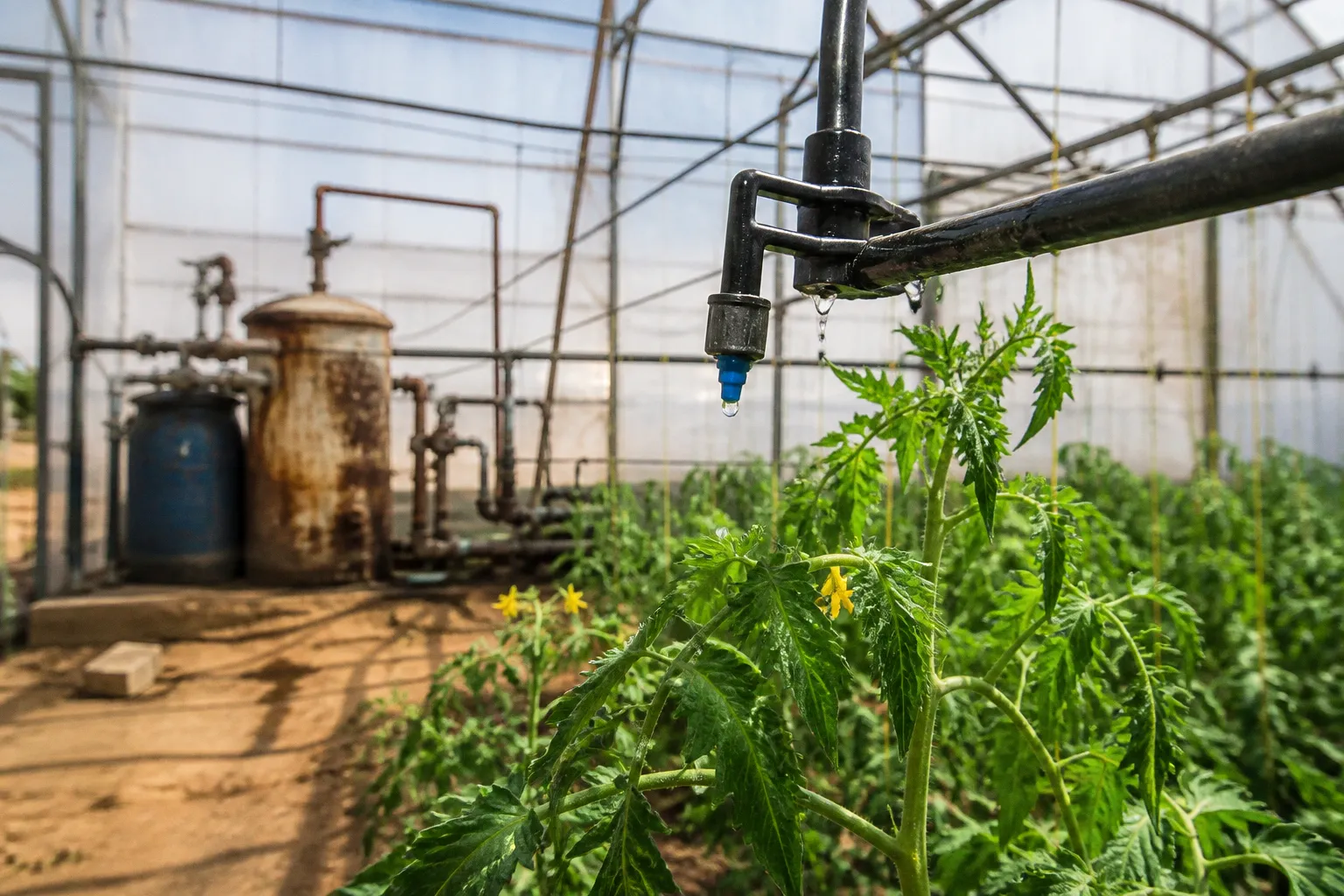
It is usually visible in the crop: pale new leaves in one row, overly vigorous growth in another, blossom-end rot on tomatoes, or leafy greens that mature unevenly despite receiving the same irrigation schedule.
The cause is often not a lack of fertilizer. It is poor timing and distribution. When nutrients are mixed by hand and irrigation is opened according to habit, the root zone receives a sequence of wetting, salt accumulation, dilution, and drying that the crop cannot predict. In a country facing water scarcity, high fuel costs, degraded soils, and increasingly irregular heat, that inconsistency is becoming expensive.
A greenhouse fertigation system upgrade in Lebanon is therefore not simply a move from manual valves to digital controls. It is a change in how the farm observes the root zone, applies inputs, records production, and prepares crops for markets that increasingly expect traceability and consistent quality.
The shift from manual dosing to precision agriculture
Manual fertigation can work well on a small farm when the operator is present, experienced, and able to read the crop every day. A grower may mix a soluble fertilizer in a tank, estimate the required concentration, open the irrigation lines, and adjust the next application after inspecting the plants.
The weakness is not the farmer’s knowledge. It is the number of variables being managed at once.
Water pressure changes across the greenhouse. A clogged emitter alters the volume reaching one section. Fertilizer may not dissolve evenly. The irrigation duration may be shortened when fuel is scarce or extended because the soil surface appears dry. The same schedule is then applied to tomatoes, cucumbers, or leafy greens even though their root systems and nutrient demand differ.
A greenhouse nutrient dosing system separates these variables. It can measure or regulate:
- Irrigation volume and duration by zone.
- Electrical conductivity, which indicates the concentration of dissolved salts.
- pH, which affects nutrient availability.
- Soil or substrate moisture.
- Tank levels and injection rates.
- Pressure and flow, helping identify leaks or blocked lines.
- Fertilizer delivery through a programmed injector or dosing pump.
The practical principle is simple: the crop should receive water and nutrients in response to its demand, not only according to the clock.
This is particularly relevant in Lebanon, where fertilizer consumption reached 190 kilograms per hectare of arable land in 2023, according to World Bank data. That figure does not tell us whether every kilogram is being used efficiently. In greenhouse production, efficiency depends on whether fertilizer reaches the active root zone at the correct concentration and whether excess nutrients leave the system through drainage or accumulate in the soil.
What automation actually changes
Automation does not make agronomy unnecessary. It makes agronomic decisions repeatable.
A grower still has to determine the crop’s target conductivity, irrigation frequency, and nutrient balance. The system then applies those decisions more consistently than a manual routine can, particularly during periods when one person is managing several greenhouse blocks.
For a drip fertigation upgrade, the basic infrastructure generally includes:
1. A clean water source and filtration. Sand, sediment, and organic particles must be removed before they reach the emitters. Automation cannot compensate for poor filtration.
2. Separate fertilizer tanks or concentrated stock solutions. Calcium products, phosphates, and sulfates may require separate tanks to avoid precipitation and blocked lines.
3. An injector or dosing pump. This draws concentrated fertilizer into the irrigation stream at a controlled rate.
4. Sensors and control equipment. Depending on the farm’s budget, this may include EC, pH, pressure, flow, moisture, and tank-level sensors.
5. Zoned distribution. Different crops, planting dates, or soil types should not be forced into one irrigation schedule.
6. A reliable power and communications arrangement. Remote alerts are useful only when the controller, pump, and mobile connection remain available.
The most common mistake is to begin with the controller rather than the hydraulic system. If pressure is uneven or emitters are poorly matched, a sophisticated dashboard will simply document an uneven application pattern.
Automation is valuable when it makes the root zone more predictable. A screen full of data cannot repair a badly designed irrigation line.
What the Lebanese pilots reveal about savings
The strongest case for automated fertigation is not technological novelty. It is resource performance.
The ILO’s BOUZOUR project tested sensor-based irrigation and automated fertigation across 15 sites in Lebanon. The pilots recorded water reductions of 22% to 40%, with savings reaching up to 50% in orchards. Fertilizer use fell by as much as two-thirds in some applications. Automated dosing also improved the share of Class A produce by 16% and saved between 18 and 25 labor hours per production cycle.
These figures matter because they connect infrastructure to farm economics. A reduction in fertilizer use lowers the amount purchased and the amount that can accumulate in the soil. Lower water demand reduces pumping time. Fewer labor hours do not remove agricultural workers, but they allow skilled staff to spend more time on pruning, scouting, harvest handling, and quality control rather than repeatedly mixing tanks.
The results are not a universal promise for every greenhouse. Savings depend on the starting point. A farm already using well-calibrated irrigation may see a smaller improvement than one applying water and nutrients by rough estimation. Crop type, soil texture, emitter spacing, water quality, and greenhouse ventilation also influence the result.
Still, the direction is clear: measuring the delivery system can reduce waste before the farmer has to expand the cultivated area.
Where the savings come from
| Farm variable | Manual routine | Automated fertigation approach | Practical consequence |
|---|---|---|---|
| Irrigation timing | Often based on habit, weather observation, or fixed duration | Adjusted through schedules and sensor readings | Less overwatering during cool periods and better response to heat |
| Nutrient concentration | Mixed by batch and estimated by volume | Dosed through controlled injection and EC targets | More consistent root-zone nutrition |
| Distribution | One schedule may cover several greenhouse zones | Zones can receive separate programs | Better fit for different crops and planting stages |
| Leak and clog detection | Found during visual inspection or after crop stress appears | Flow and pressure changes can trigger alerts | Faster correction of hidden losses |
| Labor | Repeated tank mixing and valve adjustment | More time spent on supervision and crop decisions | Reduced routine labor without eliminating field work |
| Records | Often kept informally | Applications can be logged by date, zone, and recipe | Stronger traceability for buyers and certification |
The Akkar trials provide a useful example because they involved ordinary production pressures rather than a laboratory-only environment. Automated fertigation and sensor-based technology were tested in six tunnel greenhouses growing leafy greens and tomatoes. The farms reduced water, fertilizer, and fuel use by 40%, halved operational costs, and increased yields by 8%.
Leafy greens are especially revealing. Their production cycles are short, so an uneven nutrient supply can affect marketable quality within days. A tomato crop has more time to show the consequences of poor fertigation, but it also has a longer period during which salt buildup, nutrient imbalance, or irregular watering can reduce fruit quality.
For both crops, the system should be assessed through the crop and the root zone—not through the appearance of the equipment.
The soil question: automation cannot replace rehabilitation
A greenhouse fertigation system upgrade does not erase soil degradation. In some cases, it makes existing problems more visible.
Years of repeated cropping, limited rotation, excessive fertilizer application, and poor drainage can create a root zone with high salinity, low biological activity, and weak structure. The plants may then appear nutrient-deficient even when the soil contains plenty of fertilizer. Roots are unable to access the nutrients efficiently because the chemical and physical environment has deteriorated.
This is where soil microbiology and fertigation have to be considered together. Organic matter supports aggregation and microbial activity. Crop rotation interrupts some pest and disease cycles. Proper drainage prevents salts from concentrating around the roots. Fertigation then becomes a tool for delivering nutrients into a functioning root environment rather than a substitute for one.
A practical farm assessment should examine:
- Water salinity and bicarbonate levels, not only water availability.
- Soil pH, electrical conductivity, texture, and organic matter.
- Drainage depth and the presence of compacted layers.
- Root color and density when plants are removed.
- Emitter uniformity across the greenhouse.
- Fertilizer compatibility in stock tanks.
- Crop demand at each growth stage.
- The amount and quality of drainage leaving the root zone.
For soil-grown tomatoes, irrigation pulses may need to be shorter and more frequent as temperatures rise, but the correct schedule depends on soil texture and root depth. A sandy soil loses available water quickly. A heavier soil may remain wet while the surface looks dry, creating a misleading signal for manual irrigation.
In substrate or hydroponic systems, the margins are narrower. The grower controls more of the root environment, but mistakes in EC, pH, or irrigation frequency can affect plants rapidly. That is one reason AUB’s automated vertical farm and hydroponic unit is useful as a national reference point, even though it is not a direct template for every farm.
Akkar and the Bekaa: two different operating realities
The automated fertigation trials in Akkar show how technology can work within tunnel greenhouse production, where growers must manage fuel, labor, water, and market timing at the same time.
A system installed in this context should be robust rather than overcomplicated. The grower needs a clear answer to practical questions:
- Did every greenhouse zone receive the intended volume?
- Did the pump run for the planned duration?
- Was fertilizer injected at the expected concentration?
- Did the system continue safely during a power interruption?
- Can the operator identify a blocked filter without waiting for crop damage?
- Are the records understandable to someone other than the installer?
The West Bekaa presents a different set of conditions. SmartLand Agri, based in Hawsh Elharimeh, has installed more than 100 automated irrigation and fertigation systems across Lebanon. Its work reflects the growing demand for sensor-based delivery and mobile monitoring, but the systems still depend on local infrastructure: water storage, pump reliability, filter maintenance, electricity, and the operator’s ability to respond when an alert arrives.
A mobile application can show that pressure has dropped. It cannot clean the filter, repair a damaged pipe, or decide whether the drop is caused by a leak or a scheduled change in the irrigation zone. The human system around the technology remains decisive.
A sensible upgrade path for an existing greenhouse
Farmers do not need to replace every component at once. A staged approach is often more resilient, especially when capital is limited or the greenhouse is still being evaluated for market potential.
Stage one: measure the present system.
Before buying controllers, test the flow from representative emitters across the greenhouse. Measure pressure at the beginning and end of lines. Record irrigation duration, fertilizer quantities, fuel use, and crop yield for at least one production cycle if possible. Without this baseline, a claimed saving is difficult to verify.
Stage two: repair the hydraulic weaknesses.
Replace damaged lines, clean or upgrade filters, correct pressure problems, and divide the greenhouse into practical zones. Uniform water delivery is the foundation of any smart fertigation system.
Stage three: automate the most repetitive decisions.
A timer, dosing pump, EC sensor, or moisture sensor may provide more value than a fully integrated platform if the farm’s first problem is inconsistent scheduling. The equipment should address a known loss.
Stage four: add remote monitoring and records.
Once the physical system is reliable, mobile alerts and digital logs can help the operator follow applications, detect faults, and compare crop performance across zones.
Stage five: connect production data to market requirements.
Record fertilizer batches, irrigation events, harvest dates, and quality grades. Export buyers and certification systems increasingly expect evidence of how produce was grown, not only a visual inspection at packing.
That last stage is where environmental performance and commercial access meet. Reducing fertilizer use is agronomically useful, but documenting the reduction, the application schedule, and the crop response gives the farm a stronger position with buyers who require traceability and responsible input management.
The AUB solar greenhouse model: high-tech, but not universal
On June 13, 2025, the American University of Beirut launched Lebanon’s first fully automated vertical farm and hydroponic unit in a 72-square-meter solar glasshouse. The unit grows approximately 2,300 plants and was developed through the BONEX initiative with support from the EU’s PRIMA program.
The model demonstrates what happens when irrigation, nutrient delivery, environmental control, and plant density are treated as one system. In a hydroponic unit, the nutrient solution can be monitored and recirculated with much greater precision than in an open soil system. Solar glasshouse infrastructure also shows how energy generation can be integrated into protected cultivation, although it should not be mistaken for proof that all automated fertigation in Lebanon is solar-powered.
This distinction matters. A vertical hydroponic farm and a family-run tunnel greenhouse have different capital requirements, crop cycles, labor arrangements, and routes to market. The AUB unit is valuable as a research and demonstration platform, but a grower should adopt only the parts that solve a real production constraint.
For some farms, the best investment may be automated dosing and better filtration. For others, it may be a storage tank, pressure regulation, shade management, or soil rehabilitation. High technology is not automatically high resilience.
When hydroponics makes sense
Hydroponics can be attractive where land is limited, water quality can be managed, and the crop has a reliable premium market. It offers control over nutrient concentration and reduces dependence on degraded soil. But it also requires technical discipline.
The grower must manage:
- Source-water quality.
- Nutrient recipes and crop-stage changes.
- Reservoir temperature and oxygenation.
- Root disease risk.
- Cleaning and sanitation.
- Backup power and pumping.
- Safe handling of concentrated inputs.
- A market able to pay for consistent quality.
A hydroponic greenhouse that loses circulation during a heat event can suffer quickly. A soil-based crop may have a larger buffer, although it carries other risks. The choice is therefore not between old farming and modern farming. It is between different risk profiles.
Export certification begins in the irrigation room
Lebanese cooperatives seeking international markets face a practical challenge: quality must be repeatable across farms, not only excellent in one harvest.
An automated greenhouse fertigation system can support that consistency by creating records. A cooperative can document when water and nutrients were applied, which recipe was used, whether a sensor alarm occurred, and how the crop moved from greenhouse to packing facility. That information becomes valuable when buyers ask about residues, input use, water management, or traceability.
Certification does not come from installing a sensor. It comes from having a working procedure around the sensor.
A cooperative may need to standardize:
- Fertilizer storage and labeling.
- Stock-solution preparation.
- Calibration intervals for EC and pH sensors.
- Filter cleaning and emitter inspection.
- Irrigation records for each greenhouse block.
- Corrective action after a pressure or dosing failure.
- Worker training and protective equipment.
- Harvest-lot identification through packing.
This is also where cooperatives can reduce individual costs. A single small farm may struggle to justify a technician, calibration tools, or data management. A cooperative can share training, maintenance, spare parts, and agronomic support. It can also compare results across members without pretending that every field has the same soil, water source, or crop schedule.
The goal is not to make every farm identical. The goal is to make differences measurable and manageable.
For export production, the irrigation record is part of the crop. If the farm cannot show what entered the root zone, it is harder to defend quality when the shipment is questioned.
Scaling smart infrastructure without creating fragile farms
Lebanon’s agrotech transition is still at an early adoption stage. Automated systems are spreading, but they have not replaced manual fertigation. The next phase will depend less on enthusiasm for sensors and more on service networks that keep equipment working.
A controller that fails because a sensor was never recalibrated is not a smart system. A dosing pump that cannot be repaired locally becomes a production risk. Imported parts, unstable electricity, weak connectivity, and unclear technical support can turn a promising installation into an expensive manual workaround.
The infrastructure around the equipment should therefore be planned from the beginning:
- Keep manual bypasses for essential irrigation lines.
- Store spare filters, emitters, fuses, and basic sensor components.
- Train at least two people per farm or cooperative.
- Set alarm thresholds that reflect crop conditions rather than generating constant warnings.
- Maintain a written recipe for each crop and growth stage.
- Check actual fertilizer delivery against the controller’s displayed rate.
- Review water and fertilizer use per kilogram of marketable produce.
- Schedule calibration before the high-demand season, not after a failure.
A cooperative can also create a shared data layer. Farmers do not need a complex platform at first. A consistent record of crop, area, irrigation volume, fertilizer quantity, yield, and Class A percentage can reveal which interventions are producing real gains.
This is especially useful when comparing greenhouse nutrient dosing systems. One unit may reduce water use, but if it lowers yield or increases disease pressure, the farm has not improved its overall performance. The meaningful measure is productive output per unit of water, fertilizer, fuel, and labor.
A seasonal timeline for moving from manual to automated fertigation
A farm planning a greenhouse fertigation system upgrade should avoid installing equipment in the middle of the most demanding crop cycle unless the existing system is unsafe. Transition is easier when it follows the agricultural calendar.
Before the next planting
Begin with a water analysis, soil or substrate assessment, and hydraulic audit. Walk every irrigation line. Replace damaged emitters and identify zones with uneven pressure. Decide whether the first upgrade should focus on dosing, irrigation scheduling, filtration, or monitoring.
At this stage, also select the crop recipe. Tomatoes and leafy greens should not share an undifferentiated fertilizer program simply because they occupy neighboring tunnels.
During nursery preparation
Install and test the controller, injector, filters, and sensors before transplanting. Run clean water through the system. Check whether the displayed EC and pH values match handheld measurements. Confirm that the system can operate through a power interruption and that the operator knows how to switch to manual control.
This is the safest period to discover that a sensor cable is too short or that a fertilizer tank is positioned incorrectly.
First four weeks after transplanting
Use conservative irrigation pulses while roots establish. Inspect root development, drainage, pressure, and emitter uniformity frequently. Do not allow the automation to become a reason to stop looking at the crop.
Record the relationship between irrigation events and plant response. A moisture sensor reading has meaning only when it corresponds with the actual root zone and crop stage.
Peak vegetative growth and fruiting
Adjust frequency and nutrient concentration as plant demand increases. In tomatoes, monitor fruit quality and leaf balance alongside EC and pH. In leafy greens, watch for uneven size, tip burn, and excessive softness.
Compare fertilizer use and water consumption with the manual baseline. The objective is not to maximize the number of irrigation events. It is to maintain a stable root environment with the least waste.
Harvest and post-cycle review
Separate total yield from marketable yield. The 16% increase in Class A produce recorded in the BOUZOUR pilots illustrates why quality grade can be as significant as tonnage.
Review:
- Water used per production cycle.
- Fertilizer used by nutrient and by greenhouse zone.
- Fuel or electricity consumed for pumping.
- Labor hours spent on dosing and irrigation.
- Percentage of Class A produce.
- Equipment faults and corrective actions.
- Crop losses associated with salinity, disease, or uneven irrigation.
Then decide what the next investment should be. It may be additional sensors, better filtration, a second dosing channel, solar integration, or simply improved maintenance.
The practical direction for Lebanese farms
Automated fertigation in Lebanon is not a single technology package. It is a gradual correction of a system that has been exposed to water stress, expensive energy, soil fatigue, and demanding markets.
The evidence from BOUZOUR, the Akkar greenhouse trials, SmartLand Agri installations, and AUB’s automated hydroponic research points in the same direction: precise delivery can reduce water and fertilizer use, lower routine operating costs, improve crop quality, and create records that support market access.
But the strongest farms will not be the ones with the most sensors. They will be the ones that connect measurement to action. They will repair the hydraulic system before digitizing it, restore soil function rather than feeding around it, train people alongside installing equipment, and treat certification records as part of production rather than paperwork added at the packing house.
For a Lebanese grower, the sensible path is seasonal and incremental: measure this cycle, repair the lines before the next planting, automate the most wasteful task, document the result, and expand only when the crop data supports it. That is how smart fertigation becomes infrastructure rather than fashion—and how a greenhouse can produce more consistent food with less pressure on the water, soil, and labor that sustain it.