Greenhouse hydroponics in Lebanon: a step-by-step project
For our growers across the Beqaa, the South, and the coastal plains, the question is no longer whether soilless cultivation works in Lebanon — it's how a cooperative can put it to work without burning through the water table or the diesel budget.
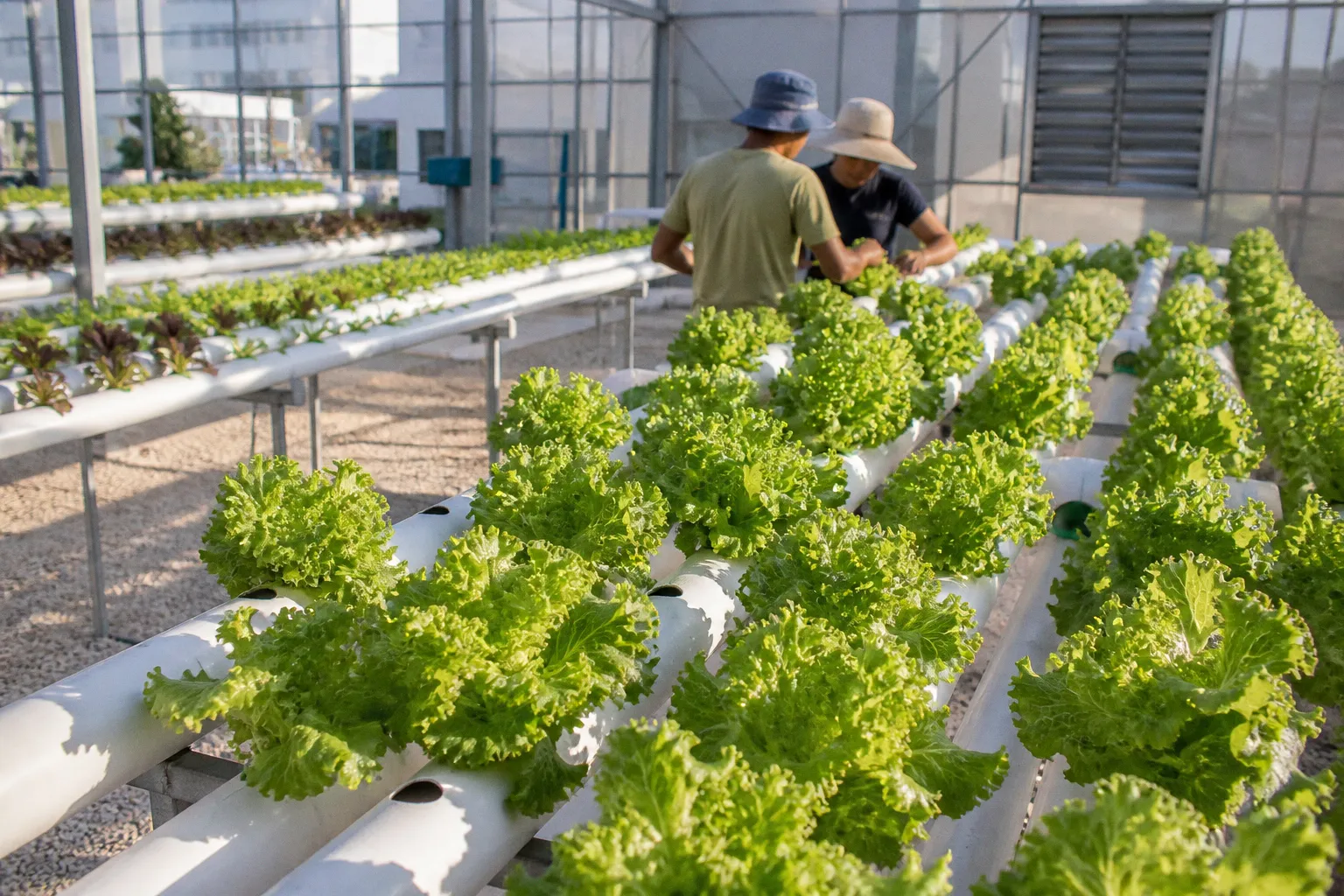
Water scarcity has tightened the grip on every farmer we know, and the public electricity grid has become an unreliable partner at best. Greenhouse hydroponics answers both problems in the same breath: it recycles water in a closed loop, it pairs naturally with solar power, and it gives us a blemish-free, export-ready crop we can stand behind as a collective.
This is a project outline, not a sales pitch. Think of it as the conversation we might have around a table at the cooperative, weighing the kit we'd actually need, the partners who can help us source it, and the harvest cycles we can realistically expect in our climate.
A closed-loop hydroponic greenhouse isn't a luxury technology for Lebanon — it's the most honest answer we have to water scarcity and grid instability in the same field.
Designing for scarcity: solar power and closed-loop water
When we sit down with a cooperative considering a greenhouse hydroponics project, the first conversation is always about the two scarcities we cannot negotiate with: water and electricity. The good news is that the same design choice solves both.
A closed-loop irrigation system captures the nutrient solution that doesn't get absorbed by the roots and routes it back through the system. In the BONEX demonstration project run by AUB's Faculty of Agricultural and Food Sciences, that closed loop dropped water consumption to 40.6 mm per year — a fraction of the 150–200 mm per year that traditional open-field cultivation demands. The same BONEX research documented water savings of 70–80% compared to conventional growing methods, a figure that holds real weight when we're talking about cooperative-level volumes flowing through a single system. GrowLeb's precision platform goes further still, cutting water use by roughly 90% compared to open-field farming. These aren't marginal gains. They are the difference between a viable cooperative season and a season cut short by a dry pump.
Solar power completes the picture. The AUB vertical farm, housed inside a 72-square-meter solar glasshouse in Beirut, generates 3,627 kWh per cycle from rooftop panels — enough to keep the pumps, the LED supplementation, and the climate controls running without leaning on the grid. For cooperatives planning a similar setup, the rule of thumb is straightforward: size your solar array to cover the pump load first, climate control second, and lighting third. The pumps never stop; the lights can be timed to off-peak sunlight.
Here's how the resource math usually lands for a cooperative-scale project:
| Resource | Traditional greenhouse | Closed-loop hydroponic + solar |
|---|---|---|
| Water use per year | 150–200 mm | 40.6–60 mm |
| Energy source | Diesel generator / grid | Solar PV + battery buffer |
| Pesticide use | Routine | Minimal to zero (GrowLeb reports zero pesticides in its NFT operations) |
| Harvest predictability | Weather-dependent | Calendar-controlled |
| Export-grade share of yield | Variable | High (uniform, clean product) |
That table is the single most useful document any cooperative can put on its planning wall, because it reframes the conversation from "can we afford this?" to "can we afford to keep doing it the old way?"
The technical core: NFT gutters and vertical towers
Once the resource equation is settled, we turn to the actual growing system. Two technologies dominate the Lebanese scene right now, and our growers have good reasons to know both.
The Nutrient Film Technique (NFT) is the workhorse. Plants sit in channels or gutters; a thin film of nutrient solution flows continuously past their roots. It's simple, repairable in the field, and forgiving enough that a cooperative with two careful technicians can run it without an agronomist on site every day. GrowLeb runs NFT at commercial scale — over 100,000 plants per month — achieving zero pesticides in their operations through disciplined closed-loop management. Backyard Farms, for its part, manages a mixed footprint of hydroponic and traditional farms spanning more than 80,000 m² across Choueifat, Chouf, Koura, and Batroun, applying hydroponic technology where the crop mix and market channel justify it while maintaining soil-based cultivation for crops that call for it.
Vertical rotating towers take the same NFT principle and stack it upward. AUB's 72-square-meter unit in Beirut fits around 2,300 plants by combining vertical towers, NFT channels, and gutter systems in the same footprint. The vertical orientation isn't a gimmick — it lets a small parcel of land produce a yield that would otherwise require several times the area, which matters enormously when our cooperatives are working with inherited family plots rather than open plains.
A practical note we share with every group starting out: don't automate everything on day one. Manual feeding and pH checks are the right starting point for a resource-limited cooperative. Automation earns its keep once you have a stable harvest rhythm and the cash flow to justify it. AUB's fully automated vertical farm is the destination, not the starting line.
Scaling the cooperative model: lessons from operators already running
Before any of us commit cooperative funds, it's worth listening to the growers who are already pulling trays off the racks every morning.
Backyard Farms built its model on pesticide-free leafy greens and ready-to-eat salads, certified under ISO 22000 — a standard that opens doors to European and Gulf retailers our cooperatives have struggled to reach for a decade. Their deliberate mix of hydroponic and traditional farming speaks to a reality every cooperative knows: not every member wants to abandon soil cultivation overnight. The hydroponic side carries the export premium; the soil side carries the cultural and culinary crops our domestic markets still demand. Learning to run both in parallel is a skill worth developing, not a compromise to apologize for.
GrowLeb shows what scale looks like when the system runs clean. With more than 100,000 plants per month and zero pesticides in their NFT lines, they've built a brand around consistency — the kind of consistency exporters reward with repeat contracts. For our growers, the takeaway isn't "go that big." It's "go that clean." A consistent, blemish-free harvest is what unlocks the price premium that pays back the infrastructure. When a Gulf importer samples the same lettuce variety across three consecutive shipments and finds identical size, colour, and shelf life every time, that importer stops looking elsewhere.
WAM (Witness as Ministry) built its first two solar-powered hydroponic greenhouses in 2023, added three more in 2024, and expanded again in 2025 to reach a capacity of 40,000 plants per year with harvests every 40–45 days. WAM's project is also a reminder that greenhouse hydroponics in Lebanon can be a humanitarian act as much as a commercial one — and that the same technology serves both purposes. When a community cooperative can feed its own neighbourhood and sell surplus to a buyer in Jounieh or Dubai from the same greenhouse, the economics stop being theoretical.
The path to a premium export contract runs through uniformity — the same crisp leaf, the same blemish-free head, harvest after harvest.
Sourcing equipment and managing the climate
Equipment sourcing is where most cooperative projects either gain momentum or stall. The Lebanese market has matured enough that we no longer need to import everything ourselves, but knowing who to call — and in what order — still matters.
Hydro Dynamic acts as the official distributor in Lebanon for AC Infinity climate control systems and SananBio vertical hydroponic modules (including the Radix system). For cooperatives building out a controlled-environment greenhouse, that single channel removes a lot of the customs and brokerage headaches that have historically made equipment sourcing slow and unpredictable.
The Green Van Lebanon has been designing and installing hydroponic systems since 2011, and now partners with Hydro Dynamic to integrate AI-driven automation, solar power, and closed-loop irrigation into cohesive installations. Having a local partner who understands both the hardware and the Lebanese operating context — the voltage fluctuations, the customs timeline, the summer heat profiles — cuts months off the learning curve for a cooperative entering the space. That matters when your growing season won't wait for a delayed container at the port.
Climate control deserves its own paragraph. A greenhouse hydroponics lebanon project will fail on temperature management long before it fails on nutrients. Our summers push 35°C and above in the Beqaa and inland valleys, and root-zone temperatures above 24°C starve lettuce and herbs of oxygen. The margin between a healthy crop and a bolting disaster is measured in a few degrees that arrive, silently, in the root zone. Plan for:
- Exhaust fans sized to exchange the full greenhouse volume at least once per minute during peak summer.
- Shade cloth rated for 50–70% light reduction, retractable rather than fixed, so winter light isn't lost.
- A buffer tank for nutrient solution kept in the shade or underground — warm nutrient solution is a silent yield killer that most first-time growers don't anticipate.
- Climate controllers with remote alerts. AC Infinity's controllers, distributed locally by Hydro Dynamic, let a cooperative manager check conditions from a phone before driving to the site.
None of these are exotic line items. They are the routine fixtures of any greenhouse hydroponics project that intends to harvest through August. Skip one, and the system punishes you in the month you can least afford it.
Economics, training, and the path forward
We won't pretend the numbers are easy. The exact setup cost for a commercial hydroponic greenhouse in Lebanon is hard to pin down — local pricing swings with currency instability and import channels, and we owe our cooperative members honesty about that uncertainty rather than a fantasy spreadsheet built on last year's exchange rate. What we can say is that the operating costs drop dramatically once the closed loop and the solar array are in place, because the two largest recurring expenses in Lebanese agriculture — diesel for pumps and diesel for generators — fall away. When the sun drives the pumps and the water recycles itself, the monthly cost base starts to look more like a fixed lease payment than a gamble on fuel deliveries.
Yield is where the math gets more forgiving. The AUB vertical farm produces 28 units of Romaine lettuce per square meter in its NFT and tower configuration. Backyard Farms and GrowLeb run commercial-scale harvests of leafy greens and salads at cycles between 30 and 45 days. That kind of turnover, repeated across the calendar, is what turns a hydroponic greenhouse from a capital expense into a working asset. A cooperative that harvests every five weeks from a single NFT line generates cash flow that can fund the second line within the first year — provided the sales channel is locked in before the first seed goes in.
Two more pieces of the cooperative puzzle deserve attention:
1. Training and inclusion. In the BONEX workshops, 60% of participants were women. That isn't a footnote; it's a signal. Greenhouse hydroponics is knowledge-intensive, and cooperatives that build structured training into their budgets from day one — rather than relying on informal knowledge transfer or the memory of a single agronomist — tend to establish more resilient operations. In a system where a missed pH check or a failed pump can wipe out a week's growth, distributing knowledge across the team isn't a nice-to-have; it's the difference between a greenhouse that runs on schedule and one that lurches from crisis to crisis. Build the training line item into the project proposal before you submit it to any funder, not after the greenhouse is already standing.
2. Phasing the build. A cooperative doesn't need to fund the whole greenhouse at once. A common path we see working: start with one NFT gutter line under a modest polyhouse, prove the harvest cycle and the market channel, then expand into vertical towers and full climate control with the cash flow from the first harvests. The partnership between The Green Van and Hydro Dynamic — combining installation expertise with local equipment distribution — gives cooperatives access to the components they need at each stage without committing to a full buildout upfront. This staged approach also lets the team learn the system in manageable increments, catching operational mistakes on a small scale before they become expensive ones.
For our growers weighing whether to take this on, the honest summary is this: greenhouse hydroponics in Lebanon is no longer a pilot project. AUB has proven the model in Beirut, Backyard Farms and GrowLeb are running commercial volume, WAM is producing tens of thousands of plants a year, and the equipment supply chain is mature enough to install and maintain locally. What remains is the cooperative work — the conversations, the training, the phased investment, the shared standards that let a group of small growers present a single, uniform, export-ready harvest to a buyer who has never heard of any of them individually.
We built this sector by showing up for each other in the field. The greenhouse hydroponics lebanon project is the same work, scaled up and wrapped in glass.