Digital soil testing: how sensor data transforms Bekaa crops
Walk through the Bekaa Valley in late summer and you'll feel it underfoot—the soil cracking in wide fissures, baked hard by a sun that once nourished vineyards and wheat fields but now threatens to desiccate them.
For decades, farming here followed a rhythm set by tradition and intuition. A farmer checked the earth with a bare hand, estimated moisture by feel, and applied fertilizer based on generational habit. But the Bekaa's climate has shifted. Rainfall patterns are less predictable. Groundwater tables are dropping. And the old ways of managing soil—however deeply rooted—are producing diminishing returns in a landscape that demands precision.
The question isn't whether Lebanese agriculture needs to change. It's how fast the tools for that change can reach the hands that need them most.
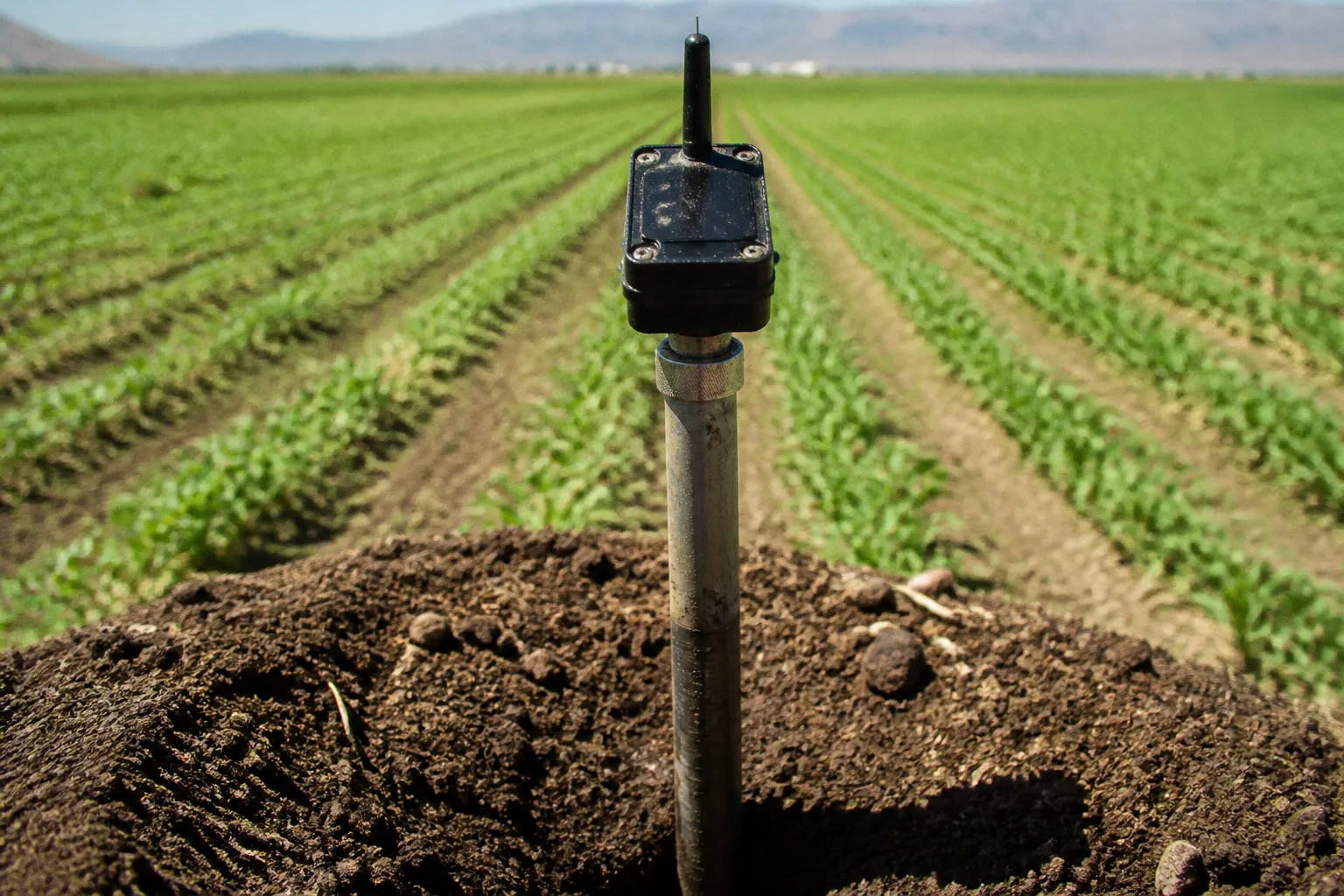
Digital soil testing—using in-ground sensors, IoT-connected monitoring systems, and smartphone-based decision support platforms—is no longer experimental theory in Lebanon. It's being deployed across pilot farms in the Akkar and Bekaa areas, producing measurable results: 22% to 40% reductions in water use, up to two-thirds cuts in fertilizer consumption, and yield improvements that translate directly into export-grade produce. This is the science of soil microbiology meeting real-time data, and the implications for Lebanon's agricultural cooperatives are substantial.
From Traditional Labs to Real-Time Sensor Networks
The Lebanese Agricultural Research Institute has operated soil and water testing laboratories for years. Its Tal Amara station in the Bekaa Valley provides farmers with the foundational analyses—texture, pH, electrical conductivity, organic matter content, NPK levels, and heavy metal screening. These are the baseline measurements that any serious soil management strategy depends on. A farmer brings in a sample, waits for results, and adjusts inputs accordingly.
The limitation is obvious: it's a snapshot. Soil is a living system. Its moisture content shifts with irrigation cycles, its nutrient availability fluctuates with microbial activity, and its temperature profile changes hour by hour. A lab result from Tuesday morning tells you nothing about what's happening in the root zone on Thursday afternoon.
This is where sensor networks change the equation entirely. Take the system deployed by SmartLand Agri, a Lebanese agrotech enterprise based in Hawsh Elharimeh in West Bekaa. Their automated smart irrigation and fertigation systems connect in-ground sensors to a mobile application, giving farmers continuous readings of soil moisture, temperature, pH, and nutrient levels. The International Labour Organization partnered with SmartLand Agri to deploy these sensor-based systems across 15 pilot farms in the Akkar and Bekaa areas. The results were striking: water savings ranging from 22% to 40%, with orchard operations achieving up to 50% reductions. Fertilizer use dropped by as much as two-thirds—all without reducing yields. In fact, the proportion of Class A produce increased by 16%.
What makes this significant isn't just the numbers. It's the shift from reactive to predictive farming. When a sensor tells you the volumetric water content in your root zone has dropped below the optimal threshold for your specific crop at its current growth stage, you irrigate—precisely, deliberately, and only as much as the soil biology actually requires. You stop guessing. You stop over-applying inputs as insurance against uncertainty.
The Acquaount project, funded by the European Union, took this approach further by installing continuous soil moisture monitoring at pilot sites across the Bekaa Valley, including Haouch el Ammik, Saaidi-Kfardan, and Sariine. Using Enviropro sensors and MRL-8 dataloggers, these installations record volumetric water content and soil temperature around the clock, building datasets that reveal patterns invisible to the human eye—how soil moisture responds to micro-climatic shifts, how deep percolation occurs in specific soil types, how the relationship between irrigation timing and root uptake actually functions under field conditions.
This is the kind of granular soil science that transforms crop rotation planning from guesswork into calibrated strategy.
Quantifying Efficiency: What the Sensors Actually Save
Numbers matter. A farmer considering the investment in sensor technology needs to understand what those upfront costs deliver in tangible, seasonal returns. Here's where the data from Lebanon's pilot programs becomes essential.
| Parameter | ILO SmartLand Agri Pilots | Bluleaf® DSS (Durum Wheat) | SEALACOM Project (Potato & Zucchini) |
|---|---|---|---|
| Water savings | 22–40% (up to 50% in orchards) | 25.7% (over 1,000 m³/ha) | 60% in zucchini production |
| Fertilizer reduction | Up to 66% | Not separately measured | Fertigation optimized |
| Yield impact | 16% increase in Class A produce | Maintained yields with less water | 17.8% increase (potato), 22% increase (zucchini) |
| Labor savings | 18–25 hours per production cycle | — | — |
The labor savings deserve attention. Eighteen to 25 hours per production cycle may not sound transformative on paper, but in a cooperative context—where shared labor resources are stretched across multiple members' plots—that time compounds. It frees workers for harvesting, sorting, and the post-harvest handling that determines whether produce meets export-grade specifications.
The shift isn't from cheap farming to expensive farming. It's from over-spending on inputs you don't need to investing in data that tells you exactly what your soil requires.
The SEALACOM project's findings on continuous fertigation are particularly instructive. By delivering dissolved nutrients directly through the irrigation system at rates calibrated to crop uptake, the technique eliminated the boom-and-bust cycle of granular fertilizer application—where a heavy initial dose floods the root zone with nutrients, most of which either leach into groundwater or bind into unavailable forms before the plant can absorb them. The 60% water savings in zucchini production alone demonstrates that precision irrigation and nutrient delivery are not separate problems. They're the same problem, solved together.
Smart Vineyards: A 300-Hectare Proof of Concept
Château Kefraya's estate in West Bekaa provides perhaps the most compelling case study for what sensor-driven soil management looks like at commercial scale. In 2017, the winery deployed Lebanon's first "Smart Vineyard" in collaboration with Libatel, Ogero Telecom, and Université Saint-Joseph ESIAM. The system uses Libelium Waspmote Plug & Sense! wireless sensor nodes distributed across the vineyard's 300 hectares, continuously monitoring soil moisture, temperature, and microclimate parameters.
For viticulture, this precision is non-negotiable. Grape quality—particularly for the fine wine market that Lebanese producers are increasingly targeting—depends on controlled vine stress. Too much water and the grapes swell, diluting flavor compounds. Too little and the vines shut down photosynthesis, halting sugar accumulation. The window between optimal and damaging moisture stress is narrow, and it shifts throughout the growing season.
The sensor network at Kefraya allows the vineyard team to manage irrigation at a resolution that was previously impossible. Rather than irrigating entire blocks uniformly, they can identify zones within the vineyard where soil moisture is depleting faster—due to slope, soil texture variation, or root density—and apply water precisely where it's needed.
This is the model that Lebanon's agricultural cooperatives should be studying. Not because every cooperative can deploy a 300-hectare sensor network, but because the principle scales. A cooperative managing 15 members' plots across a shared water source can use even a handful of strategically placed sensors to understand moisture distribution across the collective growing area. The data informs collective decisions about irrigation scheduling—decisions that currently rely on the least efficient method available: whoever shouts loudest about needing water.
Bridging Digital Decision Support with LARI Standards
Here's a tension that rarely gets discussed in agtech conversations: sensor data and laboratory analysis are not competitors. They're complementary layers of soil intelligence, and the most effective systems integrate both.
LARI's physical and chemical soil testing provides the foundational soil profile—the baseline character of a given plot. How much organic matter does it contain? What's the cation exchange capacity? Are heavy metal levels within safe thresholds for food production? These are parameters that in-ground sensors don't measure in real-time. They require laboratory instrumentation, trained technicians, and established protocols.
Sensor networks, by contrast, track the dynamic variables—moisture, temperature, real-time nutrient availability—that shift daily or hourly. They answer the operational question: what does my soil need right now, today, this week?
The Bluleaf® smartphone-based Decision Support System, tested in the Bekaa Valley on durum wheat and potatoes, illustrates this integration well. It functions as a layer between the sensor readings and the farmer's decision-making, translating raw soil moisture and climate data into actionable irrigation recommendations. In field trials on durum wheat, it achieved water savings of over 1,000 cubic meters per hectare—25.7%—compared to the traditional calendar-based irrigation scheduling that most Bekaa farmers still use.
Calendar-based irrigation is the agricultural equivalent of taking medication on a fixed schedule regardless of symptoms. It ignores the reality that soil moisture fluctuates with temperature, humidity, wind, crop growth stage, and the specific water-holding capacity of the soil type in question. A sensor-based system responds to actual conditions rather than assumptions.
The path forward for Lebanese cooperatives is clear: routine LARI lab testing for soil characterization and compliance—particularly for export certification, where documentation of soil safety and input records is increasingly required—paired with sensor-based monitoring for day-to-day irrigation and fertigation management. The two systems reinforce each other. The lab tells you what your soil is. The sensors tell you what it's doing.
The Smallholder Gap: Scaling Beyond Pilot Projects
The data from Lebanon's pilot programs is encouraging. But there's a reality that the numbers don't address: cost, access, and the structural barriers that prevent smallholder farmers from adopting sensor technology.
The ILO-supported pilots with SmartLand Agri deployed technology across 15 farms. That's a carefully selected, project-supported sample. The Bluleaf® trials were conducted on research plots. The Acquaount installations were EU-funded. Château Kefraya is one of Lebanon's largest and best-resourced wine estates. None of these represent the situation of a typical Bekaa smallholder farming five to ten hectares with limited capital reserves and no access to technical support for system maintenance.
The unknowns are significant. We don't have reliable data on how many smallholder farmers in the Bekaa Valley have independently adopted digital soil testing sensors without NGO subsidies. The long-term durability and maintenance costs of IoT sensors under the Bekaa's extreme seasonal temperature swings—from sub-zero winters to 40°C summers—remain poorly documented. And the market structure for agrotech services in Lebanon is still developing; we lack clear figures on the relative market share of providers like SmartLand Agri versus international alternatives.
What we do know is this:
1. Initial cost remains the primary barrier. A basic sensor-and-gateway setup suitable for a smallholding represents a significant investment relative to farm income, particularly in a country where agricultural margins have been compressed by economic crisis, currency devaluation, and rising input costs.
2. Technical literacy is uneven. Smartphone-based DSS platforms assume a level of digital comfort that not all farmers possess, particularly older generations who form the backbone of Bekaa agriculture. Training and ongoing extension support are essential—not as an afterthought, but as a core component of any deployment strategy.
3. Infrastructure gaps persist. Reliable mobile connectivity across the Bekaa's more remote agricultural zones cannot be assumed. Sensor networks that depend on cellular data transmission need coverage that, in some areas, remains patchy.
4. Subsidy models need transition planning. If sensor adoption depends entirely on external project funding, the technology will disappear when the project ends. The challenge is designing subsidy pathways that reduce initial costs while building farmer capacity to maintain and eventually self-fund the systems.
This isn't a reason for pessimism. It's a reason for pragmatism. The technology works—the pilot data proves that conclusively. The question is whether Lebanon's agricultural policy, cooperative structures, and international development partnerships can create the conditions for adoption at scale.
A Seasonal Timeline for Transition
For cooperatives considering the shift toward sensor-based soil management, here's a practical starting framework—organized around the agricultural calendar rather than abstract planning stages:
Late autumn (October–November), pre-planting season: Commission LARI laboratory soil analysis for all member plots. This establishes the baseline soil profile—pH, organic matter, NPK levels, micronutrient status, and any contamination concerns. It's also the documentation foundation for export certification.
Early winter (December–January): Install soil moisture sensors in representative plots—ideally two to three plots per cooperative, chosen to represent the range of soil types and topographies in the growing area. Connect to a data logging system; SmartLand Agri's platform or comparable services can provide the monitoring infrastructure.
Late winter to early spring (February–March): Begin collecting baseline moisture and temperature data before the growing season starts. This pre-season dataset is valuable—it reveals how soil moisture responds to winter rainfall and establishes reference points for irrigation scheduling later.
Growing season (April–September): Use sensor data to guide irrigation and fertigation decisions. Cross-reference real-time readings with LARI soil profiles to calibrate nutrient applications. Track inputs precisely—this data supports both cost optimization and export compliance documentation.
Post-harvest (October): Review the season's data. Compare water and fertilizer use against pre-sensor baselines. Document yield changes. This assessment informs the following season's adjustments and builds the evidence base for scaling the system to additional cooperative members.
The shift from intuition-driven to data-informed farming doesn't happen in a single season. It takes two to three cycles to build the dataset, calibrate the recommendations, and develop the farmer confidence that makes the technology genuinely useful rather than just an expensive dashboard.
But the direction is clear. In a valley where every cubic meter of water and every kilogram of fertilizer carries a cost—financial and ecological—the ability to apply exactly what the soil needs, exactly when it needs it, isn't a luxury. It's the baseline for agricultural viability in a changing climate.