Clogged drip emitters: a 10-minute vinegar fix
A blocked drip emitter rarely fails without leaving a pattern. In a Lebanese irrigation line, the first plants to show stress are often those furthest from the filter or at the highest point in the…
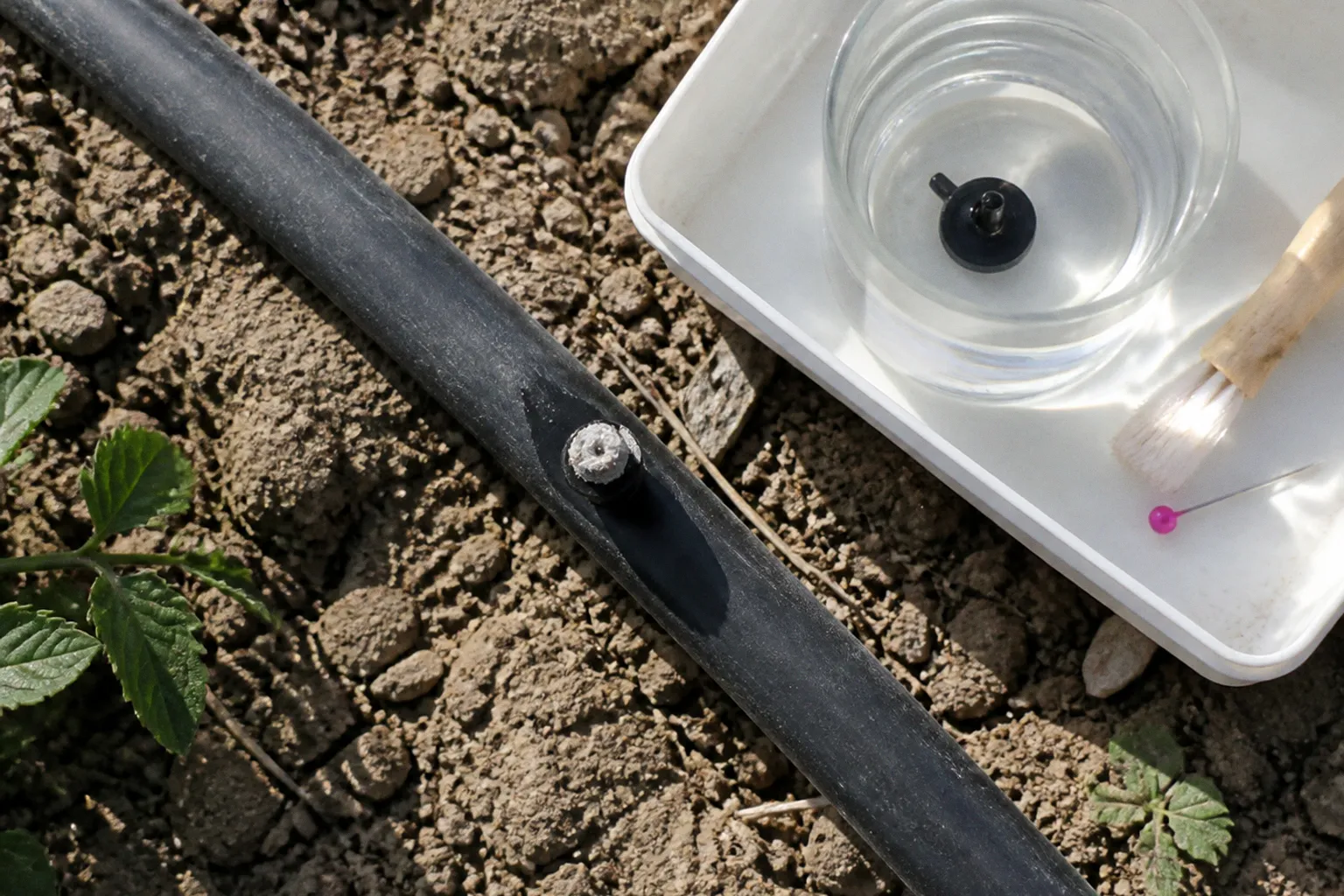
A blocked drip emitter rarely fails without leaving a pattern. In a Lebanese irrigation line, the first plants to show stress are often those furthest from the filter or at the highest point in the plot: basil wilts at midday, young cucumber leaves lose their firmness, and one row of tomatoes begins to lag while the neighbouring row remains healthy. The temptation is to increase pump pressure or add more fertilizer. Neither addresses the obstruction.
Hard water is usually the quieter cause. As irrigation water passes through emitters, calcium and magnesium carbonates can precipitate into a pale crust. The opening narrows, the discharge rate falls, and the crop receives less water even though the line appears pressurized. For a removable drip emitter, a short soak in ordinary white vinegar can dissolve this mineral scale in about ten minutes.
The method is simple, but the chemistry determines where it is safe to use. Vinegar is a descaling treatment—not a universal disinfectant, not a fertilizer, and not a substitute for filtration or routine flushing.
Mineral scale is usually the first suspect
Drip irrigation is designed around small, calibrated openings. That precision saves water, but it also gives sediment and mineral deposits very little room to accumulate before the flow changes. A thin layer of scale can reduce output enough to create uneven crop growth across the same bed.
Mineral clogging generally has a few recognizable features:
- The deposit is white, cream-coloured, or grey and feels hard when dry.
- The emitter delivers a weak trickle rather than stopping because of a soft mass.
- The problem appears repeatedly in the same part of the system, especially where water evaporates between irrigation cycles.
- The irrigation water has a history of leaving scale on tank fittings, taps, greenhouse frames, or pump components.
- Flow improves after soaking the removable emitter in an acidic solution.
Calcium carbonate and magnesium carbonate are the main components of this type of scale. They are not the same as soil particles, algae, or bacterial slime. Each requires a different response, which is why randomly pushing tools into the emitter or pouring chemicals into the line often creates more problems than it solves.
A quick diagnosis can be made by removing one affected emitter and examining it in daylight. If the opening is ringed with a chalky deposit, vinegar is a reasonable first treatment. If the material is green, brown, stringy, or slippery, you are probably looking at biological growth or trapped organic matter instead.
| What you see at the emitter | Likely cause | Most suitable first response |
|---|---|---|
| White, brittle crust | Calcium or magnesium scale | Vinegar soak and gentle brushing |
| Fine grit or visible particles | Sand, silt, or poor filtration | Remove and rinse emitter; flush the line; inspect the filter |
| Green film or slippery residue | Algae or bacterial slime | Mechanical cleaning and an appropriate oxidizing treatment |
| No flow at the end of a long line | Pressure loss, sediment, or undersized layout | Check pressure, open the line end, and flush for two minutes |
| Flow varies between identical emitters | Uneven pressure or partially clogged outlets | Compare discharge, inspect filters and pressure regulation |
Vinegar can dissolve a mineral crust. It cannot correct poor filtration, low pressure, algae growth, or a badly designed irrigation line.
In practice, the most reliable diagnosis combines appearance with a flow comparison. Place water from a clean emitter and a suspect emitter into separate containers for the same length of time. The difference does not need laboratory equipment to be useful. If one outlet consistently delivers much less, clean it before changing the irrigation schedule or crop inputs.
The 10-minute vinegar soak
For a removable drip emitter, use standard white household vinegar. A typical product contains about 5% acetic acid, which is strong enough to loosen carbonate scale without requiring the harsher acids used in commercial fertigation systems.
You will need:
- White vinegar at approximately 5% acetic acid
- A small non-metallic container
- Clean water for rinsing
- A soft toothbrush or similarly soft brush
- A straight pin, used carefully only if the opening still contains loosened debris
- A cloth or tray so small components do not disappear into the soil
The process is short, but each step protects the emitter’s calibrated flow rate.
1. Shut down the line
Turn off the pump or close the irrigation valve. Release pressure before removing any fittings. Working on a pressurized line can dislodge debris into the next section of tubing, and a small emitter can be difficult to control when water is still pushing through it.
If the system has been dosing fertilizer, flush clean water through the relevant section first. Vinegar should not be treated as an automatic companion to fertilizer residues or other chemical products.
2. Remove the affected emitter
Take out the emitter if the design allows it. Many button emitters can be unscrewed or pulled from polyethylene tubing. If the outlet is integrated into drip tape, do not enlarge the opening with a tool; clean the accessible surface and use line flushing instead.
Mark the emitter’s location if you are removing several. Keeping track of which outlet came from which section helps reveal whether clogging is concentrated near the water source, at the end of the line, or across the entire block.
3. Soak in undiluted vinegar for 10 minutes
Place the removable emitter in white vinegar and leave it submerged for about ten minutes. This gives the acetic acid time to react with the carbonate deposit. The crust may soften, flake, or become visibly less opaque.
For stubborn mineral buildup, use a 1:1 mixture of vinegar and water and extend the soak to 30–60 minutes. A longer soak is not automatically better for every plastic component, and the long-term effect of repeated vinegar exposure can vary with emitter materials and internal diaphragms. Use the shortest treatment that restores the opening.
4. Brush, do not drill
After soaking, gently brush the emitter with a soft toothbrush. The goal is to remove loosened scale from the inlet screen, outlet, and visible channels—not to reshape any part of the device.
If a small fragment remains at the opening, a straight pin can help lift it away with a light touch. Do not use a sewing needle to bore through the orifice. The calibrated opening controls the emitter’s discharge rate; widening it can permanently turn a low-flow outlet into an uncontrolled leak.
5. Rinse and test
Rinse the emitter thoroughly with clean water. Reinstall it, restore pressure, and watch the discharge for at least a minute. Compare it with a nearby emitter of the same model. A restored outlet should produce a stable flow rather than a brief burst followed by another slowdown.
If the emitter remains weak after descaling, the obstruction may be inside the inlet screen or pressure-compensating mechanism. At that point, replacing a low-cost emitter is often more sensible than forcing a tool through the internal assembly.
A note on drip tape
Drip tape is less forgiving than removable button emitters. Its thin wall and built-in labyrinth channels can be damaged by pins, wire, or improvised scraping. For tape, open the end of the row and flush the line. If the same section repeatedly clogs, investigate the filter grade, water source, storage tank, and pressure rather than treating each outlet as an isolated failure.
A vinegar bath is most useful for removable components. It is not a reason to inject undiluted vinegar into a full commercial network.
Protecting roots from low pH
Undiluted household vinegar has a pH of roughly 2.4. That acidity explains why it dissolves mineral scale, but it also explains why it can injure plant tissue and disturb the root-zone environment if applied carelessly.
Most crop root zones function within a much milder range, commonly around pH 5.5–7.0 depending on the crop and substrate. A concentrated vinegar flush near young roots can cause phytotoxicity, especially in shallow beds, containers, and greenhouse media with limited buffering capacity.
The safest approach is to remove the emitter and clean it away from the crop. When mineral deposits must be treated near plants—for example, on an exposed fitting or a surface close to the root zone—use a diluted solution of one part white vinegar to three parts distilled water. Apply it only to the deposit, not across leaves or soil, and rinse the treated surface with clean water within 90 seconds.
That distinction matters. Cleaning a plastic fitting is a controlled surface treatment. Pouring vinegar into the bed is an uncontrolled pH event. The latter can affect root hairs, microbial activity, nutrient availability, and the structure of the growing medium.
Do not use vinegar as a routine soil amendment unless you are working from a specific, measured soil-management plan. A temporary change in pH is not the same as correcting alkaline irrigation water or managing bicarbonate accumulation. Those problems require water testing, soil or substrate testing, and a properly calculated acidification strategy.
For a greenhouse or nursery bench, keep the cleaning container, rinse water, and removed emitters physically separate from trays and open substrate. A small amount of discipline here prevents a simple descaling job from becoming a crop injury incident.
Cleaning without changing the flow rate
The most common mistake in drip irrigation emitter cleaning is treating the outlet like a blocked household pipe. The opening is engineered to release a known amount of water at a given pressure. A sharp tool can make the emitter appear unclogged while quietly changing its performance.
That change has consequences across the whole irrigation design:
1. The modified emitter may discharge too quickly.
The plant beneath it receives more water than its neighbours, while the pressure available to downstream outlets falls.
2. The irrigation schedule becomes misleading.
A timer may still run for the same duration, but the volume applied to each plant is no longer consistent.
3. Fertilizer distribution becomes uneven.
In fertigation, a high-flow outlet can receive a disproportionate share of dissolved nutrients, while partially blocked emitters remain underfed.
4. Runoff and saturated pockets can appear.
This is especially damaging in heavy soil, where repeated over-application around one plant reduces air-filled pore space and stresses roots.
5. The original problem becomes harder to diagnose.
The line now contains a mixture of clean, damaged, and partially clogged outlets.
Use a soft brush for deposits on the outside and a gentle rinse for loosened particles. If an emitter cannot be cleaned without forcing a tool through its calibrated opening, replacement is the better agronomic decision.
For larger vegetable blocks, keep a small record of emitter model, row location, cleaning date, and observed flow. This may feel excessive for a few outlets, but patterns become visible after two or three maintenance cycles. If the same rows clog every month, the system is reporting a water-quality or hydraulic problem.
Vinegar is not a treatment for biological clogs
Mineral scale and biological growth can occur together, particularly in warm irrigation tanks exposed to sunlight. A vinegar soak may remove the hard outer crust while leaving algae, bacterial slime, or fungal material inside the emitter and line.
Vinegar is ineffective against biological clogging and resilient fungal spores. It should not be described as a sterilizing treatment for pathogens such as Fusarium or Pythium. Those organisms require a separate sanitation protocol, and any oxidizing product—such as hydrogen peroxide or a dilute bleach solution—must be selected and dosed according to the irrigation equipment, crop, water source, and local safety requirements.
The visual distinction is useful:
- Scale is hard, chalky, and usually pale.
- Algae often appears green or dark and may form a film.
- Bacterial slime feels slippery and can collect in filters or low points.
- Organic sediment may look like fine brown mud, decomposed leaves, or tank debris.
Do not mix vinegar with bleach or other cleaning chemicals. Combining acids and chlorine products can release hazardous gases. Clean and rinse the component thoroughly before any different treatment is considered.
If biological clogging is recurring, inspect the water source rather than relying on repeated emitter cleaning. Opaque tank covers, regular tank sanitation, suitable filtration, and reduced exposure to sunlight can address the conditions that allow growth. A disinfected line will clog again if the source water continues to carry organic material into it.
The line itself needs maintenance
Individual emitter cleaning restores outlets, but system-wide flushing prevents many of those blockages from forming. At least once a month, open the end caps or line ends and flush the entire drip section for about two minutes. The water should run until visible sediment and loose debris are cleared.
This is particularly valuable after:
- Repairing a mainline or replacing a filter
- Filling a storage tank after a period of sediment accumulation
- Disturbing soil near buried or surface lines
- Applying fertilizers that can leave undissolved particles
- Long periods when the irrigation system has been shut down
- Heavy wind or dust events that introduce material into open tanks and fittings
Flush the mains before the laterals. Otherwise, particles released from the supply pipe can be pushed directly into the smaller drip lines. If the system has multiple blocks, isolate them and flush one section at a time so the available flow is strong enough to carry debris out.
Filter inspection belongs in the same routine. A filter that looks clean from the outside may have a partially blocked screen, causing pressure loss before the water reaches the emitters. Conversely, a filter with an overly coarse mesh may allow sand and organic particles into the laterals. The correct filtration level depends on the emitter design and the water source; the smallest passage in the system should determine the protection required.
Pressure should also be measured at the beginning and end of a representative line. A weak emitter at the far end may not be clogged at all. It may simply be receiving inadequate pressure because the row is too long, the pipe diameter is too small, or the pressure regulator is incorrectly adjusted.
The best drip irrigation cleaning routine is not a stronger chemical. It is a system that keeps scale, sediment, and biological material from reaching the emitter in the first place.
When agricultural acids enter the picture
Commercial farms sometimes use phosphoric, nitric, or sulfuric acid injected into irrigation lines to dissolve mineral deposits throughout the network. These are not scaled-up versions of a household vinegar soak. They are controlled chemical treatments that require dosing equipment, pH measurement, compatible materials, worker protection, and a clear flushing procedure.
System-wide acid flushing may target a line pH between 2.0 and 4.5, depending on the product, water chemistry, deposit, and equipment. That range is far more aggressive than the root-zone environment of most crops. The acid is injected into an empty or controlled irrigation cycle, held for a specified period, and then flushed thoroughly before irrigation or fertigation resumes.
For a small cooperative, greenhouse, or mixed vegetable plot, the practical sequence is usually:
- Test the irrigation water for hardness, alkalinity, suspended solids, and biological contamination.
- Confirm that the filter and pressure regulator match the emitter specification.
- Use removable-emitter vinegar cleaning for isolated mineral blockages.
- Flush lines regularly rather than waiting for crop symptoms.
- Bring in a trained irrigation technician for calculated acid treatment across the whole network.
A vinegar flush for a drip system can be useful in a narrow, low-risk situation: a removable emitter with visible carbonate scale. It is not a reliable continuous injection strategy for commercial agriculture, and the long-term feasibility and dosage of repeated in-line vinegar use should not be assumed without testing.
The distinction is similar to soil management. A handful of compost can improve a bed because the amount and location are controlled. Dumping an unmeasured organic load into an entire irrigation network does not create resilience; it creates an unknown input.
A seasonal maintenance rhythm
Emitter cleaning works best when it is tied to the crop calendar rather than left until plants begin to wilt. The following rhythm is simple enough for a small farm team and structured enough to reveal recurring faults.
Before the irrigation season
Inspect the tank, pump, filter housing, pressure regulator, mainline, and row ends. Remove stored sediment from the tank if necessary. Open the ends of the drip lines and flush them before planting. Test a sample of emitters from the beginning, middle, and end of several rows.
If hard-water scale is already visible, remove and soak affected emitters in white vinegar for ten minutes. Use the longer 30–60-minute treatment only for deposits that remain after the first cleaning. Rinse every component before reinstalling it.
During establishment
Young plants have small root systems and little tolerance for uneven water delivery. Check the rows frequently during the first weeks. Look for repeated differences in plant size, damp patches, dry patches, and emitters that pulse rather than deliver a steady discharge.
Record problem locations. If the same section fails again, stop treating the symptom and examine pressure, filtration, and the water source.
At peak heat
Hot weather increases evaporation from tanks and exposed lines, which can concentrate dissolved minerals. It also accelerates algae growth where sunlight reaches stored water. Inspect filters more often, keep tanks covered from light where possible, and flush line ends at least monthly.
Do not extend irrigation time simply because some plants are under-watered. First confirm whether the deficit is caused by a clogged outlet or hydraulic imbalance. More runtime can saturate the plants that are still receiving full flow.
After harvest or before shutdown
Flush the system with clean water, drain vulnerable sections where freezing or sediment accumulation is a concern, and remove problem emitters for cleaning or replacement. Note which blocks had recurring scale or biological growth. That record is more valuable than trying to remember the pattern at the start of the next season.
The ten-minute vinegar method belongs in this wider routine. Used on the right component, it is inexpensive, accessible, and gentle compared with strong mineral acids. Used as a cure for every irrigation failure, it obscures the real work: testing water, protecting the filter, maintaining pressure, and designing a line that can be flushed.
A clean emitter is only one restored opening. A reliable irrigation system is one in which every opening receives suitable water, at suitable pressure, for the full length of the crop row.