Solar water pumps: 5 ways to irrigate Lebanese crops
For a Lebanese farm, the case for solar pumping is not simply about replacing diesel with panels. It is about making water arrive at the crop with less waste, fewer interruptions, and a more predictable operating cost.
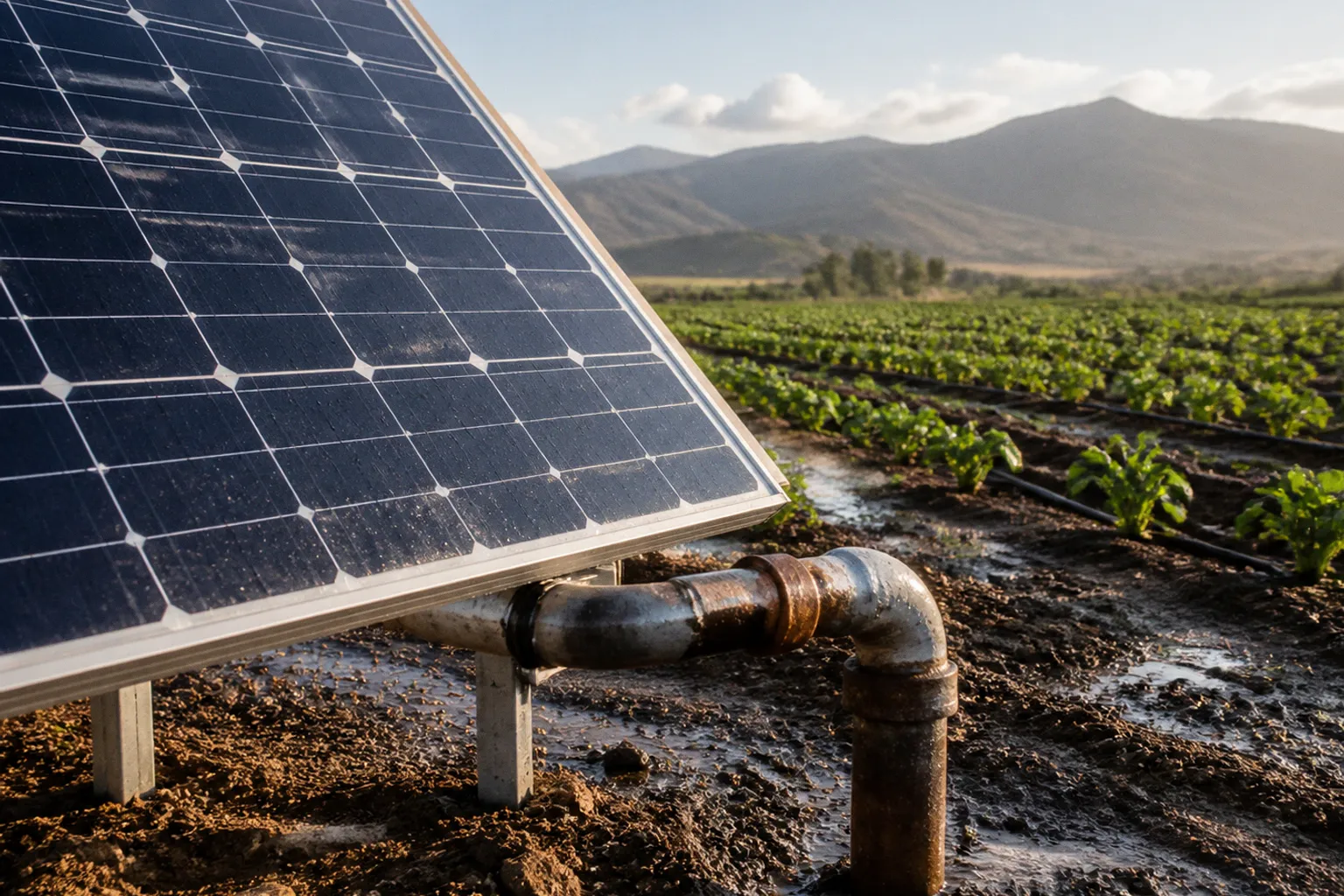
The same pump can feed a drip network, fill an elevated reservoir, pressurise sprinklers, draw from a deep borehole, or serve a protected-cultivation unit. The right configuration depends less on the panel count than on the relationship between the well, the field, the crop, and the cooperative’s ability to maintain the system.
Surface irrigation can return only a portion of applied water to the active root zone. A well-designed drip system can place a much larger share near the crop, while fertigation allows dissolved nutrients to move through the same distribution network. The research behind Lebanese agricultural projects reports nitrogen-fertilizer recovery in the range of 55% to 80% under improved irrigation and fertigation practices. That figure should not be read as a universal result for every crop or field: recovery depends on application timing, soil texture, filtration, emitter uniformity, and the way the farm measures nutrient uptake.
The energy equation is also attractive, but it is not automatic. Solar pumping reduces exposure to diesel purchases and generator maintenance, yet the system still has to be correctly sized. A pump that cannot meet the required head, a reservoir that is too small for the evening cycle, or a filter that clogs during peak demand can turn a technically sound installation into an expensive irrigation problem.
Precision Drip Irrigation and Fertigation Efficiency
The highest-leverage application of solar pumping in Lebanon is usually the PV-integrated drip-and-fertigation loop. It suits vegetables, potatoes, orchards, and other crops where water can be delivered in measured cycles rather than across the whole field at once.
A typical system combines:
- photovoltaic modules and a solar pump inverter;
- a surface or submersible pump selected for the required flow and total dynamic head;
- a sand separator or sediment filter, followed by disc or screen filtration;
- mainlines, sub-mainlines, pressure regulators, and drip laterals;
- a fertiliser injector or dosing unit;
- a controller that can respond to tank level, pressure, or soil-moisture readings.
The array does not need to power every part of the farm. Its job is to provide the hydraulic energy required to move a defined volume of water from the source to the crop. That distinction matters. Farmers often begin with the area of the field and choose a panel capacity from there, but the more useful starting point is the irrigation schedule: how much water is required per day, at what pressure, from what depth, and during which hours.
For intensive row cropping, a 10 kWp array is often discussed as a planning reference for a one-hectare installation, but it is not a universal specification. A shallow well, a low-pressure drip network, and a large storage tank may require a very different system from a deep borehole feeding several blocks at once. Pump selection should be based on the pump curve, not on the nominal motor size alone. The installer needs to account for static lift, friction losses in the pipework, filtration losses, pressure at the farthest emitter, and the decline in available solar power during the morning and late afternoon.
Drip laterals commonly operate at relatively modest pressures compared with sprinklers. Emitter discharge may be specified in litres per hour, but the figure is meaningful only when the pressure remains within the manufacturer’s range. Pressure-compensating emitters can help on sloping land or on long runs, while non-compensating lines may be adequate for smaller, more uniform plots. In either case, filtration and flushing are not optional details. Fertigation increases the value of uniform distribution, but it also makes poor maintenance more visible: a blocked section can create a dry strip in the field while the pump continues to run normally.
The reported 55% to 80% nitrogen-recovery range is best understood as evidence of the potential of improved irrigation and fertigation, not as a guaranteed result at the tuber, fruit, or plant level in every Lebanese operation. The practical gain comes from placing smaller nutrient applications closer to crop demand. It can reduce losses caused by over-application, runoff, and movement below the active root zone, but only if irrigation cycles are short enough and the soil is monitored.
Solar pumping creates the most value when the hydraulic design is precise. Panels cannot compensate for a leaking mainline, a blocked filter, or a pump chosen without reference to the actual head.
Capital cost varies with the borehole, filtration package, number of irrigation zones, automation, and the quality of the distribution hardware. Indicative planning ranges for a one-hectare PV-drip installation can be useful during early budgeting, but they should be treated as estimates rather than market quotations. Imported equipment, shipping, currency changes, civil works, and the need for a backup connection can move the final figure substantially.
The operating profile is generally simpler than that of a diesel station, but “low operating cost” does not mean “no maintenance.” A cooperative should budget for:
- periodic cleaning and replacement of filters;
- flushing of laterals and inspection of end caps;
- pump and inverter checks;
- replacement of worn valves and seals;
- sensor calibration where automated control is used;
- protection of electrical equipment from dust, water ingress, and voltage disturbances.
Collective procurement can improve bargaining power for emitters, filters, valves, and replacement parts. It may also make technical support easier to organise. The scale of that benefit depends on the cooperative’s purchasing volume and supplier relationship, so it should be negotiated rather than assumed as a fixed percentage.
Gravity-Fed Reservoir Management for Off-Grid Reliability
The simplest answer to solar intermittency is often not a battery. It is water storage.
An elevated reservoir allows the pump to operate when solar production is available and the field to receive water later, when the crop schedule requires it. During the day, the PV system lifts water into a tank. After sunset, the tank discharges through the irrigation manifold under gravity. The arrangement can support drip lines and, where the available head is sufficient, low-pressure micro-sprinklers.
The engineering is straightforward, but the elevation has to be calculated carefully. Pressure is created by the water column, and a tank that is only slightly above the field may not provide enough pressure once filtration, valves, pipe friction, and elevation changes are included. A design that appears adequate at the tank outlet can deliver weak flow at the end of a long lateral.
A reservoir-based layout usually includes:
1. a pump that fills the tank during the solar window;
2. a float switch or level sensor to prevent overflow and dry running;
3. an elevated tank sized around the crop’s irrigation cycle;
4. a separate distribution line with suitable filtration and pressure regulation;
5. an overflow route and a drain point for maintenance;
6. isolation valves so that one part of the system can be serviced without draining everything.
The tank volume should be tied to the crop schedule, not selected from a catalogue in isolation. A vegetable cooperative may need enough storage to cover evening irrigation and a short period of reduced sunlight. An orchard may have a different pattern, with irrigation divided into zones over a longer interval. A greenhouse may require relatively modest flow but greater continuity because the crop is protected from rain and depends entirely on the system.
Storage also creates a useful operational separation. The pump can run at the strongest part of the solar day while the irrigation team manages field cycles according to soil conditions and labour availability. That can reduce the temptation to irrigate simply because the generator is running or the sun is shining. It also gives the cooperative a visible reserve: tank level becomes an immediate indicator of whether the next irrigation cycle is secure.
The battery alternative has a place where night-time pressure, security systems, or control equipment must continue operating. But storing electricity is not always the most economical way to store irrigation capacity. Water storage avoids some battery replacement and thermal-management concerns, provided that land, structural support, and water quality make a reservoir practical.
The tank itself needs protection. Opaque polyethylene or properly finished concrete helps limit light exposure and algae growth. The base must be engineered for the full mass of the stored water, not merely the empty tank. In a cooperative setting, access for cleaning and inspection matters as much as the nominal volume. A reservoir that cannot be safely reached will eventually become a source of sediment, biological growth, and unreliable flow.
The gravity-fed approach is particularly useful where farmers already understand cisterns and elevated storage. It does not eliminate electrical maintenance, but it reduces the number of electrical components required for every irrigation cycle. If the pump stops, the stored water can still cover part of the scheduled demand. If the controller fails, the distribution system can often be operated manually.
Powering Sprinkler Systems for Large-Scale Field Crops
Sprinklers become more attractive when the field is large, relatively open, and planted with crops that do not justify the installation of a dense drip network. Potatoes, forage, some cereals, and other field crops may be irrigated more practically through movable or fixed sprinkler equipment, especially where contiguous acreage allows one pumping station to serve several plots.
The trade-off is water efficiency and pressure. Sprinklers generally require more pressure at the field edge than drip systems, and their application can be affected by wind, nozzle wear, and uneven terrain. A system that performs well in calm conditions may distribute water poorly during hot, windy periods. The design therefore has to consider both hydraulic capacity and the hours when irrigation can realistically take place.
A single impact sprinkler may use a substantial flow at operating pressure. Multiple heads operating together can quickly move the installation into a higher pump class, with larger inverters, heavier cables, and a wider PV field. Solar pump sizing should be based on the required simultaneous flow and pressure rather than on the total area alone. A large field can be divided into irrigation blocks so that the pump serves one section at a time, reducing the peak electrical requirement.
The main components include:
- the solar array and pump inverter;
- a pump capable of maintaining the sprinkler pressure at the design flow;
- a manifold with block valves;
- mainline and movable or fixed laterals;
- pressure gauges at the pump and the farthest block;
- sprinkler bodies and nozzles selected for the target application rate;
- a reservoir or hybrid source where irrigation must continue outside the solar window.
For large fields, the important comparison is not sprinkler against drip in the abstract. It is the cost of delivering the required volume at the required pressure across the actual field geometry.
Sprinkler systems can be a sensible cooperative investment when several farms share a pump house, intake, and mainline. Shared infrastructure spreads the cost of the high-capacity equipment, but it also introduces management questions. Someone has to schedule irrigation blocks, record water use, inspect couplings, and decide who pays when a pump or inverter requires service. Without clear operating rules, the physical system may be shared while the maintenance burden is not.
A solar sprinkler station can reduce dependence on diesel, but the financial comparison should use the cooperative’s real operating profile. Fuel consumption depends on pump efficiency, load, engine condition, head, operating hours, and the price paid at the farm. Solar output depends on array orientation, dust, shading, temperature, and the number of useful pumping hours. A credible solar irrigation system cost comparison should therefore include:
- the delivered price of the PV modules and inverter;
- pump, steelwork, cabling, protection, and civil works;
- sprinkler equipment and pipework;
- water storage, if required;
- cleaning and routine maintenance;
- diesel or generator costs under the actual irrigation schedule;
- the value of crop losses or missed irrigation during interruptions.
A generic seasonal fuel figure can make a proposal look precise while hiding the assumptions that determine the result. Cooperatives should ask suppliers to show the calculation in kilowatt-hours, cubic metres pumped, total head, and operating hours. That makes competing proposals easier to compare and exposes systems that have been sized around an optimistic pump rating.
Deep Well Extraction and Submersible Pump Integration
Deep-well extraction is where solar pump design becomes most dependent on site data. Lebanese groundwater conditions vary by district, aquifer, borehole construction, and season. Two farms that appear close on a map can have different static water levels, yields, casing diameters, and drawdown behaviour.
A submersible pump is installed below the water level and pushes water to the surface through the rising main. The pump may use helical or centrifugal stages, depending on the required flow and head. The array and inverter must be matched to that operating point. A pump that can lift water from a deep well may deliver a much smaller flow than it would at a shallow head, and the available flow can change as the water level falls during the irrigation season.
Before sizing the solar equipment, a cooperative should establish:
- static and dynamic water levels;
- sustainable well yield;
- borehole diameter and casing condition;
- water quality and filtration needs;
- total pipe length and elevation to the field;
- required daily volume;
- irrigation pressure at the field;
- access for pump retrieval and servicing.
The distinction between static head and total dynamic head is essential. Static head is the vertical distance the water must be lifted. Total dynamic head also includes friction through the rising main, valves, filters, and distribution network, as well as the pressure required at the irrigation equipment. If the system is designed only around the well depth, it may underperform even when the pump appears powerful enough on paper.
Solar submersibles are useful for remote farms because the array can be installed near the borehole and the water can be stored before it reaches the field. A reservoir can also allow the well pump to work during the most productive solar hours while a second, smaller pump distributes water later. In some sites, this two-stage arrangement is more efficient than trying to use one pump for both deep extraction and field pressure.
Deep-well installations also require attention to cable and sealing details. Cable length, gland quality, bore-casing diameter, water chemistry, and the method used to retrieve the pump all affect reliability. The pump should be protected against dry running and excessive cycling. If the well yield is limited, the control system should stop or throttle the pump rather than continuing to draw until the water level reaches the intake.
The main advantage over diesel is not simply the absence of fuel. It is the possibility of removing a noisy, regularly serviced engine from a remote location. That advantage is strongest where fuel delivery is difficult or where the cooperative can manage solar equipment more easily than it can maintain a generator. It is weaker where the borehole is low-yielding, the static head changes sharply, or the water must be lifted to a high-pressure sprinkler network.
A hydrogeological assessment and a lifecycle comparison should precede the purchase. The comparison should include pump replacement, borehole servicing, inverter protection, access equipment, and the consequences of a failed pump during the crop’s most water-sensitive period. A solar array may last for many years, but a deep-well system still depends on mechanical equipment operating in a demanding environment.
Greenhouse and Protected Agriculture Water Solutions
Greenhouses change both the water requirement and the value of reliability. Protected cultivation can reduce exposure to wind and rain variation, while high-density crops are often irrigated through small drip lines, capillary systems, or growing media. The pump may be smaller than an open-field system, but a missed cycle can matter more because the crop is fully dependent on controlled irrigation.
A compact arrangement may include a small PV array, a submersible or surface pump, a cistern, filtration, and a low-pressure distribution network. The array can be mounted beside the structure or on an adjacent frame, provided that shading, ventilation, and access for cleaning are considered. The greenhouse itself should not be treated as an automatic mounting platform: structural capacity, wind loading, maintenance access, and roof drainage all need to be checked.
The most useful design principle is separation between pumping and delivery. The pump fills the cistern when solar power is available. A low-power controller, gravity head, or small secondary pump then feeds irrigation zones according to the crop’s schedule. This arrangement protects the plants from short cloud events and avoids forcing the main pump to operate every time a single tray or bed needs water.
Protected agriculture also makes water quality more important. Fine emitters and small nozzles are vulnerable to sediment, algae, and precipitated minerals. Filtration should be sized for the actual source water, and the system should include a way to flush the lines without sending concentrated fertiliser solution into the growing area. Where fertigation is used, the injector must be compatible with the fertiliser and the flow range of the network.
A cooperative greenhouse programme can share several layers of infrastructure:
- a common procurement channel for panels, pumps, filters, and controllers;
- a technician trained to service several units rather than one;
- a shared nursery or seedling area;
- common water testing and fertigation procedures;
- a replacement-parts inventory for small pumps, valves, and filters.
This is where cooperative scale can have a practical effect without relying on an assumed percentage saving. The value may appear in fewer incompatible components, more consistent training, and faster diagnosis when a system fails. It may also improve access to financing or grant programmes, but the financing structure should be assessed separately from the hydraulic design.
Capital recovery in greenhouse irrigation should not be presented as a fixed number of months. Vegetable prices, planting dates, labour, fertiliser use, rejected produce, and market access can change the result more than the pump itself. A greenhouse with reliable irrigation may produce more saleable crop, but the financial benefit belongs to the whole protected-agriculture operation, not exclusively to the solar equipment.
Choosing the Configuration for a Lebanese Farm
The five configurations are not interchangeable. They solve different hydraulic problems.
| Configuration | Best fit | Main strength | Main limitation |
|---|---|---|---|
| Drip and fertigation | Vegetables, potatoes, orchards, high-value rows | Precise delivery and lower field losses | Requires filtration, flushing, and careful pressure control |
| Gravity-fed reservoir | Farms needing evening or backup irrigation | Stores water without relying on batteries | Needs elevation, structural support, and adequate pressure |
| Solar sprinkler station | Larger contiguous field crops | Covers broad acreage with shared infrastructure | Higher flow and pressure requirements; wind affects uniformity |
| Deep-well submersible system | Remote farms with suitable boreholes | Removes routine diesel pumping from the source | Highly dependent on well yield, head, and servicing access |
| Greenhouse water system | Protected vegetables, nurseries, intensive production | Compact equipment and controlled application | Small failures can affect crops quickly; water quality is critical |
The cost of a solar irrigation system in Lebanon should be developed from the site outward. A supplier quotation is useful only when it states the design flow, total head, daily volume, expected pumping window, storage assumptions, and irrigation pressure. “Solar pump” is not a complete specification. Two systems with the same array capacity may have completely different outputs if one lifts water from a shallow cistern and the other draws from a deep borehole.
For a cooperative, the decision should also include the management model. Will each farmer operate an independent pump? Will a common solar station fill a reservoir? Will the mainline be shared while drip systems remain private? Who controls the irrigation schedule, and how is water use recorded? These questions determine whether the infrastructure becomes a reliable agricultural asset or another underused installation.
The most resilient projects tend to combine technologies rather than treat them as competing choices. Drip can reduce the volume required in the field. A reservoir can shift water delivery away from the solar peak. A deep-well pump can fill that reservoir. Greenhouses can use a separate low-pressure loop. Sprinklers can remain on a dedicated block where the crop and field geometry justify them.
The Practical Case for Solar Pumping
Solar water pumps for Lebanese farms are no longer a single-product decision. They are part of a water-management system that includes storage, filtration, crop scheduling, field layout, and cooperative governance. The panels are visible, but the less visible components often determine whether the investment performs: the pump curve, the borehole test, the filter maintenance, the elevation of the tank, and the quality of the pipework.
The strongest starting point is usually the highest-value water use that the farm can control. For many vegetable operations, that means a properly filtered drip and fertigation network. Where irrigation must continue after the solar window, elevated storage may be more useful than a large battery. Where several hectares can be served from one station, sprinklers may justify the higher flow requirement. Where the farm depends on a remote borehole, submersible pumping can reduce fuel logistics, but only after the well has been measured. Greenhouses benefit from compact systems, provided that filtration and backup procedures are taken seriously.
No single capital figure or payback period applies across Lebanon. The result changes with well depth, crop value, water demand, diesel access, equipment quality, and the cooperative’s ability to share maintenance. That is not a weakness in the solar case; it is the reason generic promises should be rejected.
The useful question is not whether solar pumping works in Lebanon. It is whether the proposed system moves the right volume of water, at the right pressure, during the right part of the crop cycle—and whether the people operating it can keep it working. When those conditions are met, solar becomes more than a substitute for diesel. It becomes a way to organise irrigation around the crop rather than around the fuel supply.