Solar irrigation conversion: a five-stage farm project
In the Bekaa Valley, irrigation problems often appear first as crop problems. A potato field receives water, yet the soil surface seals after repeated cultivation. Greenhouse cucumbers show uneven growth along the same lateral line.
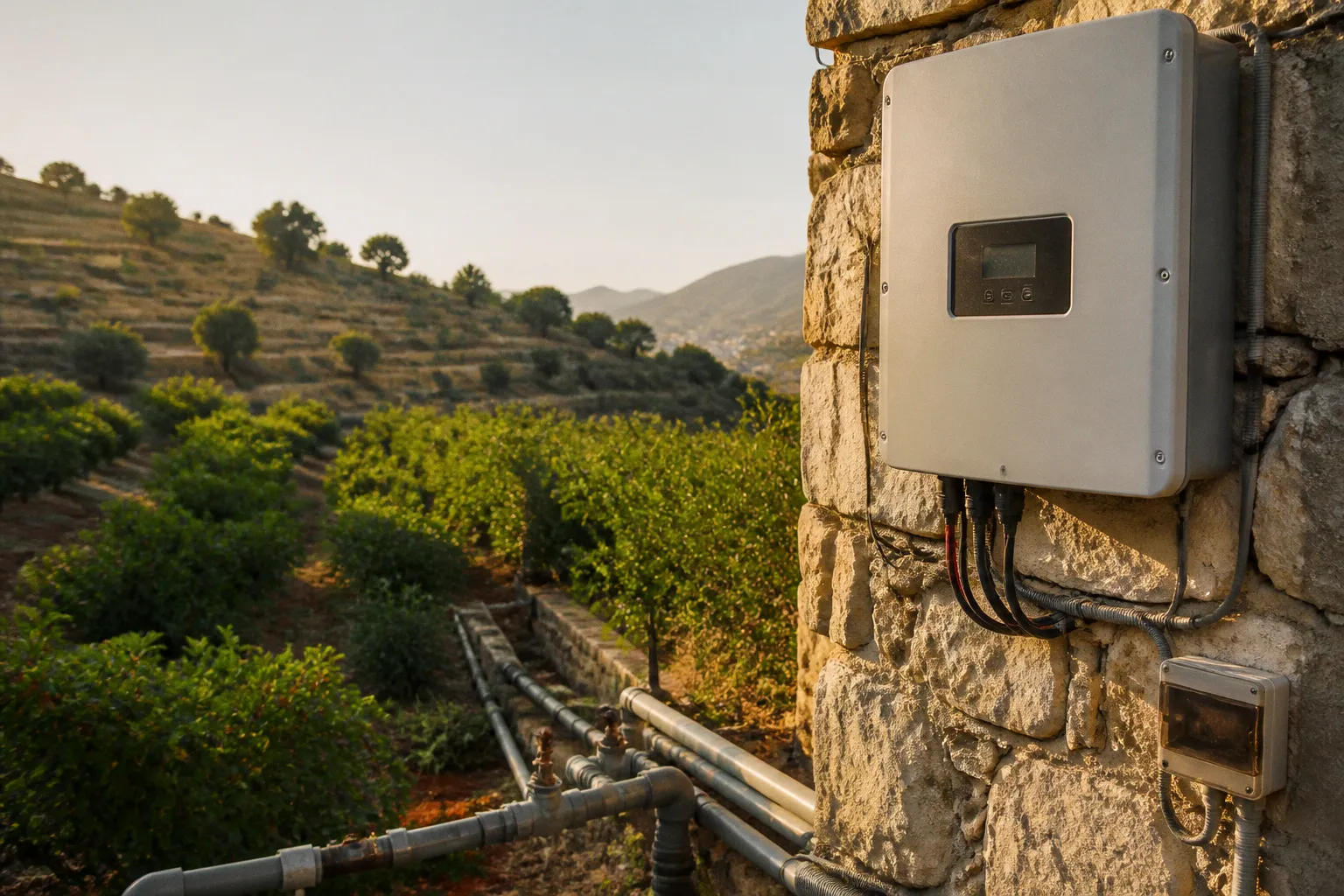
A young orchard survives, but its root zone dries quickly between pumping cycles. The immediate temptation is to add more water or run the pump longer. Often, the deeper issue is that the irrigation system is delivering water without matching the field’s hydraulic demand.
Solar irrigation conversion can improve that equation, but only when the farm is treated as a complete water-and-energy system. A solar array connected to an unsuitable pump will not make irrigation more reliable. Nor will a new inverter compensate for blocked filters, excessive pipe friction, poor storage planning, or a borehole whose yield changes sharply through the season.
For Lebanese farms, particularly in the Bekaa Valley, the practical objective is not simply to replace diesel or grid electricity with photovoltaic power. It is to deliver the required volume of clean irrigation water at the right pressure, during the crop’s most sensitive growth stages, with equipment that can be maintained locally and documented for demanding markets.
The conversion works best as a five-stage project: measure the hydraulic load, match the pump and inverter, build the array safely, add intelligent control, and maintain the system as agricultural infrastructure rather than as a one-time installation.
Stage one: measure the hydraulic load before discussing panels
The first mistake in a solar irrigation project is beginning with the available roof or the number of panels a supplier wants to sell. The correct starting point is the water requirement.
A pump does not consume energy simply because it exists. It consumes energy while moving a particular flow rate through a particular total head. That head includes the vertical lift from the water source, pressure required at the field, friction inside pipes and fittings, and losses through filters, valves, fertigation equipment, and distribution lines.
The basic relationship is straightforward:
Hydraulic power = water flow × total head × gravitational force
The electrical system must then supply more power than the hydraulic calculation alone suggests because motors, pumps, inverters, cables, and control equipment all have losses. The useful design question is therefore not “How many kilowatts of panels do we need?” but:
- How many cubic metres of water must be delivered each day?
- At what pressure must the water arrive at the irrigation block?
- How many hours of useful sunlight coincide with the irrigation schedule?
- Can the farm irrigate directly during the day, or does it need water storage?
- What happens when the crop requires water before the solar resource is strong enough?
Build a field water budget
The water budget should be calculated by irrigation block, not only for the entire farm. A cooperative with open-field potatoes, citrus, greenhouse vegetables, and stone fruit will not have one uniform demand pattern.
For each block, record:
- Crop and growth stage
- Irrigated area
- Irrigation method
- Emitter or sprinkler discharge
- Spacing between emitters or laterals
- Required operating pressure
- Irrigation frequency
- Pumping hours available each day
- Water source depth and seasonal variation
- Filtration and fertigation requirements
Drip irrigation usually allows more precise scheduling than sprinklers, but it does not automatically require a small pump. A large block with many laterals operating simultaneously can create a substantial flow demand. Conversely, reducing the number of open zones may allow an existing borehole pump to work with a smaller inverter and a more manageable solar array.
This is where crop planning becomes part of energy design. If all irrigation zones are opened at once during a hot afternoon, the electrical peak rises. If the farm irrigates in carefully sequenced zones, the same water volume may be delivered with a smaller instantaneous load.
Solar irrigation is not a panel problem. It is a scheduling, pressure, flow, and storage problem that happens to use sunlight as its energy source.
Separate water demand from pump demand
Crop evapotranspiration tells the agronomist how much water the crop needs. It does not tell the engineer how much power is needed to deliver that water. These are connected, but they are not interchangeable.
A field may need a modest daily volume but require high pressure because of elevation or long pipe runs. Another may have a large water demand but low pressure requirements if the source and irrigation blocks are close together. The same solar array can perform very differently in those two situations.
Before selecting equipment, measure the pump’s actual operating point where possible. Nameplate power is only a starting reference. The system should be assessed under real flow and pressure conditions, including the condition of filters and delivery pipes.
For a farm considering the solar pump conversion cost in Lebanon, this survey is one of the most valuable parts of the budget. It can reveal that the expensive component is not the photovoltaic array but an undersized mainline, an inefficient pump, a damaged borehole, or a pressure-control problem. Replacing those constraints first may reduce the size of every later component.
Stage two: match the inverter to the pump and the existing infrastructure
Once the hydraulic requirement is understood, the next stage is compatibility. A solar pump conversion is not a universal plug-and-play replacement for a diesel generator or unstable grid connection.
The pump motor, inverter, array, cables, protection devices, and controls must operate as one system. Compatibility depends on motor type, starting behaviour, voltage, frequency, phase arrangement, power curve, and the way the pump responds when solar input changes during the day.
Existing motors deserve a careful assessment
Many farms already have submersible or surface pumps. Reusing them can reduce the capital cost, but only if their operating characteristics suit variable solar power.
A conventional motor may draw a high starting current. A solar pump inverter can manage this more gently than a direct connection, but it still needs to be sized and configured correctly. Older motors may also have insulation damage, worn bearings, or cable losses that become more visible when the system is converted.
The assessment should include:
1. Motor type and electrical data
Confirm voltage, phase, rated current, frequency, power, and starting requirements from the motor plate and installation records.
2. Pump curve
Identify the relationship between flow and head. A pump that is efficient at one operating point may waste energy or fail to deliver adequate pressure at another.
3. Borehole and source behaviour
Confirm static water level, drawdown during pumping, recovery time, and the risk of running dry. Solar energy can encourage longer daytime pumping, which is useful only if the water source can sustain it.
4. Cable and protection condition
Long cable runs create voltage drop. Damaged insulation, poor joints, and undersized conductors are not minor defects in a wet agricultural environment.
5. Control logic
Determine whether the pump needs constant pressure, fixed flow, tank filling, or a sequence of irrigation zones.
A new inverter cannot repair a hydraulic mismatch. If the pump is too large for the borehole, the system may repeatedly lose water level and trigger protection. If the pump is too small for the required head, the panels may produce energy while the field remains under-irrigated.
Choose between direct pumping, storage, and hybrid operation
There are three common arrangements for solar-powered irrigation:
| Configuration | Best suited to | Main advantage | Main limitation |
|---|---|---|---|
| Daytime direct pumping | Farms able to irrigate during daylight and operate in zones | Lower battery dependence and simpler operation | Water delivery follows solar availability |
| Solar pumping to elevated or ground storage | Farms needing irrigation at dawn, evening, or through short cloud periods | Water becomes the storage medium | Requires tank capacity, float controls, and structural planning |
| Hybrid solar with grid or generator backup | Farms with critical crops or unreliable solar conditions | Maintains irrigation during low solar periods | More complex controls and higher installation cost |
For most agricultural applications, storing water is more practical than storing electricity in batteries. Batteries add cost, heat management, replacement planning, and additional electrical protection. A properly sized tank can provide operational flexibility without placing the entire irrigation schedule on the battery bank.
That does not mean a tank is always the right choice. A farm may have limited elevation, insufficient space, or a pumping requirement that makes direct daytime irrigation more efficient. The decision should follow the crop schedule and water distribution layout, not a generic preference for one technology.
In greenhouses, for example, a tank can help maintain stable pressure for drip lines and fertigation even when solar output changes. In large open fields, sequential irrigation blocks may allow direct pumping with minimal storage. In orchards, a combination of daytime pumping and a modest buffer tank may be enough to prevent pressure drops during short periods of cloud.
Stage three: design the array and mounting for field conditions
The photovoltaic array is the visible part of a solar irrigation conversion, but it is also the component most exposed to dust, wind, heat, mechanical damage, and poor installation practice.
A good agricultural solar system design in the Bekaa Valley must account for more than annual sunlight. The array should be matched to the pump’s daily operating window, seasonal crop demand, inverter input range, and site constraints. The layout must also allow safe cleaning and inspection without creating a new maintenance burden.
Oversizing is not a substitute for design
Solar output changes through the day. Heat reduces module performance, dust limits light transmission, and passing clouds can cause rapid fluctuations. If the array is sized only around ideal test conditions, the pump may perform well in a supplier’s calculation and poorly in the field.
A carefully designed system may include additional photovoltaic capacity so the inverter reaches a useful operating range earlier in the morning and remains productive later in the afternoon. But adding panels without checking the inverter’s maximum voltage, current, and string configuration can damage equipment or create unsafe conditions.
The designer should examine:
- Array orientation and tilt relative to the seasonal irrigation window
- Module temperature behaviour in summer conditions
- Inverter start-up and minimum operating voltage
- Maximum open-circuit voltage in cold conditions
- Dust accumulation and cleaning access
- Shading from water tanks, trees, buildings, and future structures
- Cable route length and protection from rodents, machinery, and weather
- Lightning and surge exposure
- Security against theft or accidental impact
The best mounting position is not always the one with the theoretically highest annual yield. A slightly less optimal angle may be preferable if it avoids shading, keeps the array close to the inverter, and allows a worker to clean the modules safely.
Treat structure and electrical safety as farm infrastructure
A solar array beside a field must survive agricultural realities. Tractors move close to mounting posts. Irrigation water reaches areas that would be dry on a residential roof. Dust enters enclosures. Workers may disconnect equipment under pressure during a pump fault.
Mounting frames need sound foundations, corrosion-resistant fasteners, and enough clearance to avoid standing water and soil splash. The array should be placed where future expansion is possible without blocking access to the pump house, filters, or storage tank.
Electrical protection should include the correct isolation devices, grounding, surge protection, and enclosures suited to outdoor conditions. Direct-current faults are particularly dangerous because an arc can persist even when the system is not producing its maximum output. Field staff should know which isolator controls which part of the installation and should never improvise with exposed connectors or temporary cable joints.
A practical handover includes labels in clear language, a single-line diagram kept inside the control room, and a shutdown procedure that a farm manager can follow. This is not excessive documentation. It is what turns a collection of imported components into maintainable agricultural infrastructure.
Keep export requirements in view
The connection between soil health, irrigation design, and export certification is often underestimated. Buyers and certification schemes increasingly expect farms to document water sources, irrigation practices, input use, worker safety, and traceability.
A solar-powered pump does not make produce compliant by itself. It can, however, support better records and more consistent management. A controller can log pumping hours, tank levels, pressure events, and irrigation volumes. Those records become useful when a cooperative must explain how water was managed across multiple plots or demonstrate that fertigation was applied according to a defined program.
Where exports are involved, the system should be designed so that operational data is understandable and retrievable. The farm does not need a sophisticated dashboard for its own sake. It needs reliable records that connect a crop block to a water source, irrigation event, and input application.
Stage four: integrate hybrid controllers for consistent water delivery
The solar resource is variable; crop water demand is not. This is why the controller is central to a reliable solar powered irrigation setup.
A basic controller may start and stop the pump according to solar power or tank level. A stronger system also manages pressure, dry-run protection, irrigation zones, flow irregularities, and backup power. The aim is to prevent the pump from repeatedly cycling or operating outside its useful range.
Use water storage as a control point
A tank provides a simple and robust signal: if the tank is low, pumping is needed; if it is full, the pump should stop. Float switches or level sensors can prevent overflow and reduce the need for constant supervision.
For pressurised irrigation, the controller may draw from the tank and operate a separate booster pump. This creates two energy stages, so it should be assessed carefully. In other designs, the solar pump feeds the irrigation network directly, while a pressure sensor and variable-frequency drive adjust pump speed as zones open and close.
The appropriate arrangement depends on the farm’s topography and crop mix. A cooperative with several fields at different elevations may benefit from separate pressure zones. Attempting to force every block through one pressure setting can create over-irrigation near the pump and water shortage at the far end of the network.
Sequence irrigation instead of chasing maximum flow
A solar pump does not need to deliver the entire farm’s peak theoretical demand at once. Zone sequencing can make a large difference to system size and stability.
A useful schedule might:
- Begin with lower-pressure or closer irrigation blocks while solar output is building.
- Move to higher-demand blocks during the strongest daylight period.
- Reserve the final part of the day for tank filling or a smaller zone.
- Avoid opening multiple high-flow valves when the inverter is already operating near its limit.
- Use soil moisture observations and crop stage to adjust duration rather than relying on a fixed timer.
This is also where soil management affects energy use. Compacted soil, poor aggregation, and low organic matter can cause runoff or shallow wetting. The pump may run longer, but the crop root zone still receives an uneven supply. Improving infiltration through appropriate crop rotation, residue management, and controlled traffic can reduce the hydraulic work needed to wet the effective root zone.
Soil microbiology belongs in the irrigation conversation because structure determines how water moves after it leaves the emitter. A solar conversion should not be used to compensate for a field that is losing water through crusting, compaction, or poorly timed cultivation.
Add sensors only when someone will act on the data
Pressure transducers, flow meters, tank-level sensors, and soil moisture probes can be valuable. They can also become expensive ornaments if the farm has no maintenance routine or decision protocol.
The most useful early measurements are often simple:
- Pump discharge pressure
- Flow rate at the mainline
- Tank level
- Irrigation duration by block
- Motor current or inverter load
- Soil moisture at representative depths
- Filter pressure difference
These measurements help identify changes. A sudden increase in filter pressure may signal sediment or algae. A falling flow rate at the same pump speed may indicate a blockage, leak, or borehole problem. A tank that fills more slowly than usual may reflect dust on modules, reduced sunlight, or a hydraulic fault.
The value comes from linking a reading to a response. If the pressure difference across a filter reaches a defined threshold, the operator cleans it. If the borehole level falls below a safe point, the controller stops the pump. If soil moisture remains high after an irrigation event, the schedule is reduced rather than simply increasing pumping capacity.
Stage five: build a maintenance protocol for an off-grid system
Solar irrigation equipment is often described as low-maintenance. That is true only compared with some fuel-based systems, and only when the water and electrical sides are maintained properly.
The panels have no moving parts, but the pump does. Filters clog. Valves fail. Cables degrade. Boreholes change. Agricultural machinery damages infrastructure. A maintenance plan must cover the whole chain from sunlight to root zone.
A practical maintenance rhythm
During each irrigation cycle
The operator should notice whether the pump starts normally, whether pressure stabilises, whether flow appears consistent, and whether the controller reports alarms. Unusual noise, repeated restarts, or a sudden change in discharge should not be ignored.
Every week during the irrigation season
Inspect the array for dust, bird droppings, visible damage, and shading. Check the pump house for leaks, standing water, loose covers, and signs of rodents. Compare the expected tank-filling time with the recent pattern.
After dust storms or prolonged dry weather
Clean the modules when safe and when the cleaning method will not scratch the surface or create thermal stress. Inspect filters and flush the relevant sections of the irrigation network. Dust on the array and sediment in the water system often arrive together during difficult weather.
At the beginning and end of the season
Review pump performance, electrical connections, grounding, surge protection, sensor calibration, and valve operation. Record any faults before the next crop cycle rather than waiting until peak summer demand.
Keep spare parts local where possible
An irrigation system can be technically excellent and operationally fragile if one imported component stops the farm for weeks. The design should identify which items can be sourced locally and which require planned procurement.
Useful spares may include compatible fuses, connectors, pressure sensors, float switches, valve solenoids, filter elements, cable glands, and common seals. The exact list depends on the equipment, but the principle is consistent: a cooperative should know which failures can be repaired by its own technician and which require a specialist.
This is especially important when several member farms adopt similar systems. Standardising inverter families, sensors, connectors, and control logic can make training and spare-parts management far easier than allowing every installation to become a different technical language.
Evaluate performance by water delivered, not panels installed
The most meaningful indicators are agricultural:
- Water delivered per irrigation block
- Pressure stability at the farthest emitters
- Pumping hours and energy availability
- Frequency of dry-run or overload events
- Crop response and uniformity
- Maintenance hours and downtime
- Fuel displaced by the system
- Quality of records available for buyers or certification
A system with a large array may still underperform if it sends water to the wrong place or at the wrong pressure. Conversely, a modest installation can be highly effective if it matches the borehole, crop schedule, storage capacity, and distribution network.
A seasonal transition plan for Lebanese farms
Solar irrigation conversion is easier to manage when the work follows the agricultural calendar rather than being treated as an isolated construction project.
Late season: survey and diagnose
After the main irrigation period, map the water sources, pump stations, fields, pipe routes, filters, tanks, and electrical connections. Record problems while they are still visible. Measure flow and pressure, inspect the borehole, and separate essential irrigation demand from habits that developed because the old system was inefficient.
This is also the time to test soil infiltration and review crop rotation. If a field has compacted layers or poor distribution, address those constraints before sizing the new system around excessive pumping hours.
Winter: design and procure
Complete the hydraulic calculations, pump assessment, array layout, controller logic, and protection design. Confirm which parts are available through Lebanese suppliers and which need longer lead times. For a cooperative, agree on common specifications where several farms will be connected to the same service and training model.
Do not finalise the design from a single electricity bill or fuel estimate. Compare those records with actual irrigation volumes, crop areas, pressure requirements, and seasonal water availability.
Early spring: install and commission
Install mounting structures, array wiring, pump controls, storage connections, filters, sensors, and safety equipment before peak demand arrives. Commission each irrigation block separately. Verify that the pump reaches its intended operating point, that protection devices function, and that the controller stops the system safely under low-water and full-tank conditions.
Train operators using the real equipment. A written manual matters, but a farm worker also needs to know what normal pressure looks like, how to clean a filter, where the emergency isolator is, and which alarm requires a technician.
Summer: operate by observation
The first season is a learning period. Compare sunlight availability with tank levels, pump output, soil moisture, and crop condition. Adjust zone sequencing and irrigation duration as the crop develops. Avoid making large changes based on one cloudy day or one pressure reading; look for patterns.
If the system is designed correctly, the farm should become more predictable, not merely less dependent on fuel. Predictability is the real infrastructure gain: fewer emergency refuelling decisions, clearer irrigation records, and better control over when water reaches the root zone.
Autumn: review and improve
At the end of the season, document what the system did well and where it struggled. Was the tank too small? Did the array become shaded as the season progressed? Did one block require disproportionate pressure? Did the controller provide useful information or merely generate alarms?
That review should shape the next investment. Sometimes the next improvement is more solar capacity. Often it is a larger filter, a repaired mainline, a better valve layout, improved soil structure, or a revised crop schedule.
The conversion is successful when the farm becomes easier to manage
Solar irrigation conversion for Lebanese farms should be judged by its field consequences. The pump should deliver the required water without exhausting the source. The irrigation network should maintain pressure where crops actually need it. The controller should protect equipment while giving workers useful information. The array should remain accessible, secure, and clean enough to perform through the season.
Most importantly, the system should fit the farm’s biological rhythm. Soil condition, crop rotation, water quality, fertigation, and export documentation are not separate concerns. They determine whether the energy investment produces consistent, marketable harvests.
A practical conversion therefore begins with the root zone and ends with a seasonal maintenance record. Measure the water first. Match the equipment second. Build for dust, heat, and field work. Use storage and controls to smooth the day. Then review the system after harvest, when the evidence is clearest.
That is how solar pumping becomes more than a fuel replacement. It becomes a dependable part of Lebanon’s agricultural export pipeline.