Solar irrigation pumps: choosing the right system for your farm
A solar irrigation pump can reduce dependence on diesel, unstable grid supply, and rising operating costs.
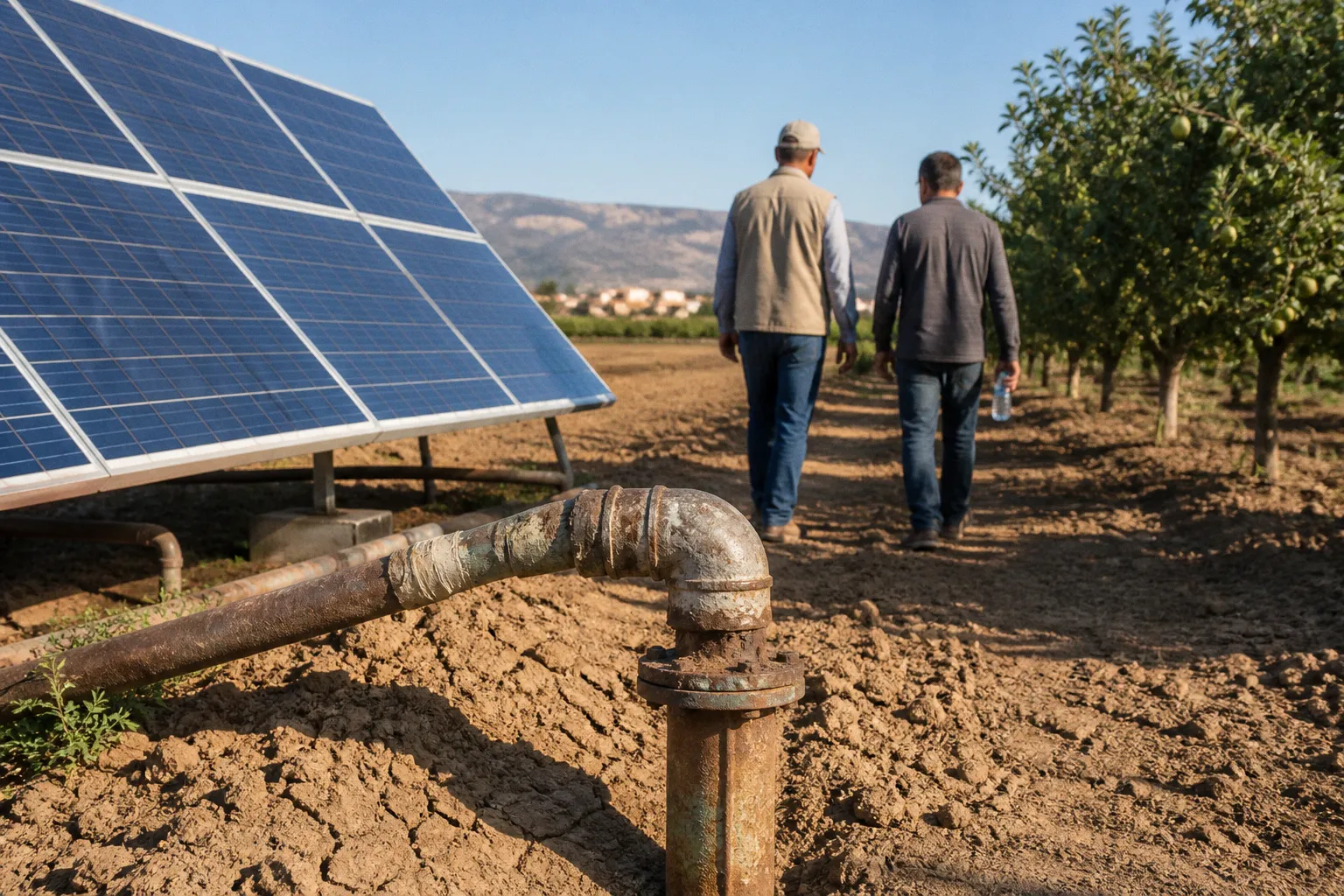
It can also become an expensive photovoltaic installation that delivers insufficient water if the system is sized from panel wattage alone.
For Lebanese farms, the decisive variables are usually underground and hydraulic: borehole yield, water level, total dynamic head, pipe friction, irrigation schedule, and the relationship between solar availability and crop demand. The correct approach to solar irrigation pump selection for Lebanese farms is therefore not to ask how many panels a pump requires. It is to define the operating point first, then build the energy system around it.
This distinction matters in the Bekaa and North Lebanon, where farms may operate from boreholes with different static water levels, shared distribution lines, storage tanks, and irrigation networks assembled over several expansion phases. Two farms with the same cultivated area can require materially different pump systems.
The pump does not irrigate the farm. The complete hydraulic system does. Panels are only one component of that system.
Beyond panel wattage: measure the borehole and the hydraulic load
The first mistake in solar pump procurement is treating the pump nameplate as a design specification. A motor rated at a particular electrical power does not, by itself, indicate how much water it will deliver from a specific borehole into a specific irrigation network.
The system must be selected around its required duty point:
- Flow rate: the volume of water required per hour or per day.
- Total dynamic head: the vertical lift plus pressure requirements and pipe losses.
- Borehole yield: the sustainable extraction rate without excessive drawdown.
- Irrigation method: drip, sprinkler, fertigation, or a mixed network.
- Operating window: whether irrigation occurs only during sunlight or must continue after sunset.
- Available energy infrastructure: direct solar operation, battery storage, grid backup, or a hybrid arrangement.
A useful starting calculation is:
Daily water demand = irrigated area × crop water requirement × application adjustment
That expression is intentionally incomplete without a site-specific crop schedule. Water demand changes with crop type, planting density, soil characteristics, evaporative conditions, and the efficiency of the delivery system. A drip network with appropriate emitter uniformity does not impose the same demand profile as open-channel distribution or overhead sprinklers.
The second calculation concerns pressure and elevation. Total dynamic head is not simply the depth of the well. It combines:
1. The pumping water level under operating conditions.
2. The elevation difference between the water source and the highest delivery point.
3. The pressure required at the irrigation equipment.
4. Friction losses in the rising main, manifold, valves, filters, and field laterals.
5. Additional losses caused by bends, reducers, check valves, and partially blocked filters.
Static groundwater depth can be misleading. A borehole may appear adequate when measured at rest but experience significant drawdown while pumping. The operating water level is the relevant figure for equipment selection.
The measurement set that should precede procurement
Before requesting quotations, a cooperative or farm operator should establish a baseline using actual site measurements rather than catalogue assumptions.
| Parameter | What to measure | Why it affects selection |
|---|---|---|
| Static water level | Water level before pumping | Establishes the initial lift requirement |
| Pumping water level | Water level during sustained extraction | Captures drawdown and the real borehole condition |
| Flow rate | Discharge at a defined operating condition | Determines whether the well can support the irrigation schedule |
| Delivery pressure | Pressure at the pump outlet and critical field points | Shows whether the network can operate uniformly |
| Pipe dimensions and length | Diameter, route, elevation, fittings | Determines friction losses |
| Irrigation demand | Daily and seasonal water requirement | Defines the required volume and timing |
| Solar operating window | Expected useful sunlight during the irrigation season | Determines array size and need for storage |
| Water quality | Sediment, salinity, and scaling risk where relevant | Influences filtration, pump materials, and maintenance |
The operating point should be recorded as a relationship between flow and head. A pump that appears powerful at low head may deliver substantially less water at the pressure required by the field network. Conversely, selecting an oversized pump for a low-yield borehole can create unstable operation, excessive drawdown, and unnecessary capital expenditure.
This is also why the phrase “solar pump capacity for a deep well in Lebanon” is incomplete. Well depth is only one input. A relatively shallow borehole with a long uphill mainline may require more hydraulic energy than a deeper borehole feeding a nearby storage tank.
Matching pump type to the farm’s operating model
Submersible pumps are common where the water source is a borehole, because the pump is installed below the dynamic water level and pushes water to the surface. Surface pumps can be suitable for tanks, open reservoirs, canals, or shallow suction conditions, but they introduce different constraints around suction lift, priming, and cavitation.
The choice should follow the water source and delivery architecture rather than a preference for a particular equipment category.
For borehole applications, the practical questions include:
- Is the pump diameter compatible with the casing?
- Is the motor suitable for continuous or intermittent operation?
- Can the pump tolerate the expected sand load?
- Does the selected model provide the required flow at the calculated head?
- Is the motor protection appropriate for dry-running, overload, and voltage variation?
- Can the controller communicate useful operating data?
- Are replacement components available through Lebanese distributors or service technicians?
The last point is a capital-cost issue disguised as a maintenance issue. A system with a lower purchase price but limited access to seals, controllers, sensors, or motor components can generate a longer outage and higher lifecycle cost. For a crop operation, downtime during a critical irrigation period is not an abstract inconvenience; it can force emergency diesel pumping or cause irrigation intervals to exceed the crop’s tolerance.
A robust selection process should compare at least three operating scenarios:
1. Normal borehole condition: expected water level and standard irrigation pressure.
2. Low-solar condition: reduced irradiance and lower instantaneous pump output.
3. Peak demand condition: the irrigation period when daily water requirements are highest.
The pump should not be judged only by its maximum flow. A more useful specification is the expected flow at the actual total dynamic head, across the hours when the farm can usefully operate.
MPPT controllers: the electrical layer that determines hydraulic stability
Photovoltaic output varies continuously with irradiance, temperature, dust, shading, and cloud cover. A solar pump system therefore needs more than panels and a motor. The controller must translate variable DC power into a usable pump operating condition.
Maximum Power Point Tracking, or MPPT, is central to this function. An MPPT controller adjusts the electrical operating point of the solar array to extract the available power as conditions change. In a pumping application, that can help maintain useful water discharge when solar radiation fluctuates, although it cannot create energy that the array is not receiving.
The result is not constant flow under all conditions. The result is better use of the available solar resource and more controlled interaction between array output and pump demand.
A controller specification should be examined for:
- MPPT operating range and compatibility with the array voltage.
- Motor type compatibility, including the required drive architecture.
- Dry-run and low-water protection.
- Overvoltage, overcurrent, and thermal protection.
- Soft starting to reduce mechanical and electrical stress.
- Data logging for runtime, flow, fault events, and energy production.
- Compatibility with float switches, pressure sensors, level sensors, and remote monitoring.
- Restart behavior after a fault or temporary loss of solar input.
- Provision for a generator or grid backup if the farm requires it.
The controller is also where many systems become difficult to diagnose. If the only information available is that the pump has stopped, the operator cannot distinguish between low solar radiation, borehole drawdown, a clogged filter, a controller fault, or an undersized array. At minimum, the system should expose operating voltage, current, pump frequency or speed, fault status, and water-level or pressure signals where sensors are installed.
Direct pumping or battery storage?
Battery storage is not automatically the most efficient answer to intermittent solar energy. In many agricultural systems, a better architecture is to pump water into an elevated or ground-level storage tank during the solar window and irrigate from that storage according to the crop schedule.
This separates the energy problem from the irrigation timing problem. The pump operates when solar energy is available; the field receives water when the irrigation network requires it.
A storage tank can also provide:
- Hydraulic buffering during passing clouds.
- A reserve against short pump interruptions.
- More stable pressure for drip irrigation.
- A practical location for filtration and fertigation equipment.
- A way to coordinate several fields with different irrigation zones.
Batteries may still be justified where water storage is impractical, land elevation is insufficient, or irrigation must run during night hours. However, they add replacement cycles, thermal management requirements, charge-control complexity, and additional conversion losses. The comparison should be made on lifecycle cost, not only on the initial equipment quotation.
For many farms, the relevant question is not whether batteries are technically possible. It is whether the battery bank provides more productive value than a correctly sized water reservoir, improved pipework, or additional photovoltaic capacity.
Irrigation efficiency determines whether solar investment pays back
A solar pump can reduce the energy cost of delivering water while leaving the underlying water losses unchanged. If the field network has poor emitter uniformity, excessive pressure variation, leaks, or unsuitable irrigation timing, the farm may simply be pumping inefficiency with a cleaner power source.
This is where solar pumping intersects with fertigation. Improved irrigation and fertigation practices in Lebanese agricultural projects have reported nitrogen-fertilizer recovery in the range of 55% to 80%. That range should not be treated as a universal performance guarantee. It depends on scheduling, emitter uniformity, nutrient concentration, root-zone conditions, filtration, and the control of application volumes.
The infrastructure sequence matters:
1. Stabilize the water source. Confirm the sustainable borehole yield and operating water level.
2. Stabilize the hydraulic network. Correct leaks, pressure imbalances, undersized mains, and filtration bottlenecks.
3. Install metering. Measure flow and pressure by irrigation zone.
4. Add fertigation control. Use a dosing arrangement compatible with the network’s flow range and chemical requirements.
5. Automate scheduling. Base irrigation duration on crop demand, soil moisture, weather conditions, and storage status.
6. Review nutrient distribution. Confirm that the last emitters in the zone receive a comparable irrigation and nutrient load to the first emitters.
The solar pump should not be sized to compensate for a poorly designed network. That approach increases capital expenditure while preserving the original failure mode.
The highest-return solar upgrade is often not a larger panel field. It is the removal of hydraulic losses that force the pump to work harder than the crop requires.
Water storage as an energy-management tool
An elevated tank is sometimes described only as a water reserve. In a solar irrigation system, it is also an energy-management device.
The tank allows the system designer to use a smaller or more stable pump schedule while reducing the need to match every moment of crop demand to every moment of solar production. It can also allow the pump to operate near a more efficient region of its performance curve rather than cycling repeatedly under partial-load conditions.
The storage design should consider:
- Required reserve volume.
- Tank elevation and resulting pressure.
- Structural support and foundation conditions.
- Inlet turbulence and sediment management.
- Overflow routing.
- Isolation valves and maintenance access.
- Protection from contamination and excessive heat.
- Whether the tank serves one farm or several cooperative members.
If the tank is too small, the system remains vulnerable to short solar interruptions. If it is oversized without a clear operating purpose, the project carries unnecessary construction and material costs. The correct volume follows the irrigation schedule and the acceptable interruption period, not a generic rule of thumb.
Cooperative pump houses can change the capital equation
Individual farms often face a difficult cost structure. Each operator needs a pump, controller, intake, protection equipment, mainline, and maintenance capability, but not every component is used continuously. A cooperative model can distribute the cost of high-capacity infrastructure among several farms, provided the hydraulic and governance arrangements are designed with equal precision.
Shared pump houses, intakes, and mainlines allow participating farms to spread the cost of solar generation and pumping equipment. This can make a larger, more efficient system viable where separate small installations would each operate below their best economic range.
The cooperative system requires more than a shared equipment purchase. It needs a defined operating protocol covering:
- Allocation of pumping hours.
- Priority during peak irrigation demand.
- Maintenance contributions.
- Metering by farm or irrigation zone.
- Responsibility for damaged valves, filters, and laterals.
- Water-level monitoring in the shared borehole.
- Reserve funds for controller and pump replacement.
- Procedures for adding new members or expanding cultivated area.
Flow meters and pressure sensors are essential in this setting. Without them, the cooperative cannot distinguish between higher water use, hydraulic leakage, unauthorized extraction, or declining borehole performance. Billing or cost allocation based only on land area may be simple, but it can be technically inaccurate where crops, irrigation methods, and seasonal schedules differ.
A shared solar system can also reduce duplicated infrastructure. One appropriately designed array, controller, pump house, and storage system may require less total equipment than several fragmented installations. The advantage disappears if the common mainline is undersized or if the pump must operate at an unnecessarily high pressure to serve the most distant plot.
A practical cooperative layout
A typical shared arrangement may include:
- A monitored borehole or surface intake.
- A submersible or surface pump selected for the collective duty point.
- An MPPT solar pump controller.
- Photovoltaic arrays with appropriate protection and isolation.
- A filtration and pressure-management station.
- Storage tanks sized around the cooperative irrigation schedule.
- Separate metered outlets for participating farms.
- Drip or sprinkler zones operated according to an agreed timetable.
- A backup connection for essential operation during extended low-solar periods.
This architecture is particularly useful where farms are close enough to share a mainline but have different crop calendars. The central system can produce and store water, while field-level valves determine when each farm receives it.
The engineering risk is concentration of failure. If a single shared pump fails, several farms lose access simultaneously. Redundancy may therefore be more valuable than maximum nominal efficiency. Depending on borehole yield and cooperative scale, that could mean a standby pump, a bypass connection, a reserve controller, or a smaller emergency diesel or grid interface.
Implementation should proceed in phases, not as one equipment purchase
Solar pump projects fail most often when the photovoltaic array, pump, and irrigation network are procured as separate products rather than designed as one system. A phased process reduces that risk and creates baseline metrics for later expansion.
Phase one: establish the hydraulic baseline
Record the borehole’s static and pumping water levels, sustained flow, delivery pressure, pipe route, and irrigation-zone requirements. The measurement should represent the actual conditions under which the farm operates, including the expected water demand period.
At this stage, inspect the existing system for leaks, blocked filters, damaged valves, and pressure variations. Replacing a failing filter before selecting the pump is not a minor preparatory task; it changes the system resistance and may alter the required duty point.
Phase two: define the irrigation schedule
Translate crop plans into daily and seasonal water volumes. Separate the demand of different crops and fields instead of using one average figure for the entire farm.
A farm with a small cultivated area can still require a substantial pump if the water must be lifted from a deep borehole and delivered through a long pressurized network. Conversely, a larger farm with low-pressure drip irrigation and a storage tank may use a lower instantaneous flow rate over a longer operating window.
This is why solar irrigation farm size in Lebanon is a weak standalone sizing metric. Area determines volume, but hydraulic conditions determine energy and pump duty.
Phase three: select the pump and controller as a pair
The pump curve and controller operating range must be assessed together. Confirm that the controller can operate the motor across expected solar conditions and that the pump provides usable flow at the calculated head.
Specify protection against:
- Dry running.
- Borehole drawdown.
- Overload and overheating.
- Voltage irregularities.
- Blocked discharge or closed valves.
- Repeated rapid starts.
- Sensor failure.
The system should also define what happens when the available solar power falls below the pump’s minimum operating requirement. A controlled shutdown and restart is preferable to unstable cycling.
Phase four: integrate storage, filtration, and fertigation
Storage should be placed where it improves both reliability and pressure management. Filtration should be sized for the actual water quality and emitter requirements. Fertigation equipment should be installed with isolation, backflow protection, and a method of verifying injection performance.
At this point, the system becomes an agricultural utility rather than a pump installation. The design should support the crop schedule, not merely move water from a source to a pipe.
Phase five: commission against baseline metrics
Commissioning should document:
- Flow at the pump and at field outlets.
- Pressure at the pump, filter station, and most distant irrigation zone.
- Solar array output under defined conditions.
- Pump speed or frequency.
- Daily water volume delivered.
- Storage level at the start and end of the irrigation window.
- Controller faults and restart behavior.
- Fertigation concentration or dosing rate where applicable.
These measurements establish a baseline for maintenance. If flow declines later, the operator has a reference point for distinguishing a clogged filter from borehole decline, pump wear, pipe damage, or controller degradation.
Reliability in the Bekaa and North Lebanon depends on the weakest component
A solar-powered irrigation system is exposed to both environmental and operational stress. Dust reduces photovoltaic output. Heat affects electrical equipment. Sediment damages pumps and clogs emitters. Unstable water levels alter the hydraulic duty point. Poorly protected cables and connectors create faults that are difficult to locate after installation.
A reliability plan should therefore include:
- Periodic photovoltaic cleaning based on observed performance, not an arbitrary calendar alone.
- Inspection of cable glands, junction boxes, earthing, and surge protection.
- Pump current monitoring to identify mechanical or hydraulic changes.
- Filter pressure monitoring to detect increasing restriction.
- Water-level measurement during pumping.
- Leak inspection along the mainline and field manifolds.
- Spare seals, fuses, sensors, and controller components where local supply is uncertain.
- A documented restart procedure after faults.
- Seasonal review of crop demand and irrigation timing.
The maintenance burden is lower than for a diesel pump in some respects, but it is not zero. Solar removes fuel logistics and combustion-engine servicing; it does not remove filtration, hydraulic inspection, electrical protection, or borehole management.
A system should also be designed for partial failure. If one sensor fails, can the pump be isolated and inspected without draining the entire network? If the controller is offline, is there a manual operating mode? If one irrigation zone is damaged, can the remaining zones continue operating? These questions are more useful than a generic claim of “low maintenance.”
Cost-benefit analysis: compare delivered water, not equipment labels
The phrase “solar-powered irrigation system cost in Lebanon” has no single meaningful answer without the system boundary. A quotation may include only panels and a pump, while another includes the controller, mounting, cabling, borehole work, tank, filtration, mainline, installation, commissioning, and monitoring.
Capital expenditure should be separated into functional categories:
- Pump and motor.
- MPPT controller and electrical protection.
- Photovoltaic array and mounting.
- Borehole adaptation or intake works.
- Rising main and distribution pipework.
- Storage tank and structural works.
- Filtration and pressure regulation.
- Fertigation equipment.
- Sensors and telemetry.
- Installation, testing, and commissioning.
- Backup generation or grid interface.
- Future replacement reserves.
Operating expenditure should include cleaning, inspections, filter replacement, pump servicing, sensor replacement, and eventual controller or battery replacement where applicable. Diesel savings are only one part of the benefit. Additional value may come from more consistent irrigation, lower fertilizer loss, reduced labour associated with fuel handling, and more reliable scheduling.
The correct financial comparison is not:
Solar equipment price versus diesel pump price
It is closer to:
Lifecycle cost per delivered cubic metre at the required pressure
That figure should be calculated under realistic operating conditions. A system that produces more water than the farm can use may have a lower unit energy cost but a higher total capital burden. A smaller system may have lower capital expenditure but require backup pumping during critical periods. Neither is automatically superior.
A simple project model should compare:
| Metric | Solar system | Diesel or grid alternative |
|---|---|---|
| Initial capital expenditure | Array, pump, controller, civil and hydraulic works | Pump, generator or grid connection, civil and hydraulic works |
| Energy cost | Solar resource, with backup costs if included | Fuel or electricity consumption |
| Delivery reliability | Dependent on storage, controller, borehole, and solar conditions | Dependent on fuel, grid quality, and mechanical condition |
| Maintenance profile | Filters, pump, electrical protection, sensors, controller | Engine service, fuel system, pump, filters, mechanical parts |
| Water output | Flow at the actual head and available operating window | Flow at the actual head and engine operating range |
| Expansion path | Additional panels, storage, zones, or shared capacity | Additional fuel capacity, power, or distribution infrastructure |
| Main technical risk | Incorrect hydraulic sizing or inadequate monitoring | Fuel cost volatility, outages, and mechanical downtime |
The analysis should be based on measured water output and the farm’s irrigation schedule. Panel capacity alone is not a proxy for agricultural performance.
The technical verdict
For Lebanese farms, the correct solar irrigation pump selection begins with hydraulic measurement and ends with an integrated operating plan. Borehole yield, pumping water level, total dynamic head, pipe friction, irrigation pressure, and crop demand define the system. The photovoltaic array supplies energy to that system; it does not define it.
MPPT controllers improve the use of variable solar radiation, but they cannot compensate for an undersized borehole, excessive friction losses, poor filtration, or an irrigation network that distributes water unevenly. Storage tanks often provide a more durable form of flexibility than batteries when the central problem is timing rather than night-time energy access. Fertigation can improve nitrogen recovery, but the reported range of 55% to 80% depends on controlled scheduling and uniform delivery. Cooperative pump houses can reduce duplicated capital expenditure, provided that metering, maintenance, and water allocation are designed before construction.
The decisive procurement document should therefore contain four things: a measured duty point, a seasonal water schedule, a complete system boundary, and a commissioning plan with baseline metrics. If a quotation cannot show how its pump will perform at the farm’s actual head and flow requirements, it is not yet a system proposal.
The numbers that matter are delivered cubic metres, operating pressure, useful solar hours, maintenance cost, and lifecycle cost per unit of water. Once those are measured, the choice between competing solar irrigation systems becomes an engineering decision rather than a panel-count comparison.