Solar water pumps: matching farm depth and power needs
Irrigation eats up to 40 percent of your total field production costs in Lebanon. Read that again.
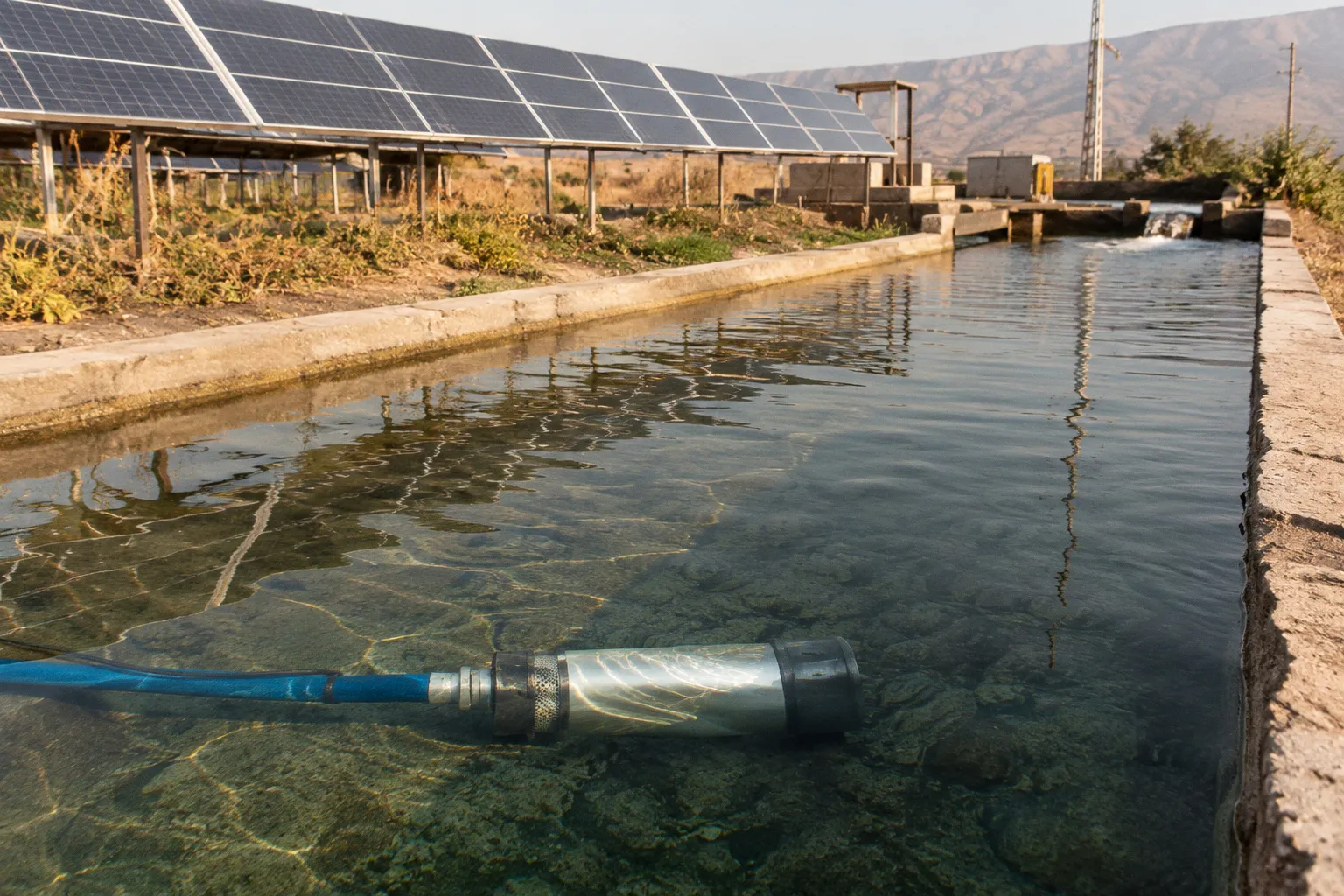
Stop Guessing at the Wellhead: How to Actually Size a Solar Pump for Lebanese Farmland
Nearly half your spend on a given harvest goes directly to moving water from point A to root zone—and if you're running diesel gensets or grid-tied electric pumps on unreliable municipal supply, that number only gets worse. Solar pumping is the single fastest lever you can pull to slash that cost line permanently, but only if you size the system correctly. Pick a pump that's too small, and your orchards bake mid-August. Overspend on capacity you'll never use, and you're burning capital that should have gone into drip lines or cold storage. The difference between a system that works and one that becomes an expensive lawn ornament comes down to two numbers: your Total Dynamic Head and your peak daily water demand. Get those right, everything else falls into place. Get them wrong, no amount of panel wattage will save you.
This guide walks you through the exact calculation sequence, the hardware trade-offs between DC submersibles and AC inverter-driven arrays, and the infrastructure decisions that matter when your fields sit 4 km from the nearest paved road in the Bekaa.
Calculating Total Dynamic Head for Lebanese Boreholes
Total Dynamic Head—TDH—is the single most critical number in solar pump selection. It's not your well depth. Let that sink in, because half the quotations I see from local installers quote a pump based on total borehole depth alone, which is how you end up with a unit that stalls three weeks into the dry season.
TDH is a composite figure built from four components:
1. Static water level — where the water sits in the casing when no one's pumping.
2. Drawdown level — how far that surface drops once the pump kicks in. This varies dramatically by aquifer. Shallow coastal wells may show 2–3 meters of drawdown; deep Bekaa boreholes can pull down 15–20 meters under heavy extraction.
3. Vertical lift to storage — the elevation difference between your drawdown level and the top of your elevated tank or pressurized header. If your tank sits on a hill 12 meters above the wellhead, that's 12 meters added.
4. Pipe friction losses — every meter of pipe, every elbow, every check valve eats pressure. Over a 4 km horizontal run across a Bekaa plain, friction losses accumulate significantly. Use standard Hazen-Williams or Darcy-Weisbach calculations, or grab friction-loss charts from any pipe manufacturer's catalogue. Don't eyeball it.
Add those four together. That's your TDH.
The pump doesn't care how deep your well is. It cares about how far it has to push every liter against gravity and friction. TDH is the only number that matters at the spec sheet.
Here's a quick reference for how this breaks down in practice:
| TDH Component | Typical Range (Lebanon) | What Drives Variation |
|---|---|---|
| Static water level | 10–180 m | Region: shallow coastal, deep Bekaa/South aquifers |
| Drawdown | 2–20 m | Extraction rate, aquifer permeability, well condition |
| Vertical lift to tank | 0–25 m | Terrain, tank placement strategy |
| Pipe friction losses | 3–15% of total head | Run length, pipe diameter, fitting count |
If your calculated TDH sits under 120 meters, a standard 1100W 3-inch submersible unit—rated for 123 meters max head at roughly 3,000 liters per hour peak flow—covers most small-to-mid acreage operations. Push past 120 meters TDH and you're stepping into inverter-driven array territory. No negotiation on that boundary.
Matching Pump Capacity to Daily Water Demand
Head alone doesn't size a pump. You need flow rate matched to actual consumption windows—and in Lebanon, those windows are defined by solar irradiance, not by your irrigation schedule preferences.
A direct-drive solar pump runs when the sun shines. No batteries, no grid backup (in most agricultural setups). During peak sunny season, you get roughly 9 or more hours of effective pumping per day. But output isn't flat across those hours. Dawn and dusk produce a fraction of peak flow. The usable production window with meaningful flow rates realistically concentrates in a 5–6 hour core.
Step-by-step demand calculation:
1. Determine daily water requirement — Liters per day per hectare, crop-specific. Orchards in the Bekaa typically need 40–80 cubic meters per hectare per day during peak summer. Vegetable plots can push higher.
2. Divide by effective pumping hours — Use 6 hours as a conservative figure for system sizing during Lebanon's productive solar months (April–October).
3. The result is your required flow rate — In cubic meters per hour (m³/h). Convert to liters per minute if you're matching to manufacturer spec sheets.
Example: You need 60 m³/day for a 1-hectare apple orchard. Divide by 6 effective hours. You need a pump delivering at least 10 m³/h at your calculated TDH. Cross-reference that against the pump's performance curve—not the "max flow" headline number, which is measured at zero head and means nothing in the field.
Never size a pump using its maximum flow specification. That number assumes zero head pressure. In the real world, your pump operates on a curve—and you need to read that curve at your actual TDH.
If demand exceeds what a single submersible unit handles, the answer is straightforward: run two pumps in parallel from a split solar array, or step up to a larger AC-driven unit with a dedicated inverter system. Which brings us to the central hardware decision.
DC Submersible Units vs. AC Inverter Arrays: Picking the Right Architecture
This is where most farm operators in Lebanon make the wrong call—usually because an installer pushes whatever they stock, not what the site actually demands. Two fundamentally different architectures exist, and they serve different operational profiles.
DC submersible solar pumps are purpose-built for solar. The pump motor runs directly on DC power from the panels, often with an integrated MPPT controller in the pump housing itself. No inverter conversion losses. Compact, sealed to IP68 standard, and designed for wells where TDH stays under approximately 120–150 meters. A typical 1,100W unit delivers up to 3,000 liters per hour at moderate head heights—enough for a smallholding or a single-plot cooperative allocation.
AC inverter-driven systems take DC from a larger solar array and convert it to 3-phase AC via a dedicated solar pump inverter. These systems scale up to 18.5 kW and beyond, driving heavy-duty centrifugal or submersible pumps that handle deep boreholes and high-volume demands. They're the architecture of choice for large cooperative operations running multiple hectares from deep wells.
| Parameter | DC Submersible (≤1.1 kW) | AC Inverter Array (up to 18.5 kW) |
|---|---|---|
| Max practical TDH | ~120–150 m | 200–300+ m |
| Peak flow at rated head | Up to ~3,000 L/h | 10,000–50,000+ L/h (system-dependent) |
| Installation complexity | Low—drop in, connect panels | Medium—requires inverter cabinet, 3-phase wiring |
| Maintenance profile | Minimal, sealed motor | Inverter servicing, motor checks |
| Battery requirement | None (elevated tank replaces storage) | None (same principle, larger tank) |
| Best fit | Individual plots, shallow-to-mid wells | Cooperatives, deep wells, high-demand irrigation |
| Typical IP rating | IP68 submersible | IP65+ for inverter (pump still IP68) |
The decision hinges on three variables: your TDH, your daily volume requirement, and whether you're operating a single parcel or coordinating supply across multiple cooperative members from a shared borehole. Under 120 meters TDH and under 20 m³/day? A direct-drive DC submersible keeps things simple and cheap. Anything above those thresholds on either axis, and you're buying into an AC inverter ecosystem.
One critical note: neither architecture requires a battery bank if you design the system with elevated storage. Pump water uphill into an insulated tank during solar hours, gravity-feed it down through your drip or sprinkler network afterward. That's the protocol the UNDP/LCWMC technical assessments validated for North Lebanon and Bekaa operations, and it eliminates the single most failure-prone and expensive component of off-grid solar systems—the battery array.
Optimizing Pumping Infrastructure for Remote Bekaa Fields
The Bekaa Valley is where Lebanese agriculture scales. It's also where logistics get brutal. Fields sit kilometers from paved access roads. Grid connections are unreliable or nonexistent. Component supply chains stretch through Beirut and Zahle before reaching your borehole.
Design your solar pumping installation with these field realities in mind:
- Panel array siting matters as much as pump selection. Dust accumulation on panels in the Bekaa can degrade output by 15–25 percent if you don't schedule cleaning. Mount arrays at a tilt angle that allows rain to self-clean during winter months—typically 30–35 degrees for Lebanon's latitude. Ground-mount with easy walk-behind access for manual cleaning during dry season.
- Pipe run optimization is non-negotiable over long distances. If your borehole is 3–4 km from the field, upsizing the delivery pipe by one diameter increment (say, from 2-inch to 3-inch) cuts friction losses dramatically. The pipe costs more upfront. The pump you save on the sizing calculation pays back the difference immediately.
- Elevated tank placement is a design choice, not an afterthought. Position the storage tank at the highest practical point relative to your irrigated plots. Every meter of elevation you gain is a meter of free hydraulic head during gravity-feed distribution. On flat Bekaa terrain, even a 6-meter steel tower makes a measurable difference in distribution pressure uniformity.
- Remote monitoring is cheap insurance. Basic cellular-enabled flow meters and tank-level sensors cost a fraction of the system price and give you real-time visibility when you're 40 km away in Beirut. If flow drops unexpectedly, you know before the crop stress becomes visible.
- Standardize components across cooperative sites. If your cooperative runs five boreholes across different plots, spec the same pump model, same inverter brand, same pipe fittings everywhere. Spare parts inventory drops to one set instead of five. A technician who learns one system services them all.
Overcoming the Technical Barriers That Kill Deep-Well Projects
Three failure modes kill solar irrigation projects in Lebanon more than any others. Know them in advance and design around them.
Undersized wiring between panels and inverter. Long cable runs from ground-mounted arrays to the pump controller create voltage drop. Over a 100-meter cable run with undersized conductors, you can lose enough voltage to prevent the inverter from starting the motor during marginal irradiance conditions—exactly the hours (morning, late afternoon) when you most need the pump running. Size cables for the actual current at maximum panel output, not for what "usually works."
Ignoring well rehabilitation before pump installation. If your borehole has been sitting idle or under-maintained, screen blockages and sediment buildup reduce yield and increase drawdown. Run a downhole camera survey and a yield test before you spec a pump. The best solar pump in the world can't pull water from a silted-up well.
Assuming peak solar output is average output. Your panels produce rated wattage under standard test conditions—1,000 W/m² irradiance, 25°C cell temperature. Real Bekaa summer conditions mean high cell temperatures (which reduce panel output by 0.3–0.5 percent per degree above 25°C) and occasional dust haze. Design for 80 percent of rated panel output as your realistic baseline, not 100 percent.
Size for reality, not spec sheets. A pump that works perfectly on paper will fail in the field if you ignore cable losses, well condition, and real-world solar derating.
The Bottom Line: Get the Numbers Right Before You Buy
Solar irrigation in Lebanon isn't a leap of faith anymore. The technology is proven, the economics are clear—cutting irrigation costs from up to 40 percent of production spend to a fraction of that over a 15–20 year system lifespan. The UNDP and local water authorities have done the technical groundwork. Commercial suppliers stock everything from 1.1 kW submersibles to 18.5 kW inverter-driven arrays ready for deployment in the Bekaa and beyond.
But the technology only works when the sizing math is right. Calculate your actual TDH—drawdown, lift, friction, all of it. Match your flow rate to real crop demand during peak season. Choose DC simplicity or AC scalability based on your numbers, not your installer's inventory. Design the full infrastructure—panel siting, pipe runs, tank elevation, monitoring—before you dig the trench.
If you're a cooperative operator coordinating multiple boreholes across scattered plots, standardize ruthlessly and build redundancy into spare parts and technician knowledge. If you're a single-plot farmer with a 60-meter well and 2 hectares of stone fruit, a direct-drive submersible with an elevated tank solves your problem cleanly.
The math takes an afternoon. The system runs for two decades. Spend the afternoon.