Sheet mulching: quick weed control for organic farms
There's a moment every spring when our growers gather at the co-op yard and the same conversation finds its way back to us. The first rains have come and gone, the cover crops are greening up, and so is everything else.
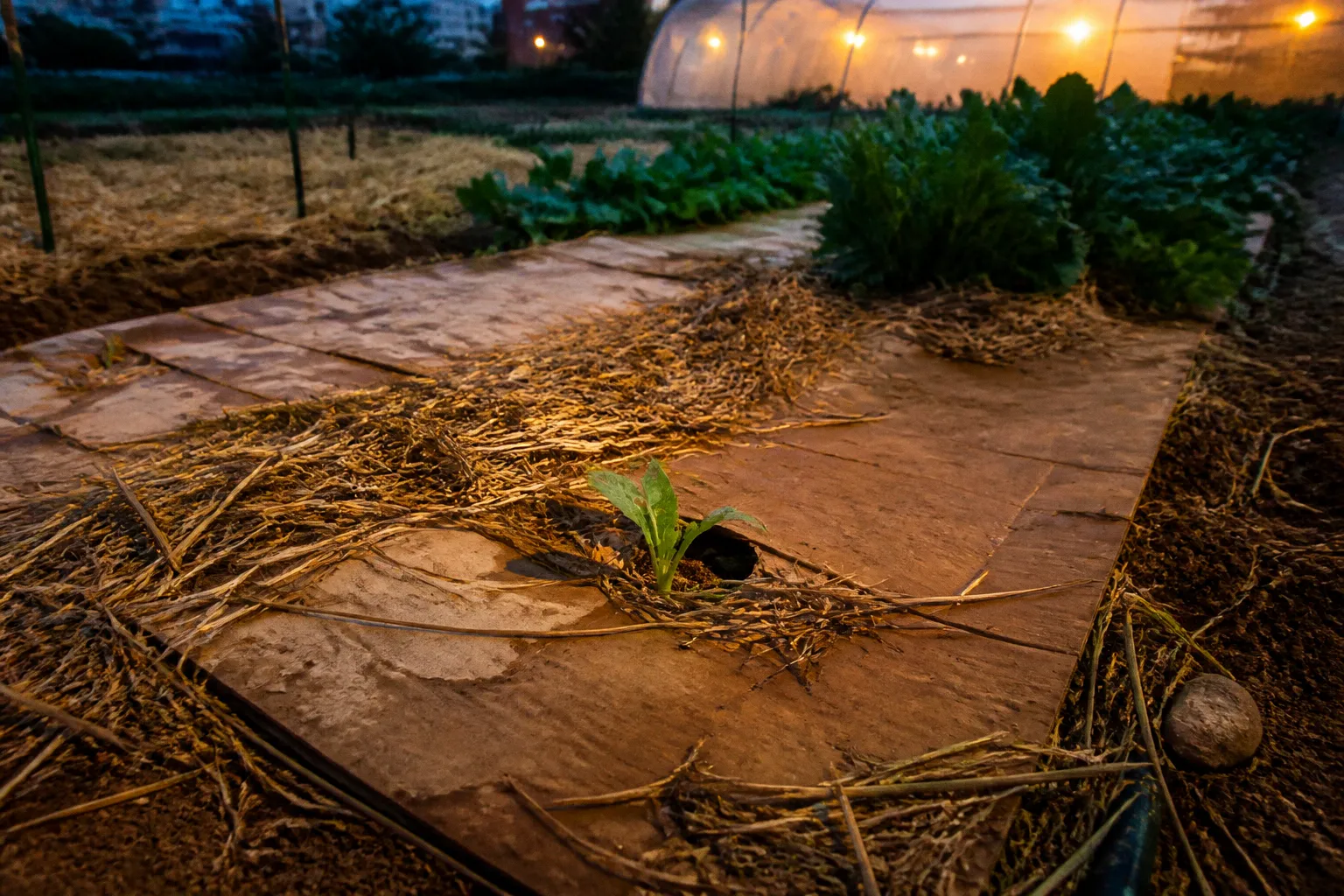
The bindweed is threading through last year's tomato rows. The purslane is already setting seed in the onion beds. Hand-weeding, our grandmothers' answer, eats hours that we no longer have — and the cooperative budget does not stretch to a crew. When our export partners ask for blemish-free produce without herbicide residues, we have two choices: reach for the chemical sprayer, or build a system that does the work for us. Sheet mulching for weed suppression has become that system on more and more of the small plots our growers tend in the Bekaa and along the coastal strip.
Sheet mulching is not a one-weekend trick. It is a season-long, collective investment in the soil that every harvest we ship downstream depends on.
The mechanics of no-dig weed suppression
At its heart, sheet mulching is closer to composting a garden bed than to fighting a war. You lay a biodegradable barrier — almost always corrugated cardboard, occasionally ten sheets of plain newspaper — directly over mown vegetation, soak it until it is heavy with water, and then bury it under alternating layers of nitrogen-rich and carbon-rich organic matter. The barrier blocks sunlight, so any annual weed seed in the topsoil stays dormant. The wet cardboard begins to break down within weeks, and the layers above it become a slow-cooking compost that warms the soil, feeds the microbial community, and holds moisture where the crop roots actually live.
What makes this work as organic weed control is the combination of two effects that happen at the same time. The physical barrier smothers the weeds that are already germinated or sprouting. The thick organic blanket on top then prevents new weed seeds — blown in or carried by birds — from finding bare soil to anchor into. Once the cardboard has decomposed, what is left behind is a friable, dark, biologically active bed that a trowel slides into. You have effectively replaced the weeds with a year of soil building.
The layers matter, and so does the depth. The cardboard or paper needs to overlap by at least 6 to 10 inches (15 to 25 cm) at every seam, because a single determined bermudagrass rhizome will find a 4-inch gap and use it as a doorway. The total organic stack — green layers of 1 to 2 inches (2.5 to 5 cm) alternating with brown layers of 4 to 8 inches (10 to 20 cm) — should come to between 6 and 18 inches (15 to 45 cm) before you plant into it. Anything thinner dries out too fast; anything much thicker can go anaerobic in the middle and sour the bed.
Preparing the foundation: cardboard selection and site prep
Half the success of any sheet mulch is decided before a single sheet of cardboard is unfolded. The site itself has to be ready: existing vegetation cut close to the ground, perennial stalks chopped back to the crown, any woody debris raked off so the cardboard can sit flat against the soil. We have learned the hard way that leaving a tuft of johnsongrass or a fist-sized clump of nut sedge under the cardboard simply hands the problem a five-month head start. Walk the plot once and pull what needs pulling before you unroll anything.
Cardboard choice is its own quiet decision. Plain, undyed, corrugated shipping cartons are the gold standard — the corrugation traps air, holds water, and breaks down at a pace that matches a full growing season. Glossy cereal boxes, frozen-food packaging with plastic windows, and any carton with heavy color printing should be set aside for the recycling bin, not the field. Before a single box is laid, every piece of plastic packing tape, every shipping label, every metal staple has to come off. A staple left in the bed will be there in three years; a strip of polyester tape will be there longer.
| Cardboard type | Safe to use? | Why it matters |
|---|---|---|
| Plain corrugated shipping cartons | Yes | Decomposes evenly, holds water, no contaminants |
| Non-glossy newspaper (10 sheets thick) | Yes | Useful for smaller beds, breaks down faster |
| Glossy retail packaging | No | Coatings resist water and shed it away from crops |
| Boxes with colored inks / heavy dye | No | Inks can carry residues we don't want in the soil |
| Waxed or plastic-lined produce boxes | No | Waterproof coating prevents decomposition |
Once the cardboard is down and overlapped, it must be thoroughly soaked. A dry sheet is a hydrophobic sheet — it will shed the first irrigation and the first rain off to the edges, leaving the bed bone-dry in the middle. We tell our growers to lay a soaker hose on top of the cardboard and let it run until a fistful of the material, squeezed hard, drips steadily. Only then is it ready to be covered.
Building the organic profile: balancing green and brown layers
This is where the cooperative model genuinely shines, because the materials that make the best sheet mulch are almost always things our growers and their neighbors already have. The "green" nitrogen-rich layer — fresh manure, kitchen scraps, coffee pulp from the roasting houses, grass clippings, legume hay — feeds the soil microbes that will, in turn, drive the decomposition of the cardboard. The "brown" carbon-rich layer — wheat straw from the threshing floors, dried olive leaves, sawdust from the carpentry shops, shredded prunings — gives the bed structure and breathability and keeps it from compacting into a sodden mat.
A simple layering recipe that has worked well for our growers on plots of 50 to 200 square meters looks like this:
1. Mow or scythe the existing vegetation as low as possible and leave the cut material in place.
2. Lay overlapping, soaked cardboard across the entire bed, edges tucked up against any border.
3. Add a 1 to 2 inch layer of green material — well-rotted manure is the most forgiving choice for first-timers.
4. Add a 4 to 8 inch layer of brown material — straw or dried leaves are the easiest to find.
5. Repeat the green-brown alternation once more if materials allow, ending with brown on top.
6. Water each layer as you go. A dry sheet mulch is a failed sheet mulch.
7. Top the whole stack with 2 to 5 inches of coarse organic mulch (wood chips, straw) to shade the surface and slow evaporation.
When we layer cardboard with manure and straw, we are not only blocking weeds. We are building the kind of soil that holds water through a Bekaa August and asks for less of the well every week.
The reason we insist on the final coarse top layer is the one detail that decides whether the bed thrives or sulks. Without it, the surface crusts over, water beads off, and the cardboard underneath goes hydrophobic again — the very problem the soaking was meant to solve. A 2 to 5 inch cap of wood chips or long straw solves it for the whole season.
Getting the green-to-brown ratio right takes a little practice but not much science. A rough guide our veteran growers pass to new members: for every bucket of fresh manure or grass clippings, lay three to four buckets of straw or dried leaves. The brown layer should always dominate in thickness. Too much green and the bed heats up aggressively, can smell of ammonia, and may attract flies; too little and the microbes that break down the cardboard go hungry and slow to a crawl. The sweet spot is a bed that smells like damp forest floor — earthy, alive, and unremarkable. If you are holding your nose, something in the ratio is off.
Composting enthusiasts will recognize the same principles at work. Sheet mulching is, in effect, a stationary compost pile built directly on the ground where you intend to grow. The difference is that you never turn it — the worms and the fungi and the bacteria do the turning for you, working from the soil surface upward through the cardboard and into the organic layers above. What arrives at the end of the decomposition cycle is not finished compost in the bagged sense, but it is close: a living, crumbly, moisture-retentive root zone that most vegetables will thrive in without further amendment for at least one full season, and often two.
Yield impacts and soil moisture: evidence from field trials
Our growers do not adopt a technique because it sounds good. They adopt it because the numbers, over two or three seasons, make sense on a clipboard. The evidence we point to when a skeptical member asks whether sheet mulching is worth the labor of gathering cardboard from the market and straw from the threshing floor is concrete and field-tested.
A SARE-funded trial run by the University of Guam Cooperative Extension on a vegetable plot showed that cardboard sheet mulching nearly doubled the pepper yield compared with the conventionally hand-weeded control, while significantly reducing hand-weeding labor costs. A separate research study on cauliflower cultivation found that organic mulch sheets increased yields by 72.18% over untreated plots that had no mulch at all. For our growers, who are selling into European wholesale channels where a clean, uniform cauliflower head is the difference between a paid invoice and a rejected pallet, a two-thirds jump in marketable yield is not a small number.
| Indicator | Untreated plot | Sheet-mulched plot | Practical meaning for the co-op |
|---|---|---|---|
| Cauliflower yield (study average) | Baseline | +72.18% | More saleable heads per square meter |
| Pepper yield (Guam SARE trial) | Baseline | Nearly doubled | Roughly 2× the harvest from the same area |
| Hand-weeding labor costs | Full season | Significantly reduced | Budget redirected to harvest and packing |
| Soil moisture retention | Evaporates quickly | Held under organic blanket | Lower irrigation cost in dry months |
| Estimated cost per 100 sq ft | — | $20 to $80 | Largely offset by labor savings |
The water-holding benefit is the one we lean on hardest when we talk to growers in the Bekaa, where the irrigation season shortens every year and the wells are not what they were. A sheet-mulched bed behaves like a sponge — the cardboard and the straw cap together slow evaporation, and the moisture that does move through the profile is held in the organic layer rather than flashing off the surface. This is the mechanism that lets a grower stretch the interval between irrigations without stressing the crop, and it is the reason that the technique has spread fastest among our members who depend on well water with declining levels.
There is a compounding effect worth noting. Each successive season that a bed is sheet-mulched — even if only the top layer is refreshed and the deeper cardboard has already broken down — the soil underneath accumulates more organic matter. More organic matter means better water-holding capacity, which means less irrigation demand, which means lower pumping costs and less draw on the aquifer. The economics are not dramatic in a single season, but they compound across three or four, and the growers who started earliest are the ones now telling the rest of us that the numbers have tipped clearly in their favor.
Managing expectations: limitations against perennial weeds
We owe our growers the truth, not the brochure. Sheet mulching is extraordinarily effective against annual weeds — the chickweed, the lamb's quarters, the purslane that seeds itself into every bare patch — and against the early flush of any perennial that depends on top growth to fuel its roots. It is not, and never will be, a reliable control for the perennial weeds that are the real headache on many of our plots.
Bindweed, bermudagrass, and quackgrass — the three perennial rhizome weeds that show up most often in conversations with our cooperative members — can and do push through a decomposing cardboard barrier. Their underground stems store enough energy to drive a fresh shoot up through a softened sheet and into the light above. If your plot has a serious infestation of any of these, sheet mulching alone will not end the problem. It will, however, weaken the stand significantly over two seasons, especially if you mow any escapes flush the moment they appear and keep the bed heavily mulched on top.
| Weed type | Sheet mulch effectiveness | Recommended approach |
|---|---|---|
| Annual grasses and broadleafs (chickweed, lamb's quarters, purslane) | High — suppressed by light exclusion | Single season of mulching usually clears them |
| Biennials in their first year (wild carrot, burdock) | Moderate — usually suppressed | Combine with a fallow season before planting |
| Aggressive perennials (bindweed, bermudagrass, quackgrass) | Limited — rhizomes punch through | Combine mulching with repeated mowing and patience |
| Local sedges (Cyperus rotundus / purple nutsedge) | Uncertain in our context | Treat as perennial — plan a multi-season strategy |
The honest unknowns matter here too. We have good data from temperate and tropical trial sites on how cardboard sheet mulch performs, but we do not yet have a published, peer-reviewed number for how fast a cardboard sheet breaks down in the semi-arid Bekaa versus the humid coast, or how well the technique holds up against purple nutsedge — one of the most stubborn perennials on Lebanese farmland. Our growers who try it on a sedge-heavy patch are running, in effect, a field trial for the rest of us. That is valuable work, and we treat it that way.
What we do know is that the longer the bed is left mulched before planting — four to ten weeks for a spring installation, five to six months for a fall installation that will be planted the following spring — the more thoroughly the cardboard has decomposed and the more the soil biology has had time to take over. Patience, in this technique, is not optional.
For plots where perennial weeds dominate, the more honest prescription is a layered strategy: sheet mulch first to weaken the root reserves, hand-pull every escape as soon as it shows green, and consider a smother cover crop — sorghum-sudan grass or a vigorous legume — planted into the mulch in the second season to out-compete whatever is left. It is slower than spraying, and it demands vigilance, but it is the path that keeps the certification and the export contracts intact.
A shared rhythm for the season ahead
Sheet mulching rewards the kind of planning that cooperatives are built for. It is not a solo act — it is a coordinated one. Somebody has to call the bakery and the appliance shops and collect a month's worth of clean cardboard. Somebody has to negotiate with the neighboring wheat farmer for a round bale of straw. Somebody has to spend a Saturday morning with mowers and a wheelbarrow. When the work is divided across a dozen hands, what looks like a daunting bed-preparation job on a single farm becomes an ordinary Saturday for the cooperative.
What we layer into the soil this season is the floor our growers will be standing on for the next five. Sheet mulching is how we lay that floor together.
If your cooperative is planning the spring rotation, pick one plot — even a small one, twenty meters by twenty — and run the experiment collectively. Source the cardboard and the straw as a group. Lay the bed on a single workday. Walk it every fortnight through the season and note what comes up, what stays down, how the moisture reads, how the labor costs compare to the bare-soil plot beside it. At the end of the harvest, share the numbers across the co-op. That is how our growers have always learned best — together, in the field, with the receipts in one hand and the soil in the other.