Cover crops for Lebanese orchards: an implementation plan
In Lebanese orchards, bare soil is not a neutral starting point. On sloping olive, grape, cherry, peach, and other fruit blocks, winter rain strikes exposed ground, accelerates runoff, and carries away the fine soil fraction that holds nutrients and moisture.
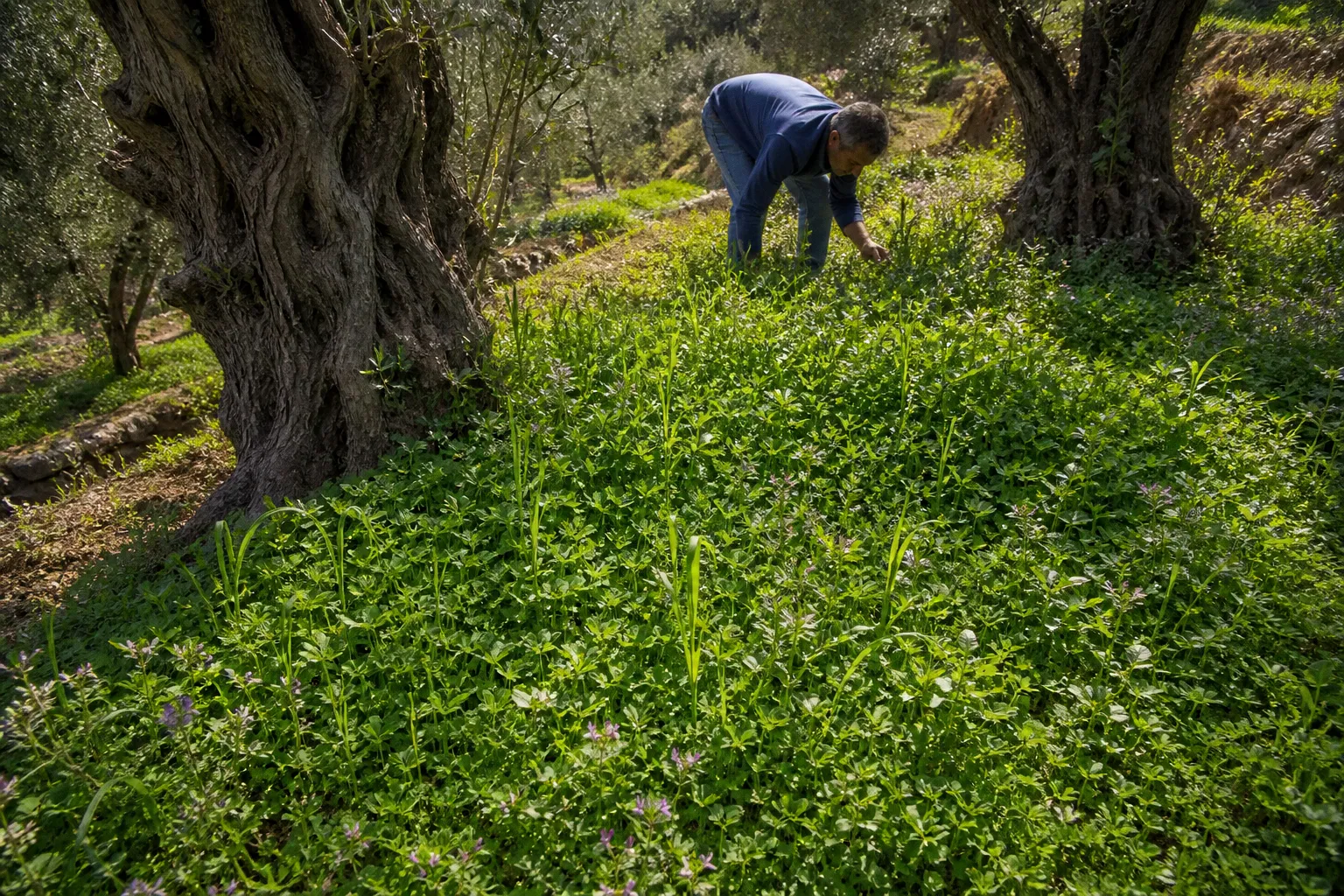
By the time the dry season arrives, the orchard has lost part of its productive top layer and is less able to absorb the next rainfall event.
Cover crops in Lebanese orchards are a practical soil-management tool, not a decorative green layer between tree rows. A minimum of 30% ground cover can reduce surface runoff by up to 50% and soil erosion by up to 80%. The result depends on establishment, root density, timing, and termination. Get the timing wrong—especially in a rainfed Bekaa system—and the cover crop can compete with orchard trees for the same limited spring moisture you need to carry the crop into summer.
The operating rule is simple: cover the soil during the erosion window, then terminate before the cover crop becomes a serious water demand.
Start with the erosion problem, not the seed mix
Your first decision is not whether to plant vetch, oats, or a mixed stand. It is identifying where the orchard is losing soil and where machinery, irrigation, and harvest access must remain clear.
In sloping Mediterranean orchards, conventional tillage leaves the inter-row exposed during the period when rainfall can generate the most runoff. Repeated cultivation may create a visually clean orchard floor, but it also breaks soil aggregates and removes protective residues. Water then moves faster across the surface instead of infiltrating through stable root channels and covered soil.
Temporary cover crops address this through several mechanisms:
- Leaves and stems intercept raindrops before they hit bare soil.
- Roots bind soil aggregates and improve resistance to detachment.
- Plant residue slows water movement across the alleyway.
- Organic matter from roots and decomposing biomass supports better soil structure.
- Improved structure creates more pathways for water infiltration.
The target is not maximum vegetation. The target is sufficient ground protection with a controlled end point.
A block with steep slopes, compacted wheel tracks, and visible rills should be managed differently from a level orchard with deep soil and reliable irrigation. Start by mapping the block into operating zones:
1. High-risk slopes: prioritize continuous cover and minimal soil disturbance. These areas lose soil first and recover slowly.
2. Tree-row strips: keep management compatible with trunks, irrigation lines, and root zones. The cover crop should not be allowed to climb into the wetted strip or compete directly with young trees.
3. Traffic lanes: maintain access for pruning, spraying, harvest, and transport. A cover crop that collapses under machinery or remains wet at the wrong time can create an operational problem.
4. Low points and runoff channels: inspect these after major rainfall. They may need additional residue, contour treatment, or a different cover strategy rather than a standard whole-orchard mix.
Do not evaluate success by colour. A dense green stand can still consume too much water, establish unevenly, or fail to protect exposed patches. Evaluate the ground: how much soil is covered, where runoff concentrates, and whether the soil remains friable under traffic.
The objective is not to grow the biggest cover crop. It is to protect the orchard floor, build soil, and shut the system down before water becomes the constraint.
Choose legumes and grasses for a job
The best cover crop depends on what you need the stand to do. There is no universal winner for Lebanese agriculture because orchard altitude, rainfall, soil depth, slope, irrigation access, and crop calendar all change the operating conditions.
Hairy vetch: nitrogen and flexible biomass
Hairy vetch, or Vicia villosa, is a frost-resistant legume suited to Mediterranean conditions. It can fix atmospheric nitrogen, suppress weeds, and produce substantial above-ground biomass. That makes it useful where the orchard needs both soil cover and a nitrogen contribution from the alleyways.
Legumes are particularly valuable when your soil tests show low available nitrogen or when you want to reduce dependence on purchased nitrogen inputs. Alleyway-grown legumes can contribute up to 50 pounds of nitrogen per acre to the orchard ecosystem, but that figure should not be treated as an automatic fertilizer credit. Nitrogen fixation depends on establishment, biomass production, nodulation, soil conditions, and what happens to the plant material after termination.
The practical use case is clear:
- Select a legume when nitrogen contribution is a priority.
- Use it where the soil can support establishment without drawing excessive moisture from the trees.
- Terminate it early enough to preserve spring water.
- Confirm the nutrient effect with soil testing rather than assuming the entire nitrogen contribution becomes available to the trees.
Cereals and grasses: biomass, residue, and soil protection
Wheat, oats, and ryegrass typically generate greater dry biomass and organic carbon uptake than legume cover crops in Mediterranean fruit orchards. That makes them effective where the main objective is physical protection, residue production, weed suppression, and improved soil organic matter.
A grass-based stand can create a stronger residue layer, particularly on erosion-prone slopes. It can also provide a more durable surface after termination. The trade-off is that high-biomass grasses may immobilize some available nitrogen during decomposition, depending on the carbon-to-nitrogen balance and soil conditions. They also require water to produce that biomass.
Use grasses when:
- Erosion control is the immediate priority.
- The orchard needs durable residue between rainfall events.
- Soil nitrogen is adequate or can be managed through a tested fertility plan.
- You have a clear termination window before late spring water demand rises.
Mixed stands: balance instead of compromise
A cereal-legume mixture can combine fibrous roots and durable residue from grasses with nitrogen fixation from legumes. It may also produce a more stable stand across variable soil conditions than a single species.
But mixtures are not automatically easier. One component may dominate, particularly where establishment conditions favour either the cereal or the legume. That is not a failure if the stand still meets the orchard’s goals, but you should define the objective before planting:
- Runoff control: prioritize fast, reliable ground cover.
- Nitrogen contribution: maintain a meaningful legume component.
- Residue production: favour the species that can deliver dry biomass without exhausting spring moisture.
- Weed suppression: focus on canopy closure and stand density.
- Soil organic matter: measure biomass and residue persistence, not just visual growth.
| Cover crop type | Primary strength | Main management risk | Best fit in an orchard |
|---|---|---|---|
| Hairy vetch and other legumes | Nitrogen fixation, weed suppression, useful biomass | Water competition if termination is delayed; nitrogen benefit varies with establishment | Blocks where nitrogen contribution and moderate cover are priorities |
| Wheat, oats, or ryegrass | High dry biomass, residue, erosion protection | Can increase water demand and affect nitrogen availability during decomposition | Slopes and alleyways where physical soil protection is urgent |
| Cereal-legume mixture | Combined residue and nitrogen functions | Species competition and less predictable stand composition | Larger blocks where the manager wants functional diversity |
| Temporary cover crop | Seasonal protection without permanent understory | Requires disciplined establishment and termination | Rainfed orchards with a defined winter-to-spring risk period |
Do not select seed solely because it is available locally or because the stand looks vigorous in a neighbouring block. Ask what the cover must deliver, then match the species to the limiting factor.
Build the plan around the Bekaa water window
The most important constraint in rainfed orchard systems in the Bekaa Valley is not winter establishment. It is spring water competition before the hyper-arid summer period.
A cover crop can protect the soil during the wet season and still damage orchard performance if it remains active too long. As the cover crop matures, it continues extracting water from the same soil profile used by trees. In shallow or compacted soils, the conflict arrives earlier. In young orchards, it is more severe because root systems have not yet reached deeper moisture reserves.
Use an if-then protocol:
- If the block is rainfed and the soil profile dries quickly, set an early termination trigger and monitor soil moisture before the cover crop reaches peak maturity.
- If trees show early water stress or spring rainfall is below expectation, terminate sooner rather than waiting for maximum biomass.
- If the orchard has deep soil or reliable supplemental irrigation, you may have more flexibility, but do not treat irrigation as permission to ignore competition.
- If the cover crop is dense near tree rows, control that strip first. The alleyway can retain cover longer than the immediate root-zone area.
- If the block is young, shallow-soiled, or exposed, prioritize tree survival and establishment over maximum cover-crop yield.
- If rainfall is concentrated in short, intense events, preserve surface cover even where total seasonal rainfall appears adequate. Runoff risk depends on event intensity and slope, not only on the seasonal total.
Termination should be planned before planting. Decide:
- What equipment will be used.
- Which rows must remain accessible.
- Whether residue will be left on the surface or incorporated.
- How close to trunks and irrigation infrastructure the operation can work.
- What soil-moisture signal will trigger action.
- How much time is needed before spraying, mowing, harvest access, or other orchard operations.
The termination date is not a calendar ritual. It is a risk-control decision based on plant development, soil moisture, weather outlook, and tree demand.
Keep the tree row and alleyway on separate schedules
Treating the entire orchard floor as one management unit creates unnecessary competition. The alleyway can carry a seasonal cover crop while the tree row receives more precise weed and moisture management.
A workable layout may include:
- Covered alleyways to slow runoff and build biomass.
- Managed tree-row strips kept clear around trunks and irrigation lines.
- Protected drainage points reinforced with residue or additional erosion-control measures.
- Permanent access lanes where machinery must travel regardless of soil condition.
This separation also improves field logistics. You can terminate the cover in the tree-row strip earlier, retain alleyway cover for erosion protection, and avoid dragging tall or wet vegetation through harvest operations.
Convert biomass into soil performance
A cover crop only improves the orchard system if its biomass is managed correctly. The plant is not the final product. The final product is better soil structure, more stable infiltration, reduced runoff, and a fertility program that uses measured nutrient availability.
Cereal and grass cover crops generally contribute more dry biomass and organic carbon uptake. Legumes generally contribute more available soil nitrogen. These functions can be combined, but they do not happen at the same speed or with the same reliability.
Terminate without destroying the soil structure
Avoid replacing a protective cover crop with aggressive tillage that recreates the original problem. If the orchard’s soil is already vulnerable to erosion, repeated incorporation can expose it at exactly the wrong time.
The appropriate termination method depends on equipment, residue volume, slope, and the next orchard operation. The operating principle is to leave enough surface protection to slow rainfall and maintain infiltration while preventing continued water use by the living cover.
On sloping blocks, surface residue is often strategically more valuable than a perfectly clean finish. On heavy or compacted soils, however, residue alone will not repair poor infiltration. You still need to address compaction, traffic patterns, and drainage concentration.
Treat nitrogen as a measured input
Legume cover crops can reduce the pressure on the nitrogen budget, but they do not eliminate the need for soil testing. Nitrogen fixation is not the same as immediate tree uptake. The timing of termination, decomposition, root distribution, and soil moisture all affect availability.
Build the fertility decision around:
- Pre-season and post-season soil tests.
- Crop load and expected orchard demand.
- Leaf analysis where appropriate.
- The amount and type of cover-crop biomass produced.
- Whether biomass remains on the surface or is incorporated.
- Signs of excessive vegetative growth or inadequate nitrogen.
If the soil test does not support a nutrient claim, do not make one. Sustainable farming is not the removal of inputs at any cost. It is the precise use of inputs, backed by field evidence.
Measure the cover, not just the crop
The 30% ground-cover threshold is an operational reference point because it links visible soil protection to reduced runoff and erosion. Use it as a minimum performance signal, not as a guarantee.
Record the following at fixed points in the orchard:
- Percentage of ground covered.
- Bare patches on slopes and under tree canopies.
- Runoff channels after heavy rain.
- Soil surface crusting.
- Infiltration response after rainfall.
- Weed pressure before and after termination.
- Biomass volume or dry matter estimate.
- Tree-row soil moisture relative to the alleyway.
- Tree vigour and signs of spring stress.
A simple fixed-photo method can work if it is consistent: same locations, same angle, same timing, and a record of rainfall conditions. Add soil sampling where the block is variable. The goal is to compare management decisions, not produce a glossy before-and-after image.
A legume is not a fertilizer invoice, and a green orchard floor is not proof of soil health. Measure the residue, the moisture, the runoff, and the tree response.
Run a pilot before scaling across the farm
The fastest way to lose control of a cover-cropping programme is to seed every block before learning how the system behaves on your soil. Start with a controlled pilot that exposes the main risks.
Use one or more representative orchard sections:
- A sloping block with visible erosion.
- A flat or gently sloping block with different soil depth.
- A rainfed block with limited spring moisture.
- A younger block where tree competition is more sensitive.
- A mature block where machinery access is the main constraint.
Compare a small number of clearly defined treatments rather than a confusing collection of mixes. For example, you might compare a legume stand, a cereal stand, a mixed stand, and the existing floor-management system. The exact design should follow local advice and available seed, but the comparison must use the same observation points and the same decision rules.
Track performance through the season:
At establishment
Check emergence uniformity, bare patches, pest pressure, and whether traffic or irrigation has disrupted the stand. Poor establishment can create the appearance of a cover-crop failure when the real issue is seedbed preparation, timing, or soil moisture.
During winter rainfall
Inspect slope breaks, wheel tracks, drainage points, and areas beneath the canopy. Look for rilling, sediment movement, ponding, crusting, and standing water. A cover crop that looks thin but stops soil movement may be more useful than a dense stand in a low-risk area.
Before termination
Compare soil moisture in the tree row and alleyway. Assess cover percentage and biomass. Review the weather window and expected tree demand. If the block is entering a dry period, act before the cover reaches its maximum possible size.
After termination
Inspect residue persistence, weed emergence, infiltration, and machinery access. Confirm whether the orchard floor remains protected after the living plants are gone. This is where the soil-management value becomes visible.
At harvest and after the season
Record operational impacts: access delays, residue interference, irrigation adjustments, tree stress, and changes in weed-control demand. A system that improves soil but blocks harvest logistics needs redesign, not blind expansion.
Regional innovation platforms can support this process. ICARDA and local institutions such as LARI have operated platforms in the Bekaa, including Qob Elias, to validate sustainable pest-management and soil-health practices with local farmers. Use these platforms and local agronomic guidance to compare practices under Lebanese conditions rather than importing a cover-crop protocol designed for a different rainfall pattern, soil profile, or orchard calendar.
Adapt the system to Lebanese orchard diversity
Lebanese orchards are not one production environment. The same cover crop can behave differently in the Bekaa, the mountains, and lower-elevation or coastal areas. Altitude changes frost exposure and season length. Soil depth changes the speed of water competition. Orchard species change the timing of canopy development, harvest access, and spring demand.
Your adaptation logic should be specific:
- High-altitude orchards: confirm frost tolerance and establishment timing. Hairy vetch is frost-resistant, but field-level success still depends on local conditions and seed quality.
- Shallow mountain soils: prioritize erosion control but keep the termination window conservative. There is less stored water available for both trees and cover.
- Bekaa rainfed systems: treat spring moisture as the key constraint. The cover crop must be terminated before it drains the profile ahead of summer.
- Irrigated orchards: use irrigation capacity to support establishment only where it makes economic and agronomic sense. Do not let irrigation conceal poor species selection or delayed termination.
- Young orchards: maintain a wider protected zone around trees and monitor competition more aggressively.
- Mature orchards with heavy machinery: design the stand around access routes and soil trafficability. A theoretically strong cover that prevents timely operations is not a workable system.
Do not claim that a single native seed mix will perform consistently across these environments. Exact establishment rates for specific Lebanese legume mixes remain dependent on microclimate, elevation, soil profile, and management. Test locally and keep the first cycle small enough to correct.
The operating protocol for your first season
Use this sequence to move from concept to field execution:
1. Map the orchard. Mark slopes, erosion channels, compacted lanes, tree rows, irrigation infrastructure, and low points.
2. Define the constraint. Choose the primary target: runoff, erosion, weeds, nitrogen, organic matter, or access protection.
3. Test the soil. Establish a baseline for nitrogen and other relevant fertility indicators before assigning a value to the cover crop.
4. Select the functional type. Use legumes for nitrogen contribution, grasses for biomass and residue, or a mixture where both functions are justified.
5. Set the termination trigger before seeding. Tie it to soil moisture, tree demand, weather, plant development, and the orchard calendar.
6. Separate tree rows from alleyways. Avoid forcing the same cover and termination timing across the entire floor.
7. Pilot representative blocks. Include the soil and slope conditions most likely to expose failure.
8. Monitor fixed indicators. Record ground cover, runoff, soil moisture, biomass, weed pressure, and tree response.
9. Terminate early when water risk rises. Do not wait for maximum biomass if the soil profile is drying.
10. Review the economics and logistics. Account for seed, labour, machinery passes, irrigation, termination, residue management, and any change in weed-control requirements.
11. Scale only the treatment that works operationally. A sustainable practice must survive the full orchard schedule, not only the winter season.
12. Keep the protocol adjustable. Seasonal rainfall and temperature will change the correct decision from one year to the next.
Mandatory compliance and field-readiness checklist
Before releasing the plan for a full orchard block, confirm:
- The block map identifies slopes, runoff channels, tree rows, and machinery lanes.
- The cover-crop objective is written in one sentence.
- The selected species or mixture matches that objective.
- Soil tests are available before making nitrogen claims.
- The rainfed water risk has been assessed for late spring.
- A termination date range and trigger have been agreed before planting.
- Tree-row management is separate from alleyway management.
- Irrigation lines and trunk zones are protected.
- Ground cover will be checked against the 30% minimum performance reference.
- Runoff and erosion will be inspected after significant rainfall.
- Biomass and residue will be recorded after termination.
- The pilot includes at least one block with the farm’s highest erosion or water-competition risk.
- Local technical support has been consulted where seed choice or field conditions are uncertain.
- Scaling will wait until tree response, soil moisture, access, and residue performance are reviewed.
Cover crops in Lebanese orchards work when they are managed as part of the production calendar, not added beside it. Protect the soil during the rain-driven erosion period. Use legumes and grasses for distinct functions. Track the water balance in the Bekaa. Terminate before the cover crop becomes a competitor. Then carry the residue, nutrient data, and field observations into the next cycle.
That is the sustainable-farming model that can scale: not maximum greenery, but controlled soil protection with a clear operational exit.