Terrace cover cropping: a soil erosion plan for Lebanon
Lebanon’s mountainous farmland can lose 50 to 70 tons of soil per hectare per year through water erosion. On a terraced slope, that is not a minor fertility issue.
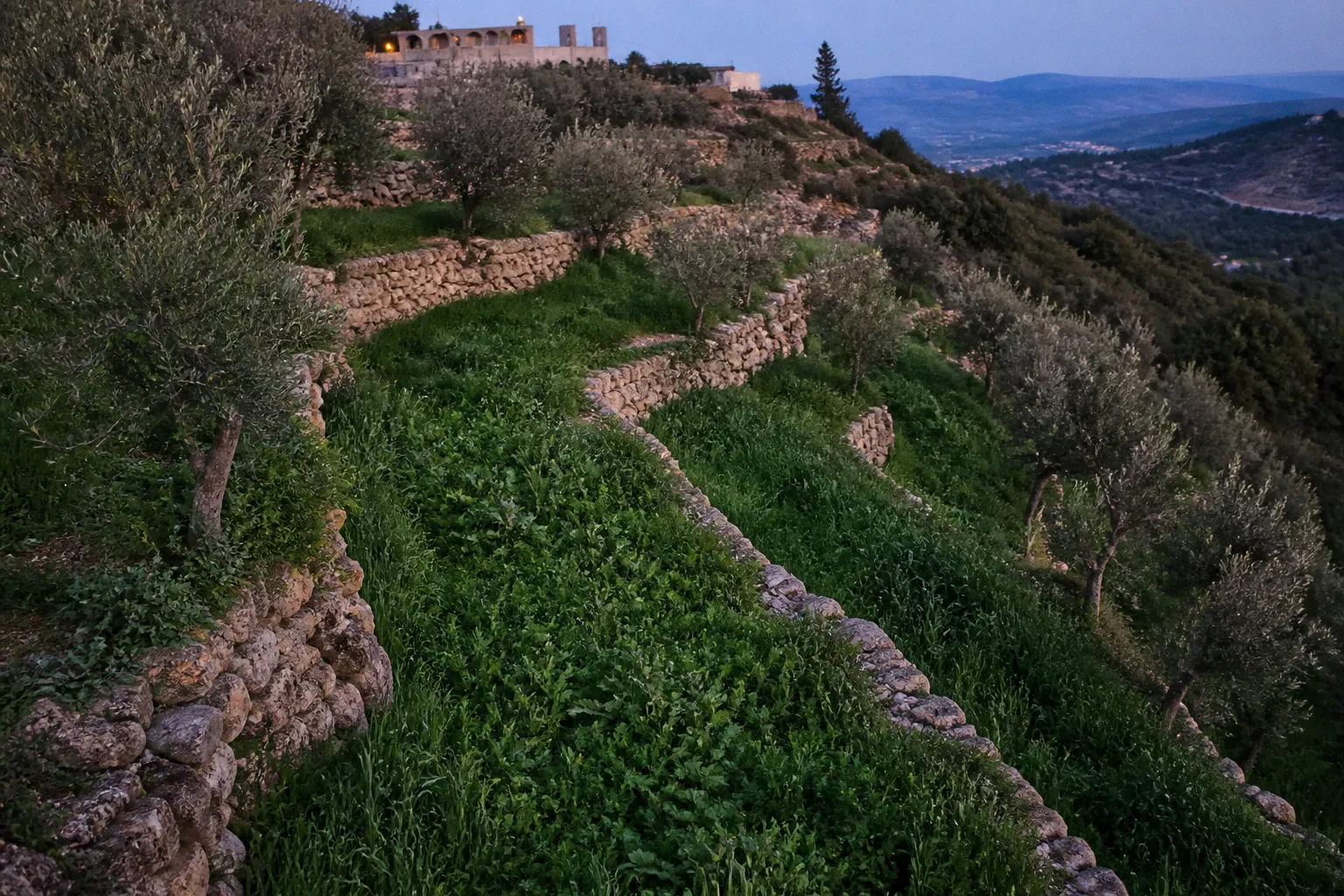
It is a logistics failure upstream: productive topsoil leaves the farm, drainage channels clog, stone walls take more hydraulic pressure, and the next harvest starts with less moisture, less organic matter, and less usable ground.
Cover crops for terraced farms in Lebanon can slow that loss, but only when they are selected and managed as part of the terrace system. A winter stand of oats, vetch, or faba beans is not a substitute for repairing dry-stone walls. It is a biological layer that protects the soil between cash crops, reduces bare-ground exposure, and builds a more stable production base.
The operating rule is simple:
Cover crops protect the soil surface. Stone walls hold the terrace. You need both systems working together.
The erosion problem starts with bare winter soil
Terrace farming in Lebanon depends on a structure that is both agricultural and hydraulic. Dry-stone walls divide steep land into workable plots, reduce slope length, and create level or semi-level growing surfaces. When those walls are maintained, they interrupt runoff. When they collapse, water can move across the slope with enough force to strip soil, expose roots, and carry sediment into lower fields.
The risk increases sharply during the period when annual crops are absent. Harvest removes the canopy. Tillage leaves the surface loose. Winter rainfall then hits open soil directly. Each storm can detach fine particles and move them toward the terrace edge. Repeated over a season, that process removes the fraction of soil that carries much of the farm’s organic matter and available nutrients.
The abandonment of terraces makes the problem worse. Rural migration has left some stone walls unrepaired and some fields unmanaged. Collapsed walls allow runoff to accelerate. Dry biomass accumulates, increasing fire risk. The farm loses both its productive surface and the infrastructure that once controlled water movement.
The western slope of the Shouf District offers a clear indication of how extensive the terrace landscape can be: dry stone-walled terraces cover around 10% of the land within the relevant area of the Shouf Biosphere Reserve. These are not decorative features. They are productive infrastructure. Their maintenance belongs in the same operating plan as seed procurement, irrigation, and harvest scheduling.
For an exporter or cooperative, erosion also creates downstream problems:
- Field access becomes less reliable after heavy rain.
- Sediment can block small drainage routes and damage farm roads.
- Uneven soil depth produces inconsistent crop maturity.
- Lower soil moisture retention increases irrigation demand later in the season.
- Produce quality varies more across the same cooperative block.
- Repeated soil loss raises dependence on purchased fertilizers and external inputs.
A cover-cropping plan should therefore start before planting. Map the terrace blocks, identify exposed edges, and mark walls with active failures. If a wall is already breached, do not treat seed as the first intervention. Stabilize the structure and redirect runoff before establishing a winter cover.
Choose the species for the job, not for the label
There is no universal “best” cover crop for Lebanese terraces. The correct species depends on the immediate operational target:
- Maximum above-ground biomass
- Fast weed suppression
- Nitrogen contribution
- Compatibility with the next crop
- Available termination window
- Soil moisture at planting
- Slope exposure and machinery access
Research from Lebaa in South Lebanon provides a useful comparison. Overwinter oat produced 915 grams of dry biomass per square metre, compared with 402 grams per square metre for narbon vetch and 292 grams per square metre for forage radish. That matters because dense biomass covers soil, competes with winter weeds, and reduces the number of days when raindrops strike exposed ground.
But biomass alone does not decide the rotation. Oats can produce strong cover and weed suppression while creating a nitrogen-management problem for the following crop. The carbon-rich residue may immobilize nitrogen as it decomposes. If the next crop has a high nitrogen requirement and the oat stand is incorporated too late or in excessive quantity, early growth can suffer.
Legumes operate differently. Vetches and faba beans can add biologically fixed nitrogen and improve soil fertility, but their biomass may be lower than a strong oat stand. They can also be more sensitive to establishment conditions, grazing pressure, and termination timing.
Use this comparison as a starting protocol:
| Cover crop | Main operational advantage | Main risk or limitation | Best fit |
|---|---|---|---|
| Oat | Highest measured dry biomass in the Lebaa trial; strong weed suppression | Residue can immobilize nitrogen for the next crop | Bare, erosion-prone blocks where surface cover is the priority |
| Narbon vetch | Legume contribution and useful residue quality; subsequent corn dry matter reached 7.6 Mg/ha in a coastal Lebanon trial | Lower biomass than oat; requires effective establishment and termination | Rotations needing fertility support before a nitrogen-demanding crop |
| Common vetch | Improves soil fertility, tree vigor, and yield in Lebanese olive orchards | Performance depends on orchard moisture and termination timing | Olive blocks and mixed orchard systems |
| Faba bean | Increased mineral nitrogen and organic matter when intercropped in olive orchards | Requires sufficient growing period and careful water management | Olive orchards with suitable winter moisture |
| Barley–vetch mixture | Combines cereal ground cover with legume fertility support | More complex seeding and termination decisions | Orchards and cereal systems where a balanced stand is needed |
| Forage radish | Can provide fast cover and root activity | Lower dry biomass in the Lebaa trial than oat or narbon vetch | Shorter windows or mixed cover strategies, subject to local performance |
For a cooperative, this means purchasing one seed type for every block is a weak approach. Segment the land first. A high-exposure terrace edge may need an oat-heavy stand. An olive orchard with a longer management window may benefit from common vetch or faba bean. A cereal block that repeatedly shows nitrogen stress may need a barley–vetch rotation rather than another monoculture.
If the soil is exposed, prioritize canopy and residue
Use oat where the immediate problem is bare soil and winter weed pressure. The Lebaa result—915 g/m² of dry biomass—makes oat a strong candidate for rapid surface protection.
However, do not roll that result into a blanket yield promise. Oat is not automatically beneficial before every crop. Its residue needs a management plan:
1. Estimate the biomass before termination.
2. Allow enough time for decomposition before planting a nitrogen-demanding crop.
3. Avoid burying a heavy oat stand immediately before a crop that needs rapid early nitrogen.
4. Where the rotation cannot provide decomposition time, blend oat with a legume or reduce the oat share.
5. Monitor the following crop for pale early growth, slow establishment, or uneven vigor.
The objective is not maximum biomass at any cost. The objective is a functioning sequence from winter protection to the next commercial crop.
If nitrogen is the constraint, prioritize legumes
Narbon vetch is a strong candidate where the next crop requires fertility support. In coastal Lebanon, incorporating whole-plant narbon vetch residues was associated with 7.6 Mg/ha of subsequent corn dry matter. Oat residues produced lower results in that comparison, consistent with the nitrogen immobilization problem.
That does not mean every vetch stand will deliver the same result. Soil type, rainfall, termination date, residue handling, and crop demand all affect the outcome. It does mean the species choice should follow the constraint:
- Erosion and weeds first: increase cereal biomass.
- Nitrogen and organic matter first: increase legume presence.
- Both problems at once: test a cereal–legume mixture in a controlled block.
If the terrace is dry, reduce the water penalty
Cover crops consume water. In a rainfed or water-limited block, that cost must be managed rather than ignored. Terminate before the cover crop reaches peak water demand if the following crop depends on stored soil moisture. Keep living cover in place longer where erosion risk dominates and the next crop can tolerate the delay.
The correct termination date is not the same across the Bekaa, coastal areas, and higher mountain terraces. Use the local rainfall pattern, soil depth, and crop calendar. A cover crop that remains productive protection on a deep terrace may become a moisture liability on shallow soil above a damaged wall.
Winter cover cropping in the Bekaa needs a rotation, not a broadcast solution
The northern Bekaa Valley offers one of the clearest rotation signals in the available evidence. Replacing unsustainable barley monoculture with a barley–common vetch rotation increased barley grain yields by 44% to 80% and straw yields by 27% to 53%.
That range is operationally significant. It shows that a rotation can improve both the commercial grain component and the straw component. It also shows why soil health should be managed through the crop sequence, not only through fertilizer additions.
Barley monoculture creates several predictable weaknesses:
- The same rooting pattern repeats year after year.
- Nutrient demand is concentrated in the same seasonal window.
- Weed and disease pressure can become more difficult to manage.
- Soil organic matter receives less diverse residue input.
- Bare periods may become longer if planting and harvest schedules slip.
Adding common vetch changes the sequence. The legume contributes a different root system and residue profile. Nitrogen cycling improves when the biomass is terminated at the correct stage. The following barley crop can then access a more favorable soil environment.
Build the rotation around a defined target:
Rotation protocol for a barley block
1. After barley harvest, map rills, eroded terrace edges, and areas with weak straw cover.
2. Before winter rainfall, establish common vetch or a barley–vetch mixture on the most exposed ground.
3. Keep the terrace wall visible and accessible. Do not allow dense vegetation to hide active stone displacement.
4. Terminate the cover before it competes excessively for stored moisture.
5. Distribute or incorporate residues according to the next crop’s nitrogen demand.
6. Record grain yield, straw yield, soil workability, and weed pressure by block.
7. Repeat only after comparing performance against the previous monoculture block.
That last step is where cooperatives gain control. Do not evaluate cover crops through visual appearance alone. A thick green field may still fail if termination is late, soil moisture collapses, or the next crop suffers nitrogen lock-up. Record the production result.
Olive orchards need living ground cover without creating a water conflict
Lebanon’s olive systems are particularly suited to perennial, low-disturbance soil protection. Trees remain in place for years, while the inter-row soil is often exposed to winter rain and repeated passes. A well-managed winter cover can reduce surface exposure, improve soil structure, and return organic matter to the orchard.
Common vetch planted in Lebanese olive orchards has been associated with improved soil fertility, tree vigor, and overall crop yield. Trials in Abra also found that intercropping olive orchards with faba beans or a barley–vetch mixture significantly increased soil mineral nitrogen and organic matter content.
The orchard protocol must protect the trees first. Keep the cover crop away from the trunk zone. Maintain access lanes for pruning, harvest, and transport. Terminate before the cover competes with the olive trees for critical spring moisture.
A practical orchard layout includes:
- A managed cover in the inter-row area.
- A clean or lightly managed strip around each trunk.
- Defined access lanes for workers and harvest equipment.
- Inspection points at terrace walls and drainage outlets.
- A termination date linked to expected spring water demand.
- A residue strategy that returns carbon without blocking orchard operations.
Faba bean can be useful where the orchard has enough winter moisture and the cooperative can manage the longer crop cycle. The Abra trials indicate a fertility benefit, but the decision still depends on field access and harvest timing. If bean biomass blocks movement during olive operations, the agronomic gain may be offset by labor and handling problems.
The same applies to a barley–vetch mixture. It may provide more balanced ground cover than a single species, but it introduces additional decisions: seeding ratio, maturity timing, termination method, and residue distribution. Use it where the cooperative has the labor and equipment to manage the stand. Do not deploy complexity where the field team cannot execute it.
The best cover crop is the one your crew can establish, inspect, terminate, and integrate before it disrupts the next harvest window.
Use local landraces where drought resilience is part of the brief
Dry regions require more than a generic organic farming recipe. A cover crop must survive the local moisture regime, produce usable biomass, and fit the farm’s termination capacity.
Local red vetchling, Lathyrus cicera, offers one relevant option for dry Lebanese areas. Reported local landraces can enrich the soil with 140 to 250 kg/ha of organic matter from root residues and produce 95 to 665.7 kg/ha of above-ground biomass. The range is wide, which is exactly why field-level testing matters. Performance varies by landrace, soil, rainfall, establishment date, and management.
Use a small trial design rather than changing the whole farm at once:
- Select three representative terrace blocks.
- Reserve one block as the current-practice comparison.
- Test the proposed local landrace in the second block.
- Test a mixed stand in the third block.
- Measure establishment density, winter survival, biomass, weed suppression, soil moisture, and following-crop performance.
- Review the results after one full rotation.
Do not call a cover crop drought-resilient because it germinated successfully after one rainfall event. The useful measure is whether it provides protection without exhausting the soil water reserve needed by the commercial crop.
The wall inspection is part of the cover-crop operation
Cover cropping will not stabilize a terrace with a failed retaining wall. Dense vegetation can reduce raindrop impact and slow sheet flow, but it cannot replace stonework. In some cases, unmanaged biomass can conceal cracks, obstruct inspection, or add fire fuel when it dries.
Every field pass should include a wall and drainage check. Schedule it before seeding, after major winter storms, and before termination.
Inspect for:
- Loose or displaced capstones.
- Bulging sections in the wall face.
- Fresh sediment deposits at the terrace edge.
- Water channeling around the wall ends.
- Blocked drainage outlets.
- Exposed roots or newly formed rills.
- Dry biomass accumulating against the wall.
- Access problems for repair crews.
If water is concentrating in one path, fix the flow route before relying on vegetation. If a wall has collapsed, remove or manage the cover near the repair zone so workers can reach the structure. If the terrace edge is stable but bare, establish cover before the next heavy-rain period.
This is where terrace soil health and logistics meet. A cooperative cannot treat each plot as an isolated farm unit if its runoff damages the plot below. Create a shared inspection map. Record wall failures, cover-crop status, and repair priority by block. Then schedule labor before the harvest calendar becomes crowded.
Soil fertility depends on residue timing
The residue is the product of the cover-crop operation. Leaving it unmanaged creates a new bottleneck.
Legume residues generally support nitrogen cycling, but their effect depends on maturity and decomposition. Cereal residues contribute carbon and physical protection, but their high carbon-to-nitrogen balance can temporarily tie up available nitrogen. The next crop’s demand determines the correct handling method.
Use this decision sequence:
1. If the next crop is nitrogen-demanding and planting is immediate, avoid incorporating a heavy oat stand directly before planting.
2. If the field has a longer fallow or decomposition window, oat residue can be retained or incorporated earlier.
3. If fertility improvement is the primary objective, use common vetch, narbon vetch, faba bean, or a cereal–legume mix.
4. If erosion risk remains high after termination, retain surface residue rather than leaving the terrace bare.
5. If residue blocks access or increases fire risk, manage it before the dry season and keep terrace walls and drainage routes clear.
6. If crop performance declines after a cover, adjust the species ratio, termination date, and residue placement before abandoning the system.
The cooperative should record at least five metrics per block:
- Cover establishment date
- Biomass at termination
- Soil moisture at termination and planting
- Weed pressure in the following crop
- Yield and quality of the following commercial crop
Add labor hours and machinery passes where possible. A cover crop can improve soil without improving the operation if the termination process consumes too much labor or delays planting.
Build a cooperative protocol that can survive export schedules
Individual farmers can test species. Cooperatives must standardize execution. Buyers do not purchase soil health as an abstract benefit; they purchase consistent produce, predictable harvest windows, and compliant lots.
A cooperative cover-cropping protocol should define:
Block selection
Start with fields showing one or more of the following:
- Visible sheet erosion or rills
- Shallowing soil on upper terraces
- Repeated weed pressure
- Declining barley performance under monoculture
- Low organic matter or weak soil structure
- Olive orchard inter-rows left bare through winter
- Stable walls that can support a biological protection trial
Do not begin on a terrace with unresolved structural failure. Repair the wall and control runoff first.
Seed and establishment
Select species by function, not availability alone. Record seed lot, seeding date, field moisture, and emergence. If establishment is patchy, investigate the cause before increasing the rate. Poor emergence can reflect late planting, crusting, weak seedbed preparation, or insufficient moisture.
Avoid aggressive tillage on steep land. The aim is to establish a protective stand while preserving soil structure and minimizing additional disturbance.
Termination
Set a termination trigger before planting. The trigger can be calendar-based, moisture-based, or linked to the development stage of the cover crop. Make it visible to the field team.
For each block, specify:
- Who authorizes termination
- Which equipment is used
- Where residue will remain
- How close equipment can operate to the wall
- How quickly the next crop must be planted
- What happens if rainfall delays the operation
If the cover is terminated late because no one owns the decision, the system is not managed. Assign responsibility.
Traceability
Add cover-crop data to the cooperative’s field records. For export-oriented production, traceability should connect the cover-crop block to:
- The following crop
- Input applications
- Irrigation records
- Harvest date
- Lot code
- Any organic or sustainability claim made to the buyer
Do not claim that a field is organic, regenerative, or pesticide-free solely because it has a winter cover. Cover cropping is one practice within a broader production and compliance system. Keep the agronomic record separate from the marketing language.
Soil protection becomes an export advantage only when the cooperative can prove what happened in the field, when it happened, and how it affected the crop.
A field-ready decision tree
Use the following if–then sequence when planning the next season:
1. If the terrace wall is damaged, then repair and stabilize it before establishing a cover.
2. If the wall is stable but the soil is exposed, then prioritize a high-biomass cover such as oat.
3. If weed suppression is the main problem, then select the stand that produces sufficient winter biomass and close canopy cover.
4. If the following crop has high nitrogen demand, then include a legume or allow enough time for cereal residue to decompose.
5. If the block is an olive orchard, then use inter-row cover while maintaining trunk clearance and harvest access.
6. If the field is in the northern Bekaa and barley is grown repeatedly, then test a barley–common vetch rotation against monoculture.
7. If water is limited, then terminate earlier and compare soil moisture against the protected-soil benefit.
8. If the next crop is delayed, then maintain residue cover rather than leaving the terrace exposed.
9. If biomass dries against a wall or drainage route, then remove or redistribute it before the fire-risk period.
10. If results are inconsistent, then divide the problem into establishment, species selection, termination, and residue management instead of changing everything at once.
Mandatory pre-season compliance checklist
Before approving the cover-crop plan, the cooperative field manager should confirm:
- Each terrace block has a recorded erosion and wall condition.
- Damaged dry-stone walls are assigned a repair priority.
- Drainage routes and terrace edges are accessible for inspection.
- Species selection is linked to a defined objective: biomass, weeds, nitrogen, or moisture management.
- The following crop and its nitrogen demand are recorded.
- Seeding dates and seed lots are documented.
- Termination responsibility is assigned to a named operator.
- Residue placement will not block harvest access, drainage, or wall inspection.
- Soil moisture will be checked before and after termination where water is limited.
- Yield, biomass, weed pressure, and labor inputs will be compared by block.
- Any organic or regenerative claim is supported by the cooperative’s full production records.
- Cover-crop performance is reviewed before expanding the practice across all terraces.
Lebanon’s terrace farms do not need a fashionable soil-health program. They need a disciplined one. Start with the erosion rate, the exposed soil, the failed wall, and the next crop’s requirements. Use oats where surface biomass is the priority. Use vetches and faba beans where nitrogen and organic matter need reinforcement. Use rotations in the Bekaa instead of repeating barley monoculture. Keep the wall visible, the drainage functional, and the residue under control.
The result is not instant protection and not a guarantee against every storm. It is a stronger production system: less bare soil, better nutrient cycling, more reliable terrace function, and a field record that can support the next commercial decision.