Cover crops for Lebanese soil: choosing the right species
Walk into a Lebanese orchard after the first heavy December downpour, and the water leaving the field tells you something the soil cannot.
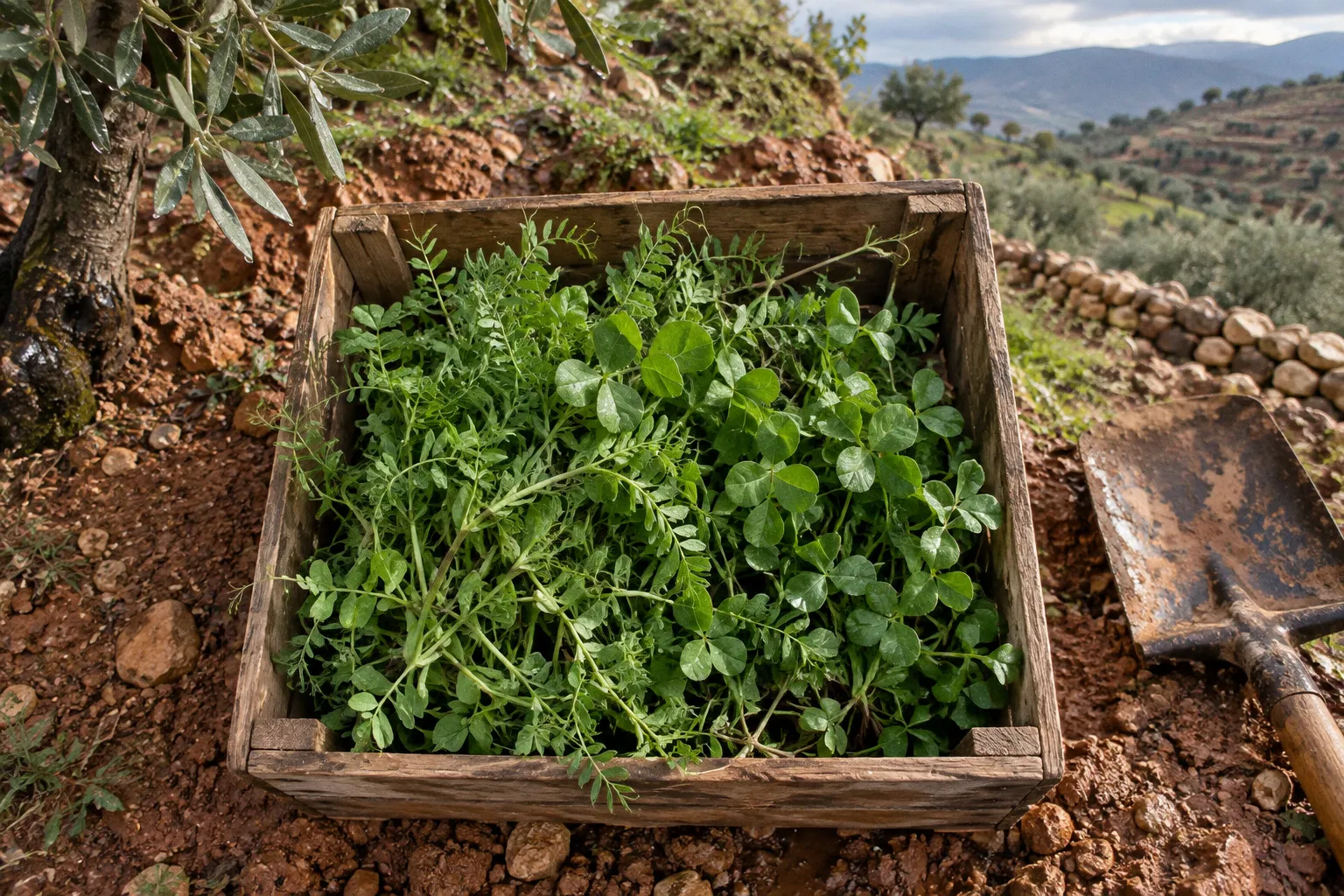
The Erosion Crisis: Protecting Lebanon's Terraced Landscapes
On a bare terrace under olive or grape, that runoff carries silt and nutrients downhill in a brown plume — fine particles that took centuries to form, gone in an afternoon. On a terraced slope in Mount Lebanon, unprotected ground can shed 50 to 70 tons of soil per hectare each winter. That figure is not abstract; it is the difference between a working terrace and a collapsing one, between topsoil that holds moisture through the August drought and subsoil that does not.
Lebanon's orchards and vineyards sit on some of the Mediterranean's most vulnerable agricultural geometry. Terraces carved into mountain slopes concentrate erosive force, and the spaces between trees are too often left bare through the wet season — the exact window when rain intensity peaks. The result is a slow, measurable decline in organic matter, soil structure, and the capacity of the land to feed a cash tree through the dry months that follow.
This is where cover crops enter the picture, not as a green gesture but as a working tool. A minimum of 30% ground cover in an orchard can reduce surface runoff by up to 50% and soil erosion by up to 80%. The roots and residues do something a stone wall cannot: they slow the water before it accelerates, then they feed the biology that holds the soil together.
A bare terrace in winter is an open wound. A cover-cropped terrace is a bandage that becomes skin.
The deeper problem is that erosion does not stay local. Buyers and certification bodies auditing Lebanese fresh produce look closely at soil management history. Documented erosion control is now part of the conversation in GLOBALG.A.P. and organic audits, and the question every cooperative field officer eventually hears is whether the orchard floor was protected during the rainy season. A cover crop record is one of the simplest ways to answer it.
Proven Species for Mediterranean Climates: Oats, Vetch, and Faba Beans
Not every species performs in Lebanon's specific moisture and temperature pattern. What works in northern Europe or the U.S. Midwest often bolts too early, fixes too little nitrogen, or demands water the Bekaa cannot spare in late spring. The reliable performers under Lebanese rainfed conditions cluster around four species: oats, barley, vetch, and faba beans.
A field trial established in November 2020 at the LARI-Abdeh station in Akkar, run with the Lebanese University, compared treatments including faba beans (Vicia faba) and a barley (Hordeum vulgare) plus common vetch (Vicia sativa) mixture. The result was consistent: soil mineral nitrogen and organic matter content rose under legume-containing treatments. This is the kind of evidence that matters to a grower weighing the cost of seed against the benefit of nitrogen the following spring.
Each species does a different job, and a good mix exploits the differences:
- Oats (Avena sativa): the fibrous root workhorse. Produces fast biomass, holds soil structure, scavenges residual nitrogen before it leaches below the root zone. Carbon-rich above-ground residue.
- Vetch (Vicia sativa): the nitrogen fixer. A legume that hosts Rhizobium and converts atmospheric N into plant-available forms. Grows well mixed with a grass that supports its climbing habit.
- Barley (Hordeum vulgare): the drought-tolerant backbone. Tolerates poor soils, establishes quickly on stony terraces, contributes fibrous root mass.
- Faba beans (Vicia faba): the deep miner. Long taproot breaks compaction, fixes substantial nitrogen, leaves large residue nodules after termination.
The standard Bekaa mix proportions are roughly 60% oats by weight, 25% vetch, and 15% legume blend (often including faba beans). The grass component prevents the legume from lodging, while the legume feeds the system biologically. This is not a theoretical recipe — it is a working ratio adapted to Mediterranean rainfed orchards.
A small but important caution: avoid species that volunteer aggressively into the cash crop the following year. Some legumes can reseed and become weeds in a grape row if not terminated at the right stage. Roll-crimping at full bloom terminates the stand cleanly and sets the seed before any can mature.
The Bekaa Valley Protocol: Sowing Windows and Termination Timing
Timing is everything in a Mediterranean cover crop system. Too early, and the seed sits in dry soil and dies. Too late, and the crop establishes weakly and contributes little biomass before the cold slows growth. The window that has worked in the Bekaa is mid-October to mid-November — the period when the first reliable rains have wet the profile but soil temperature still supports rapid germination.
Seeding rate depends on the mix, but for a 60/25/15 oats-vetch-legume blend the typical range falls between roughly 80 and 120 kilograms per hectare, depending on seed size and pure live seed percentage. Drilling is preferable to broadcasting on terraces with stony or crusted surfaces; broadcasting can work in orchards with established tree shading and softer understory soil, but the seed-to-soil contact must be reliable.
Termination is the other critical timing decision. In the Bekaa, the working window is early April, at full bloom of the legume component. At that stage:
- Maximum biomass has been produced.
- Peak nitrogen fixation has occurred in the root nodules.
- The legume has not yet set viable seed.
- Soil moisture reserves are still adequate for the cash crop ahead.
Roll-crimping is the preferred termination method. It lays the cover crop flat, crimps the stems at multiple points to kill growing points, and leaves a thick mulch mat on the surface. This mat is the second gift the cover crop gives: it shades the surface, reduces evaporative loss into May and June, and feeds the soil microbiome as it slowly breaks down.
One hard limit applies: a cover crop cannot be left growing into the dry season in a rainfed orchard. The cover will continue drawing soil moisture long after the cash crop needs it, and in a Mediterranean climate without irrigation reserve this can mean the difference between a filled olive and a shriveled one. Termination must be deliberate, not delayed by indecision.
Economic Impact: Balancing Seed Costs Against Labor Savings
The economics of cover cropping in a Lebanese orchard are tight but real. Seed for a Bekaa-standard mix runs roughly $80 to $120 per hectare, depending on the species composition and the year. That is the headline figure a grower wants to see first.
Against that, the savings show up in two places. First, fewer tillage passes are needed to prepare the orchard floor in the following season because the cover residue suppresses early weed flushes and the root channels improve water infiltration. Second, the diesel and labor that would have gone into those passes — typically estimated at around $40 to $60 per hectare — stay in the bank account. The net cost is often near zero in the first year, and turns positive from year two onward as soil organic matter rises and fertilizer inputs can be reduced.
| Cost / Saving Item | Typical Range (USD/ha) | Notes |
|---|---|---|
| Cover crop seed mix | $80–$120 | 60% oats, 25% vetch, 15% legume blend by weight |
| Seeding labor (drill or broadcast) | $15–$25 | Single pass after first autumn rain |
| Diesel and tillage savings (next spring) | $40–$60 | Fewer passes, softer soil, better infiltration |
| Nitrogen fertilizer offset (estimated) | Variable | Depends on legume biomass and cash crop demand |
Beyond direct dollars, there are resilience gains that do not appear on a single-season ledger. Soil organic matter increases water-holding capacity, which translates into measurable buffering against the dry summers that have become more common. A soil with 2% organic matter holds noticeably more plant-available water than one at 1%, and a cover-cropped orchard trends upward over years while a tilled and bare orchard trends downward.
For a cooperative exporting fresh produce, this matters in another way as well. Buyers increasingly ask for evidence of soil-building practices. A cover crop record across multiple seasons becomes part of the documentation that supports premium pricing and market access.
Integrating Biological Cover with Structural Terrace Maintenance
A common misunderstanding is that a cover crop can substitute for a dry-stone retaining wall on a steep Lebanese slope. It cannot. What a cover crop does is work alongside the structure: it slows runoff before it reaches the wall, drops its sediment load, and reduces the hydrostatic pressure that undermines terrace edges during heavy rain. The two systems are complementary, not interchangeable.
On a terrace that is structurally sound, a cover crop is a finishing layer that protects the investment. On a terrace where the wall is failing, no amount of vetch will hold the slope, and the grower should repair the wall first, then establish the cover. The hierarchy is clear: structure, then biology.
A few practical notes for orchards on terraces with established trees:
- Keep the cover crop at least 30 to 50 centimeters from the trunk of young trees, where excessive moisture and rodent harborage can damage the bark.
- On the steepest sections, favor a denser grass component (more oats, less vetch) because the fibrous root mat binds soil more effectively than a sparse legume stand.
- Watch for voles and snails in thick residue piles near irrigation lines; integrate monitoring into the regular orchard walk rather than waiting for visible damage.
- After the first two seasons, observe the change in weed pressure. A well-timed roll-crimped cover often reduces summer weed flushes enough to cut one mechanical weeding pass.
The integration question also reaches into export compliance. Lebanese cooperatives shipping table grapes, olives, citrus, and stone fruit into European and Gulf markets are increasingly required to demonstrate soil conservation practice. Cover crop records, species lists, sowing and termination dates, and the visible effect on erosion are all items that can be logged in a simple field book and carried forward into audit documentation. The practice serves both the soil and the paperwork.
A Seasonal Timeline for Transitioning an Orchard
The end of the year is the natural decision point for a cooperative considering cover crops for the coming season. Here is how the year lays out in practice under rainfed Lebanese conditions:
- August–September: assess last winter's erosion. Note where rills formed, where topsoil washed, where terrace walls took pressure. Identify the two or three blocks where cover will deliver the highest return.
- Early October: order seed. Mix proportions for the Bekaa work well elsewhere with adjustments for altitude; coastal growers may shift earlier by a week or two.
- Mid-October to mid-November: sow after the first soaking rain. Drill where possible. Roll the seedbed if broadcasting.
- December–February: monitor establishment. Walk the field once a month. Watch for poor germination patches and record rainfall.
- Late March: check legume bloom stage. Plan termination for the early-April window.
- Early April: roll-crimp at full bloom. Leave the mulch mat in place.
- May–June: observe cash crop performance, weed pressure, and soil moisture. Record observations for the next cycle.
Cover cropping is not a one-season intervention. It is a three-year commitment to see organic matter move and a five-year commitment to see soil biology change. The first season is the most expensive; every season after that is cheaper.
The right species for Lebanese soil are not exotic. Oats, vetch, barley, and faba beans have grown in this region for centuries. What is new is the deliberate use of them as a managed cover between cash crops — timed to the rain, terminated at bloom, and rolled flat to feed the soil that feeds the orchard. Done well, it cuts erosion, builds nitrogen, lowers input bills, and leaves a record that export auditors recognize. Done poorly — left too long, sown too late, or expected to do the work of a stone wall — it disappoints.
The starting point is simple: this autumn, after the first proper rain, put seed in the ground on at least one block. Watch what happens to the runoff in December. Note what happens to the soil in April. The rest of the decision writes itself.