Stone fruit varieties for export: selecting the right cultivars
For Lebanese growers, choosing a stone fruit cultivar is no longer only a question of which tree performs well in a particular orchard. It is a decision about timing, handling, market access, and the shared rhythm of an entire cooperative.
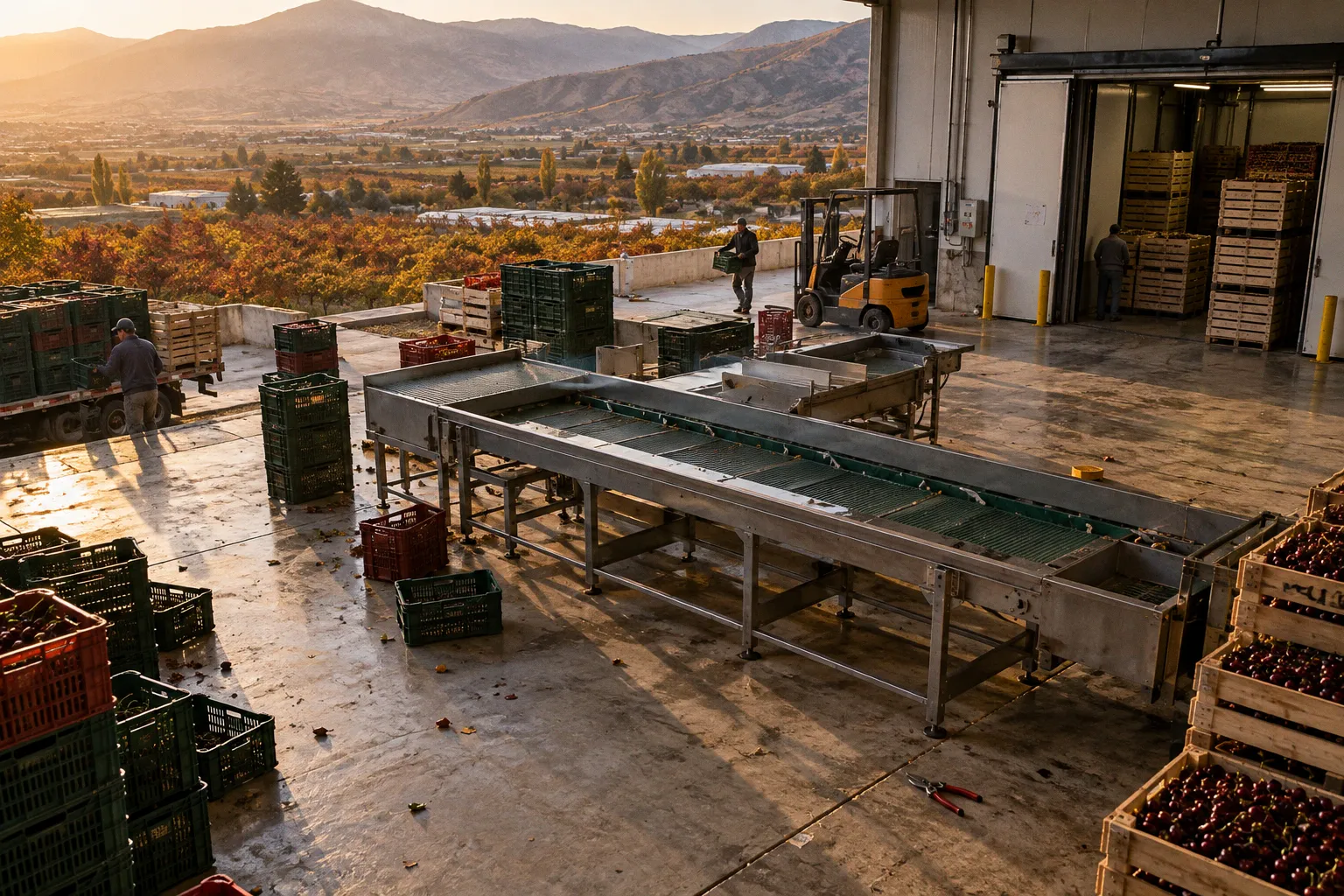
A beautiful cherry that reaches the packing house too soft, or a peach that arrives after a buyer has already filled the order, can lose value even when the harvest itself was generous.
This is especially important in Lebanon, where stone fruit production stretches across distinct altitude zones, from the Bekaa Valley to Mount Lebanon. Around 80% of the country’s cherry production is concentrated in the Bekaa Valley, at elevations ranging from roughly 900 to 2,000 meters. That geographic variation is a strength: it can help our growers extend the season and offer buyers a steadier supply. But it only works when cultivar selection is planned collectively, rather than orchard by orchard.
The strongest strategy for Lebanese stone fruit varieties for export is not to choose one “perfect” variety. It is to build a portfolio: local cultivars that express Lebanon’s agricultural identity, international cultivars that match buyer specifications, and harvest windows that give our cooperatives room to grade, cool, pack, and move fruit before quality begins to decline.
A cultivar is also a market decision
Every stone fruit variety carries a practical set of commercial traits. Some are visible in the orchard: fruit size, skin color, firmness, cracking, and uniformity. Others only become clear after harvest: how well the fruit tolerates handling, how long it remains crisp, whether it can be cooled quickly, and whether a buyer can place it confidently on a retail shelf.
When we speak about selecting stone fruit cultivars for commercial orchards, we are really balancing four questions:
- Will the variety produce reliably in the orchard’s altitude and microclimate?
- Will the harvest arrive when buyers are still actively looking for it?
- Will the fruit meet the expected appearance, firmness, and size profile?
- Can the cooperative handle, cool, grade, and dispatch it without unnecessary losses?
The answer must be considered at group level. A cooperative may have growers at several elevations, each with slightly different flowering and ripening patterns. That creates an opportunity to supply over a longer period, but only if planting decisions, harvest records, and packing plans are connected.
Lebanon’s main export-oriented stone fruits include cherries, peaches, nectarines, plums, and apricots. Their market roles are not identical. Cherries often depend heavily on firmness, stem condition, color, and careful handling. Peaches and nectarines offer a longer national harvest window because they are produced across different altitude zones, with availability extending from May through October. Plums and apricots can add diversity to the export calendar, but they still need the same discipline around maturity, grading, and post-harvest movement.
The best export cultivar is not simply the one with the largest fruit; it is the one that arrives in the buyer’s hands with its value still intact.
Local character and international demand
Lebanon has established local cherry varieties such as Feraouni, Moukahal, and Benni, alongside international cultivars including Georgia, Ferrovia, Lapins, Noire de Meched, and Sweetheart. This combination gives our growers more than a choice between tradition and modernization. It gives us a way to build a layered offer.
Local varieties may carry a distinctive identity and perform well in familiar growing conditions. International cultivars may be more recognizable to buyers or better aligned with requirements for size, firmness, color, and late-season availability. European retail markets, in particular, often favor specific late-season cultivars that can meet strict commercial specifications. That does not make local varieties irrelevant. It means each cultivar needs a clear role in the sales plan.
A cooperative should know whether a variety is intended for:
- premium retail packs;
- wholesale markets where visual uniformity is still important but specifications may be broader;
- regional trade with shorter transit times;
- processing or lower-grade channels when fruit does not meet export presentation standards;
- a differentiated origin story built around Lebanese cultivation and local agricultural heritage.
Without that distinction, every variety is asked to serve every market, and the packing house is left to solve the problem after harvest. By then, the options are narrower and the fruit is more vulnerable.
Designing the harvest calendar across Lebanon’s altitude zones
One of Lebanon’s strongest advantages is its varied terrain. The same crop does not mature at exactly the same time at 900 meters and at 2,000 meters. For a cooperative, this is not merely a geographical observation; it is a planning tool.
Peaches and nectarines are available from May to October because production takes place across different altitude zones. That long window can help Lebanese suppliers stay present in regional and international markets for more weeks of the year. It also creates a responsibility: buyers need accurate information about expected volumes, harvest timing, and quality, not broad promises that change from one week to the next.
A useful cooperative harvest map should connect each orchard to:
1. Altitude and location — so expected ripening differences can be understood before the season begins.
2. Cultivar and rootstock information — so similar blocks can be grouped for planning.
3. Flowering and maturity observations — so the expected picking window is based on the current season, not only on last year’s calendar.
4. Available labor and picking capacity — because a fruit that is ready but cannot be harvested carefully is already at risk.
5. Packing-house capacity — including grading, cooling, and dispatch schedules.
6. Buyer requirements — especially the target size, firmness, color, and delivery period.
This kind of map does not need to begin as a complicated digital system. A shared spreadsheet, clearly labeled orchard records, and one person responsible for keeping updates consistent can already make a meaningful difference. The point is to turn scattered information into a common picture before the crop reaches its most delicate stage.
Use overlapping cultivars with intention
A strong export portfolio usually includes cultivars that mature in sequence rather than all at once. This spreads labor, packing demand, and transport requirements. It can also reduce the pressure to sell a large volume immediately, when prices and logistics may be less favorable.
For cherries, a cooperative might combine early, mid-season, and later cultivars, always checking how each one performs in its particular altitude zone. Georgia, Ferrovia, Lapins, Noire de Meched, and Sweetheart can contribute to an international-facing program, while Feraouni, Moukahal, and Benni can remain part of a broader Lebanese offer where their quality and identity are valued.
For peaches and nectarines, the same principle applies, although the wider May-to-October availability offers more room to coordinate planting zones. The goal is not simply to lengthen the calendar on paper. It is to create a dependable sequence of fruit that the cooperative can actually harvest, cool, grade, and ship.
A calendar that exceeds the cooperative’s handling capacity is not an advantage. It is a queue of fruit waiting to lose firmness.
What buyers mean by export quality
Stone fruit export quality is often discussed as though it were a single standard, but buyers usually evaluate a combination of characteristics. A fruit can be large and attractive yet unsuitable for a longer journey if it is too soft. Another can be firm enough for transport but fail to meet the expected color or size range. The cooperative’s work is to understand these trade-offs and assign the right fruit to the right channel.
The most practical quality categories include:
- Size uniformity: Mixed sizes make retail packing more difficult and weaken the visual consistency of a shipment.
- Firmness: Fruit must be mature enough to offer good eating quality while retaining enough structure for handling and transit.
- Surface condition: Bruising, cracking, pressure marks, and visible blemishes reduce commercial value quickly.
- Color and finish: Buyers may expect a particular blush, background color, or overall appearance depending on the cultivar and market.
- Stem and calyx condition: Particularly for cherries, fresh-looking stems can support the impression of freshness and careful handling.
- Cleanliness: Soil, residue, and damaged plant material can complicate packing and undermine confidence.
- Traceability: A cooperative must be able to connect packed fruit with the orchard, cultivar, harvest date, and handling process.
These characteristics do not carry equal weight for every fruit. Cherries are especially sensitive to appearance, firmness, and shelf life. Peaches and nectarines may be judged strongly on size, skin finish, firmness, and eating maturity. Plums need careful attention to color development and texture, while apricots can move quickly from marketable to overripe.
The practical lesson is simple: quality should be defined before harvest, not negotiated after fruit arrives at the packing house.
A working comparison of cultivar roles
| Cultivar role | Commercial strength | Main management question | Best cooperative use |
|---|---|---|---|
| Local Lebanese variety | Distinctive origin, familiarity in local growing regions, potential for differentiated marketing | Which buyers value its appearance, flavor, and seasonal identity? | Premium local identity, regional trade, and selected export channels |
| International late-season cultivar | More closely aligned with established retailer expectations and extended availability | Can the orchard maintain the required size, firmness, color, and consistency? | Structured export programs and retail-oriented shipments |
| Early-season cultivar | Helps open the sales window and use early market demand | Will picking and cooling be ready at the first harvest? | Early regional and international supply |
| Mid-season cultivar | Supports continuity between early and late harvests | Can labor and packing capacity handle the overlap? | Core volume and steadier weekly programs |
| Late-season cultivar | Extends availability and can meet buyers seeking fruit later in the calendar | Will transit and storage conditions protect quality? | Longer market presence and planned late-season orders |
This table is not a substitute for local orchard knowledge. It is a way to make that knowledge useful across the cooperative. A grower knows the block; the cooperative must know how the block fits into the larger supply program.
Traditional Lebanese varieties should have a clear place
There is sometimes a temptation to treat traditional cultivars as obstacles to export development, as though international trade requires every orchard to become uniform. That approach leaves value on the table.
Local Lebanese varieties can contribute to a differentiated offer, particularly when the cooperative can communicate where and how the fruit was grown, when it was harvested, and why its flavor or appearance is distinctive. They may not fit every retail program, and we should not assume that a traditional variety will automatically satisfy strict European specifications. But neither should we discard it without understanding its strongest market.
The cooperative can separate its offer into different lanes:
- Specification-led export: cultivars selected for consistent size, firmness, color, and transit performance.
- Origin-led export: local varieties presented as a distinctive Lebanese product, with careful attention to grading and storytelling.
- Regional fresh markets: fruit that may have a shorter journey and can be sold closer to eating maturity.
- Processing or secondary channels: fruit that is sound but does not meet fresh retail presentation requirements.
This approach protects the value of the harvest. Not every fruit must enter the same market to be considered successful. What matters is that each grade has a planned destination, and that good fruit is not downgraded simply because the cooperative failed to separate and market it properly.
Tradition becomes a commercial strength when we give it a defined market role instead of asking it to compete on rules written for another cultivar.
The numbers show why selection and handling must work together
Lebanon’s stone fruit opportunity is real, but so is the cost of inconsistency. Reported figures show that peach and nectarine export value rose from USD 2.3 million in 2015 to USD 15.5 million in 2022, alongside reported exports of 43,399 tons in 2022. Peaches and nectarines covered 3,097 hectares in 2021 according to FAO data cited in the research.
These figures point to a sector with capacity and market potential. They do not mean that every additional ton automatically creates more income for growers. Export value depends on the portion of the crop that reaches the intended market in saleable condition, the timing of delivery, and the consistency buyers can expect from one shipment to the next.
Cherry export revenues illustrate this volatility. The reported value reached USD 4.532 million in 2021, fell to USD 1.088 million in 2023, and recovered to USD 1.306 million in 2024. A fluctuation like this can reflect many factors, including production conditions, market access, logistics, and shipment quality. It is a reminder that a cooperative should not measure success by planted area alone. It should also track how much fruit survives the journey from orchard to buyer at the right grade.
That is where cultivar selection becomes inseparable from infrastructure. A variety with good export potential cannot compensate for delayed cooling, rough collection crates, inconsistent maturity, or a packing line that mixes fruit from different quality levels.
Reducing the post-harvest gap
Lebanon can lose between 30% and 40% of fresh produce after harvest, with stone fruit particularly vulnerable because of its sensitivity to surface damage, firmness changes, and limited shelf life. This is not a small technical issue at the end of the chain. It should influence decisions at the beginning, when cooperatives are choosing cultivars and designing their harvest program.
A cultivar that looks excellent in the field may still be a poor export choice if the cooperative cannot cool it promptly or move it through packing without bruising. Conversely, a slightly less visually dramatic cultivar may create stronger returns if it holds firmness and arrives with fewer defects.
Five practical moves for cooperative loss reduction
1. Set maturity targets by cultivar.
Harvest teams should not use one broad instruction for every peach, nectarine, cherry, plum, or apricot. Each cultivar needs a practical maturity range connected to its destination and expected transit time.
2. Harvest into containers that protect the fruit.
Deep, overfilled containers increase pressure on the lower layers. Shallow, clean, carefully handled crates help preserve the blemish-free surface buyers expect.
3. Move harvested fruit out of the sun quickly.
Field heat accelerates softening. Shade, organized collection points, and predictable movement to the packing house are simple improvements with a direct effect on quality.
4. Separate grades early.
Fruit with different firmness levels or visible damage should not travel through the same packing flow. Mixing grades creates confusion and can expose stronger fruit to unnecessary handling.
5. Record the cause of rejection.
A cooperative learns quickly when it records whether losses came from bruising, cracking, undersize fruit, softness, poor color, or delayed dispatch. That information should guide next season’s cultivar and handling decisions.
This is where our growers benefit from acting as a collective. One orchard may notice cracking, another may notice softness, and a third may have a recurring problem with mixed sizing. When those observations are shared, the cooperative can identify whether the issue is cultivar-specific, weather-related, or connected to a common handling practice.
Cold-chain planning begins before the first picking day
Cold-chain control is often treated as a logistics concern, but the plan begins in the orchard. Harvest timing, crate availability, transport routes, pack-house staffing, cooling capacity, and buyer dispatch windows must be aligned.
For stone fruit, speed alone is not enough. The fruit must also be handled gently and cooled in a way that suits its condition. A rushed load placed into a chaotic receiving area can suffer as much as a delayed load. The best system is calm and repetitive: clear orchard labels, known arrival times, dedicated receiving space, and a packing sequence that does not leave fruit waiting unnecessarily.
A cooperative does not need to begin with the most expensive infrastructure. It needs to identify the bottleneck that causes the first quality loss and address that bottleneck consistently. In one group, it may be the shortage of shaded collection areas. In another, it may be the lack of standardized crates. Elsewhere, the problem may be that harvest information does not reach the buyer until the fruit is already packed.
Turning cultivar selection into a cooperative plan
The decision process can be organized around one shared seasonal meeting, held before planting changes or major orchard investments are made. The conversation should include growers, the packing-house team, transport coordinators, and the person responsible for buyer communication.
Bring the following questions to the table:
- Which cultivars performed well in each altitude zone?
- Which blocks produced fruit with the most consistent size and firmness?
- Which varieties reached the market too early or too late?
- Where did the largest losses occur: orchard, collection, packing, cooling, or transit?
- Which buyers requested specific cultivars or quality profiles?
- Can the cooperative supply the expected volume for the full promised window?
- Which local varieties deserve a separate origin-led marketing program?
- Where would a new international cultivar strengthen the calendar rather than create an unmanageable harvest peak?
The aim is not to force every grower into the same planting pattern. It is to coordinate differences so they become useful. A cooperative with several altitude zones and a balanced cultivar mix can offer something a single orchard often cannot: continuity.
That continuity has value. Buyers can plan promotions, distributors can organize transport, and our growers can make harvest decisions with better visibility. The relationship becomes less dependent on one shipment and more grounded in a repeatable supply program.
A practical selection framework for the next planting cycle
Before adding a cultivar, score it against the cooperative’s real conditions rather than its reputation in another country. A simple internal review can include:
- Climate fit: flowering, ripening, chill requirements, and performance at the intended elevation.
- Market fit: size, color, firmness, flavor profile, and likely buyer demand.
- Calendar fit: whether it fills a gap between existing cultivars or intensifies an already crowded harvest period.
- Handling fit: tolerance to picking, grading, cooling, and transport.
- Labor fit: whether the cooperative can harvest the cultivar at the correct maturity without leaving fruit on the tree.
- Packing fit: whether the fruit can be graded and packed using existing equipment and procedures.
- Risk fit: sensitivity to cracking, bruising, softness, or inconsistent sizing.
- Identity fit: whether the cultivar strengthens a Lebanese-origin offer or serves a specification-led export program.
The result does not need to be a complicated scorecard. Even a shared discussion with clear written conclusions can prevent expensive decisions based on enthusiasm alone.
A good cultivar is not good in isolation. It is good because it fits the orchard, the harvest calendar, the cooperative’s capacity, and a buyer who understands what the fruit offers.
Building Lebanon’s export future one harvest window at a time
Lebanese stone fruit varieties for export should be selected with both feet on the ground: one in the orchard and one in the market. Our altitude zones, local knowledge, and range of traditional and international cultivars give us a strong foundation. But the opportunity becomes dependable only when variety selection is connected to maturity planning, grading discipline, cold-chain control, and shared buyer commitments.
The export story of Lebanese peaches, nectarines, cherries, plums, and apricots will not be written by a single cultivar or a single season. It will be built through many coordinated decisions: the right tree in the right elevation, the right harvest window, the right crate, the right cooling plan, and the right market for each grade.
That is the work of a cooperative at its best. We do not need every orchard to look the same. We need our differences to work together—so that local character remains visible, international standards are met where required, and more of each crisp, carefully harvested, blemish-free fruit reaches the people waiting for it.