Precooling setup for Lebanese cherry export pallets
Lebanese cherry export quality is determined before the pallet reaches the border. The critical variable is not the reefer set point; it is the amount of field heat removed during the first four hours after harvest.
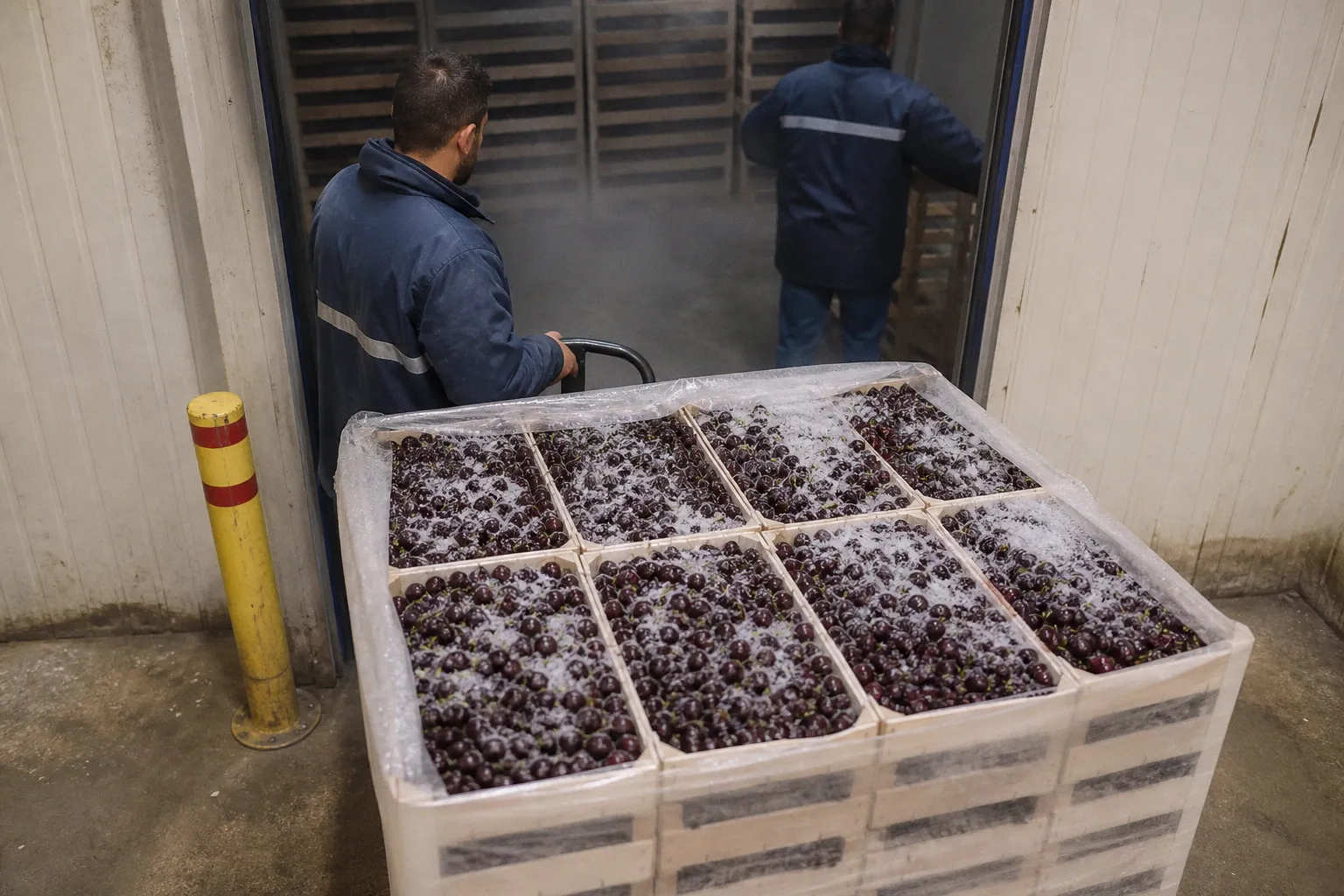
Export cherries should reach a core temperature below 5°C within that window, then be stabilized near freezing under high relative humidity.
That requirement is particularly consequential in the Bekaa Valley, where approximately 80% of Lebanon’s cherry production is concentrated. The region supplies local cultivars such as Feraouni, Moukahal, and Benni alongside international varieties, but production concentration does not simplify the logistics. It creates a narrow operational problem: large volumes must move from orchards to cooling infrastructure without allowing harvest temperature, packaging density, or truck delays to determine the final pulp temperature.
At 0°C, cherries still generate approximately 6–10 mg of CO₂ per kilogram per hour through respiration. Precooling does not stop that biological process. It reduces its rate early enough to preserve firmness, stem condition, color, and marketable shelf life. A refrigerated container can maintain a properly cooled load during transport. It cannot serve as a substitute for the equipment that removes field heat from a warm pallet.
A reefer maintains temperature. A precooling system creates the temperature that the reefer is expected to maintain.
Field Heat Management and Harvest Timing in the Bekaa Valley
The Lebanese cherry export cold chain protocol begins in the orchard, not in the cold room. Harvest timing controls the thermal load presented to every downstream component: hydrocooler capacity, forced-air fan load, cold-room occupancy, pallet turnover, and the duration required to reach export temperature.
Cherries should not be harvested when ambient air temperatures exceed 27°C. Wet morning conditions also create a separate handling risk. Fruit harvested while wet carries surface moisture into sorting, packing, and cooling operations, increasing the possibility of decay and reducing the consistency of post-harvest handling. The practical operating window is therefore defined by both temperature and surface condition.
A workable harvest protocol has four controls:
1. Schedule picking before the orchard reaches the 27°C threshold. The target is not merely worker comfort or reduced sun exposure. Lower fruit temperature reduces the refrigeration load that must later be extracted from every container, tray, and pallet.
2. Keep harvested fruit out of direct sunlight. Field crates should move immediately into shaded staging areas or covered vehicles. A short exposure period can raise the surface temperature while the core remains cooler, creating a misleading visual indication of readiness for packing.
3. Avoid loading wet cherries into the export flow. If morning condensation or rain has left the fruit surface wet, the operation needs a controlled drying interval before packing. The exact duration will depend on airflow, humidity, cultivar, and fruit condition; the principle is to avoid sealing free moisture inside export packaging.
4. Control the time from picking to first cooling stage. The four-hour target for reaching a fruit core temperature below 5°C is a process limit, not a general aspiration. Every delay consumes part of the available cooling window.
The field operation should record at least the harvest start time, orchard block, cultivar, approximate incoming fruit temperature, and arrival time at the cooling station. These are baseline metrics, not administrative decoration. Without them, a cooperative cannot distinguish between a refrigeration capacity problem and a scheduling problem.
For a cooperative serving several orchards, the most useful improvement is often a dispatch schedule linked to cooling capacity. If the hydrocooler and forced-air room can process only a defined number of pallets per hour, harvesting should be released in batches that match that capacity. Otherwise, trucks become temporary storage units, and the cooling system receives fruit already carrying several hours of accumulated field heat.
Orchard-to-cooling handoff
The handoff should be designed around thermal continuity:
- Harvest containers remain shaded and ventilated until collection.
- Trucks are loaded to prevent excessive compression and allow airflow around the crates.
- The receiving station measures incoming pulp temperature rather than relying only on air temperature.
- Pallets are prioritized according to harvest time and temperature, not simply arrival order.
- Fruit with visible wetness, decay, or damaged stems is separated before export packing.
This does not require a complex digital platform. A calibrated probe, time-stamped receiving log, and pallet identification system provide a functional baseline. Sensor arrays can improve control later, but instrumentation has value only when the readings change the sequence of work.
The Two-Stage Cooling Protocol: Hydrocooling and Forced-Air Integration
A reliable pallet cooling protocol for stone fruit uses two distinct cooling stages:
1. Rapid hydrocooling immediately after harvest or initial handling
2. Forced-air cooling after export packing and palletization
The stages are complementary. They do not perform the same task, and neither should be treated as a complete replacement for the other.
Stage one: hydrocooling for rapid initial heat removal
Hydrocooling uses chilled water to remove heat quickly from the fruit surface and exposed packing surfaces. Water transfers heat more efficiently than cold air, which makes the method suitable for the first reduction in fruit temperature when incoming cherries are still carrying substantial field heat.
The operating objective is to reduce the temperature quickly without creating a new quality problem. Water quality, sanitation, contact time, fruit condition, and drainage all affect the result. A hydrocooling line that lowers the surface temperature while leaving the fruit core warm has not completed the export cooling process.
The receiving team should measure representative fruit from different positions in the load. A single cold surface reading can conceal a warm core, especially when cherries are already inside packed containers. Temperature measurements should therefore include fruit from the center of a box or crate, not only fruit exposed to the cooling medium.
Hydrocooling also introduces a sequencing constraint. If wet fruit is transferred directly into packaging without adequate drainage and handling control, the operation may exchange thermal risk for moisture-related decay risk. The solution is not to abandon hydrocooling; it is to integrate drainage, inspection, and packing into the line design.
Stage two: forced-air cooling after packing
The second stage begins after the fruit has entered its final export packaging and the pallets have been assembled. Cold air is pulled through the package openings rather than moving only around the outside of the pallet. This is the stage that corrects the limitation of in-line water cooling.
Hydrocooling can produce a rapid external temperature reduction, but packed export boxes may still contain warmer fruit at their cores. The box geometry, liner material, vent design, pallet pattern, and load density determine whether cold air reaches those warm zones. Forced-air cooling creates a controlled pressure difference that draws air through the pallet instead of allowing it to bypass the product.
The system should be configured around the actual export pack. Changing from one box format to another can alter airflow resistance enough to change cooling time, even when the room temperature and fan settings remain unchanged. A tunnel optimized for ventilated cartons may perform poorly with dense trays or packaging that blocks side vents.
The precise air velocity or static pressure requirements mandated by LIBNOR are not established in the available technical record. That gap should be addressed through commissioning trials rather than filled with a generic fan specification. The correct baseline is empirical and product-specific:
- Record the starting pulp temperature after packing.
- Place temperature probes in the warmest expected pallet positions.
- Measure the time required for the pallet core to fall below 5°C.
- Compare center, edge, top, and bottom locations.
- Repeat the test with the actual box, liner, pallet, and wrapping configuration used for export.
- Set the operating protocol from the slowest cooling position, not from the coldest sensor.
The target is uniformity. A pallet with cold exterior boxes and a warm center is not compliant in operational terms, even if an outer probe reports the desired temperature.
Integrating the two stages
A two-stage system should be planned as one process rather than two independent pieces of equipment.
| Process point | Primary function | Main control variable | Typical failure mode |
|---|---|---|---|
| Orchard harvest | Limit incoming field heat | Air temperature, fruit exposure, harvest time | Fruit enters the chain already overheated |
| Covered staging | Prevent rewarming before cooling | Shade, ventilation, dwell time | Cherries remain in crates while cooling capacity is occupied |
| Hydrocooling | Remove initial field heat rapidly | Water temperature, sanitation, contact, drainage | Surface cools while packed fruit cores remain warm |
| Export packing | Establish final package geometry | Ventilation, box density, pallet pattern | Packaging blocks airflow through the load |
| Forced-air cooling | Pull cold air through the packed pallet | Core temperature and cooling uniformity | Air bypasses the pallet or leaves a warm center |
| Cold storage | Stabilize product before dispatch | -1°C to +1°C and 90%–95% RH | Condensation, dehydration, or temperature drift |
| Reefer loading | Preserve the established condition | Product temperature at loading, door discipline | Container is expected to remove field heat |
The capital expenditure decision should follow this sequence. Installing a larger cold room without forced-air capability may increase holding capacity while leaving the central bottleneck untouched. Conversely, purchasing forced-air equipment without controlling harvest timing can overload the system with fruit that arrives too hot and too late.
The minimum viable investment is therefore not a single machine. It is a controlled chain consisting of shaded receiving, rapid initial cooling, post-packing forced-air capacity, temperature measurement, and cold storage that can hold the product inside the required range.
Regulatory Compliance: Packaging Is Part of the Cooling System
Packaging decisions affect both legal compliance and thermal performance. Lebanese Ministry of Agriculture Decision No. 1/358 of 1997, amended by Decision No. 1/2 in 2000, prohibits polystyrene containers for fresh fruit and vegetable exports. Export packaging must use compliant food-grade materials, while pallets must be heat-treated and suitable for international movement under ISPM-15 requirements.
This is not a secondary paperwork issue. Packaging determines how air moves through the load, how water drains after hydrocooling, how much product is exposed to compression, and whether the pallet can be accepted by the destination market. A package that cannot be legally exported is irrelevant; a legal package that blocks forced-air cooling is operationally defective.
The Lebanese fresh produce export standards framework also includes cold-storage and post-harvest handling requirements under Ministry of Agriculture Decision No. 1/87, together with quality rules associated with LIBNOR compliance. The cooperative or exporter should translate these obligations into a facility-level operating file containing:
- Approved packaging specifications and material declarations
- Pallet treatment records
- Cooling-stage temperature records
- Storage-room temperature and humidity logs
- Cleaning and water-sanitation procedures
- Lot identification from orchard block through dispatch
- Corrective actions for loads that miss the temperature target
A compliant export operation needs traceability at the pallet level. If one pallet fails to reach the required core temperature, the operator must be able to identify its harvest time, cooling sequence, packaging format, storage location, and intended dispatch. Otherwise, the facility can only make broad assumptions about an entire shipment.
Packaging design and airflow
The best package for cherry export is not automatically the cheapest carton or the most rigid tray. It must perform across four dimensions:
1. Ventilation: Openings need to align with the direction of forced airflow. Decorative perforations that do not connect across stacked cartons have little cooling value.
2. Structural stability: Boxes must retain their geometry under pallet load. Collapsed cartons reduce airflow channels and increase compression damage.
3. Drainage and moisture control: After hydrocooling, packaging should not trap standing water around the fruit or inside liners.
4. Material compliance: Polystyrene export containers are prohibited under the cited Lebanese Ministry decisions. Untreated wood is also not an acceptable substitute for compliant heat-treated pallets.
The packaging specification should be frozen before forced-air commissioning. If the exporter changes carton depth, vent area, liner, or pallet height after validation, the cooling profile should be re-tested. The system has not been validated if the product configuration has changed.
The pallet is not a passive unit of transport. It is a thermal structure, and its geometry determines whether forced air reaches the fruit that matters.
Maintaining Cold Chain Integrity in Storage
Once the cherries have been precooled, the cold room becomes a stabilization environment rather than a rescue mechanism. Recommended storage conditions are approximately -1°C to +1°C, with relative humidity between 90% and 95%. These parameters are narrow because cherries must be protected from both warming and moisture loss.
Temperature control should focus on the fruit, not merely the room thermostat. A room can display the correct air temperature while pallets near doors, evaporator outlets, or poorly distributed airflow experience different conditions. Product probes should be placed in representative pallet cores, with additional sensors near known warm zones.
The control system should distinguish four measurements:
- Incoming fruit temperature: establishes the thermal load.
- Post-hydrocooling temperature: shows whether the first stage is reducing field heat.
- Post-forced-air core temperature: confirms whether packed pallets have cooled uniformly.
- Storage and dispatch temperature: confirms that the cold chain remained intact after precooling.
A single final reading cannot explain where a failure occurred. Sequential measurement can.
Storage-room layout
Cold-room layout affects both temperature stability and pallet turnover. Pallets should be positioned so that cold air can circulate around the load without creating blocked aisles or dead zones. Product should not be pressed directly against evaporator discharge paths, where localized cold exposure can create uneven conditions, nor should it be stacked in a way that prevents the return air from reaching the sensors.
Door openings are a practical source of temperature variation. The loading schedule should group movements rather than opening the room repeatedly for individual boxes. Pallet identification and dispatch paperwork should be prepared before the door opens. Every minute saved at the door reduces the chance of warming at the product surface, although the more significant control remains the condition of the fruit before it enters storage.
Relative humidity between 90% and 95% limits dehydration, but high humidity does not compensate for poor sanitation or wet packaging. Moisture management must therefore combine humidification or evaporator control with clean surfaces, controlled drainage, and separation of damaged fruit.
Commissioning metrics
A cooperative commissioning a new system should establish a baseline using the actual cherry varieties and export configuration. The test should document:
- Harvest-to-hydrocooling interval
- Incoming pulp temperature
- Hydrocooling outlet temperature
- Packing and palletization duration
- Forced-air start time
- Core temperature at the end of forced-air cooling
- Storage-room air temperature
- Storage relative humidity
- Temperature variation between pallet positions
- Product temperature at reefer loading
The goal is not to produce a visually impressive dashboard. The goal is to identify the slowest step. If the fruit consistently reaches the hydrocooler too late, expanding the forced-air room may yield less benefit than changing orchard dispatch. If the pallet core remains warm after packing, lowering the storage-room set point will not solve the problem. The intervention must match the measured failure.
Why Reefer Containers Cannot Replace Precooling Infrastructure
A reefer container is designed to maintain the pulp temperature of properly cooled cargo during transport. It is not engineered to extract the full field heat from warm cherry pallets. Treating it as a mobile precooling chamber creates three predictable problems.
First, the container may register an acceptable air set point while the center of the pallet remains above the export target. The container’s refrigeration system circulates cold air, but the packaging and pallet structure limit how quickly that air can remove heat from dense loads.
Second, warm product increases the thermal burden inside the container. The system must manage the product load, the respiration heat, air infiltration during loading, and the normal operating demands of the transport unit. It still cannot compensate for a failed orchard-to-packing schedule.
Third, a reefer does not validate the condition of the shipment. If the cargo enters the container without a documented forced-air cooling step, there is no reliable evidence that the pallet cores have reached the required temperature. A low container-air reading is not equivalent to a low fruit-pulp reading.
The correct loading sequence is therefore straightforward:
1. Complete hydrocooling as early as the receiving flow permits.
2. Pack and palletize the fruit in its final export configuration.
3. Run forced-air cooling until the pallet cores meet the target.
4. Transfer the stabilized pallets into cold storage within the specified temperature and humidity range.
5. Load the reefer with minimum door-open time.
6. Use the reefer to preserve, not create, the established cold condition.
This division of responsibility also clarifies capital expenditure. Precooling equipment absorbs the initial thermal shock. Cold storage stabilizes the product. The reefer protects it in transit. Each asset has a defined function, and substituting one for another generally transfers the failure downstream rather than removing it.
A Practical Implementation Sequence for Lebanese Exporters
Facilities that currently rely on basic cold rooms should implement the protocol in phases. The sequence below prioritizes measurable control over premature equipment expansion.
Phase one: establish the baseline
For one representative harvest period, record orchard departure, receiving, hydrocooling, packing, forced-air, storage, and loading times. Measure pulp temperature at each stage. Separate results by cultivar and package type where possible.
This baseline will show whether the dominant constraint is harvest timing, transport delay, cooling capacity, packaging airflow, or storage stability. Without it, ROI calculations for additional equipment remain speculative.
Phase two: correct the non-capital losses
Before purchasing new machinery, remove avoidable delays:
- Move harvested cherries into shade immediately.
- Match orchard dispatch to receiving capacity.
- Stop treating trucks as holding rooms.
- Prepare packaging and pallets before the fruit arrives.
- Reduce idle time between hydrocooling and forced-air cooling.
- Standardize probe placement and recording intervals.
These measures require process discipline rather than major capital expenditure. They also produce cleaner data for the next investment decision.
Phase three: validate the two-stage configuration
Run a controlled trial using the intended export package and pallet pattern. Compare hydrocooling alone with the combined hydrocooling and forced-air sequence, but evaluate the pallet core rather than only surface fruit.
The trial should answer four questions:
- Does the fruit reach below 5°C within four hours of harvest?
- Does forced-air cooling remove the residual core heat after packing?
- Are temperature differences between pallet positions acceptable?
- Can the facility process the required daily volume without creating a queue at receiving or storage?
The second question is the most frequently neglected. Hydrocooling can look efficient at the line while the packed pallet remains thermally incomplete.
Phase four: integrate compliance records
Connect each pallet to its orchard lot, cultivar, packaging specification, cooling timestamps, storage position, and dispatch record. Retain the documents required for heat-treated pallets, food-grade packaging, cold-storage operation, and quality compliance.
The value of traceability is operational as much as regulatory. It allows the exporter to identify which handling configuration produces the best cooling uniformity and which one creates repeated deviations.
Phase five: calculate investment return from rejected risk
The ROI model should not rely on an invented average loss rate or a generic equipment price. It should use the cooperative’s own baseline:
- Volume harvested and packed per day
- Number of pallets processed
- Cooling time per pallet
- Labor hours in receiving and handling
- Product downgraded or held because of temperature
- Dispatch delays caused by incomplete cooling
- Storage occupancy created by slow pallet turnover
- Additional transport or inspection costs caused by nonconforming loads
A dual hydrocooling and forced-air installation may require more capital and more coordination than hydrocooling alone. Its justification is the removal of the warm-pallet bottleneck, not a generalized promise of higher quality. The investment is defensible when the measured throughput, temperature compliance, and reduction in delayed dispatches offset the added operating cost.
The Numbers That Define a Viable Export Protocol
For Lebanese cherry export pallets, the operating specification can be reduced to a small set of non-negotiable thresholds and decisions:
- Harvest before ambient air exceeds 27°C.
- Keep fruit shielded from direct sunlight immediately after picking.
- Avoid processing fruit harvested under wet morning conditions until surface moisture is controlled.
- Reach a fruit core temperature below 5°C within four hours of harvest.
- Use hydrocooling for rapid initial heat removal.
- Use forced-air precooling after packing to cool the pallet core.
- Hold precooled cherries at approximately -1°C to +1°C.
- Maintain relative humidity at 90%–95%.
- Use compliant food-grade export packaging.
- Exclude polystyrene containers from fresh fruit export packaging.
- Use heat-treated wooden pallets suitable for international movement.
- Treat the reefer as a maintenance system, not a precooling system.
- Record the temperature of the product at every critical transition.
The definitive verdict is technical rather than rhetorical: a Lebanese cherry export operation is viable when it can repeatedly demonstrate that pallet cores, not just room air or exposed fruit surfaces, reach below 5°C within the four-hour post-harvest window and remain within the -1°C to +1°C storage range at 90%–95% relative humidity. The two-stage system carries the process cost, but it also addresses the actual thermal problem. Hydrocooling removes the initial field heat; forced air resolves the packed-pallet core; cold storage and reefers preserve the result. Any configuration that omits the second stage is relying on the transport container to perform a function it was not designed to perform.