Soil organic matter in orchards: transformation before and after
In a Lebanese orchard, soil degradation rarely begins with a dramatic failure. It starts more quietly: a crust after the first heavy rain, a terrace edge that loses fine soil, irrigation water that…
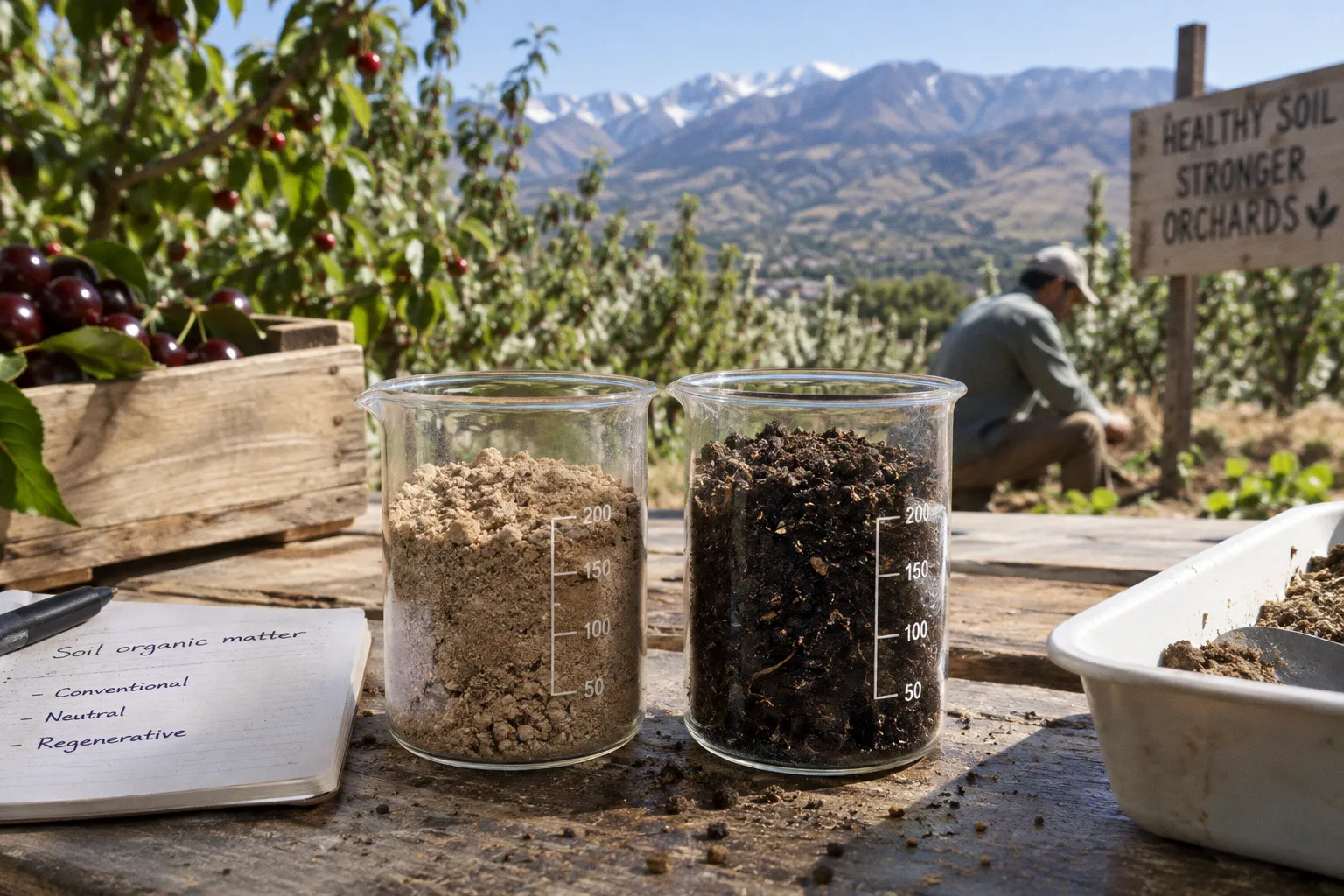
In a Lebanese orchard, soil degradation rarely begins with a dramatic failure. It starts more quietly: a crust after the first heavy rain, a terrace edge that loses fine soil, irrigation water that disappears unevenly, or a tree that responds to fertilizer but still produces weak new growth. These are not separate problems. They often point to the same underlying condition—the soil has lost organic matter and, with it, much of its biological function.
Measurements from small-scale farms in mountainous Lebanon show the difference clearly. Conventional fields recorded an average soil organic matter level of 1.86%. Regenerative fields reached 3.32%, with neutral management between them at 2.75%. That change is not a cosmetic improvement in a laboratory report. It represents a different soil system: more active microbial communities, better aggregation, greater biological respiration, and a stronger capacity to hold water and nutrients around the tree roots.
Soil organic matter improvement in Lebanese orchards is therefore not simply a matter of adding compost. It is a management transition. Cover crops, reduced tillage, carefully chosen organic amendments, and protection from erosion must work together over several seasons. The goal is not to make an orchard look greener for a single year. It is to rebuild the carbon cycle beneath the canopy.
The baseline: what conventional orchard soil is losing
Many Lebanese orchards operate under difficult conditions before management even begins. Mountain terraces are exposed to intense rainfall events, long dry periods, and increasingly irregular seasons. The Bekaa Valley faces a different combination of pressures: hot summers, limited water, compacted working soils, and repeated cultivation that leaves bare ground exposed between rows.
Conventional orchard management often relies on some combination of:
- repeated tillage to control weeds;
- bare soil between tree rows;
- mineral fertilizers applied without regular soil biology monitoring;
- removal or burning of pruning residues;
- irrigation that wets only part of the root zone;
- machinery traffic over the same working lanes.
Each practice may appear manageable on its own. Together, they interrupt the processes that form stable soil aggregates.
Tillage breaks apart fungal networks and exposes protected organic particles to oxygen. Bare soil receives the full force of raindrops, which detach fine particles before runoff carries them downslope. Repeated passes from machinery compress the surface and reduce the continuity of pores. Fertilizer can supply nutrients, but it cannot by itself rebuild the carbon compounds that help soil hold those nutrients in place.
This is why an orchard can receive adequate nitrogen and still behave like a hungry soil. The issue is not always the amount of an input. It is whether the soil has enough structure and biological activity to retain, transform, and deliver that input to the tree.
The comparison below summarizes the management shift.
| Soil and management indicator | Conventional orchard management | Regenerative orchard management |
|---|---|---|
| Soil organic matter | 1.86% measured in conventional mountain farms | 3.32% measured in regenerative farms |
| Soil respiration | 156 mg C-CO₂ per week | 380 mg C-CO₂ per week |
| Earthworm density | 2.92 per liter | 5.72 per liter |
| Ground cover | Often bare or frequently disturbed | Cover crops, retained residues, or protected understory |
| Tillage | Repeated soil disturbance | Reduced or discontinued disturbance |
| Erosion exposure | Higher on unprotected slopes and terraces | Lower when living roots and residues protect the surface |
| Carbon storage | More carbon rapidly lost through disturbance | Greater accumulation in protected soil fractions |
These figures should not be interpreted as a promise that every orchard will move from 1.86% to 3.32% on the same schedule. Soil texture, elevation, tree age, moisture, crop history, and residue management all influence the result. The useful lesson is the direction of change: when soil is kept covered and disturbed less often, carbon and biological activity can begin to recover.
The first visible sign of healthier orchard soil is often not a larger harvest. It is soil that stays in place, absorbs water more evenly, and remains workable after weather extremes.
How cover crops rebuild the carbon cycle
A cover crop is not merely a weed-control measure between tree rows. It is a temporary carbon-capturing system that feeds the soil through roots, fallen leaves, and decomposing stems.
In high-altitude cherry orchards in Jurd Aarsal, winter leguminous and barley cover crops supplied between 140 and 250 kg of organic matter per hectare per season through root residue decomposition. Their above-ground biomass contributed an additional 95 to 665.7 kg per hectare per season.
These residues do several jobs at once.
First, living roots keep releasing carbon compounds into the rhizosphere—the narrow zone of soil directly influenced by roots. Those compounds feed bacteria and fungi, which in turn help form soil aggregates. Second, root channels create pathways for air and water. Third, above-ground growth shields the soil surface from rainfall and reduces the speed of runoff. Finally, decomposing plant material becomes food for earthworms and other soil organisms.
Legumes can contribute biologically fixed nitrogen, but their role should not be simplified into a guaranteed fertilizer replacement. A legume cover crop still needs appropriate timing, moisture, and termination. Barley and other cereals can produce substantial biomass and protect the ground well, but their carbon-rich residues may temporarily immobilize available nitrogen as microbes break them down. This is particularly relevant in young orchards or in soils already low in available nitrogen.
The better question is not whether a particular cover crop is universally good. It is whether the cover crop fits the orchard’s water supply, slope, tree spacing, termination method, and nutrient plan.
Choosing a cover crop for Lebanese orchard conditions
For a rain-fed or water-limited orchard, a winter cover crop is usually easier to manage than a vigorous summer understory competing with trees during peak water demand. In higher elevations, winter growth may be slow but still valuable because the plants protect the soil during the season of intense rainfall.
A practical selection process considers:
- Water competition: How much water will the cover crop use before termination, and where will its roots sit relative to the trees?
- Termination date: Can it be cut or rolled before it begins competing strongly with the orchard canopy?
- Residue quality: Does the mixture provide a balance between nitrogen-rich and carbon-rich material?
- Slope protection: Will it establish quickly enough to protect terraces and exposed soil?
- Seed access and cost: Can the cooperative source reliable seed without making the system financially fragile?
- Tree age: Young trees with small root systems require more conservative understory management than mature trees.
A mixed stand can provide more balanced functions than a single species. A legume may support nitrogen inputs, while barley or another cereal contributes upright biomass and fibrous roots. But the mixture should be monitored rather than assumed to be beneficial. If the soil dries early in spring, the cover crop must be terminated before it becomes a serious competitor.
Reduced tillage is the second half of the process. Cover crops add organic material; reduced disturbance gives that material a chance to remain in the soil long enough to form more stable carbon pools.
Reduced tillage changes what remains in the soil
In Mediterranean olive orchards, stopping tillage and other land disturbance was associated with an average increase of 18.6 Mg of carbon per hectare in the topsoil of 80% of unworked plots. Particulate organic matter larger than 50 micrometers increased from 20% in actively tilled plots to 30% in uncultivated soils.
Particulate organic matter is an important transitional pool. It is not yet the most stable form of soil carbon, but it is protected within aggregates and provides food for soil organisms. It helps explain why the first benefits of reduced tillage may appear in soil structure and infiltration before the orchard shows a clear change in yield.
The practical mistake is to treat reduced tillage as an all-or-nothing decision. An orchard does not need to move instantly from frequent cultivation to complete neglect. A staged approach is often more realistic:
1. Map the working lanes and tree rows. Identify where machinery causes repeated compaction and where erosion begins.
2. Stop unnecessary passes first. If a cultivation operation is not solving a specific weed or access problem, remove it from the schedule.
3. Keep residues on the surface where disease risk allows. Chipped prunings, mown cover crops, and leaf litter can protect the soil from heat and rain.
4. Use targeted disturbance only where needed. A localized intervention is less damaging than cultivating the entire orchard floor.
5. Observe infiltration after rainfall. Water ponding, rapid runoff, and crusting are practical indicators that structure still needs attention.
This is also where soil health restoration techniques in Lebanon connect to export requirements. Buyers and certification systems increasingly expect evidence of responsible input use, traceability, residue control, and consistent production practices. A biologically active soil does not replace residue testing or records, but it can reduce dependence on repeated corrective inputs and make orchard management more predictable. A cooperative that records cover-crop dates, amendment batches, tillage operations, irrigation decisions, and soil tests is better prepared to explain how its fruit was produced.
The biological transformation: respiration, earthworms, and structure
Organic matter is often discussed as if it were a static percentage. In practice, its quality matters as much as its quantity.
Two soils may contain similar amounts of organic matter but behave differently if one has more active microbial biomass, better aggregation, and a wider range of decomposing materials. Soil respiration provides one indication of biological activity. In the Lebanese mountain-farm comparison, respiration measured 156 mg C-CO₂ per week under conventional management, 296 mg under neutral management, and 380 mg under regenerative management.
Earthworm counts followed a similar pattern: 2.92 per liter in conventional systems, 4.24 in neutral systems, and 5.72 in regenerative systems.
Earthworms are not a universal soil-health score, and their absence does not prove that an orchard is failing. But they are useful field indicators because they respond to residue availability, moisture, and reduced disturbance. Their channels can improve the movement of water and air, while their casts contribute to nutrient cycling and aggregation.
A practical orchard observation can begin with the soil surface:
- Does water enter the soil or run immediately downslope?
- Does the surface form a hard crust after drying?
- Are there visible roots in the upper soil layer?
- Do residues disappear gradually into the soil, or remain dry and undecomposed?
- Can a spade cut through the surface without meeting a dense compacted layer?
- Are earthworm channels visible in moist soil?
These observations do not replace laboratory analysis. They tell the grower where to investigate.
Laboratory testing should track at least soil organic matter, pH, electrical conductivity, available nutrients, and bulk density where possible. Testing at the same depth and around the same season makes before-and-after comparisons more meaningful. A single high result after compost application may reflect the amendment itself rather than a stable change in soil carbon. The stronger signal is a trend maintained across several sampling periods.
Compost: a promising resource that requires discipline
Lebanon generates roughly 3,500 tons of municipal solid waste each day. Between 50% and 70% of that material—approximately 1,500 to 2,100 tons daily—is organic matter potentially suitable for conversion into agricultural compost amendments.
This creates an important opportunity for Lebanese cooperatives. Compost made from separated organic waste could return carbon and nutrients to orchards while reducing pressure on disposal systems. It could also create a local input supply for farms that cannot afford large quantities of imported amendments.
But municipal organic waste is not automatically safe compost.
The quality of the feedstock determines the quality of the amendment. Mixed waste can contain plastic fragments, glass, heavy metals, salts, persistent chemicals, or other contaminants. Compost that has not fully matured may also heat the root zone, release unpleasant compounds, or temporarily tie up nitrogen. For export-oriented orchards, an uncontrolled amendment creates a traceability problem as well as a soil problem.
A cooperative sourcing compost should establish a basic acceptance protocol:
- receive material only from a source that separates organic waste before processing;
- request batch information and laboratory analysis;
- check maturity, moisture, electrical conductivity, pH, and visible contamination;
- avoid applying material with a strong anaerobic odor or obvious undecomposed waste;
- test for contaminants where the waste stream creates a credible risk;
- record supplier, batch, application rate, date, and orchard block;
- apply conservatively at first and monitor soil salinity and nutrient changes.
Compost should be treated as an amendment, not as a complete fertility program. Its nutrient content varies, and high application rates can create excessive phosphorus, salinity, or nitrogen release. The right rate depends on the compost analysis, soil test, tree demand, irrigation water, and the intended role of the material.
For fruit trees, compost is often most useful when paired with surface protection and living roots. Placing organic matter on a bare, repeatedly tilled surface gives it less chance to become part of a stable soil system. Combining it with cover crops and reduced disturbance allows microbial activity, roots, and soil aggregates to do the longer-term work.
What the before-and-after transition should look like
The transformation of soil structure is gradual, but the management sequence can be organized by season. The following timeline is designed for Lebanese orchard conditions and should be adjusted for elevation, rainfall, tree species, and irrigation access.
Late summer: establish the baseline
Before autumn rains, divide the orchard into practical management blocks. Note slope, tree age, soil texture, irrigation pattern, visible erosion, and areas with poor growth.
Take soil samples consistently. Do not mix eroded terrace edges with deep, productive soil and expect the result to guide the whole block. Record the current tillage schedule, fertilizer inputs, pruning-residue handling, and any compost already used.
This is also the right period to identify where machinery can be excluded. Permanent traffic lanes reduce random compaction and protect the root zone.
Autumn: sow and protect
After the first reliable moisture, establish the selected winter cover crop. Seed mixtures should be chosen according to the orchard’s water limits and the desired residue balance. On slopes, rapid ground cover may be more valuable than maximum biomass.
Avoid turning the first season into a competition between trees and cover crops. Maintain a clear, managed zone around trunks and monitor soil moisture as temperatures fall. The objective is living roots through the wet season, not an uninterrupted carpet at any cost.
Winter: observe the soil rather than disturb it
Winter is the period when rainfall reveals whether the system is functioning. Inspect runoff routes, terrace edges, ponding, and sediment movement after storms. If soil is leaving the orchard, the cover crop or residue layer is not yet providing enough protection.
Avoid entering wet soils with heavy machinery. A single pass over saturated ground can create compaction that persists after the surface dries.
Spring: terminate before competition peaks
As temperatures rise, decide when to mow, roll, or otherwise terminate the cover crop. The timing should reflect rainfall, irrigation capacity, tree phenology, and the condition of the ground. A cereal cover allowed to mature too far may produce valuable residue but also increase water competition and nitrogen immobilization during decomposition.
Leave the residue in place where disease and pest conditions allow. The surface layer is part of the soil-building system.
Summer: conserve moisture and measure response
Summer management is less about adding biomass and more about protecting what has been built. Maintain mulch or residue cover, avoid unnecessary cultivation, and inspect irrigation distribution. Organic matter can improve water retention, but it does not eliminate the need for efficient irrigation.
Compare the orchard with the baseline. Look for changes in infiltration, crusting, soil friability, root distribution, and tree response. Do not judge the program only by yield in the first season. Weather, alternate bearing, pruning, and market conditions can obscure soil effects.
After two or more cycles: refine the system
With repeated cover-crop cycles and reduced disturbance, the orchard can begin to show a more stable pattern. Soil organic matter should be retested using the same sampling method. Adjust the cover-crop mixture, compost rate, and termination date according to the evidence.
The transition is working when the orchard requires fewer emergency corrections: less runoff repair, fewer severe crusting events, more even wetting, and a more resilient root zone. These are operational benefits before they become headline yield benefits.
The economics of resilience is found in fewer corrections
The long-term value of increasing soil carbon in the Bekaa Valley or restoring soil structure in mountain orchards is not limited to the carbon number itself. Healthier soil can make water use more effective, reduce erosion losses, support more consistent nutrient cycling, and protect the productive depth of terraces.
Still, the economics must be measured honestly. The available evidence supports strong changes in soil organic matter and biological indicators, but it does not establish a universal payback period for high-rate compost application in commercial cherry orchards. Costs will vary with transport, compost quality, labor, seed, mowing, irrigation, and the value of lost or retained production during the transition.
Cooperatives are well placed to reduce those costs. They can purchase cover-crop seed in bulk, coordinate compost testing, share mowing equipment, standardize record-keeping, and compare soil results across orchard blocks. They can also turn soil management into part of the export story without resorting to vague sustainability claims. A buyer is more likely to trust a cooperative that can show dates, inputs, laboratory results, and field records than one that relies on green language alone.
The strongest case for regenerative orchard management in Lebanon is practical. A soil with 3.32% organic matter, higher respiration, and more biological activity is not valuable because the number looks impressive. It is valuable because that soil has more capacity to receive water, hold carbon, cycle nutrients, and remain intact under stress.
Improvement begins with a simple sequence: measure the baseline, keep living roots in the orchard, reduce disturbance, use tested organic amendments, and reassess after each season. The soil will not transform in one application or one harvest. But with consistent management, the before-and-after difference becomes visible—in the surface structure, in the movement of water, in the life below the trees, and eventually in how reliably the orchard can produce for both local and international markets.