Lebanese no-till transition: soil moisture before and after
Walk through a freshly plowed field in the Bekaa Valley in late June and you will hear it before you see it: the faint crackle of clay splitting open under the sun.
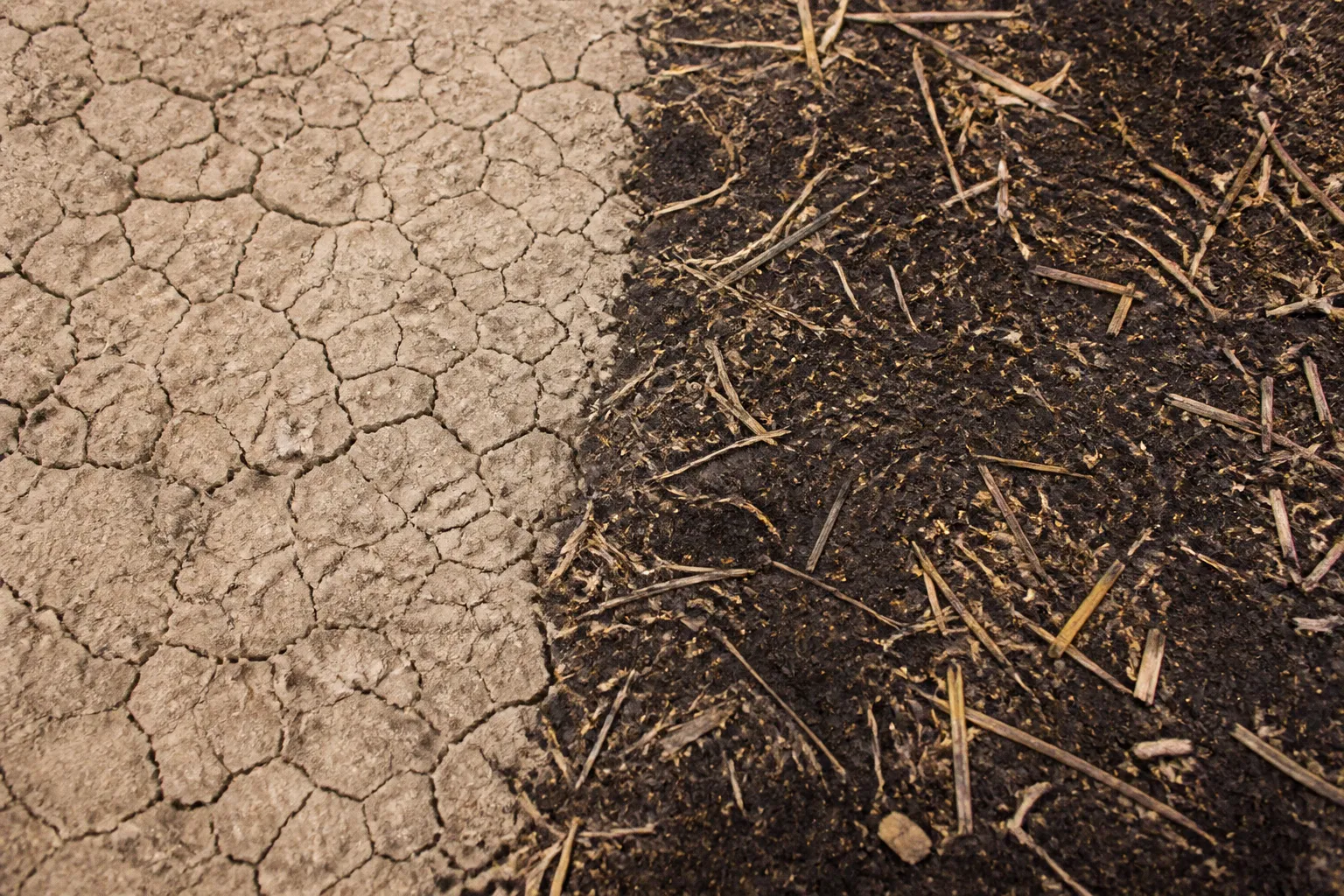
The topsoil, loosened by the disc harrow just weeks earlier, has already begun to fracture into polygonal plates. By midsummer, those cracks may reach deep into the profile, drawing moisture downward into layers where shallow-rooted wheat and lentil crops cannot follow. What was meant to be a seedbed becomes, in effect, a drainage system working against the farmer.
This is the paradox at the heart of conventional tillage in Lebanon’s most productive agricultural region. The Bekaa Valley accounts for roughly 42 percent of the country’s cultivated area, and its farmers have relied on mechanical plowing for generations. But in a semi-arid Mediterranean climate, where rainfall is concentrated in a narrow winter window and summers are punishing, every pass of the plow can accelerate the very problem it is supposed to solve. Disturbing the soil breaks apart the aggregates that hold moisture in place, exposes organic matter to rapid oxidation, and leaves the surface vulnerable to crusting that blocks infiltration when the rains finally arrive.
There is a different approach gaining ground—not through ideology, but through the quiet, economics-driven pragmatism that characterizes most real change in farming. No-till, or direct seeding, means exactly what it sounds like: you stop turning the soil over. You plant directly into the residue of the previous crop. And what happens to water dynamics in the top layer of soil is, frankly, the most compelling argument for the practice in a water-scarce region like Lebanon.
The Economic Catalyst: Why Lebanese Farmers Shift to No-Till
Here is something that surprises people who approach sustainable agriculture from an environmental perspective: many Lebanese farmers who adopt no-till do not start with soil health. They start with their fuel receipts.
The arithmetic is straightforward. Conventional tillage in the Bekaa typically involves two or three passes with heavy machinery: moldboard plowing, followed by discing and sometimes a secondary cultivation to refine the seedbed. Each pass burns diesel, adds labor hours, and puts wear on equipment that is expensive to maintain or replace. When those passes are eliminated, the cost savings are immediate and tangible. A farmer running a 50-hectare dryland wheat operation might see machinery and fuel costs drop by a third in the first season alone.
This matters enormously in a context where agricultural margins are thin and input costs have been climbing. The Lebanese agricultural sector has faced compounding pressures—currency devaluation, rising fertilizer prices, and disrupted supply chains—and the farmers who have survived are the ones who have learned to cut costs without cutting corners on yield. No-till offers exactly that equation, at least once the transition period is navigated.
The first season without plowing is not about soil health—it is about the diesel bill. Soil health comes later, and it is the reason farmers do not go back.
There is a second economic driver that is less obvious and, in some ways, more important for Lebanon’s agricultural future: access to export markets. International buyers of Lebanese produce—whether table grapes from the West Bekaa, potatoes from the central valley, or citrus from the coastal strip—are increasingly asking about production methods. Organic certification and sustainability credentials are no longer just marketing niceties; they can become gatekeeping requirements for premium European and Gulf markets. A cooperative that can document reduced chemical inputs, improved soil metrics, and water-conserving practices has a stronger hand at the negotiating table.
The connection between no-till and those credentials is not automatic. Nor does no-till turn a farm into an organic operation. The practice can support a broader soil-health strategy, but certification depends on the entire production system, including crop protection, seed, fertilizer, record-keeping, and post-harvest handling.
Weed management is one of the clearest examples of why the transition cannot be reduced to a simple list of benefits. No-till changes weed dynamics rather than making weeds disappear. Without cultivation to bury or uproot emerging plants, some species may become more difficult to control, while residue on the surface can alter the timing and pattern of emergence. During the transition, farmers may rely more heavily on herbicides, particularly where rotations, cover crops, or mechanical alternatives are not yet established.
The practical answer is integrated weed management: combine crop rotation, competitive stands, residue retention, carefully timed control measures, field scouting, and herbicides where they are agronomically and legally appropriate. The aim is not to assume that no-till will reduce herbicide use by itself. It is to avoid replacing one routine with another and to manage weeds according to the field’s actual response. In some systems, better rotation and residue cover can reduce pressure over time; in others, herbicide dependence may increase before the system stabilizes.
That distinction matters for cooperatives making sustainability claims. Reduced soil disturbance is a documented management choice. Reduced chemical use is a separate claim that has to be demonstrated rather than inferred.
Mechanics of Moisture: How Direct Seeding Protects the 0–10 cm Layer
To understand why no-till changes the water equation, you need to think about soil not as inert dirt but as a living structure—a three-dimensional matrix of mineral particles, organic compounds, air pockets, and biological activity. The top 0–10 centimeters of this matrix is where much of the early root exploration happens for annual crops, and it is also the layer most vulnerable to tillage damage.
When a plow turns over the soil, it physically disrupts aggregates: small clumps of particles bound together by fungal hyphae, bacterial polysaccharides, and humic compounds. Think of aggregates as the soil’s internal architecture. They create pore spaces that allow water to infiltrate during rain events and then hold that water against the pull of gravity during dry intervals. Break the aggregates, and you weaken the architecture. The soil may become a dense, structureless mass that sheds water, or a loose powder that dries out quickly.
The damage is not limited to one dramatic moment in the field. Repeated disturbance also exposes protected organic matter to oxygen and accelerates its breakdown. That reduces one of the materials that helps bind particles together. Over time, the soil can lose the crumb structure that makes it both absorbent and workable.
Research from dryland cereal systems across the Mediterranean basin shows the pattern clearly. In trials comparing no-till with conventional plowing, fields managed with direct seeding and retained stubble showed 36 percent less water runoff and 29 percent less soil loss. Those are not marginal differences. They represent a fundamental shift in how the soil interacts with rainfall.
The mechanism is straightforward. Crop residue left on the surface acts as a physical barrier against raindrop impact, one of the primary drivers of surface crusting. That crust is the enemy of infiltration. When rain hits bare, tilled soil, the impact dislodges fine particles that settle into a near-impermeable seal. Water that should soak in instead sheets across the surface, carrying topsoil with it. In the Bekaa, where rainfall events can be intense but brief, a significant portion of the year’s precipitation may be lost before it reaches the root zone.
Under no-till, residue absorbs much of the energy of raindrops. The soil surface is less exposed, and the pores created by roots and soil organisms have a better chance of remaining functional. Water infiltrates more gradually. Because the aggregates have not been mechanically destroyed, the pore structure beneath the surface can hold that water in place and release it slowly to plant roots over days and weeks rather than losing it immediately to runoff or surface evaporation.
No-till does not mean that all water remains in the topsoil. Deep cracks, drainage pathways, and the texture of the underlying layers still matter. Nor does surface moisture automatically mean water is available to crops. A residue-covered field can be moist near the surface while poor compaction, salinity, or root restriction prevents plants from using the available water. The advantage is not magic retention. It is a better chance for rainfall to enter and remain in a soil structure that roots can access.
What the 0–10 cm layer tells the farmer
The top layer is also where the transition becomes visible first. A farmer monitoring a no-till field should not look only at whether the surface appears damp. More useful observations include:
- whether water begins to pond after a short, intense rain;
- whether the soil surface forms a hard crust as it dries;
- how easily a root or soil probe enters the first 10 centimeters;
- whether residue is evenly distributed or concentrated in windrows;
- how quickly moisture disappears after several dry, hot days;
- whether emerging seedlings are establishing uniformly through the residue.
These observations do not replace laboratory testing, but they help connect soil measurements with field decisions. Soil moisture before and after rain, infiltration behavior, residue cover, and crop establishment tell a more useful story together than any one measurement in isolation.
Bekaa Valley Field Realities: Managing Soil Density and Compaction
Now, a word of honesty about the challenges, because no-till in the Bekaa is not a frictionless transition. The valley’s soils are predominantly clay-rich, and clay behaves differently under no-till management than the loamier soils where much of the global no-till research has been conducted.
Clay soils are prone to compaction, and one of the traditional arguments for plowing is that it loosens compacted layers. Remove the plow, and you need another strategy for managing soil density. This is where the practice becomes specific to local conditions, and where generic advice from other regions can mislead.
Field evaluations in comparable Mediterranean clay soils show that no-till management can maintain bulk density within the optimal range of 1.0 to 1.4 grams per cubic centimeter—the range where roots can penetrate freely and water can move through the profile. But this result depends on how the system is managed. Driving heavy machinery over wet clay soil, even once, can create compaction zones that persist for years when there is no regular tillage to break them up.
The practical implication for Bekaa farmers is that the timing of field operations becomes more critical, not less. You cannot simply stop plowing and continue doing everything else in the same way. Traffic patterns need to be controlled, ideally using the same wheel rows season after season so compaction is confined to narrower strips rather than spread across the entire field. Equipment may need to be lighter or fitted with wider tires to distribute weight. Harvesting and spraying schedules should account for soil moisture, because a rushed operation on wet ground can undo several seasons of structural improvement.
The transition period, typically the first two or three years, also requires patience. Soil biology needs time to rebuild the aggregate structure that repeated tillage has weakened. That process is not uniform across a field. Headlands, turning areas, low spots, and lanes used by heavy equipment may respond differently from the main growing zone.
No-till does not eliminate compaction—it changes where and how you manage it. The field becomes a mosaic of growing zones and traffic zones, and that is a feature, not a flaw.
There is also the question of residue management. In the Bekaa, many farmers have traditionally burned crop stubble after harvest—a practice that is fast and cheap but destroys the very material that no-till depends on. Retaining stubble means finding alternatives for weed suppression and seed placement, while also making sure residue is chopped and distributed evenly enough for the planter to work through it.
Too much residue concentrated in a narrow band can interfere with seed-to-soil contact or create uneven emergence. Too little residue leaves the surface exposed to rainfall and heat. The target is not simply to leave every piece of plant material where it falls. It is to manage the residue as part of the cropping system.
That brings the equipment question into focus. Direct seeders must cut through residue and place seed at the correct depth without opening and disturbing the entire field. They require adjustment to soil moisture, residue load, seed size, and crop type. For smallholder cooperatives pooling resources, the capital outlay can be a genuine barrier, but shared ownership or scheduled access can make the equipment more viable than individual purchase.
A cooperative can also share the less visible costs of transition: operator training, calibration, repairs, field records, and agronomic advice. Those functions matter because a direct seeder used badly can produce a poor stand and make no-till look like the problem. In reality, the failure may lie in planting depth, closing pressure, residue distribution, or an operation carried out when the clay was too wet.
Quantifying the Benefits: Runoff Reduction and Aggregate Stability
Let us put concrete figures on what changes in the soil when you move from conventional tillage to no-till, because this is where the practice earns its credibility.
The most consistently documented metric is water-stable aggregates: the percentage of soil structure that holds together when immersed in water. Under conventional tillage, aggregate stability in clay soils is typically lower because the mechanical action of plowing repeatedly shatters the bonds between particles. Under no-till, aggregate stability can increase, particularly in the critical 0–10 centimeter topsoil layer. This matters because water-stable aggregates allow soil to absorb rainfall without slumping into a dense, impermeable mass.
Soil moisture retention follows the same general pattern. In the top 10 centimeters—the zone where many annual crop roots begin their exploration—no-till fields often show higher moisture levels during dry periods than adjacent conventionally tilled fields. The difference is not only about residue cover reducing evaporation, although that is part of it. It is also about pore structure. Intact aggregates create a network of micropores that hold water through capillary tension, keeping some of it available to roots even as the surface dries.
The most useful measurements are usually comparative rather than absolute. A cooperative can monitor a no-till plot beside a conventionally managed plot, using similar crop varieties and planting dates. It can record rainfall events, soil moisture at consistent depths, fuel use, time spent in field operations, emergence, weed-control interventions, and final yield. The point is not to produce a perfect experiment. It is to build a local record that reflects the soil, machinery, and cropping calendar actually in use.
Here is a comparison that illustrates the practical difference:
| Parameter | Conventional Tillage | No-Till with Residue |
|---|---|---|
| Water runoff | Baseline | 36% reduction in comparable dryland cereal trials |
| Soil loss | Baseline | 29% reduction in comparable trials |
| Topsoil aggregate stability | Often disrupted by repeated plowing | Supported by biological bonding and reduced disturbance |
| Bulk density | Variable, with possible compaction below the plow layer | Can remain within the 1.0–1.4 g/cm³ range when traffic and timing are managed |
| Surface residue cover | Often buried or burned | Retained to protect the soil surface |
| Fuel and machinery costs | Multiple passes per season | Reduced number of field passes |
| Weed dynamics | Cultivation can suppress some weeds temporarily | Requires integrated management; herbicide use may rise during transition |
| Soil moisture after rainfall | More vulnerable to crusting and runoff | More likely to infiltrate and remain available in the root zone |
The yield picture is more nuanced, and anyone who says no-till immediately increases yields in every context is selling something. In the first one or two seasons, yields may hold steady or even dip slightly as the soil biology adjusts, planting equipment is calibrated, and weed-management patterns change. By years three to five, as organic matter accumulates and the biological community stabilizes, yields may recover to match or exceed conventional levels. In many cases, the more important improvement is consistency across variable rainfall years rather than a dramatic increase in the average.
That consistency has economic value. A crop that performs acceptably through a dry spring may be more useful to a farmer than a crop that produces a higher yield only under ideal moisture conditions. Soil moisture retention is therefore not merely a conservation metric. It is a form of production insurance, though it cannot replace irrigation planning, drought-tolerant varieties, or responsible groundwater management.
Strategic Transition: Balancing Soil Health with Operational Efficiency
If you are managing a cooperative or advising one, and the economics and soil science have convinced you that no-till is worth pursuing, the question becomes practical: how do you do this without betting the farm on it?
The answer is incremental, and it follows a logic that respects both the soil’s timeline and the farmer’s financial reality.
Year one: observation and small-plot trials. Identify a field or section of a field where you can test direct seeding alongside conventional practice. This is not about proving a point. It is about learning how a specific soil responds. Monitor soil moisture at 10-centimeter depth through the dry season. Note when and where weeds emerge. Track the number and timing of control interventions, including herbicide applications where they are used. Record fuel consumption and machinery hours on the no-till plot and the conventional plot.
The trial should also include a clear record of residue management. Was the stubble retained, grazed, removed, or burned? Was it distributed evenly after harvest? Did the planter leave residue in the seed slot? These details often explain establishment problems more accurately than the label “no-till” does.
Year two: expand residue retention and refine weed control. If the trial plot shows promise, extend the practice to a larger area, but focus first on residue management and operational discipline. Stop burning stubble where the production system and local rules allow. Invest in or share a direct seeder through the cooperative. Map problem weeds and adjust the rotation or timing of control measures rather than assuming that a single herbicide program will remain effective indefinitely.
The economics of shared equipment make this step feasible for smaller operations that could not justify the purchase individually. A cooperative schedule also prevents the direct seeder from being treated as a machine that can enter every field at any moisture level. Someone still has to decide when conditions are suitable.
Year three: full transition on selected fields. By now, the soil biology in the trial plots has had two seasons to rebuild part of the aggregate structure. You should be able to see differences in moisture retention, infiltration, surface condition, and traffic-related compaction. Expand no-till to the fields best suited to the system, including fields where moisture-holding benefits are most valuable and where machinery access can be controlled.
Do not confuse the longest-running field with the best field. A field with severe compaction, poor drainage, or an established perennial weed problem may require a separate remediation plan before it can carry a no-till system successfully. In some cases, a targeted corrective intervention may be more sensible than allowing a known restriction to persist under the assumption that time alone will solve it.
Years four and five: refine and document. This is where the export-market argument comes full circle. By year four, a cooperative may have enough data—moisture readings, yield comparisons, input-cost records, field-operation logs, and weed-management notes—to make a credible case to certification bodies and international buyers. Document everything. The cooperatives that can show a multi-year trajectory of reduced disturbance, stable or improving soil metrics, and carefully managed inputs are in a stronger position than those relying on broad sustainability language.
The seasonal rhythm matters too. In the Bekaa’s cropping calendar, the transition window opens after the wheat or barley harvest in June. That is when the farmer decides whether to burn or retain the stubble, assesses the condition of the soil, and plans the next sequence of operations. The planting window for winter cereals opens in November, giving the farm several months to manage residue, control weeds without relying on repeated cultivation, and prepare the direct seeder.
Summer crops such as potatoes and vegetables present a different challenge. They typically require more intensive soil preparation, and the transition to no-till or reduced disturbance for these crops is a longer conversation involving cultivar selection, bed design, irrigation management, residue handling, and harvesting equipment. A cooperative does not need to force every crop into the same system at once. It may be more practical to begin with dryland cereals, build competence, and then decide where the approach can be adapted.
The records that make the transition useful
A no-till transition should generate more than a general impression that the soil is improving. At minimum, the farm or cooperative should track:
- the number of machinery passes and the fuel used for each crop;
- soil moisture at consistent depths and dates;
- residue cover and how evenly it is distributed;
- emergence and early-season plant vigor;
- weed species, density, and timing;
- herbicide products and application dates where applicable;
- visible runoff, ponding, crusting, and erosion after major rainfall;
- yield, harvest losses, and grain or produce quality;
- repairs, planting delays, and equipment-setting changes.
These records create a basis for decisions. They also make it easier to distinguish a soil problem from an equipment problem, or a weed-management problem from a moisture problem. Without that distinction, a single disappointing season can send a farmer back to the plow for reasons that have little to do with no-till itself.
What This Means for Lebanon’s Agricultural Resilience
The Bekaa Valley is not going to stop being Lebanon’s breadbasket. The soils are too productive, the climate too favorable for a range of crops, and the farming knowledge too deeply rooted for that. But the way those soils are managed is likely to change, driven by economics, water scarcity, and the demands of markets that Lebanese cooperatives are trying to reach.
No-till is not a silver bullet. It will not solve the groundwater over-extraction problem that plagues the valley, and it will not by itself make Lebanese agriculture climate-proof. It can also create new management pressures, particularly around weeds, residue, compaction, and equipment access. The practice works when those pressures are acknowledged and managed, not when they are hidden behind a sustainability label.
What no-till does address is one of the system’s most fundamental vulnerabilities: the loss of soil structure and moisture-holding capacity through repeated mechanical disturbance. In a region where every millimeter of rainfall matters and where summer soil cracking is a visible symptom of deeper degradation, preserving what moisture the soil receives is not an abstract benefit. It can be the difference between a crop that survives a dry spring and one that does not.
The farmers making this shift are not doing it because someone told them it was virtuous. They are doing it because the diesel bill can fall, because the soil can hold together better after the first winter rains, because the wheat may not stress as early in the dry season, and because a cooperative can gain more control over its production costs and market story. The environmental benefits are real, but they arrive as consequences of good management, not as goals pursued in isolation.
That is the kind of change that lasts: not a promise that no-till will solve every problem, but a measured shift toward keeping soil covered, keeping rainfall in the field, and making every machinery pass justify itself.