Pomegranate skin cracking: the steady irrigation fix
Every cooperative season, the same heartbreak rolls through our orchards: a grower opens a crate of what looked like flawless pomegranates under the tree, only to find half of them split wide open…
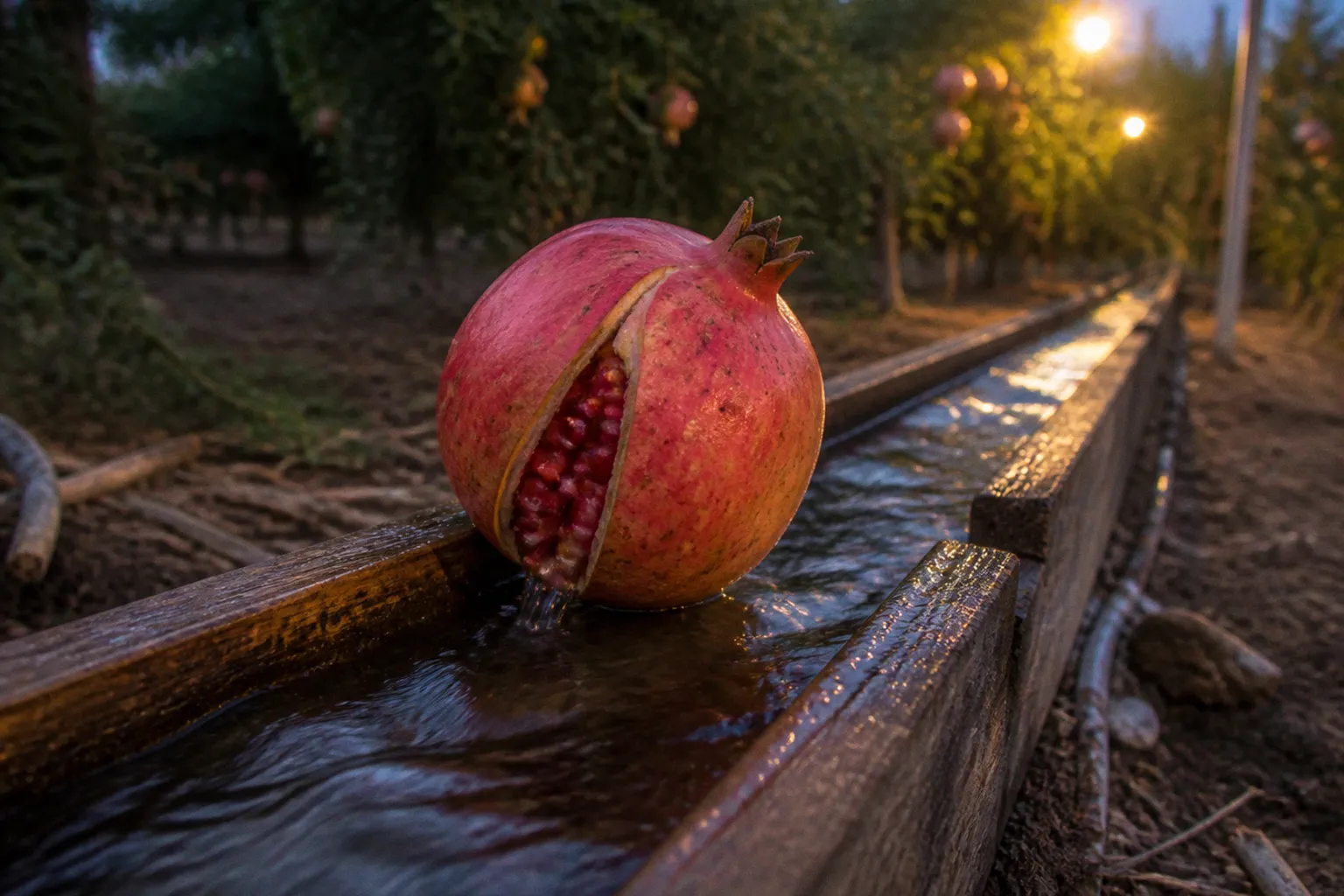
Every cooperative season, the same heartbreak rolls through our orchards: a grower opens a crate of what looked like flawless pomegranates under the tree, only to find half of them split wide open — ruby arils exposed, fungal growth already beginning, and the buyer’s rejection notice forming in our heads. The first suspect is usually irrigation, and with good reason. Irregular watering is the primary trigger behind many cracking problems, especially when a dry spell is followed by heavy rain or a sudden, excessive irrigation cycle.
But water is not the whole story. Nutrient deficiencies can weaken the rind, and sharp day-to-night temperature fluctuations can add further stress. The practical lesson is not that every cracked fruit has a single cause. It is that steady moisture gives the orchard its strongest first line of defense, while balanced nutrition and temperature management help the fruit withstand pressure when conditions turn difficult.
Fruit cracking in pomegranates is one of the most damaging pre-harvest disorders our growers face. In susceptible horticultural crops, splitting can wipe out anywhere from 50% to 85% of an otherwise market-ready yield. For a cooperative that has invested months of labor — pruning, fertilizing, coordinating harvest crews — watching a third of the crop crack open on the branch is more than a financial setback. It erodes the trust we have built with export partners who expect consistent, sound fruit.
The good news is that the main trigger is understandable, and much of the response can be organized at orchard level. We can reduce the sharp swings in soil moisture, improve the way water reaches the root zone, watch for mineral deficiencies, and prepare trees for the temperature stress that comes with late summer in Lebanon. None of these measures is a miracle cure on its own. Together, they form a workable approach to pomegranate skin cracking prevention techniques.
The Mechanics of Fruit Splitting: Why Rinds Fail Under Pressure
To fix the problem, we need to understand the mechanics. A pomegranate rind — the tough, leathery husk that protects the arils inside — is not infinitely elastic. It grows and thickens gradually as the fruit develops, but it has a limit. When the arils and surrounding tissues take up water faster than the skin can expand, internal pressure rises. Eventually, the rind cracks along a weak point.
This follows a familiar pattern: a period of moisture stress — a dry spell, an irrigation gap, or a stretch of hot Bekaa Valley days without adequate watering — followed by a sudden influx of water. That influx might come from heavy rain, emergency over-irrigation by a worried grower, or a change to a water source with a higher flow rate. The fruit swells quickly, while the rind cannot adjust at the same speed. The result is splitting.
This is why irregular irrigation is usually the primary trigger in orchard conditions. A tree that receives relatively even moisture is less likely to move abruptly from water deficit to excess. A tree that alternates between stress and saturation is exposed to repeated pressure changes at precisely the stage when the fruit is enlarging.
Still, the rind’s ability to tolerate that pressure depends on more than water. Calcium and boron deficiencies can affect cell-wall strength and tissue development. If the fruit skin is already structurally weak, a moisture surge that might not crack a well-nourished fruit can become enough to split it. Temperature fluctuations can compound the problem: very hot days followed by sharply cooler nights place additional stress on the fruit and the tree.
What makes this particularly painful for our cooperative model is that cracking often strikes just as the fruit reaches its peak marketable size. The pomegranates look gorgeous on the outside — deep red, heavy, perfectly shaped — and then they burst. Once the rind opens, exposed arils deteriorate quickly. Fungal pathogens such as Aspergillus and Penicillium can move into the damaged fruit, turning a disorder that began in the orchard into a total loss by the time the crates are sorted.
Irregular watering is usually where cracking begins, but a weak rind and sharp temperature stress can decide whether the fruit holds or splits.
The first step, then, is not simply to water more. It is to keep soil moisture from swinging too far in either direction, while giving the tree the nutritional and environmental support it needs to build a resilient rind.
Transitioning from Flood Irrigation to Precision Drip Systems
Many of our orchards still rely on traditional flood irrigation — opening a channel and letting water run between the tree rows until the ground is saturated. It is the method our parents used, and their parents before them. It works in a general sense, but it is blunt. Water distribution is uneven, soil saturation is inconsistent, and there is no practical way to control the exact volume reaching each tree’s root zone.
In a pomegranate orchard, that inconsistency creates the kind of stress-then-deluge cycle that encourages cracking. One part of a row may remain too dry while another receives more water than the root zone can absorb. The surface can look wet even when deeper roots are under stress, or it can dry quickly after a shallow irrigation. A grower then responds to what is visible, often with a heavier application than the tree actually needs.
Drip irrigation changes the equation. Instead of flooding the entire orchard floor, a network of emitters delivers water directly to the root zone of each tree, slowly and predictably. The goal is not to keep every inch of soil permanently wet. It is to create a more stable moisture profile where the active roots can draw water without the tree moving suddenly from shortage to abundance.
The figures available from pomegranate production are encouraging: with three emitters per tree, growers have documented 55% higher yields compared with traditional flooding methods. Fruit weight increases by roughly 65%, while water productivity — the amount of usable fruit produced per unit of water — rises by 64%. These results should not be treated as a guarantee for every Lebanese orchard. Soil, tree age, emitter design, maintenance, and scheduling all matter. They do show why a controlled system is worth considering.
For a cooperative managing dozens of hectares, efficiency gains also have a collective value. More predictable water delivery means more uniform fruit development across member farms, easier planning for harvest crews, and less pressure on a shared water supply.
A practical transition usually begins with five decisions:
1. Assess the current water source and flow rate. Before installing a system, measure what is actually available during peak summer demand, not only what the well or reservoir produces in a cooler month. The system must be designed around the flow the orchard can reliably receive.
2. Plan emitter placement around the active root zone. Three emitters per tree can provide a useful starting design, with placement near the drip line rather than directly against the trunk. Pomegranate roots spread widely, and distributing water around the canopy edge encourages a broader, deeper root system.
3. Install filtration before the lines. Sediment, algae, and mineral buildup can block emitters during the season. A screen or disc filter is a small part of the total installation cost, but it protects the entire system from uneven delivery.
4. Use pressure regulation. Drip systems operate at low pressure, typically around 1 to 2 bar. Without regulation, emitters near the beginning of a line may discharge more water than those at the far end. That difference recreates the unevenness the system was installed to correct.
5. Test every row before the crop enters its most sensitive stage. Walk the orchard, check emitters, inspect joints, and measure whether the end of each line receives the same attention as the beginning. Leaks and blockages are easier to repair before the first serious heat arrives.
The upfront investment is real, and we should not pretend otherwise. But the cost has to be compared with the value of fruit that would otherwise be lost to cracking, poor grading, and rejected consignments. Cooperatives can reduce the burden by pooling purchases, standardizing equipment across member farms, and sharing installation or maintenance labor. A system that is too complicated for one grower to maintain is not a solution; a system that the cooperative can service together has a better chance of lasting.
Drip irrigation is also not automatically effective simply because it is installed. A poorly filtered, badly pressurized system can produce a new form of inconsistency. The equipment is only the delivery mechanism. The real improvement comes from combining reliable hardware with a schedule that responds to soil, weather, tree age, and fruit development.
Optimizing Soil Moisture with Organic Mulching Strategies
Drip irrigation alone is powerful. Drip irrigation paired with organic mulch is more resilient.
When we place sugarcane mulch — or another suitable organic material — around the base of our pomegranate trees and over the areas served by the drip lines, we address two weaknesses at once. First, mulch slows evaporation from the soil surface. In the Bekaa Valley’s dry summer heat, exposed soil can lose moisture rapidly after irrigation. A mulch layer keeps more of that water in the root zone for the tree to use.
Second, mulch moderates soil temperature. Bare soil heats strongly during the day and cools quickly at night. That movement is not the main cause of fruit cracking, but it can add to the stress already created by irregular moisture or a weak nutritional status. A stable layer of organic material creates a less extreme environment around the roots.
Combining drip irrigation with sugarcane mulch has been shown to save up to 64% of water while improving pomegranate fruit output by 30% to 35%. As with any production result, the outcome depends on local conditions and execution. Mulch cannot compensate for blocked emitters, a severely deficient soil, or a watering schedule that leaves trees under stress for long periods. Its value is that it makes a well-managed irrigation system more forgiving.
When sourcing mulch, we should work with what is locally available and safe for the orchard. Sugarcane residue is effective and often inexpensive in regions where it is processed. Straw, dried leaves, and well-composted pruning waste can also serve the purpose. Fresh, diseased, or poorly decomposed material should not be placed against the trunk, where it can create a damp shelter for pests or pathogens.
A useful mulch layer is generally 8 to 10 centimeters thick. It should cover the active root area without touching the trunk directly. As it breaks down, it needs to be topped up. A thin scattering that disappears after the first wind or irrigation will not provide the same moisture-buffering effect as a maintained layer.
Mulching also helps us read the orchard more accurately. With less evaporation from the surface, the top layer of soil may remain damp for longer. That means surface appearance becomes a less reliable guide to irrigation timing. We should judge moisture deeper in the root zone, using a soil probe, a simple physical check at depth, or another method suited to the farm. The point is to avoid both extremes: irrigating because the surface looks dry when deeper soil is still moist, or delaying water because the surface looks damp while the root zone is already drying.
Mulch is not decoration. It is a moisture-management tool that keeps the root zone steadier when the air above it is anything but steady.
Organic mulch also contributes to soil structure as it decomposes. Better structure helps water move into the soil rather than running off the surface, particularly where the ground has become compacted. It can support a more active root environment, although it should be regarded as part of orchard management, not a replacement for soil testing or nutrient planning.
Seasonal Watering Schedules for Lebanese Orchard Conditions
The most sophisticated irrigation system in the world will not prevent cracking if the schedule does not match the tree’s actual needs through its growth cycle. This is where many well-intentioned growers go wrong: they install drip lines and then run them on a flat schedule all season, or they react to visible stress by flooding the orchard in panic. Both approaches recreate the instability we are trying to avoid.
A schedule should be treated as a working framework, not a fixed calendar. Soil type, canopy size, tree age, rainfall, heat, wind, and mulch coverage all change how quickly the root zone loses moisture. The objective is consistent availability, not identical irrigation on every date.
Spring: bud break through fruit set
Trees are waking up and pushing new growth. Water requirements are moderate compared with the fruit-sizing period, but consistency still matters. Establish the irrigation rhythm before the weather becomes demanding. A deep irrigation every 7 to 10 days can be a useful starting interval, delivering enough water to moisten the soil to roughly 60 to 90 centimeters where conditions allow.
The important point is to confirm that the water is reaching depth. Short, frequent surface applications may make the orchard look cared for while encouraging shallow roots. Shallow rooting leaves trees more exposed when the upper soil heats and dries during summer.
Spring is also the time to inspect the full irrigation system, repair damaged lines, and check filtration. If a blockage is discovered during fruit sizing, the tree may already have entered the stress cycle that makes later correction dangerous.
Summer: fruit development and sizing
This is the critical window for preventing fruit split. As temperatures climb and the fruit enlarges, water demand rises. Maintain an even rhythm and avoid allowing trees to move from visible stress to emergency saturation.
The 7-to-10-day deep-watering interval used as a starting point in spring may need adjustment as heat and canopy demand increase. Sandy soils drain faster and may require more frequent applications. Heavier soils hold moisture longer but can become waterlogged when irrigation is too generous. The schedule should follow the condition of the root zone rather than the date alone.
Do not skip cycles simply because the surface soil looks damp, particularly where mulch is being used. At the same time, do not add a large compensating irrigation without checking how much moisture remains below the surface. A missed cycle followed by heavy watering is precisely the pattern that causes the fruit to swell faster than the rind can accommodate.
Rainfall requires the same discipline. A summer storm after a dry period may supply more water than the orchard needs at once. If the root zone is already saturated, adding a routine irrigation immediately afterward can intensify the fluctuation. The response should be based on soil moisture and weather conditions, not on habit.
Late summer and early fall: ripening
As pomegranates approach full size and begin to color, irrigation management becomes more delicate. The fruit is no longer expanding at the same pace, but the trees can still suffer if water is withdrawn too abruptly. The aim is to reduce excessive moisture without creating a new period of stress.
In some orchards, intervals may be extended toward every two to three weeks during the ripening phase, depending on soil and weather. That is not a universal rule. A light soil under severe heat will behave differently from a heavier soil with good mulch coverage. Watch the trees, check moisture at depth, and avoid sudden changes.
This is also the period when temperature fluctuations can become especially relevant. Hot days and cool nights may place additional stress on fruit that has already reached a high internal pressure. Stable irrigation and mulch cannot control the weather, but they can prevent water stress from compounding it.
Post-harvest
After the crop is off, a final deep watering can help the tree recover and maintain the root zone before winter dormancy. The timing and amount depend on rainfall and soil conditions. In Lebanon, winter rains typically take over from there, but post-harvest care should not be ignored simply because the marketable fruit has left the orchard.
A tree that enters dormancy depleted or damaged may begin the next season with less resilience. Cooperatives should record which blocks experienced cracking, when it appeared, and what irrigation or weather conditions preceded it. Those observations become useful when planning the next crop.
Across member farms, a shared record can reveal patterns: one soil type may crack after a particular irrigation gap, while another may respond more strongly to late-season rain or a nutrient issue. This is where the cooperative model has a real advantage. Shared observations turn isolated losses into information that can improve the entire production system.
Beyond Water: Managing Nutrient Deficiencies and Temperature Stress
It would be misleading to suggest that irrigation alone determines whether pomegranates crack. Water management is the primary lever because irregular moisture is the most common and most directly manageable trigger, but the condition of the rind and the stress placed on the tree also matter.
Calcium and boron
Calcium and boron deficiencies can weaken developing tissues, including the fruit wall. A pomegranate with inadequate calcium may have a rind that is less structurally resilient. Boron contributes to cell-wall integrity and membrane stability. These deficiencies do not mean that every cracked fruit needs an immediate spray, and indiscriminate applications can create new problems. The first step is to identify whether the orchard actually has a deficiency.
Soil testing at the start of the season provides a stronger basis for action than diagnosing a mineral problem from cracked fruit alone. Where testing or tissue analysis confirms a deficiency, corrective soil amendments or foliar treatments may be appropriate. Timing matters: applications made early in the growth cycle, before or around fruit set, give the tree more opportunity to incorporate nutrients into developing tissues.
Nutrition should be balanced rather than driven by the hope that more fertilizer will make larger fruit. Excessive vigor, poorly timed nitrogen, or an imbalance between nutrients can complicate water management and fruit quality. The cooperative can help here by arranging consistent testing and sharing recommendations suited to local soils rather than treating every orchard as identical.
Temperature fluctuations
Sharp day-to-night temperature changes are harder to manage. In the Bekaa Valley, late summer can bring very hot days followed by noticeably cooler nights. The fruit experiences thermal stress, and that stress can compound the mechanical pressure created by uneven moisture.
We cannot control the weather, but we can reduce the number of additional stresses the tree has to absorb. Consistent irrigation keeps the root zone from drying sharply. Mulch moderates soil temperature. A healthy canopy and balanced nutrition support the tree’s general resilience. These measures do not guarantee that fruit will never crack during an extreme weather event; they improve the odds that the rind will tolerate ordinary fluctuations.
Orchard monitoring
The first visible crack is often the end of a process that began days earlier. Monitoring should therefore include more than counting split fruit at harvest. Walk the orchard regularly during fruit development and note:
- whether cracking is concentrated in one block, soil type, or end of an irrigation line;
- whether fruit on the sunny side of the canopy is more affected;
- whether cracks follow rain, a missed irrigation, or a repaired line with a different flow;
- whether trees show signs of uneven vigor or nutrient stress;
- whether the soil is dry at depth or saturated near the emitters.
These observations help separate causes that may look similar. If cracking is concentrated at the end of a drip line, pressure or blockage may be involved. If it follows a long dry period and then a heavy irrigation, moisture fluctuation is the stronger suspect. If it appears across well-watered areas with weak foliage or poor fruit development, nutrition deserves closer attention. If it increases after a period of extreme heat and cool nights, temperature stress may be contributing.
What we want to avoid is treating every case with the same response. More water will not correct a blocked emitter. Fertilizer will not repair an irrigation schedule that repeatedly swings between drought and saturation. Mulch will not solve a serious deficiency by itself. The most reliable pomegranate crop quality control comes from diagnosing the pattern before choosing the intervention.
Building a Cooperative Approach to Cracking Prevention
The orchard-level practices are clear enough: deliver water steadily, protect the root zone, monitor the system, test the soil, and adjust for weather. The harder question is how to make those practices workable across farms with different equipment, soils, and resources.
A cooperative can begin with shared standards rather than insisting that every member install exactly the same system. For example, members can agree to inspect drip lines before the high-demand season, record irrigation interruptions, check filters on a common schedule, and report significant cracking events. Those basic habits create a common language for discussing what happened.
Group purchasing can make filtration, pressure regulators, replacement emitters, and mulch materials more accessible. Shared technical support can reduce the risk of installing systems that look efficient on paper but deliver unevenly in the field. Training should focus on practical diagnosis: how to check flow at the start and end of a line, how to assess moisture below the surface, and how to distinguish a water problem from a likely nutrient or temperature contribution.
Harvest and packing records also matter. Cracking should not be treated only as a field problem. Fruit that reaches the packing shed with small openings may deteriorate quickly, particularly if handling and storage conditions are poor. Recording which orchard blocks contributed damaged fruit can guide the next season’s irrigation and nutrition plans.
The cooperative model is especially valuable because no single grower sees every pattern. One member may notice that a particular soil dries much faster than expected. Another may identify a recurring pressure problem at the far end of a row. A third may have success using locally available mulch. When those observations are shared carefully, they become more useful than isolated advice detached from local conditions.
What This Means for Lebanese Pomegranate Growers
Every season without a coordinated approach to irrigation management is a season in which marketable fruit may be left on the ground — literally. The primary lesson is straightforward: prevent long moisture stress, avoid sudden heavy watering, and keep the root zone as stable as the season allows.
That does not mean treating water as the only variable. Nutrient deficiencies can leave the rind more vulnerable. Sharp temperature changes can add stress during ripening. Poor filtration, uneven pressure, compacted soil, and weak monitoring can all undermine an otherwise sensible plan. Pomegranate fruit split prevention works best when these factors are considered together, with irrigation at the center rather than irrigation alone.
The strongest changes are often quiet ones. A cooperative checks the far end of a drip line before summer. A grower replaces a blocked emitter instead of compensating with more water. Mulch is renewed before the hottest weeks. Soil is tested before a deficiency becomes visible. Irrigation is adjusted after rainfall rather than continued automatically. None of these actions is dramatic, but each reduces the chance that a manageable stress becomes a cracked crate.
The pomegranate is Lebanon’s fruit. It is on our tables, in our traditions, and increasingly in the crates we send to markets that expect consistent quality. Steady irrigation is not glamorous. It does not make for dramatic stories at cooperative meetings. But it is the quiet practice that keeps fruit intact, buyers confident, and growers in business.
The fix is not simply more water. It is better-timed water, supported by stable soil, balanced nutrition, and close attention to the orchard’s changing conditions. That is how we reduce fruit cracking in orchards — together, one well-managed tree and one better-watered block at a time.