Olive pomace mulch: easy moisture lock for dry soil
In Lebanon’s dry farming seasons, the soil can lose useful moisture long before the crop shows visible stress.
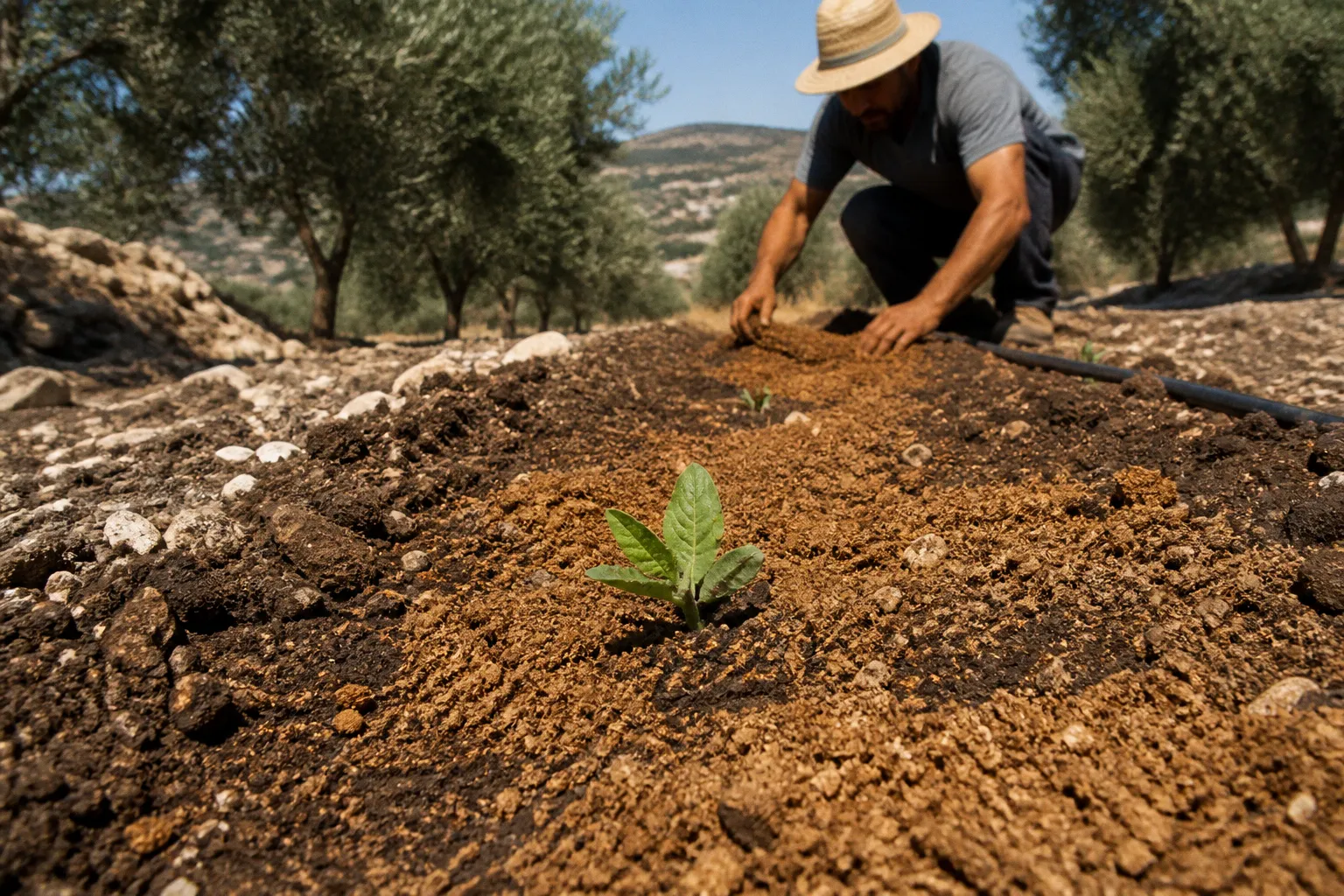
The surface becomes pale and crusted, irrigation runs off instead of moving gently into the root zone, and every hot day takes a little more water away from the plants. For growers in the Bekaa and other Mediterranean production areas, organic mulch is one of the simplest ways to slow that loss.
Olive pomace—known locally as jift—offers a particularly practical material because it already exists within our agricultural economy. It is produced at olive mills, often close to the farms that need soil improvement, and it contains organic matter that can support better structure, porosity, and water retention when properly stabilized.
But there is an important distinction between using jift as a managed soil amendment and spreading fresh olive mill waste directly over a field. Raw pomace is not a ready-made mulch for seeds or young seedlings. Its acidity, oils, and phenolic compounds can interfere with germination and plant growth. The useful version is composted, matured, and handled as part of a cooperative system rather than treated as a waste product to be tipped onto the nearest plot.
Why olive pomace belongs in the moisture conversation
Olive pomace is the solid material left after oil extraction, made up of olive skins, pulp, and fragments of pits. Depending on the extraction process, it can represent as much as 35–40% of the total olive weight processed. That is a substantial volume for Lebanese mills and farming communities to manage each season.
When it is left unmanaged, the material can become a nuisance: it may smell, attract flies, occupy valuable space, or create a disposal problem around the mill. When it is dried and compressed, its calorific value—approximately 23 MJ per kilogram—also makes it useful as a fuel source, and many mills turn it into heating briquettes or pellets for winter.
So the question is not whether jift has value. It clearly does. The practical question is which value we want to preserve.
For fields, composted pomace can contribute to a more resilient soil surface in several ways:
- It adds organic matter that helps soil particles hold together rather than collapsing into a hard crust.
- It improves the soil’s ability to retain water, with reported increases in water-holding capacity of approximately 2–4% after composted pomace application.
- It can improve aggregate stability by about 20%, helping irrigation water enter the soil instead of moving across the surface.
- It reduces soil bulk density by roughly 8–15%, creating a lighter, more porous growing environment.
- It contributes nutrients, particularly potassium, although it should not be treated as a complete fertilizer.
These changes matter most in soils that are dry, compacted, low in organic matter, or repeatedly disturbed by cultivation. A thin organic surface layer cannot solve every water problem in a farm, but it can help the moisture already delivered through rainfall or irrigation stay available for longer.
The strength of jift is not that it replaces water; it is that it helps our soil waste less of the water we already have.
Fresh jift and composted jift are not interchangeable
The most common mistake with olive pomace mulch is treating all pomace as if it had the same behavior. Fresh material may look dark, fibrous, and organic, but appearance is not a maturity test.
Raw olive pomace can contain approximately 8–14% fats and oils on a dry matter basis, as well as 1–3% phenolic substances. Its pH is around 5.2, which is acidic. These compounds are part of the reason fresh pomace can suppress seed germination or injure young plants when applied without stabilization.
The risk is particularly serious where growers are sowing directly into the amended area. Seeds and small seedlings have limited root systems and little tolerance for an unstable material that is still decomposing. Fresh pomace may also consume available nitrogen as microorganisms break it down, leaving crops competing for nutrients at the very stage when they need a clean start.
That does not mean raw jift has no place in the wider farm system. It may be directed toward composting, energy production, or other controlled uses. It simply means that the material beside the mill is not automatically suitable for the seedbed.
A cooperative can make this distinction visible with a simple classification system:
| Material condition | Suitable use | Main concern |
|---|---|---|
| Fresh, wet pomace | Compost feedstock or controlled energy processing | Phenolic compounds, oils, acidity, and unstable decomposition |
| Partially decomposed pomace | Continued composting with monitoring | Uneven maturity and possible nitrogen competition |
| Fully matured pomace compost | Soil amendment or carefully managed mulch | Needs clean handling and appropriate field placement |
| Dried and compressed pomace | Heating briquettes or pellets | Valuable as fuel rather than as a direct soil input |
This kind of separation is not bureaucratic decoration. It prevents a good circular-farming idea from becoming a crop-loss problem.
Building a stable compost from olive mill waste
Composting jift is a shared responsibility between the olive mill, the cooperative, and the growers who will eventually use the material. The quality of the final compost depends less on enthusiasm than on balance.
Olive pomace is carbon-rich and relatively oily, so it benefits from nitrogen sources such as well-managed manure. It also needs a bulking material, such as straw, to improve airflow and keep the pile from becoming dense and wet. For active composting, the target carbon-to-nitrogen ratio is approximately 25:1 to 35:1.
In practical terms, our growers do not need to calculate every fragment of olive skin and straw in a laboratory. They do need to avoid building a pile from pomace alone and assuming that time will solve everything. A mixed pile with enough dry structure, nitrogen, and oxygen will mature more evenly than a compact mound of wet material.
A workable cooperative process looks like this:
1. Separate the material at the mill. Keep pomace intended for agricultural use away from plastics, chemical containers, treated wood, and other contamination. If some of the pomace is being dried for fuel, do not mix the two streams later.
2. Choose a firm, contained composting area. The site should not sit directly beside a drainage channel or in a position where rainwater can carry concentrated liquids into a stream or neighboring field.
3. Blend pomace with nitrogen and bulking materials. Manure supports the microbial process, while straw or another dry fibrous material creates air pockets. The blend should be moist but not saturated.
4. Watch the heat of the pile. Active composting temperatures should reach approximately 113–140°F. Heat is a useful sign that decomposition is underway, but it is not the only sign of maturity.
5. Turn or aerate the pile as needed. Compacted, oxygen-poor areas decompose slowly and may remain uneven. A cooperative schedule can assign turning days to a shared tractor, loader, or small work team rather than leaving each grower to manage a separate pile.
6. Allow enough time for stabilization. Olive pomace compost may require approximately six to ten months to mature. A material that has merely cooled on the outside is not necessarily finished inside.
7. Store the finished compost cleanly. Keep mature compost protected from renewed contamination and excessive waterlogging until it is ready for the field.
Maturity should be judged by more than color. Finished material should have a stable, earthy character rather than a sharp olive-waste smell, should no longer heat rapidly when piled, and should be visibly integrated rather than made up of obviously fresh oily fragments. Where a cooperative has access to laboratory support, testing can add confidence, especially for pH, salinity, nutrient content, and maturity.
This is one place where collective infrastructure makes a real difference. A single smallholder may not have room for a six-to-ten-month composting process, a loader, or the time to turn material regularly. A group can share a site, tools, labor, and recordkeeping, while the mill provides a predictable stream of raw material.
Using composted pomace as a moisture-saving layer
Once the pomace has matured, the next question is where it belongs on the farm. The answer depends on the crop, the soil, and the irrigation system, but the central principle is consistent: keep the composted material on or near the soil surface without allowing it to smother the plant or obstruct water delivery.
For established olive trees, vines, orchard crops, and some larger vegetable beds, a surface layer around the active root zone can reduce direct evaporation and soften the impact of hot weather. It should not be piled tightly against trunks or stems, where persistent dampness and poor airflow can create new problems. Around drip-irrigated crops, the mulch needs to sit where water can still reach the root zone; placing organic material too far from the wetting pattern will not improve plant access to moisture.
Composted jift can also be incorporated shallowly before planting, particularly where the aim is to improve structure rather than provide a visible mulch layer. The decision should be made according to the crop cycle:
- Before sowing: use only fully matured compost, mixed into prepared soil rather than fresh pomace placed in the seed line.
- Around established plants: apply as a surface amendment while leaving breathing room around stems and trunks.
- Between rows: use where it will not interfere with cultivation, harvesting, or irrigation maintenance.
- On compacted ground: combine with reduced tillage and organic residue management so the soil structure has time to recover.
There is no universal application rate that can be responsibly prescribed for every Lebanese farm. Pomace moisture, soil texture, crop type, irrigation method, and compost maturity all change the result. A cooperative is better served by starting with a small demonstration area, recording the material used and the field conditions, and comparing soil moisture and crop response with an untreated strip.
The comparison does not need to be elaborate. Growers can observe whether the mulched area forms less crusting after irrigation, whether the soil remains workable for longer, and whether plants maintain steadier growth between irrigation events. If the cooperative has access to a soil moisture meter, the same locations can be checked at consistent depths and times. Even simple records are valuable when they are repeated across several farms.
A successful mulch trial is not the plot that looks darkest on the first day; it is the one that helps the soil remain open, moist, and productive through the difficult part of the season.
Where jift mulch fits within climate-resilient farming
Moisture retention is only one part of climate adaptation. In the Bekaa, water conservation also depends on irrigation timing, soil cover, wind exposure, crop choice, and the condition of the root zone. Olive pomace compost works best when it is part of that wider system.
A farm using drip irrigation, composted organic matter, cover crops, and reduced soil disturbance is addressing water loss from several directions at once. The compost supports aggregate stability; the mulch shades the surface; living roots and residues protect the soil between crops; and efficient irrigation delivers water closer to where plants can use it.
By contrast, spreading pomace over severely compacted soil without addressing drainage or infiltration may only move the problem around. If water cannot enter the soil, a surface layer will not transform runoff into deep root-zone moisture. Likewise, composted pomace does not eliminate the need for irrigation in dry regions. The observed improvement in water-holding capacity is useful, but it is measured in percentage points, not a complete replacement for water inputs.
For our growers, the most productive approach is to connect jift use to a field objective:
- If the soil crusts after irrigation, focus on aggregate stability and surface protection.
- If the soil dries rapidly, combine compost with mulch placement and better irrigation scheduling.
- If the soil is dense and difficult to work, use mature organic matter alongside reduced traffic and less aggressive cultivation.
- If nutrient availability is uneven, test the soil and treat pomace compost as one contribution, not a substitute for a balanced fertility plan.
- If erosion is a concern, maintain cover between rows and avoid leaving bare soil exposed through the dry, windy months.
This framing also protects the cooperative from overselling the material. Jift is not a miracle input, and it should not be marketed as one. It is a locally available resource that can make soil management more circular and more resilient when the preparation is careful.
The cooperative model: from disposal problem to shared resource
The most promising part of olive pomace mulch may be organizational rather than technical. Every mill produces material at a seasonal rhythm, while farms need amendments according to different planting calendars. Without coordination, one side has an accumulation problem and the other side has to purchase organic matter from elsewhere.
A cooperative can connect those two timelines.
The first step is a shared inventory: how much pomace is produced, when it becomes available, how wet it is, and how much straw or manure can be sourced nearby. The second is a clear decision about the portion reserved for fuel and the portion intended for composting. Dried pomace has real energy value, so agricultural reuse should not undermine a mill’s winter heating needs. The aim is to allocate the resource intelligently.
A simple internal record can include:
- the date and mill of origin;
- whether the pomace was fresh, dried, or already mixed;
- the nitrogen and bulking materials added;
- compost pile temperature observations;
- turning or aeration dates;
- the date the material was judged mature;
- the farms and crops receiving it;
- field observations after application.
This information turns an informal waste stream into a traceable input. It also gives the cooperative something useful to discuss with buyers. Export markets increasingly care about how soil fertility, water, waste, and chemical inputs are managed, even when those details do not appear on a box of apples, olives, or vegetables. A documented circular practice cannot guarantee market access, but it gives growers a stronger and more credible story about stewardship.
There is also a quality advantage. When several farms share a composting protocol, the resulting material becomes more consistent. That consistency matters for growers trying to protect blemish-free produce, maintain crisp vegetable quality, or meet buyer expectations across multiple harvests. A buyer may not see the compost pile, but they will notice when a cooperative’s products are more uniform from one shipment to the next.
The work can be divided without creating a heavy administrative burden:
- Mills provide clean, separated pomace and basic production timing.
- Cooperative leaders coordinate the composting site and shared equipment.
- Growers contribute straw, manure, labor, or a small agreed maintenance fee.
- Field teams document application areas and crop response.
- Agronomists or soil specialists support testing where the cooperative can arrange it.
This is the kind of collective effort that makes sustainable farming practical rather than aspirational. No single grower has to carry the entire system.
Common mistakes that weaken the result
Several problems appear repeatedly when agricultural byproducts are introduced without a shared protocol.
Applying fresh pomace to planted rows. This is the most serious error. The material’s phenolics, oils, and acidity can affect germination and young roots. Compost first, particularly where direct seeding is involved.
Using a pile made entirely of pomace. Dense, wet material may lack the airflow and nitrogen balance needed for even decomposition. Add suitable bulking and nitrogen sources and monitor the pile rather than assuming it will stabilize on its own.
Calling cooled material mature. A pile may stop heating temporarily while remaining unstable in the center. Time, odor, texture, and, where possible, testing should all inform the decision.
Covering the trunk or stem. Even good compost can create a damp, poorly ventilated collar around a plant. Keep a clear space around the base.
Expecting mulch to replace irrigation. Improved water-holding capacity is valuable, but dry Lebanese farms still need a water plan. Mulch reduces loss; it does not create water.
Ignoring contaminants. Plastic twine, treated wood, chemical containers, and other waste can enter a mill’s pomace stream. Once mixed into compost, they become a field problem.
Applying without a field comparison. A small untreated strip gives growers a reference point. Without one, it is easy to attribute every improvement—or every failure—to the mulch alone.
Treating compost as a complete fertility program. Pomace compost can improve structure and contribute potassium, but crop nutrition still depends on soil testing, crop demand, and the rest of the farm’s fertility strategy.
The practical response is not to abandon jift. It is to slow down the chain between mill and field, giving each stage a clear purpose.
A more durable path for Lebanese farms
Olive pomace mulch works because it addresses two needs at once: it gives mills a productive destination for a large seasonal byproduct, and it gives dry soils more organic matter with which to hold structure and moisture. That combination is especially valuable in farming communities where every outside input carries a cost and every irrigation decision matters.
The most reliable path is straightforward, even if it requires patience:
1. Separate clean pomace from fuel and contaminated waste streams.
2. Compost agricultural material with nitrogen sources and bulking agents.
3. Maintain a target carbon-to-nitrogen balance of approximately 25:1 to 35:1.
4. Keep the pile active, aerated, and within the working temperature range of roughly 113–140°F.
5. Allow six to ten months for stabilization rather than rushing immature material to the field.
6. Trial the finished compost on established crops or prepared soil, not directly around germinating seeds.
7. Record the result across farms, soils, and seasons.
For our cooperatives, this is more than a mulch decision. It is a way to make the olive harvest support the next crop, to turn local processing into local soil care, and to show that export readiness can begin beneath the plants—in healthier soil, steadier moisture, and a more organized relationship between growers and mills.
The goal is not simply to keep the ground looking covered. It is to build soil that remains open, living, and productive when the weather is least forgiving. Properly prepared jift can be one useful layer in that work, and collective management is what allows its value to reach the field safely.