Pomegranate harvest timing: three signs of peak export quality
Pomegranate harvest timing isn't something we can finesse after the fact. There's no ripening on the warehouse floor, no last-minute sugar gain in cold storage, no second chance for the arils to…
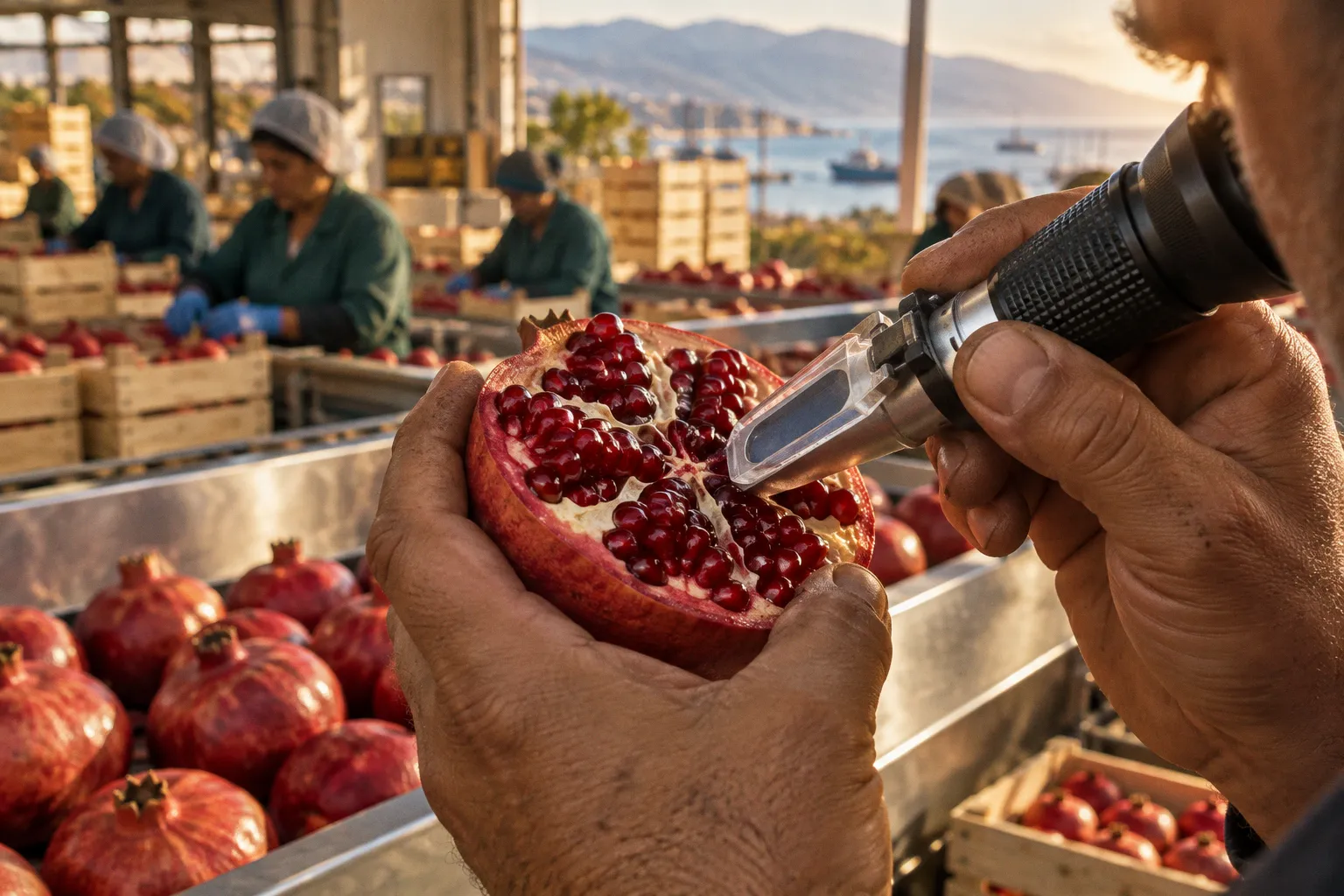
Pomegranate harvest timing isn't something we can finesse after the fact. There's no ripening on the warehouse floor, no last-minute sugar gain in cold storage, no second chance for the arils to plump up and the sugars to settle into that crisp, balanced sweetness our buyers expect. The fruit we pick is the fruit we sell, and that's why the stretch between August and October carries so much weight for our Bekaa Valley cooperatives. Every grower knows the quiet tension of standing under a heavy crown of red arils and wondering whether next week's pick will be too early or, worse, too late.
The window is narrow, and it closes once and for all.
The Non-Climacteric Reality: Why Timing is Final
Pomegranates belong to a category of fruit that behaves differently from the ones most of us grew up picking. Unlike bananas, peaches, or apples, they are non-climacteric, which means they do not continue to ripen once they've left the tree. The sugars, the acids, the aromatic compounds that define a memorable pomegranate are all built up while the fruit is still hanging on the branch, drawing from the root system and the canopy around it. Cut it early, and you're shipping a sour, underdeveloped disappointment to a buyer in Rotterdam who paid for a Wonderful, not a tart green globe.
This is the reality our cooperative members have learned to plan around, and it reshapes the entire harvest conversation. Timing isn't a flexible deadline we can push for market convenience; it's a biological event tied to cultivar, climate, and the particular rhythm of each orchard block. For export growers in the Bekaa and along the southern foothills, that translates into careful scouting, repeated sampling, and a harvest calendar built around maturity indicators rather than calendar dates alone.
Harvest timing is the one decision we get exactly once. Get it right, and the fruit carries our reputation to market. Get it wrong, and the entire season's work arrives underperforming.
The good news is that pomegranates give us clear signals. We just have to know how to read them, and more importantly, which signals actually matter for the export grade we're targeting.
Decoding Maturity: Brix Levels and Acidity Thresholds
The first conversation we have with growers new to export work always comes back to two numbers: Brix and titratable acidity. These are the measurable heart of pomegranate maturity, the figures our buyers check when they open a sample crate at the receiving dock, and they're what separates a premium shipment from a commodity load.
Total Soluble Solids (TSS), measured in degrees Brix, is essentially the sugar content of the juice. For most export programs, the accepted minimum sits around 14° Brix for general commercial grade, rising to 16° Brix for specific cultivars like Wonderful and Herskovitz. The window most of our cooperatives aim for stretches from about 14° to 17° Brix, high enough to deliver the sweetness buyers expect, low enough to leave a margin of safety against cracking and over-ripening in the supply chain.
Titratable acidity (TA), the second number, captures the sharpness of the juice. A mature, export-ready pomegranate should drop below 1.85% acidity. As the fruit matures on the tree, sugars climb while acids gradually decline, and the ratio between them is what gives a ripe pomegranate its characteristic sweet-tart balance. When acidity is still high, say above 2%, the arils taste sharp and underwhelming no matter how red the skin looks on the outside, and no amount of post-harvest handling will rescue that eating experience.
The relationship between these two measurements matters more than either one alone. A fruit at 15° Brix with acidity sitting at 1.6% will deliver a noticeably sweeter eating experience than a fruit at 16° Brix with acidity stubbornly holding above 2%. That's why our field teams carry handheld refractometers and simple titration tools throughout the harvest stretch — we measure both, and we trust both, rather than leaning on a single shortcut.
For growers wondering how to sample: pull fruit from the sun-exposed side of the tree, from the mid-canopy, and from multiple trees spread across a block. A single fruit tells you almost nothing. A composite sample of eight to ten fruit from a representative section of the orchard gives a much more reliable picture of what's actually ready to pick, and it smooths out the variability that always exists between individual trees.
Cultivar-Specific Indicators: Beyond Skin Color
Here's where the conversation gets more nuanced, and where the experience of our growers, particularly those who manage mixed cultivar blocks, really earns its weight. Not all pomegranates announce their readiness the same way, and relying on skin color alone has cost more than one cooperative a portion of its export grade over the years.
Wonderful, the cultivar most of our export growers favor for international markets, is famously deceptive on the outside. The skin can stay greenish or mottled even as the arils inside are reaching peak sugar and dropping toward acceptable acidity. This is a fruit that ripens from the inside out, which means a beautiful-looking pomegranate on the outside may be underwhelming in the glass, while a homely greenish one might deliver the sweet, wine-colored arils a buyer is actually paying for. Our Wonderful growers have learned to crack open sample fruit and check the aril color directly, rather than judging by skin alone.
Acco and Angel Red, two cultivars increasingly planted for early-season export windows, behave the opposite way. Their skin blushes to a vivid red well before the arils have caught up in sugar development. A stunning red Acco harvested a week too early can look like a premium product in the carton and taste like a tart disappointment once the consumer cuts it open. For these cultivars, the skin is a beautiful liar, and Brix readings become the only honest measure we have.
This is why cultivar-specific harvest protocols matter so much for our cooperatives. A blanket rule that says "pick when the skin turns red" works well enough for some Mediterranean heirloom varieties, but it can undermine Wonderful and Acco alike when applied without adjustment. What follows is a simplified comparison of the maturity behavior our growers most often encounter in the orchard:
| Cultivar | Skin color at peak ripeness | Internal ripening pattern | Key maturity check |
|---|---|---|---|
| Wonderful | Often greenish or mottled | Ripens internally first; arils reach peak sugar before skin fully reddens | Brix and acidity, confirmed by aril sampling |
| Acco | Deep red externally | Skin reddens early; arils lag behind in sugar development | Brix 16°+ and acidity below 1.85%; skin alone unreliable |
| Angel Red | Bright red externally | Similar to Acco — external color develops ahead of internal sweetness | Brix readings mandatory before harvest decision |
| Local Lebanese heirloom cultivars | Variable | Typically ripen more evenly between skin and arils | Combined skin color, Brix, and a taste test in the orchard |
The takeaway is straightforward. Cultivar dictates which signal we trust, and harvest timing that works for one block can quietly undo the next.
Skin color tells us what the pomegranate looks like. Brix and acidity tell us what it actually tastes like. Only one of those two answers earns us the export grade.
The Cracking Risk: Balancing Sugar Content and Harvest Windows
The temptation, of course, is to wait. Every extra day on the tree pushes Brix a little higher, gets us closer to the upper end of that 17° sweet spot, and promises a fruit that will stand out on a buyer's quality sheet. But there's a real cost to waiting, and our growers have seen it firsthand in seasons past: cracking.
Pomegranate skin doesn't stretch the way a grape's does. As the arils swell with juice in the final weeks of maturation, the rind comes under increasing internal pressure, and once that pressure exceeds what the skin can bear, the fruit splits. The damage isn't cosmetic. Once the rind is broken, the arils inside become vulnerable to mold, insect entry, and rapid moisture loss, and the fruit is effectively unexportable. A cracked pomegranate in a carton can also compromise its neighbors, spreading decay through the rest of the shipment long before it reaches its destination.
The numbers on this are sobering. In one documented trial on Wonderful pomegranates, cracking rates climbed to roughly 30% by the time harvest was pushed out to 185 days after full bloom, compared with negligible cracking at earlier windows. That's a third of the crop lost to a decision that, on paper, was framed as maximizing quality. In practice, it was a decision about maximizing risk, and the orchard paid for it.
The harvest window most of us work with generally falls between 140 and 180 days after full bloom, depending on the cultivar, the season's heat accumulation, and the specific microclimate of each block. Within that window, there's a narrower sweet spot, usually a stretch of two to three weeks, where Brix has climbed into the export range, acidity has dropped below threshold, and cracking risk remains manageable. Our most experienced growers learn to identify that window through repeated scouting rather than commit to a fixed date months in advance, and they adjust as the season unfolds.
A few practical habits help bring that discipline into the orchard:
- Scout each block twice a week once fruit begins to color, walking different sections to spot early cracking before it spreads across the canopy.
- Harvest in stages rather than stripping a block in a single pass — pick the most mature fruit first, then return for the rest as they catch up over the following days.
- Keep records from year to year, block by block. A block that consistently matures early should be scheduled earlier the following season, and that pattern only becomes visible if we write it down.
Bringing It Together: A Shared Harvest Rhythm
What I appreciate most about working with our cooperatives is how harvest timing has become a shared discipline rather than an individual guess. We pool our scouting notes, we share refractometer readings across blocks, and we coordinate our deliveries to the packing house so the export program receives fruit at consistent maturity rather than a chaotic mix of over-ripe and under-ripe loads arriving on the same truck. That coordination is the difference between a cooperative that builds long-term buyer relationships and one that struggles to hold a price from one season to the next.
The three signals worth holding onto as the season opens are simple to state and worth repeating:
1. Brix has reached the export range for the cultivar in question — generally 14° to 17°, with 16°+ for Wonderful and Herskovitz, confirmed by refractometer readings rather than guesswork.
2. Titratable acidity has dropped below 1.85%, confirming the sweet-tart balance buyers expect when they cut the fruit open at the other end of the supply chain.
3. The cultivar-specific maturity pattern matches what we're actually seeing in the orchard — Wonderful showing internal sweetness even when the skin is still greenish, Acco and Angel Red delivering aril sugar even when the skin has looked ready for weeks.
When those three signals line up, we pick. When they don't, we wait one more scouting cycle, because the window is narrow and final, and the season's worth of effort deserves to arrive at its destination tasting exactly the way our growers meant it to.