Gulf transit packaging: 5 ways to protect fresh produce
Five to ten days. That is the transit window you are fighting every time a container of Lebanese cherries, stone fruit, pomegranates, or table grapes leaves Port of Beirut for Jeddah, Dammam, Kuwait, or another Gulf destination.
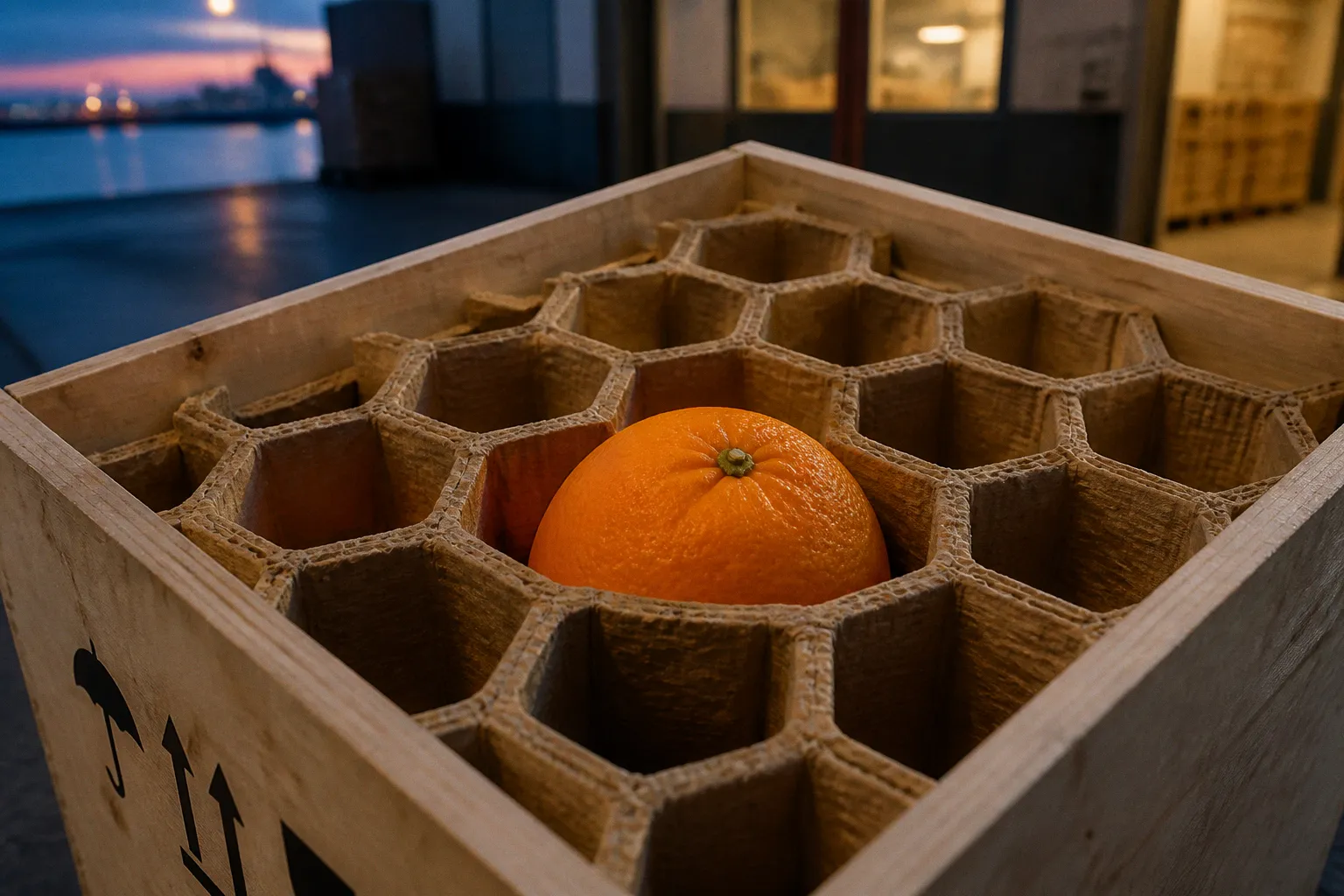
The reefer may be set correctly, but refrigeration cannot repair fruit that was warm at loading, cartons that have softened in humidity, or labels that fail inspection at the border.
A single collapsed carton can damage the boxes beneath it. A pallet that sweats through the hold can turn sound fruit into a decay claim. A missing country-of-origin mark can leave a shipment waiting while its commercial value declines by the hour. The problem is not one dramatic mistake. It is usually a chain of small packaging decisions made before the container doors close.
GCC importers do not accept excuses about the heat. They accept pallets that arrive cold, intact, traceable, and properly declared. For Lebanese exporters, that means treating packaging as part of the cold chain rather than as a disposable outer layer.
A reefer container is not a packaging strategy. It is a delivery vehicle. The packaging is what survives the days before the plug goes in.
1. Strip Out Banned Materials Before They Reach the Container Yard
Lebanese export law prohibits expanded polystyrene containers for fresh fruit and vegetables under Ministry of Agriculture Decision No. 1/358 (1997) and its amendment, Decision No. 1/2 (2000). For fresh produce packaging for Gulf transit, that is the first line to draw: polystyrene crates and foam trays cannot be treated as harmless packing-room supplies simply because they are inexpensive or familiar in the domestic market.
The practical risk is not limited to the main crate. Polystyrene can enter an export line through small components: foam trays, corner protection, end-caps, separators, or a mixed pallet purchased during a peak-season shortage. A packhouse may have compliant outer cartons while still using a prohibited insert inside the retail pack. The export packaging audit has to cover the entire product-contact and load-support system.
At the line, the basic controls are straightforward:
- Audit every packhouse input, including trays, dividers, end-caps, cushioning pieces, and retail inserts, for polystyrene.
- Replace prohibited components with corrugated kraft, molded-fiber pulp, or rPET clamshells where the product needs rigidity and visibility.
- Separate domestic and export packaging stocks so that a temporary substitution cannot move into the wrong order.
- Record the approved replacement in the packing specification rather than relying on a supervisor’s memory.
- Keep the substitution record in the pre-shipment compliance file. If an inspector asks what changed, a documented answer is stronger than an explanation given beside the loading bay.
Several Gulf markets may apply additional requirements to packaging, particularly for leafy greens, herbs, and retail-ready produce. The Lebanese baseline is therefore not the whole compliance conversation. Confirm the destination requirements for each product format, not just for each country. A bulk pallet of produce going to a wholesale market may be handled differently from a branded consumer pack, even when both contain the same crop.
The weak point is often seasonal labor. Polystyrene remains common in domestic Lebanese retail because it is cheap and widely available. During cherry, apricot, and grape runs, a packhouse may pull in temporary workers or move staff between lines. That is exactly when an old tray or an unapproved insert can reappear. A supervisor should walk the line during the run, not only sign the final dispatch documents.
There is also a logistics reason to remove prohibited materials early. Once a pallet is wrapped and staged, a packaging correction becomes expensive and disruptive. The team may have to break the pallet, re-sort retail packs, reprint labels, and repeat quality checks. An input audit at the start of the shift is cheaper than discovering a problem at the port.
2. Lock the Pulp Temperature Before the Reefers Plug In
Sea transit may take five to ten days, and a reefer set point commonly sits in the chilled range required by the commodity. But a reefer is designed to maintain the condition of a properly prepared load; it is not a substitute for field-heat removal. Fruit packed at room or field temperature will not become commercially stable merely because the container display shows a low number.
Forced-air pre-cooling after packing is the central thermal step. It pulls cold air through the cartons and across the produce, rather than cooling only the exposed surfaces. That distinction matters when cartons are dense, liners are poorly perforated, or pallets are wrapped too tightly for air to move through the load.
The operational protocol should be built around the product rather than a single warehouse setting:
- Start forced-air cooling immediately after packing whenever the facility and commodity allow it. Delaying the process until the next morning extends the period in which moisture can condense inside the package.
- Set the target pulp temperature by commodity. Apples and many stone-fruit programs may require a colder band, while grapes and pomegranates can have different thermal requirements. Do not force every crop through one universal set point.
- Use a calibrated probe inserted into the flesh or the warmest part of the load. Surface readings can give a false sense of security, particularly when the outside of a carton has cooled faster than the fruit in the center.
- Sample across the pallet, including cartons from the middle and lower layers. The first box at the aisle is not necessarily representative of the load.
- Record the pulp temperature before loading and retain the record with the shipment documents.
The sequence matters. Cooling, sealing, staging, and loading should be treated as one operation. A cold pallet that waits for hours in a warm loading area can regain heat before it reaches the reefer. A liner sealed before the product has reached the appropriate condition can trap moisture. A reefer loaded with warm cartons must spend its early operating time removing heat that should have been removed at the packhouse.
Condensation is not always visible at the start. It can form inside the carton during the first cooling cycle and create the moisture conditions for fungal decay. The damage may only become obvious after several days, when the container is already halfway to Dammam or Jeddah and the exporter has few practical options left.
The answer is not simply to cool harder. Excessive cooling, poor airflow, and unsuitable humidity control can create their own problems. Some fruit is vulnerable to chilling injury; some loses firmness or flavor when handled outside its proper range. The packing specification, pre-cooling program, and reefer setting must therefore be matched to the commodity, maturity, carton design, and expected route.
If the fruit enters the reefer warm, you are paying for refrigeration that spends the first part of the journey correcting a packhouse failure.
The same discipline applies to dock delays. A reefer set point cannot protect a pallet that sits exposed while documents are corrected, a truck is changed, or a loading slot is missed. Use insulated staging where available, keep the interval between pre-cooling and loading short, and make the handoff responsibility clear. Thermal management is a chain of decisions, not a number displayed on a container controller.
3. Engineer the Carton for the Worst Day of the Route
Standard produce cartons are often designed around a short domestic movement. Gulf transit is a more demanding system: stacking, vibration, humidity, pre-cooling, port handling, customs delays, and possible exposure to hot ambient conditions while the load waits for the next step.
The carton should be specified for the worst credible day rather than the average one. That does not mean adding material without analysis. It means understanding what the carton must carry when the product is heavier, the air is wetter, the pallet is stacked, and the load has already spent days in transit.
| Parameter | What to specify | Why it matters |
|---|---|---|
| Wall construction | A double-wall corrugated structure, with the board construction confirmed by the supplier for the intended load | Provides a stronger thermal and mechanical buffer during pre-cooling, stacking, and dock delays |
| Compression performance | A tested strength appropriate to the commodity weight, pallet pattern, and expected humidity | Protects lower cartons from crushing as moisture weakens fiber |
| Liner | Macro-perforated or modified-atmosphere packaging where the commodity and program require it | Balances gas exchange, moisture retention, and dehydration control |
| Moisture barrier | Wax-coated or otherwise moisture-resistant outer surfaces where sweat-through is a known risk | Helps the carton retain strength through the cooling cycle |
| Ventilation | Aligned openings on the top and bottom faces, with the pallet pattern kept clear | Allows forced-air pre-cooling and reefer circulation to reach the product |
| Internal support | Dividers, pads, or molded inserts selected for the fruit’s shape and sensitivity | Limits movement, pressure points, and abrasion during handling |
| Closure and pallet fit | A secure closure and a footprint that sits squarely on the pallet | Prevents shifting, leaning, and exposed edges during transport |
The earlier temptation to specify a neat wall-thickness number is misplaced. Corrugated performance is not determined by thickness alone, and a nominal measurement can be misleading when the board grade, flute construction, moisture exposure, and compression requirement are unknown. Ask the supplier for the construction and test performance that match the actual pack rather than treating a small thickness figure as a universal guarantee.
Carton geometry matters as much as board selection. Vent holes that do not align from carton to carton can interrupt airflow through the pallet. A liner that blocks the openings can defeat the pre-cooling design. Stretch wrap applied too tightly can turn a ventilated pallet into a sealed wall. The pallet pattern should be tested as a complete system, not judged from one carton on a worktable.
The same is true of stacking. A carton that looks rigid when empty may soften after exposure to condensation. Lower layers carry the weight of the cartons above them, and repeated handling can turn a small crease into a failure point. Keep the pallet square, avoid overhang, use corner protection where needed, and make sure the load can be handled by forklifts without cutting into the cartons.
Managing moisture without trapping the crop
Liners are not interchangeable. A macro-perforated liner, a modified-atmosphere format, and an unlined carton each create a different environment around the produce. The right choice depends on respiration, maturity, temperature, humidity, and the duration of the route.
The exporter’s objective is not to make the package airtight. It is to slow dehydration without creating an environment where condensation remains on the fruit. Produce loses water when the vapor pressure difference between the product and the surrounding air is high. That loss shows up as shriveling, reduced firmness, lower saleable weight, and a weaker price at receiving.
A liner can help moderate that transfer, but it cannot compensate for warm fruit or a carton that cannot breathe. If the package is sealed before cooling, moisture may remain trapped. If the ventilation is excessive, the product may dehydrate before arrival. The specification should therefore state the liner type, perforation approach, commodity, and route rather than using a generic instruction such as “add plastic.”
Packaging suppliers should be evaluated on performance, not only unit cost. A cheaper carton that collapses in the middle of a pallet is not cheaper after it damages the cartons below and above it. For Lebanese agricultural export packaging, the supplier file should include the approved board construction, moisture behavior, closure method, pallet pattern, and any commodity-specific limitations. Your corrugated supplier deserves the same scrutiny as the buyer who will receive the load.
4. Lock Down GSO 9:2013 Labeling Before the Truck Leaves
Packaging compliance does not end with material selection. A technically sound carton can still become a border problem if the label is incomplete, unclear, or inconsistent with the shipping documents.
The Gulf Standardization Organization provides a common framework for technical standards across GCC member states. For pre-packaged food, GSO 9:2013 is a baseline reference for labeling. Fresh produce may move through different commercial channels, and enforcement can vary by destination and pack format, but that is not a reason to treat labeling as an afterthought. It is a reason to prepare a destination-specific matrix.
For retail-ready cartons, the label should cover the information required for the product and market, including:
- Product name and variety in Arabic and English where required.
- Country of origin, such as “Product of Lebanon,” presented clearly and consistently.
- Net weight in metric units.
- Producer or packer identification and address, or a batch code that can be traced back to the source.
- Production, packing, or harvest information as required by the destination and product format.
- Shelf-life or best-before information where applicable.
- Storage conditions appropriate to the chilled product.
- Lot or batch identification that connects the carton to the packing record.
The exact label design should be reviewed with the importer, forwarder, and relevant destination compliance contact before the first shipment of the season. Translation is only one part of the job. Arabic text must be legible, the origin statement must not be hidden by tape or pallet wrap, and the printed information must match the invoice, packing list, certificates, and traceability records.
Do not assume that a label accepted in one Gulf entry point will automatically pass at another. A shipment routed through Jebel Ali may face a different practical review from one moving through Shuwaikh. The product may also be handled differently depending on whether it is entering a retail distribution center, a wholesale market, or a repacking operation.
For bulk shipments, the label burden may be different from that of consumer-facing packs, but the country-of-origin mark remains central. Repacking in the UAE or another Gulf market does not erase Lebanese origin. A statement such as “Repacked in UAE” should not replace the required origin information.
The label must also survive the route physically. Ink that blurs under condensation, a small sticker placed on a damaged carton face, or a barcode hidden beneath stretch film can create avoidable delays. Apply labels to a stable, visible surface; keep them away from carton seams and ventilation openings; and check a sample after cooling and pallet wrapping. Compliance is only useful when the information remains readable at receiving.
A practical destination matrix should record the market, product, packaging format, language requirements, origin wording, traceability code, storage statement, and document cross-check. It should be part of the packing-room release process, not a file that exists only in the commercial office.
5. Future-Proof the Supply Chain Against Packaging Shifts
The packaging decision made for this season can become a commercial liability before the next one. The European Union’s Packaging and Packaging Waste Regulation introduces restrictions that include a deadline of January 1, 2030, for certain single-use plastic produce packaging formats under 1.5 kg. Lebanon’s principal fresh-produce export route may be the GCC, but European retail buyers and wholesale networks serving the Lebanese diaspora are already asking suppliers what their packaging roadmap looks like.
That question is not limited to legal compliance. Buyers are also looking at recyclability, material separation, supplier continuity, and whether a packhouse can change formats without disrupting the cold chain. A business that waits for a buyer to reject its current tray has already lost time.
If the line still depends on single-use plastic trays for sub-1.5 kg retail packs, begin evaluating alternatives now:
- Move suitable retail formats above the relevant threshold where the product and buyer requirements allow it.
- Convert selected packs to molded fiber or corrugated formats after checking moisture resistance and product protection.
- Evaluate certified compostable alternatives carefully rather than assuming that every “compostable” material is accepted in every market or facility.
- Test visibility, ventilation, stacking, and labeling on the replacement pack before committing to a full seasonal purchase.
- Keep the packaging roadmap linked to the commodity plan. A molded-fiber solution that works for firm pomegranates may not protect soft stone fruit in the same way.
Material substitution can create new transit risks. Fiber may absorb moisture unless it has the right treatment. A thinner plastic component may reduce protection even if it improves recyclability. A clamshell that looks efficient at retail may restrict airflow around warm fruit. Sustainability is not a permission to ignore compression, condensation, or temperature management; the replacement has to perform on the route.
The Saudi market reopening for Lebanese agricultural produce in mid-2026 and the resumption of transit trade at Masnaa Border Crossing in August 2026 provide a reason to plan capacity and packaging together. New or restored routes can bring different handling patterns, buyers, pallet configurations, and documentation demands. The correct response is not to keep the old packaging and hope the route behaves as before. Build a format that can be adjusted for destination, transit duration, and sales channel.
Future-proofing also means reducing dependence on one packaging supplier. Approved alternatives should be technically comparable and available before the peak harvest window. A packaging design that exists only in a sample room is not a supply-chain solution. It must be purchasable, printable, compatible with the line, and supported by a packing specification that seasonal staff can follow.
The durable export pack is not the one with the most material. It is the one that still protects the fruit when temperature, humidity, handling, and paperwork all become less forgiving.
Make the five moves part of the packing operation
The useful test happens before the container closes. The team should be able to identify the approved materials, show the pulp-temperature record, explain the liner choice, verify the pallet pattern, and produce the correct label for the destination without improvising.
That means building the controls into ordinary work:
- Keep prohibited polystyrene components out of export inventory rather than relying on a final visual inspection.
- Record pulp temperature from representative cartons, including the warmest parts of the pallet.
- Write the carton, liner, ventilation, and pallet requirements into the order specification.
- Confirm that packaging remains intact after pre-cooling, staging, and wrapping.
- Cross-check labels against the destination matrix and shipping documents.
- Brief the forwarder on commodity, set point, transit duration, packaging format, and documentation before stuffing.
- Review new fiber, corrugated, or compostable formats on a real route before scaling them across the season.
A container that leaves the packhouse in good condition is not automatically safe, but a weakly prepared load is already compromised. Transit damage begins with warm pulp, poor airflow, weak fiber, trapped moisture, an unstable pallet, or a label that nobody checked closely enough.
Ship the pallet that can survive the final day of the route, not merely the pallet that looks clean on the first morning. Gulf importers buy on arrival condition. Arrival condition is built in the packhouse, through the interaction of cooling, materials, handling, and compliance—not created by the reefer set point after loading.