Cherry fruit splitting: three ways to protect your harvest
The morning starts the way it always does at the height of cherry season in the Bekaa — the air thick with birdsong and the faint sweetness of fruit already heavy on the branch. Then the clouds roll in.
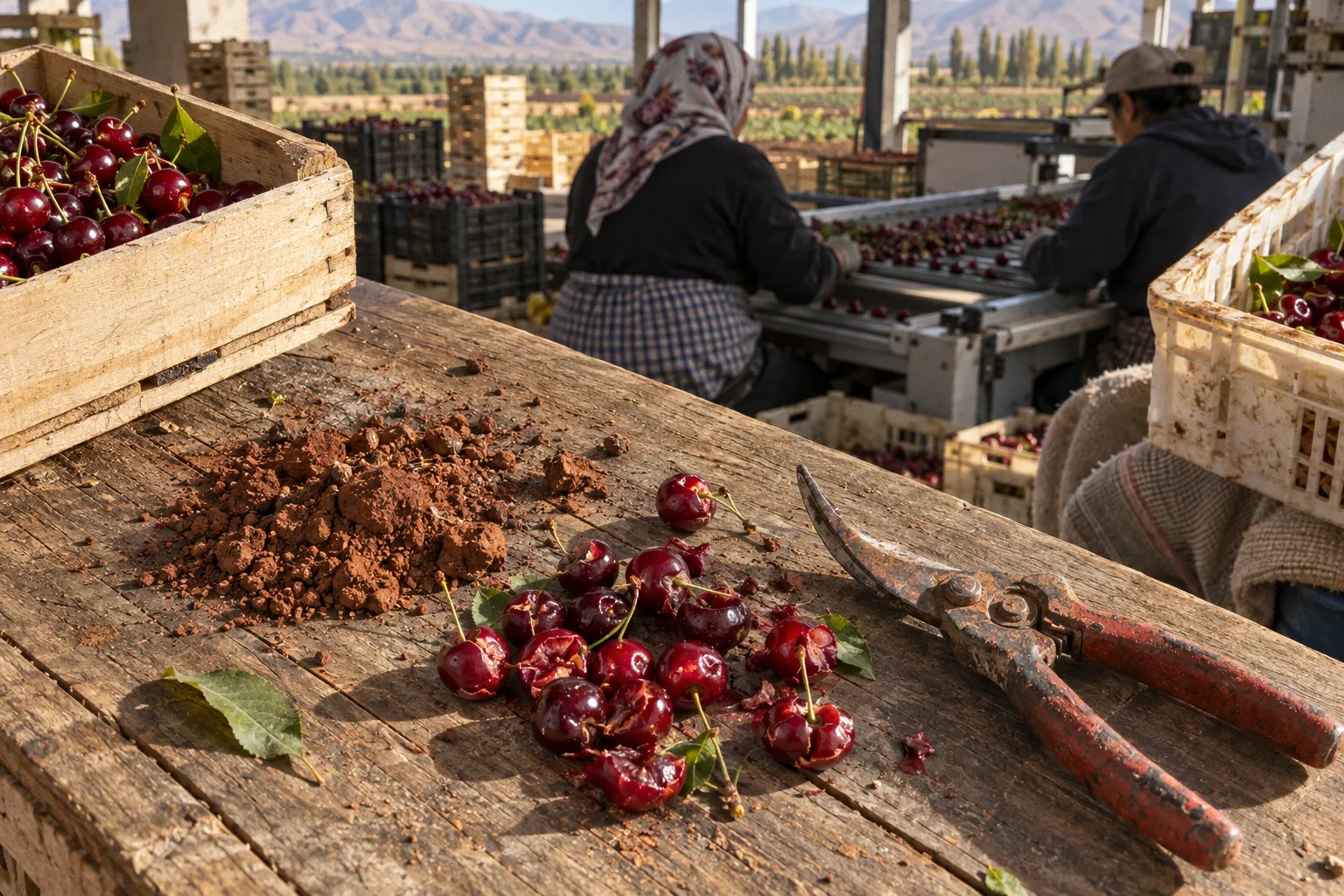
By noon the first drops are tapping against ripening Burlat and Van cherries, and by evening the question on every grower's mind has returned: how much of this harvest will we lose to splitting? For our cooperatives, that question is not abstract. A single unseasonal downpour can crack open a meaningful share of the crop, and once the skin ruptures, the fruit is no longer the glossy, blemish-free cherry our buyers expect. Walk through an orchard the morning after a storm and the evidence is right there at your feet.
This is a problem our growers know intimately, and it is one we can do something about. Cherry fruit splitting is a physiological disorder, not a disease, which means we can manage it through the choices we make across the season — from the way we feed the trees to the covers we install above them. The research from cherry-producing regions around the world converges on a few practical levers, and they translate cleanly to our Lebanese orchards. What follows are three proven pathways our cooperative members are already adapting, with the timing, the logic, and the honest tradeoffs each one involves.
A split cherry is not a spoiled cherry by nature — it is a cherry whose skin could not keep pace with the water rushing in.
The mechanics of skin rupture: why rain triggers splitting
To choose the right protection, we first have to understand what is actually happening on the fruit. Cherry splitting is driven by two water pathways working either alone or together. The first is the obvious one: rainwater lands directly on the fruit, and the cuticle — that waxy outer skin — absorbs free water faster than the flesh beneath can accommodate it. The skin simply cannot stretch quickly enough, and it ruptures. The second pathway is internal. When the soil beneath the tree is saturated, the roots keep pulling moisture upward, and that water moves into the fruit through the vascular system. Either pathway, or both at once, can push a ripe cherry past its elasticity limit.
What matters for our planning is that both pathways peak in the window just before harvest, when sugars are highest and the cuticle has already begun to thin and develop micro-cracks of its own. This is why a moderate rain at straw-color stage behaves differently than the same rain a fortnight earlier. The vulnerability is cumulative, and so is our response. We can slow the water getting in, we can strengthen the cells that have to hold it, and we can physically keep the rain off the fruit. Each approach addresses a different part of the same chain.
| Pathway | Where water enters | When risk peaks | Best defense |
|---|---|---|---|
| External uptake | Through the fruit cuticle | During and just after rainfall at straw-color and beyond | Hydrophobic biofilms and overhead covers |
| Internal uptake | Through roots from saturated soil | When wet soil meets ripening fruit | Deficit irrigation before the rain |
| Cuticle weakness | Throughout the fruit skin | Final weeks before harvest | Pre-harvest calcium sprays |
Strengthening cell walls with pre-harvest calcium treatments
The first lever we can pull is calcium, and we want to begin pulling it well before the rain ever arrives. Calcium is the mineral that holds cell walls together — it sits between the pectin molecules and locks the architecture of the skin in place. A cherry with strong calcium reserves in its skin stretches a little further before it tears. A cherry starved of calcium tears earlier, and the tear is more likely to run deep into the flesh.
Across published trials, pre-harvest calcium treatments have reduced sweet cherry cracking index by roughly 38% to 66% compared with untreated fruit. That is a wide range because application rate, formulation, and timing all matter, but the direction is consistent: more calcium in the skin means fewer splits after the rain. For our growers, this translates into a specific seasonal rhythm.
A practical approach many of our cooperative members follow looks like this:
1. Begin foliar calcium sprays around pit hardening, when the developing fruit is still actively laying down skin tissue.
2. Repeat applications at 10 to 14 day intervals through the straw-color stage, alternating calcium chloride or calcium nitrate formulations to avoid leaf burn.
3. Aim for steady coverage on the fruit itself, not just the foliage — the spray needs to land on what we are trying to protect.
4. Hold the final application about a week before expected harvest to keep residue within market limits.
The work is not glamorous, and it requires the sprayer to be running when there are a hundred other things to do. But the payoff is real, because calcium does something the other two levers cannot: it hardens the cherry from the inside, so that even when water does arrive, the skin holds.
Managing water uptake through deficit irrigation strategies
The second pathway — root-driven uptake from saturated soil — is the one we have most direct control over in many of our orchard layouts, because we already run the irrigation. The idea behind deficit irrigation is to back off the water deliberately in the final weeks before harvest so that the tree is not sitting in a fully charged root zone when the rain comes. Less water in the soil means less water moving up through the vascular system, and less internal pressure on the fruit skin.
Research on deficit irrigation in sweet cherries has shown that managing the orchard at around 70% of crop evapotranspiration during the vulnerable ripening window can lower cracking ratios from roughly 27% down to about 8%. That is not a small adjustment. For a grower selling into fresh markets where a 20% to 25% cracking rate already puts the crop at risk of rejection, moving into the single digits can be the difference between a marketable harvest and a heartbreaking one.
The key is to start the deficit before the rain, not after it. Once a heavy downpour has saturated the profile, the irrigation decision has largely been made for us. So our cooperatives build the deficit schedule around the forecast, not around the calendar. The standard sequence looks roughly like this:
- Through pit hardening: maintain normal irrigation to support fruit sizing.
- From straw-color stage onward: reduce applied water to roughly 70% of crop evapotranspiration, monitoring soil moisture rather than guessing.
- Resume closer to harvest only if trees show clear water stress, since cherries at this stage are still vulnerable to shrivel if pushed too far.
The honest tradeoff is that deficit-managed fruit may size fractionally smaller, and growers need to weigh that against the savings on cracked fruit. In most of our Bekaa and Mount Lebanon orchards, the balance clearly favors the deficit — the fruit that survives intact is worth far more than the grams we lose to modest water stress.
Physical barriers: using orchard covers and hydrophobic biofilms
Sometimes the cleanest answer to rain is to keep the rain off the fruit. That is what orchard covers and hydrophobic biofilms do, and they are the third lever in our toolkit. They are also the most visible intervention, and for cooperative members sharing equipment and infrastructure, visibility has its own value.
Overhead covers and netting. Plastic and net covers installed above the canopy physically intercept rainfall and reduce the volume of free water reaching the fruit surface. Trials have reported reductions in natural cracking index of up to 40% with well-designed protective covers. For Lebanese orchards, the practical question is which system to choose and how to pay for it as a group:
- Full overhead plastic tunnels offer the strongest rain protection and can also extend the harvest window by a few days, but they are a significant capital investment.
- Rain-shielded netting is lighter, less expensive, and easier for our cooperatives to install section by section; it cuts rain intensity without fully blocking sunlight.
- Temporary pull-out covers mounted on simple frames can be deployed only for the highest-risk storms, which spreads the cost across many seasons.
Hydrophobic biofilms. Where covers are not yet feasible, hydrophobic cuticle supplements offer a complementary layer. Applied as a spray at straw-color stage, these organic biofilms create a thin water-repellent coating on the cherry skin, slowing external water uptake and limiting the micro-cracks that would otherwise spread during a rain event. The application window is short — too early and the coating weathers off; too late and we are trying to protect fruit that is already softening. Our growers who use biofilms typically time the spray with the color change and rely on cooperative spray teams to cover all member orchards within a single week.
| Intervention | What it stops | Approximate installation or application window | Best fit |
|---|---|---|---|
| Calcium sprays | Cuticle weakness | Pit hardening through straw-color | Every orchard, every season |
| Deficit irrigation | Root water uptake | Straw-color to pre-harvest | Orchards with controlled irrigation |
| Hydrophobic biofilm | External water uptake | Straw-color stage | Orchards needing short-term protection |
| Net or plastic covers | Direct rainfall | Before ripening season begins | Orchards with cooperative-shared infrastructure |
Economic impact: protecting your harvest from market rejection
The reason all of this matters is the buyer at the end of the chain. Fresh-market buyers and exporters sort to tight tolerances, and cracked cherries are sorted out. Historically, a cracking rate above roughly 20% to 25% has been enough to render a standard cherry crop unmarketable without specialized optical sorting lines — equipment that is not common in our cooperative infrastructure. In a severe rain event near harvest, total yield losses from cracking can climb as high as 90%, which is the kind of number that defines a season for a family orchard.
When we talk about prevention inside the cooperative, we frame it in those terms: what is the cost of a season's calcium program, and what is the cost of losing a third of the harvest? What is the cost of a shared cover system, divided across twenty growers, and what is the cost of watching fruit split on the tree? The arithmetic almost always favors prevention, but the arithmetic also depends on us acting together. No single grower can move cracking rates from 27% down to 8% on their own — but a cooperative running a shared irrigation schedule, a coordinated calcium program, and pooled cover infrastructure can get there across a whole valley.
This is where our model earns its keep. The three levers work best when they are stacked: calcium hardens the skin, deficit irrigation keeps the roots quiet, and a cover or biofilm keeps the rain off in the first place. Each one partially protects the fruit. Together, they cover the pathways the water uses to get in.
Cracking is not solved by any single spray or cover — it is solved by a season of small choices that all point the same direction.
Bringing it together for the season ahead
The honest truth our cooperative members already know is that there is no silver bullet for cherry splitting. Anyone who promises 100% protection under prolonged heavy rainfall is selling something other than orchard science. What we can do, and what the research keeps confirming, is build a layered defense that catches the water before it reaches the fruit, the fruit before it overwhelms the skin, and the skin before it tears open.
For most of our growers, the most accessible starting point is calcium — it is inexpensive, fits into existing spray rounds, and pays back across every rainy season to come. The next step is the deficit irrigation schedule, which costs nothing but attention and a soil moisture probe. Covers and biofilms come next, ideally as shared cooperative infrastructure so that the investment is spread across many harvests rather than borne by one.
We do not need to choose between these approaches. We need to layer them, season after season, until our orchards are sending the kind of crisp, blemish-free cherries our buyers remember us for. The rain will keep coming — it always does in late May and early June — but with a little collective preparation, the sound of it on our covers can stop being something we dread and start being something we have planned for.