Loquat bruising: the single-layer paper fix
Loquat — akideneh in Lebanese orchards and wholesale markets — is one of the most punishingly delicate fruits a cooperative can move from tree to buyer.
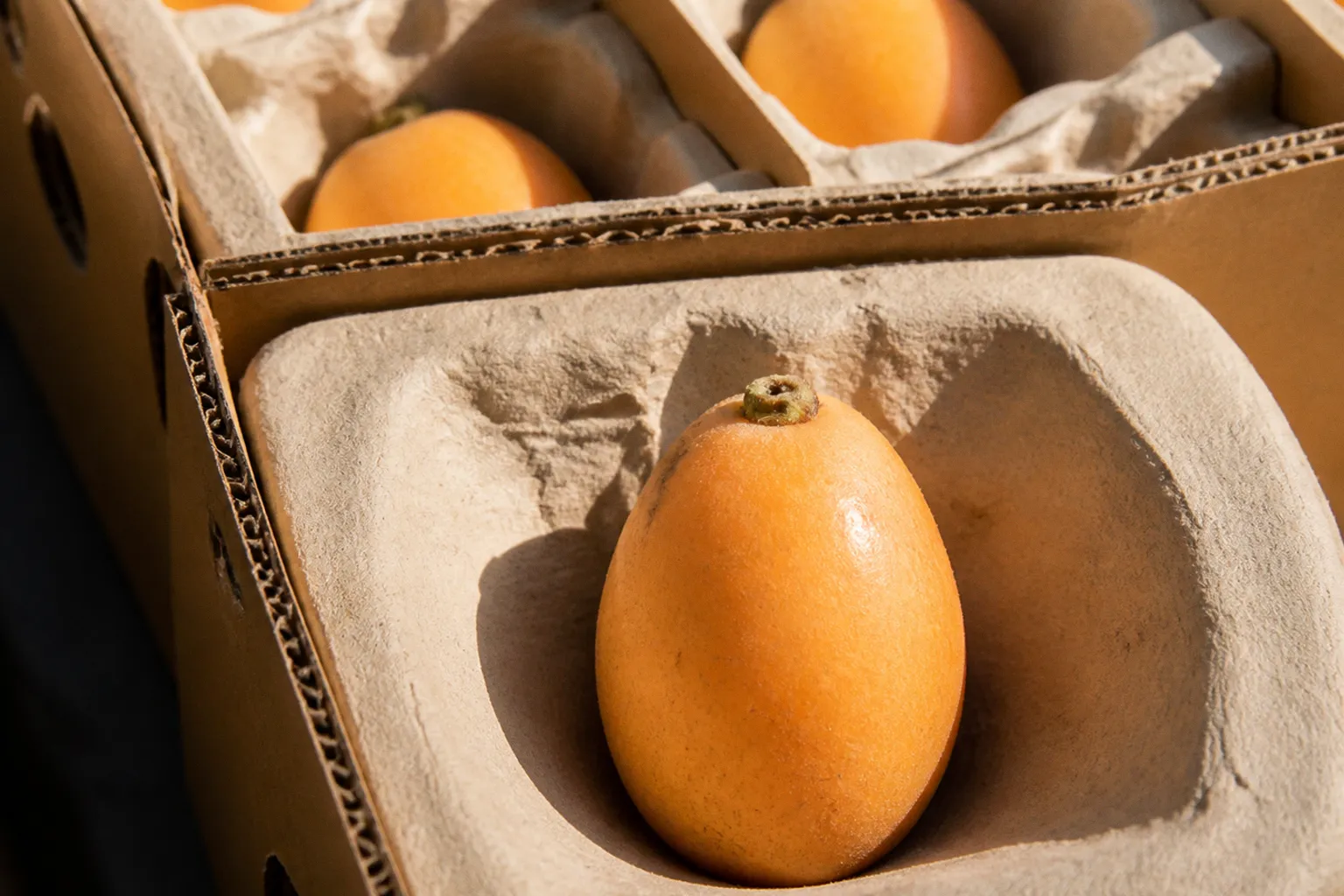
The skin is thin, the flesh gives way easily under pressure, and there is a hard stone at the center that complicates the way any impact travels through the fruit. A loquat that looks flawless leaving the picker's basket can arrive at the packing shed or wholesale market with a brown, sunken bruise that nobody saw form. Once that bruise starts, moisture loss accelerates, opportunistic pathogens find their way in, and the fruit that looked export-worthy yesterday is suddenly only fit for jam. Understanding why this happens — and what packaging actually changes — is a problem worth solving before every harvest season begins.
The mechanics of loquat sensitivity: why thin peels fail
A loquat is built for short, gentle journeys, not for stacking in crates. Botanically it is a non-climacteric subtropical fruit, which means it does not continue to ripen meaningfully after picking. Whatever sugar, color, and firmness it has at harvest is what it carries to market. That is the first vulnerability: there is no buffer period in which a small bruise can heal or soften before the fruit is judged.
The second is physical. The peel is remarkably thin — paper-thin in the literal sense — with a soft, juicy mesocarp directly beneath it. At the center of each fruit sits a comparatively dense kernel, or set of kernels. When a force is applied to the outside of the fruit, the soft tissue compresses easily while the kernel does not. The result is a stress concentration pattern that punches damage inward from the contact point.
Loquat bruises are not a handling problem that happens to the fruit — they are a stress problem that happens inside it, traveling through tissue from contact point to kernel.
Bruise formation is a sequence rather than a single event. Cellular membranes rupture at the impact site. Polyphenol oxidase and other enzymes that normally sit quietly inside healthy cells meet phenolic compounds and oxygen from the surrounding air. The chemistry oxidizes and the damaged tissue turns brown. As the cells lose integrity, water moves out faster than it would from intact tissue, and the surface of the fruit begins to sink slightly — that characteristic flattened, dark patch that growers recognize at a glance. Once the skin barrier is broken in this way, postharvest fungi and bacteria find ready entry points, and decay typically follows within days under common wholesale temperatures.
This is why a bruise is never really just cosmetic. It is the start of a chain of moisture loss and pathogen colonization that the fruit cannot reverse on its own.
Impact dynamics: analyzing stress during transit and handling
Research on loquat collisions tells a precise story. Finite element impact analysis — the kind of modeling used to simulate what happens when a fruit strikes a surface — shows that the maximum contact force, the equivalent stress inside the fruit, and the internal energy generated during a collision against hard surfaces such as steel or wood are significantly higher than the same measurements taken when the fruit strikes a softer material like rubber. The same drop from the same height produces a fundamentally different bruise profile depending on what the fruit lands on.
For Lebanese cooperatives working with mixed fleets — wooden field crates, plastic harvest buckets, steel sorting tables, and rubber or foam lining at packing — this matters because each transition is a fresh opportunity for impact. A fruit that survives picking unscathed can still be bruised when tipped from a bucket onto a hard surface during sorting, or when crates are stacked tightly enough that the fruit layer below is compressed under the weight of the layer above it.
The kernel inside the fruit introduces an additional wrinkle. Because it blocks the transmission of stress from one side to the other, the location and severity of bruising depends heavily on where the impact lands and how the fruit is oriented when it hits. Bruise susceptibility actually increases with collision drop height at first — more energy means more damage — but the relationship is not strictly linear. Past a certain drop height, the bruise pattern changes rather than simply growing worse, because the energy begins to dissipate through different tissue pathways.
The broader scale of the problem is worth sitting with. Across agricultural products globally, more than thirty percent of harvested volume is estimated to incur bruising damage due to collisions during postharvest transportation and handling. That is not a loquat-specific figure — it includes everything from apples to tomatoes — but it underlines why this category of loss deserves serious attention from any cooperative thinking about its export economics. For a high-value, delicate fruit like loquat, the per-kilogram cost of a damaged unit is usually far higher than the per-kilogram cost of preventing the bruise in the first place.
| Contact surface | Relative contact force | Equivalent stress in fruit | Internal energy transmitted |
|---|---|---|---|
| Hard surface (steel, wood) | High | High | High |
| Soft padding (rubber, foam) | Substantially lower | Substantially lower | Substantially lower |
| Single-layer paper wrap around fruit | Reduced friction at contact | Reduced peak stress at impact | Distributed across wrap |
The role of single-layer paper in microenvironment regulation
Paper packaging is often treated as a simple cushion, but in loquat handling it does more than absorb impact. A single layer of paper wrapped around individual fruits — or placed as a separator between fruit layers in a crate — regulates the immediate microenvironment around each fruit. It buffers humidity swings, slows the rate at which water leaves the bruised tissue, and reduces the friction between adjacent fruits as they shift during transport.
That microenvironment work matters because loquat's thin peel makes it highly responsive to ambient conditions. In dry conditions, an unprotected fruit loses water rapidly through its skin; in overly humid conditions, condensation can form on the surface and create exactly the kind of moisture film that pathogens exploit. Paper acts as a low-tech humidity moderator — taking up and releasing small amounts of water vapor — which keeps the conditions immediately around each fruit closer to neutral than the open air in a truck or shed would be.
The friction-reduction role is just as practical. Two loquats rubbing against each other in a crate, even gently, can produce small abrasions and bruises along their points of contact. A paper layer between them converts what would be fruit-on-fruit contact into fruit-on-paper contact, with paper-on-paper sliding far more easily under any lateral movement. The fruit never sees the friction that would otherwise have been transmitted through the peel.
In cooperative packing operations, this is the kind of intervention that tends to pay for itself in reduced sorting time at the destination market. Fewer bruised fruits at arrival means less labor spent trimming or discarding damaged units, and a higher proportion of the crate reaching the buyer in salable condition.
Practical packing strategies for Lebanese akideneh harvests
For a Lebanese cooperative preparing for the akideneh window — typically a late spring to early summer harvest — the move toward single-layer paper protection can begin well before the first fruit comes off the tree. A few practical steps, drawn from the agronomic and postharvest literature, translate the science into field routines:
1. Line the bottom and sides of each harvest crate with a single layer of clean paper before picking begins. This converts the first hard surface the fruit will touch into a soft one.
2. Wrap individual fruits in a single sheet of paper as they are placed into the field crate, particularly for fruit destined for export or longer transport routes. The wrap does not need to be tight; loose is fine, and reduces the time added to each pick.
3. Avoid stacking more than two layers of loquat in any single crate. The weight of upper layers compresses the lower ones, and the kernel-blocked stress pattern means lower-layer fruit can bruise from above even when no individual impact event occurs.
4. Keep field crates out of direct sun between trips. Heat accelerates moisture loss and amplifies any bruise chemistry that has already begun. A shaded holding spot near the orchard, even an improvised one, is worth the small effort.
5. Move harvested fruit from field crates to transport packaging — paper-lined trays, shallow boxes, or ventilated cartons — within a few hours of picking. The longer fruit sits in field containers, the more opportunity there is for cumulative low-level stress to become visible damage.
6. During transport, keep crates from sliding. Strapping, non-slip matting under the stack, or simply packing enough paper between layers to prevent lateral movement all reduce the chance of the entire stack shifting during a brake or turn.
Each of these steps is small in isolation. Together they form a chain that catches the bruising problem at multiple points rather than relying on any single intervention to do all the work.
Preserving shelf life by minimizing postharvest pathogen decay
Bruising and decay are not separate problems — they are phases of the same problem. Every cut, scrape, or compressed patch on a loquat is a future site of moisture loss and pathogen entry. The reason single-layer paper protection translates into longer shelf life is that it interrupts the bruise-decay sequence at its earliest, cheapest stage.
A loquat that arrives at the wholesale market without a single bruise has intact cellular structure throughout its flesh. Its skin barrier is unbroken. Even if postharvest fungi are present in the surrounding air, they have no easy route in. That fruit can typically sit on a shelf for several days at common wholesale temperatures and still meet the visual and firmness standards a buyer expects.
The same fruit, with a single unnoticed bruise, behaves differently. The damaged tissue begins losing water within hours. The browned patch becomes a visible defect. Within a day or two at ambient temperature, depending on humidity, opportunistic pathogens colonize the damaged area. The fruit may still be technically edible, but it has dropped out of the premium grade and into a lower price band — or onto the cull pile entirely.
For cooperatives working toward export markets, the standards are tighter still. International buyers, particularly in Gulf and European wholesale channels, grade heavily on appearance. A crate with even a small proportion of bruised fruit can be downgraded or rejected, and the cost of that decision falls on the cooperative that packed it. Reducing bruising at the source is therefore not just a quality question — it is a market-access question, and a price-realization question, all at once.
A seasonal transition timeline for the akideneh harvest
Adopting single-layer paper protection does not require new infrastructure or large capital outlays. For a cooperative planning the transition, the work can be staged across the months leading into harvest:
- Three to four months before harvest: Audit current packing and transport steps. Identify every hard surface a fruit touches between picker and buyer, and mark the points where bruising is most likely.
- Two months before harvest: Source a consistent paper supply. Food-grade kraft or similar single-layer papers are typically appropriate; what matters is consistency across the season so crew habits do not have to adjust from one shipment to the next.
- One month before harvest: Train the picking and packing crew on the new routine. Hands-on practice with paper wrapping is faster than verbal instruction; one well-run training session pays off across the entire harvest.
- During harvest: Run paper protection on every crate, track arrivals at the destination market, and note the proportion of fruit arriving without visible defects. Compare informally with previous seasons.
- After harvest: Review what worked and what did not. The transition is rarely perfect in year one, and small adjustments — paper placement, crate depth, transport routing — compound over subsequent seasons.
The loquat season is short, and the fruit gives a cooperative very little room for error. A single bruised fruit is a small loss; a crate of bruised fruit is a damaged commercial relationship; a season of bruised fruit is a market position that takes years to rebuild. Paper is not glamorous technology, but it is the most direct answer the agronomic literature currently offers to the physics of loquat damage. Cooperatives that adopt it carefully, and that treat it as one link in a longer chain of careful handling, will see the difference in their crates, in their receipts, and in the reputation their fruit carries into the next season.