Lebanon’s Shrinking Formal Economy and the Burden on Agricultural Cooperatives
The registered membership of the Beirut and Mount Lebanon Chamber of Commerce, Industry and Agriculture has reportedly fallen from roughly 14,000 to 8,000 businesses, according to Libnanews reporting…
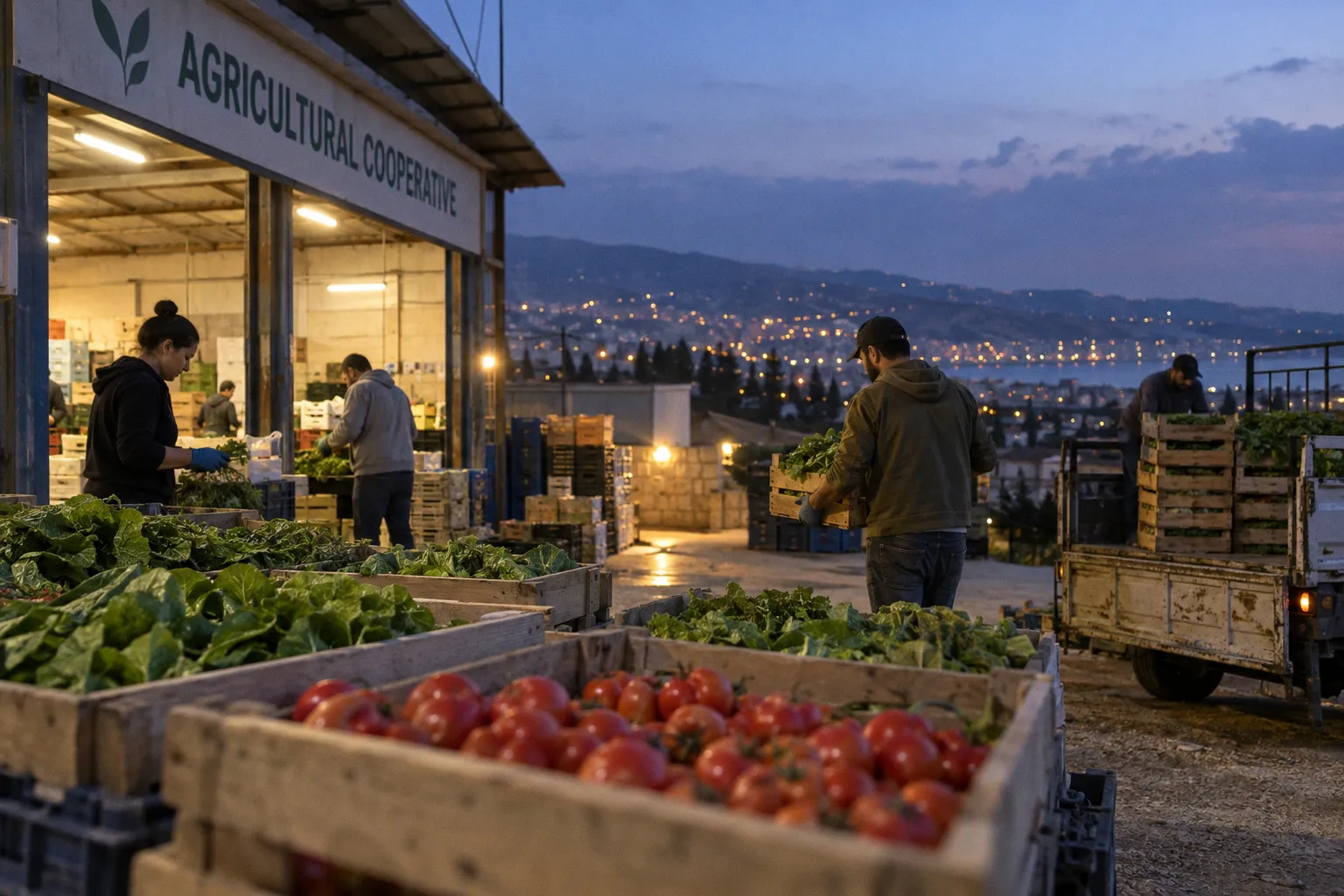
The registered membership of the Beirut and Mount Lebanon Chamber of Commerce, Industry and Agriculture has reportedly fallen from roughly 14,000 to 8,000 businesses, according to Libnanews reporting dated 8 September 2026. For a cooperative trying to ship fresh produce through export channels, the headline is less about the raw count and more about what the drop signals: the organized economy is contracting while informal trade absorbs the space, and the two systems compete on very different terms.
The compliance gap, seen from the field
A registered cooperative carries costs an informal operator does not. Accounts, fees, import paperwork, product-safety and labour compliance — each layer adds friction, and each one is also the reason a buyer abroad will sign a purchase order. As Libnanews notes, registered companies must absorb burdens that competitors working outside official structures can sidestep, which lets those competitors undercut on price. The race is no longer only about quality or yield. It is about how much of the rulebook a supplier is willing to carry.
For a smallholder cooperative weighing whether to formalize a packing line, add traceability, or chase export-grade documentation, the calculation has shifted. The premium an export buyer pays for compliance has to cover the real cost of staying formal — and right now, the formal side is shrinking.
Reading the 14,000-to-8,000 drop carefully
The figure deserves caution before it becomes a talking point. Public material from the same Chamber still references more than 10,000 represented enterprises and continues to process membership renewals. The gap may reflect the difference between registered and active members, a chosen reporting period, or a narrow definition of what counts as a member. Libnanews itself flags this uncertainty. The direction, however, lines up with what has been reported about Lebanon's private sector since 2019: the banking crisis cut access to credit, the pound's collapse reset costs, the pandemic disrupted trade, the port explosion destroyed infrastructure, and successive conflicts added further losses. The pattern is consistent enough that cooperatives should treat the trend, not the exact number, as the working assumption.
What this changes for the next harvest
Here is where the field observation matters. A cooperative that wants to stay in export markets this season needs to treat compliance as a production input, not an administrative afterthought. Three things are worth checking before the next packing window opens:
- Whether buyer contracts still specify the traceability and product-safety documents the buyer actually checks at the port of arrival, and whether those documents are current.
- Whether cooperative overhead is being absorbed by a single product line. Spreading sales across at least two buyer types — wholesale plus retail, or domestic plus export — reduces the leverage any single informal competitor can exert on price.
- Whether the cooperative has a documented cost of formality — fees, audit costs, compliance labour — that can be compared honestly against the export price premium being offered. If the premium does not cover the cost, the informal channel will keep winning.
The deeper signal from the Chamber numbers is structural. When the state operates poorly, the cost of staying formal rises faster than the benefits, and even operators who prefer the formal path find themselves pushed toward the edges. For Lebanese fresh-produce cooperatives whose future depends on export documentation, the practical question is not whether the informal economy exists — it does, and it will — but whether their own cost of compliance stays low enough to keep them inside the formal channel where their buyers are waiting.