Vietnam becomes China’s third biggest fresh produce supplier
According to Fruitnet, Vietnam supplied almost 16% of China’s fresh produce imports in the first half of 2026, reaching US$2.16 billion across fresh produce, flowers and roots.
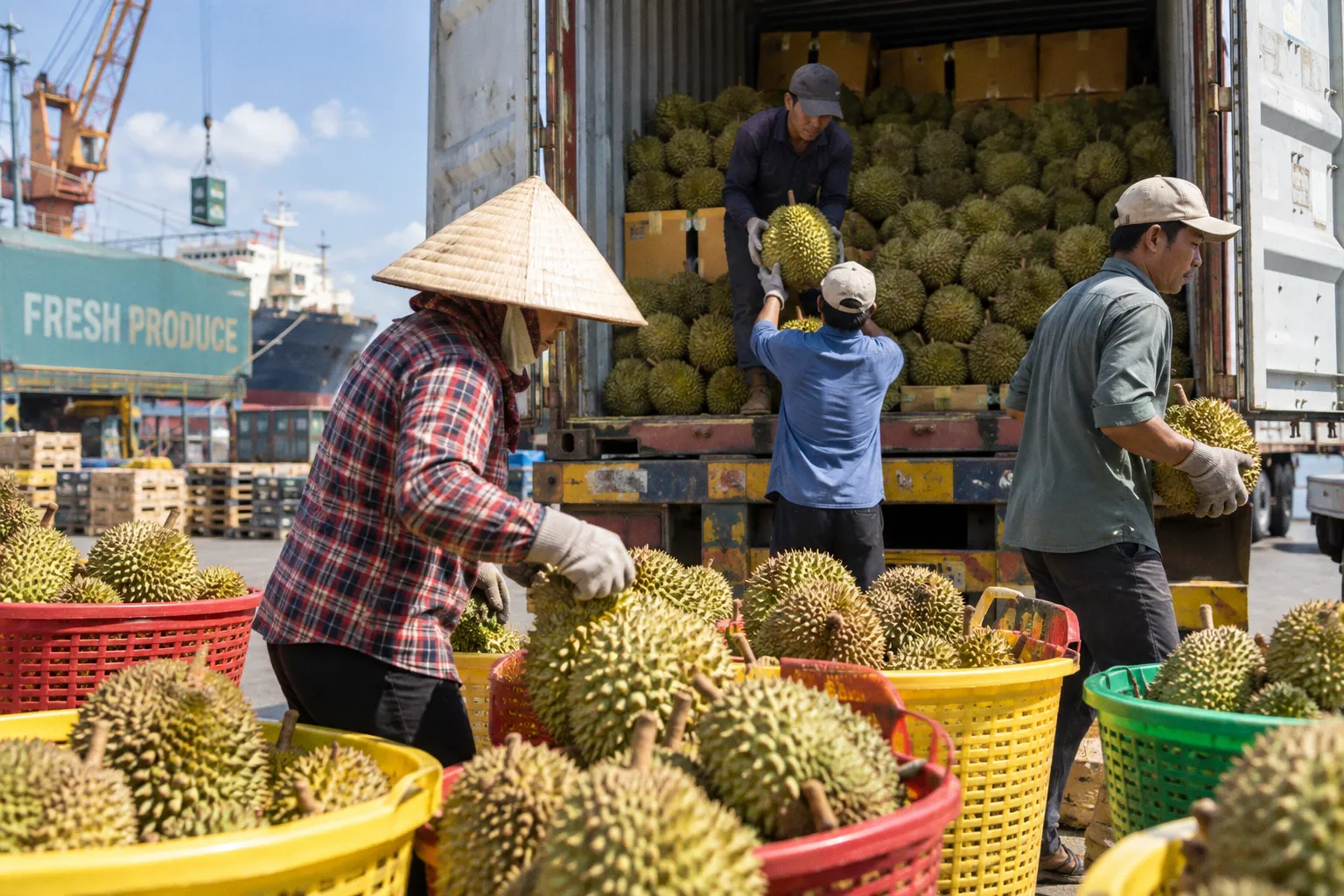
That puts Vietnam in third place among China’s suppliers, behind Thailand and Chile, with durian providing the strongest growth. For Lebanese cooperatives, the lesson is not simply that one country has gained market share: proximity, consistent quality, and disciplined traceability can determine whether a regional supply chain earns room in a demanding market.
The advantage is built between the farm and the border
Vietnam’s imports into China rose 19.3% compared with the same period in 2025, while its share of China’s fresh produce imports increased 13.8% year on year. Thailand held 37% of the market and Chile 17%, leaving Vietnam close behind Chile.
Durian was the largest growth driver. China paid almost US$988 million for Vietnamese fresh and frozen durian during the period, up 43% from the same period in 2025.
The wider point for our growers is that market access is rarely won by the harvest alone. The source reports that Vietnam’s proximity to China helps exporters preserve better quality and keep logistics costs lower than suppliers in other parts of Southeast Asia and South America. That proximity also gives exporters more flexibility when serving second- and third-tier cities and provinces in northern and western China.
Lebanon cannot reproduce Vietnam’s geography, but our cooperatives can work more deliberately around the parts of the equation we can control: harvest timing, sorting, packing, documentation, and the cold chain. A crisp, blemish-free shipment that arrives in a predictable condition is more valuable than a larger shipment whose quality varies from box to box.
Traceability is becoming a shared responsibility
The report also points to expanded access for Vietnamese fruits, while warning that China’s import requirements are becoming stricter. Origin fraud, misuse of growing-area codes, and pest contamination can lead to codes being temporarily suspended or revoked, affecting exports from an entire growing region.
That is a critical cooperative issue. Traceability cannot sit with one farmer, one packing house, or one exporter. If a shipment carries a cooperative identity, every member must understand what that identity requires.
A practical framework is straightforward:
- assign each orchard or plot a clear growing-area code;
- keep harvest records connected to the packed lot;
- separate produce by grower, variety, grade, and harvest date;
- check labels and documents before the truck leaves the facility;
- record cleaning, inspection, and pest-control steps in one shared system.
The value is not in creating paperwork for its own sake. It is in making a shipment explainable from field to buyer. When a market asks where a box came from, our cooperative should be able to answer quickly, consistently, and without relying on memory.
What Lebanese cooperatives should watch next
Vietnam’s progress offers a useful benchmark for Lebanese export groups considering Asian markets or other destinations with strict import controls. The immediate question is not whether we can compete with Vietnam on volume. It is whether we can present our produce as a reliable collective offer, with the same grade, the same documentation standard, and the same care in every shipment.
Cooperatives can begin by choosing one export product and mapping its full journey: orchard, harvest crew, collection point, packing line, transport, and buyer. The exercise will reveal where quality is lost, where records become unclear, and where responsibilities overlap.
The strongest export pipeline is built collectively. Our growers do not need to solve every market challenge at once, but they do need a shared standard that holds from the first crate to the final delivery. Vietnam’s rise in China shows how quickly a disciplined regional supply chain can become a serious supplier. For Lebanon, that is an encouraging reminder that consistency itself can be an export asset.