Lebanese produce transit to the Gulf: a five-stage project
For Lebanese growers, the reopening of the land route to Gulf markets is more than a border announcement.
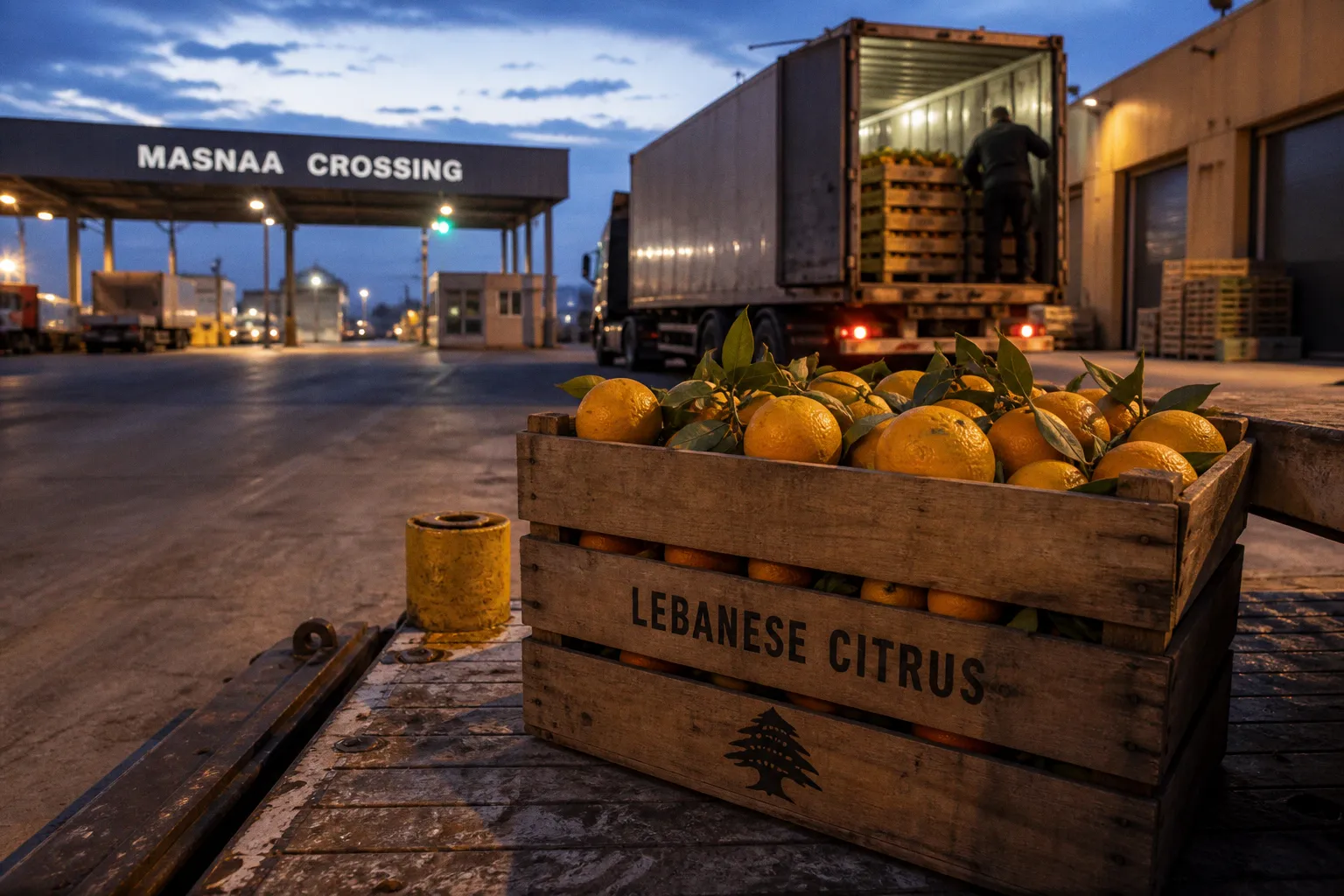
It is a chance to rebuild a working rhythm that once carried crisp apples, pomegranates, potatoes, cherries, and other fresh produce from our fields toward Saudi Arabia and the wider GCC.
Saudi Arabia officially lifted its five-year ban on Lebanese agricultural imports in June 2026. On August 20, Lebanese and Saudi officials marked the resumption of land trade at the Masnaa Border Crossing, following the installation of an advanced inspection scanner secured in partnership with CMA CGM. The reopening restores a route that had been closed since April 2021, when Saudi customs seized more than 5.3 million Captagon pills concealed in a pomegranate shipment.
The opportunity is significant, but it will not be secured by reopening the road alone. Our growers, cooperatives, exporters, drivers, packhouses, inspection services, and Gulf buyers now have to make the full chain dependable again. A shipment must leave the farm with the right quality, arrive within its shelf-life, pass inspection cleanly, and reach the buyer in a condition that justifies ordering from Lebanon again.
That is the real project: not simply moving produce across a border, but coordinating five connected stages from harvest to Gulf distribution.
The Masnaa reopening restores a critical land bridge
Before the 2021 suspension, Saudi Arabia imported approximately 60,000 tons of Lebanese agricultural produce each year. That represented more than 22% of Lebanon’s total agricultural exports. Across the GCC, Lebanese agricultural exports reached roughly 200,000 tons annually before the ban.
These figures explain why the land route matters so much to farming communities in the Bekaa and elsewhere. The Gulf is not a distant, abstract market for our producers. It has long been part of the commercial geography of Lebanese agriculture, particularly for growers whose harvests are too perishable, too seasonal, or too expensive to move efficiently by sea.
The Masnaa crossing is especially important because it connects Lebanon’s agricultural heartland to Syria and then onward toward regional Arab markets. According to the Chamber of Commerce, Industry and Agriculture in Zahle and the Bekaa, around 35% of all Lebanese land exports pass through Masnaa.
The route is not frictionless. Trucks still depend on transit procedures, border capacity, security conditions, and the reliability of onward corridors. The reopening of Masnaa does not mean every crossing is ready for the same traffic, and it should not be treated as a guarantee that all land routes will operate identically. In particular, procedures for reopening the Abboudieh crossing in northern Lebanon remained pending as of August 2026.
Still, Masnaa gives our cooperatives something they have been missing: a practical overland option for reaching Gulf buyers within a time frame that fresh produce can tolerate.
A reopened road creates opportunity; a coordinated cold chain turns that opportunity into a reputation.
The difference between those two outcomes will be visible in every crate. A shipment that arrives crisp, clean, and correctly documented helps restore confidence. A shipment delayed at a border or packed without consistent grading can make buyers hesitate before the next order.
Why overland transit changes the calculation
For fresh produce, time is not a small operating detail. It is part of the product.
Overland transit from Lebanon to Gulf markets takes approximately five to six days. Maritime container transport from the Port of Beirut can take between 14 and 25 days, depending on the route and security disruptions. That difference affects firmness, appearance, shrinkage, and the number of days a buyer has left to sell the produce after arrival.
The cost comparison is also meaningful. The estimated freight cost for moving produce overland between Lebanon and the Gulf is approximately $3,000 per shipment, compared with about $7,000 for maritime container shipping. These figures do not eliminate the need to compare routes carefully: transit fees, border handling, insurance, fuel, security conditions, and the size of the shipment can all change the final calculation. But they show why the land bridge is attractive for products that depend on speed.
| Transport option | Approximate transit time | Estimated freight cost | Best operational advantage |
|---|---|---|---|
| Overland truck transit | 5–6 days | About $3,000 per shipment | Faster delivery for time-sensitive fresh produce |
| Maritime container transport from Beirut | 14–25 days | About $7,000 per shipment | Useful when sea freight, container availability, or route planning is more suitable |
| Air freight | Not established in the available figures | Not established | Reserved for products where exceptional speed can justify the cost |
Land transit should not completely replace maritime or air shipping. A cooperative with a stable sea program, a buyer planning well ahead, or a product with longer storage tolerance may still find refrigerated container shipping from Beirut to the Gulf appropriate. Likewise, the land route can be affected by security disruptions and variable border infrastructure.
The stronger approach is a mixed logistics plan. We use the land route where speed and cost offer a clear advantage, while keeping maritime capacity available for larger, less time-sensitive, or more predictable consignments.
That flexibility is particularly valuable for cooperatives. One grower may have a crisp early-season apple crop ready for a short transit window, while another has a larger volume that requires careful container planning. A cooperative can combine these needs instead of forcing every producer into one route.
The five stages of a reliable export pipeline
The five stages below are an operational roadmap for organizing Lebanese agricultural exports transit stages. They are not presented as a formally titled government project. They are the practical sequence our farming groups can use to connect field decisions with border and buyer requirements.
1. Harvest and pack to a shared market specification
The first stage begins before the truck is booked. It begins with agreement on what the buyer will receive.
A cooperative may have excellent fruit and still lose value if one grower sends large apples, another sends mixed sizes, and a third uses packaging that does not protect the produce during loading. Gulf buyers are not purchasing the story of a good harvest; they are purchasing a consistent commercial product.
For each crop and destination, the cooperative should establish a shared specification covering:
- size ranges and grading categories;
- acceptable color, firmness, and maturity;
- tolerance for blemishes, bruising, cracks, and decay;
- carton or crate dimensions;
- net weight and pallet configuration;
- labeling and traceability information;
- temperature expectations from packing through loading.
This does not mean every farm must produce an identical harvest. It means the cooperative needs a clear sorting system that directs different grades to the right buyers. Blemish-free premium fruit should not be mixed with sound but lower-grade produce, and a crate intended for a wholesale market should not be packed as if it were going directly to a retail shelf.
Shared grading is one of the most practical forms of cooperation because it protects both the grower and the buyer. The grower receives a fairer result for quality, while the exporter can describe the shipment accurately instead of apologizing for variation after arrival.
2. Consolidate volumes without losing traceability
A single farm may not produce enough volume to fill a regular truck or meet a Gulf buyer’s purchasing schedule. That is where collective effort becomes commercially useful.
Cooperatives can consolidate produce from several growers, but consolidation must not become a blur. Each incoming lot should remain identifiable through the packing process. Records should connect the produce to the grower, harvest period, crop, grade, and packing location.
The aim is not to create complicated paperwork for its own sake. Traceability gives the cooperative a way to answer straightforward questions quickly:
- Which growers contributed to this truck?
- When was each lot harvested?
- Which packhouse handled it?
- How was it graded?
- Which cartons belong to which lot?
- Where should a quality issue be investigated if one appears after delivery?
A shared collection schedule also protects freshness. If produce sits at different farms waiting for an irregular pickup, the cooperative has already used part of its quality window before the truck even begins its journey. Collection points, loading times, and packhouse capacity should be planned around the crop’s condition rather than around convenience alone.
For smaller cooperatives, this may begin with a simple shared dispatch calendar and standardized lot records. The system can grow more sophisticated over time, but the principle remains the same: pooled volume should strengthen accountability, not dilute it.
3. Protect the cold chain from the field to the truck
A refrigerated vehicle cannot repair poor handling before loading. Cooling and temperature control must be treated as a continuous chain, not as a single piece of equipment hired at the last moment.
The cooperative’s practical questions are familiar:
- Is the produce shaded immediately after harvest?
- Does it reach the packhouse without unnecessary waiting?
- Is the product cooled before loading when the crop requires it?
- Are pallets arranged so air can circulate?
- Is the truck pre-cooled and suitable for the cargo?
- Can the cooperative document loading time and dispatch condition?
The exact temperature depends on the crop, the packaging, the maturity, and the buyer’s specification. Apples, pomegranates, potatoes, cherries, and leafy produce do not share one universal handling profile. The operational mistake is to speak of “the cold chain” as though one temperature setting solves every product problem.
What we need is disciplined handover. The farm hands produce to the collection team. The collection team hands it to the packhouse. The packhouse hands it to the carrier. At each point, responsibility for condition should be understood and recorded.
This is also where packaging earns its place. A sturdy carton, a correctly secured pallet, and enough ventilation can protect yield far more effectively than last-minute negotiation over a lower freight rate. Produce should be packed for the actual journey, including loading, border handling, and unloading—not only for the moment it leaves the orchard.
Documentation and border clearance must be designed together
The fourth and fifth stages are often discussed as if they begin at the border. In practice, the work starts much earlier, when the shipment is assembled and its documents are prepared.
Agricultural exports require coordination among the exporter, cooperative, carrier, customs representatives, and the relevant inspection authorities. A document error can hold an entire truck even when the produce itself is crisp and correctly packed. That is why shipment preparation should include a document review before loading, not after the vehicle is already waiting at Masnaa.
The cooperative’s export file should be organized around the actual consignment and should match the physical shipment. Product descriptions, quantities, packaging, origin information, and lot records must be consistent across the documents used by the parties handling the cargo. Phytosanitary and other required certificates should be prepared through the appropriate authorities, with the exporter confirming the requirements for the destination and commodity before dispatch.
This is not an area for assumptions. Requirements can differ by product and destination, and a route that passes through more than one country introduces additional transit considerations. Our exporters need a named person responsible for the file, rather than a general expectation that someone will notice a missing document.
4. Inspection and secure border handling
The installation of an advanced inspection scanner at Masnaa is a significant part of the reopened trade framework. The equipment, secured in partnership with CMA CGM, is intended to strengthen inspection capacity at the crossing.
For legitimate agricultural exporters, stronger inspection is not an obstacle to work around. It is part of rebuilding trust in the route. The seizure that led to the 2021 ban showed how a concealed shipment can damage an entire country’s producers, including growers and cooperatives with no connection to the wrongdoing.
The new environment requires clean cargo integrity. Loads should be assembled through controlled procedures, sealed appropriately, and matched to their documentation. Any change in the shipment after loading should be recorded and communicated through the responsible logistics chain.
The operational goal is simple: make the cargo easy to understand and easy to verify. A well-organized shipment gives inspectors a clear physical and documentary picture. A mixed, poorly labeled, or unexplained load creates delay and suspicion even when the underlying produce is sound.
Border technology cannot replace cooperative discipline. Scanners, seals, documentation, and inspection staff work best when the cargo arriving at the crossing has already been prepared with care.
5. Coordinate onward delivery in the Gulf
Passing Masnaa is not the end of the journey. It is the point at which one logistics team hands responsibility to another.
Before the truck departs Lebanon, the exporter and Gulf buyer should have agreed on the receiving location, delivery window, contact person, unloading conditions, and procedures for reporting damage or quality concerns. The produce may pass through several hands after the border, and every additional handover can affect timing and condition.
For cooperatives, a reliable buyer relationship is built through visibility. The buyer should know when the load has been packed, when it leaves, and when it reaches the next stage of transit. If a delay occurs, early communication gives the buyer a chance to adjust labor, storage, or sales plans.
This matters especially when rebuilding a market after five years of interruption. Buyers will not judge only the first truck. They will watch whether the next shipment follows the same grade, timing, and documentation standard. Consistency is what turns a reopened trade corridor into a dependable commercial route.
The first successful truck reopens a conversation. Repeated, predictable trucks rebuild the market.
How cooperatives can divide responsibility
The most resilient export groups are not those where one person tries to manage every task. They are the ones that assign responsibilities clearly while keeping the whole chain visible to everyone involved.
A cooperative can create a small export coordination group with responsibility for:
1. Crop planning and volume aggregation.
Growers share expected harvest windows, estimated quantities, and likely grades early enough to plan trucks and buyers.
2. Quality and packing standards.
One trained team or supervisor checks whether produce meets the agreed specification before it enters the export lot.
3. Cold-chain coordination.
The group confirms collection times, packhouse readiness, pre-cooling arrangements, vehicle suitability, and loading records.
4. Documentation and compliance.
A named coordinator maintains the shipment file and checks that physical cargo, certificates, labels, and declared quantities correspond.
5. Carrier and border communication.
The logistics contact tracks dispatch, transit updates, inspection status, and any change that could affect delivery.
6. Buyer feedback and corrective action.
Quality complaints are recorded by lot, not treated as a personal dispute between a grower and a buyer. The cooperative looks for the point where the process can improve.
This structure can be modest. It does not require every cooperative to purchase expensive software or create a large administration department. A shared spreadsheet, numbered lots, printed loading records, and a single communications channel may be enough to begin. The essential investment is not the tool; it is the agreement to use the same system.
Our growers also need a fair way to distribute shared costs. Border handling, packaging improvements, cold storage, inspection preparation, and coordinated transport all carry expenses. If those costs are hidden, the cooperative may appear profitable while quietly exhausting the people doing the work. A transparent contribution model helps members understand what the collective service costs and what value it creates.
Land, sea, and the value of keeping options open
The renewed Lebanon Gulf trade routes should be approached as a portfolio rather than a single bet.
Overland transport offers speed and, according to the available estimates, a lower freight cost than maritime shipping. It is naturally attractive for produce with a short commercial life or for buyers who need replenishment quickly. But security disruptions, transit arrangements, and border capacity can change the route’s reliability.
Maritime transport from Beirut remains relevant for larger programs and products that can tolerate a longer journey when correctly handled. The 14-to-25-day range makes planning, pre-cooling, packaging, and buyer timing especially important. A sea shipment that arrives late in its sales window may be technically delivered but commercially weakened.
Air freight may serve limited, high-value consignments where speed outweighs cost, although the available figures do not establish a general cost or transit comparison. It should be considered product by product rather than assumed to be a broad solution for Lebanese agricultural exports.
For our cooperatives, route choice should follow the product and the buyer:
- Short shelf-life or highly time-sensitive produce may benefit most from the land route when the corridor is operating reliably.
- Larger, planned consignments may remain suitable for refrigerated containers from Beirut to the Gulf.
- Premium or urgent small lots may justify a faster but more expensive transport method.
- Mixed seasonal programs may need more than one route over the course of the year.
The strongest exporters will be able to shift between these options without changing their quality discipline. The cold chain, lot records, grading, and documentation should remain consistent even when the vehicle or route changes.
The revenue opportunity depends on execution
Projections for renewed GCC market activity place potential export revenue between $500 million and $1.5 billion. That range signals ambition, but it is not a result that appears simply because a border has reopened.
Revenue will depend on whether Lebanese suppliers can restore buyer confidence, meet volume commitments, maintain quality across successive shipments, and respond to inspection requirements without creating unpredictable delays. It will also depend on how many growers can participate in a way that rewards quality rather than forcing everyone into the lowest common grade.
The Gulf market will not be rebuilt by one exporter alone. It will be rebuilt through many visible acts of reliability:
- the apple lot that matches its declared size;
- the pomegranate shipment whose seals and documents correspond;
- the refrigerated truck loaded on schedule;
- the cooperative that responds quickly when a buyer reports bruising;
- the carrier that communicates a delay before it becomes a missed delivery;
- the packhouse that treats every grower’s harvest as part of a shared reputation.
This is why cooperative development belongs at the center of the logistics conversation. Infrastructure opens a route, but collective behavior determines whether buyers continue using it.
A practical starting point for Lebanese farming groups
A cooperative preparing for renewed Gulf exports does not need to solve every challenge in one season. It can begin with one crop, one buyer, and one clearly managed truck, then improve the process with each dispatch.
The first working cycle should establish a shared product specification, a harvest and collection calendar, a lot-numbering method, a loading record, and a named logistics coordinator. After delivery, the group should review what happened: where time was lost, which cartons held well, whether grades matched the buyer’s expectations, and which documents or handovers caused confusion.
That review is not a formality. It is how practical knowledge becomes collective knowledge. When one grower discovers that a certain packing method preserves firmness better, the lesson should belong to the cooperative, not remain isolated on one farm. When one exporter finds a clearer way to organize shipment records, it should become part of the next group dispatch.
The reopening of Masnaa gives Lebanon’s agricultural communities a route back to markets that once absorbed substantial volumes of our produce. But the most important work now happens between the orchard and the border, and again between the border and the buyer.
If we organize those handovers with care, the land bridge can carry more than cargo. It can carry a renewed standard for Lebanese agricultural exports: crisp produce, predictable delivery, secure inspection, and a cooperative effort strong enough to make Gulf buyers return season after season.