Lebanese Gulf exports: the shift from land to sea transit
For our growers, the hardest part of exporting to the Gulf has never been simply finding a buyer.
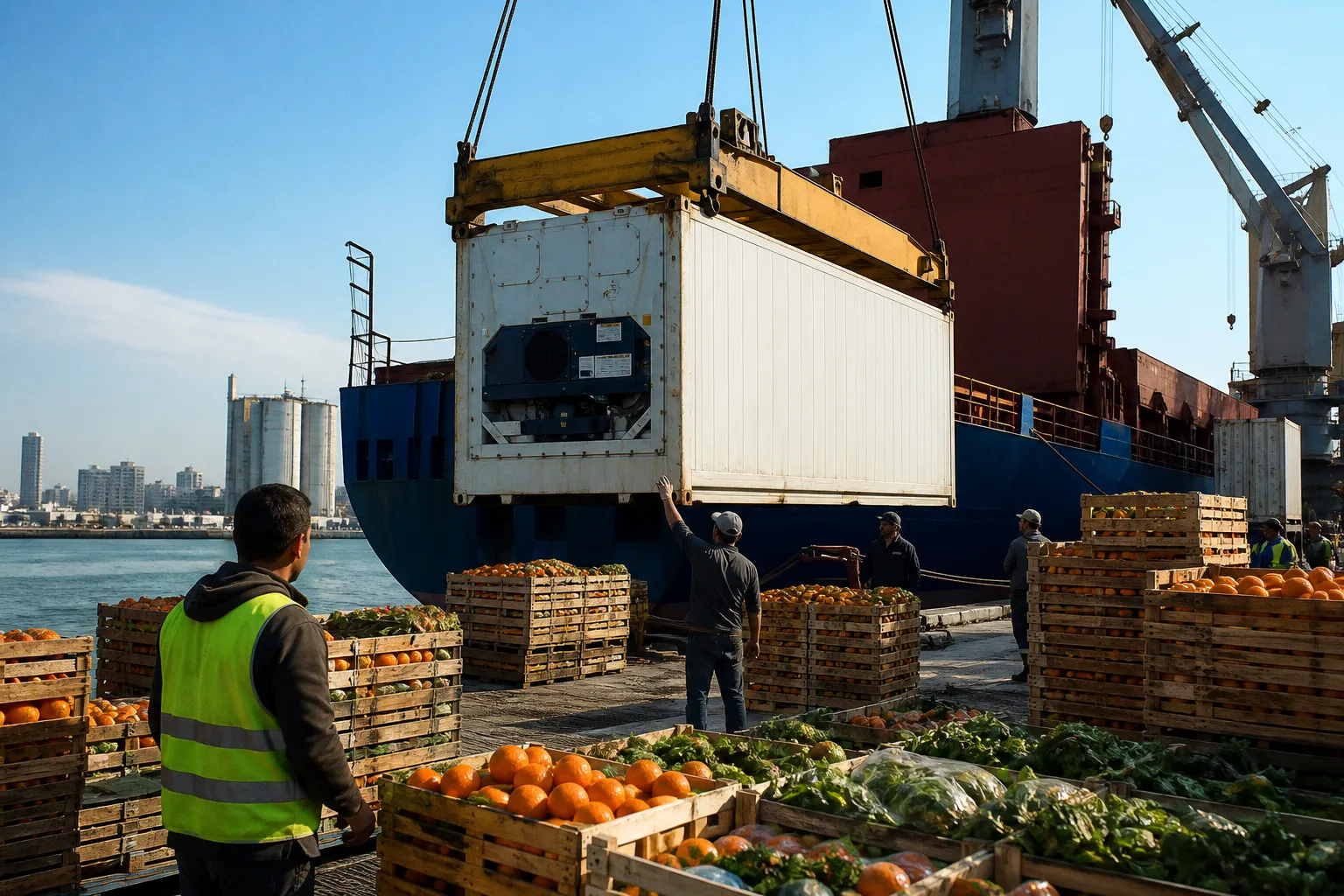
It is making sure that a crisp apple, a blemish-free pomegranate, or a crate of table grapes reaches that buyer with the same quality it had when it left the orchard. After Saudi Arabia banned Lebanese fruits and vegetables in April 2021, that challenge became much more expensive: the familiar overland route through Syria was replaced, in many cases, by maritime shipping from Beirut.
The change was not a minor adjustment in the transport plan. It altered the economics, timing, documentation, cold-chain requirements, and risk calculations behind Lebanon’s Gulf agricultural trade routes. Saudi Arabia lifted the import ban in June 2026, but the old route has not simply reappeared at full strength. Border equipment failures, tighter compliance expectations, and the practical need to rebuild confidence still shape how our cooperatives choose between land, sea, and air.
For Lebanese agricultural groups, the question is no longer whether one route is universally better. The useful question is more grounded: which route protects the crop, the cooperative’s margin, and the buyer relationship for this particular shipment?
The route that disappeared—and why it mattered
Before the 2021 ban, Saudi Arabia received roughly 60,000 tons of Lebanese agricultural produce each year. That represented more than 22% of Lebanon’s total agricultural exports, making the Saudi market a central destination rather than one option among many.
The overland route had a practical advantage that fresh produce exporters understand immediately. A truck could move from Lebanon toward the Gulf in roughly six days, with fewer handovers than a container moving through a maritime schedule. That shorter journey gave growers more room to work with delicate products, especially produce that loses firmness, color, or shelf appeal when temperatures fluctuate.
In April 2021, Saudi customs authorities seized more than 5.3 million Captagon pills concealed in a pomegranate shipment. Saudi Arabia responded by banning imports of Lebanese fruits and vegetables. In October of the same year, the ban expanded to cover all Lebanese imports.
The consequences reached well beyond the shipments directly stopped at the border. Agricultural exporters lost a major market, and the wider export system lost volume. Overall agricultural exports fell from approximately 550,000 tons to 200,000 tons after the 2021 ban, according to the available industry reporting. For cooperatives, that kind of contraction affects everything at once: harvesting decisions, packing-house utilization, transport contracts, seasonal labor, and the confidence to plant for export quality in the first place.
The old land route had also been built around relationships and routines. Growers knew when to harvest for a six-day journey. Transporters knew the border sequence. Buyers understood the expected arrival window. Once the route closed, our supply chain had to replace not just a road, but an entire working rhythm.
Why sea freight became the fallback
Maritime shipping from Beirut offered access to the Gulf when land transit was no longer available. But it came with a cost that could not be hidden inside optimistic planning.
A container that cost approximately $3,000 to move by land could cost around $7,000 by sea. Transit time also extended from roughly six days to at least 14 days. Those two differences are decisive for fresh produce. A higher freight bill reduces the value left for the grower, while an additional week in transit increases exposure to dehydration, bruising, decay, and temperature abuse.
| Factor | Overland transit | Maritime shipping |
|---|---|---|
| Approximate container cost to the Gulf | $3,000 | $7,000 |
| Typical transit duration in the available comparison | About 6 days | At least 14 days |
| Main operational advantage | Faster delivery and shorter exposure to handling | Access to Gulf markets when land routes are restricted |
| Main pressure point | Border crossings, security checks, and road disruptions | Higher freight cost, longer transit, and port scheduling |
| Best fit | Firm produce with a predictable border route and confirmed clearance | Planned shipments that can tolerate a longer journey and stronger packaging |
| Cold-chain demand | Continuous temperature control across road legs | Continuous temperature control across inland, port, vessel, and destination legs |
This is why the move to sea cannot be described as a simple modernization of Lebanese produce shipping. It was a forced adaptation. Sea freight preserved a channel to the Gulf, but it transferred pressure from border transit to port operations, vessel schedules, container availability, and longer cold-chain exposure.
For a cooperative, the difference appears in the packing room. Sea-bound produce needs more disciplined grading and packing because the journey leaves less margin for inconsistency. A mixed-size load, a weak carton, or a pallet with poor airflow may survive a shorter trip and fail during a two-week maritime movement.
Sea freight did not replace the land route on equal terms; it kept the market reachable while asking every part of the supply chain to become more precise.
What the sea route asks from our cooperatives
A cooperative cannot treat a maritime export as a truck shipment placed inside a container. The commercial unit may still be a crate of fruit, but the operating system is different.
Harvest timing becomes a logistics decision
The harvest window must be connected to the vessel schedule, not only to field maturity. Produce picked too early may arrive with weak flavor or poor color. Produce picked too late may lose firmness before it reaches the buyer. The cooperative needs a shared calendar that connects orchard readiness, packing capacity, container booking, port cut-off times, and the buyer’s receiving schedule.
That coordination is especially valuable when several small growers contribute to one export lot. One farm may have crisp fruit ready on Monday, while another reaches the same grade later in the week. Without a common standard, the shipment becomes a collection of slightly different decisions rather than one reliable product.
Our growers do not need every farm to behave identically. They do need the collective lot to meet the same commercial promise.
Grading must be visible and repeatable
For Gulf buyers, grading is not decoration. Size, color, firmness, surface condition, maturity, and packaging consistency all influence whether the shipment can be sold at the expected value.
A cooperative should define its export grade in language that can be used at the receiving line:
- the acceptable size range for each product and destination;
- the maximum tolerance for blemishes, bruising, cracking, or decay;
- the maturity stage required for a longer sea journey;
- the carton or crate format, including ventilation and stacking limits;
- the temperature range and pre-cooling requirement before loading;
- the procedure for separating export-grade produce from local-market or processing grades.
The purpose is not to make the standard unnecessarily severe. It is to prevent disagreement after loading, when the produce is already at sea and the cooperative has few ways to correct a problem.
Packaging has to carry the journey
A container protects produce from weather, but it does not compensate for weak packaging. Cartons must withstand stacking and handling, while ventilation must support the chosen temperature regime. Pallets should be stable and loaded so that air can move through the cargo rather than circulate only around its exterior.
The right package depends on the crop. Pomegranates, apples, grapes, leafy produce, and stone fruit do not have the same tolerance for compression or extended storage. A cooperative that uses one packaging format for every product is usually saving time in the packing house and spending it later through waste, claims, or reduced saleability.
Before committing a product to sea freight, the group should compare the value of a stronger carton, better internal protection, or improved pallet configuration with the cost of rejected or downgraded produce. That is a practical calculation, not an academic one. If the additional packaging cost protects a full container from quality loss, it may be the least expensive part of the journey.
The cold chain is a chain, not a refrigerated box
The phrase cold chain can sound complete once a reefer container has been booked. In practice, the chain is only as strong as its warmest and most delayed link.
For Lebanese produce shipping by sea, temperature management may include:
1. Field-to-packing movement. Harvested produce should not sit exposed for long periods before grading, particularly during warm weather. Shade, rapid transfer, and sensible scheduling reduce the first quality loss.
2. Pre-cooling. Produce should enter the export container at the temperature appropriate to the crop and its maturity. A refrigerated container is designed to maintain conditions; it is not a substitute for removing field heat.
3. Packing-house control. Workers need a clear loading sequence so that warm pallets do not wait beside already cooled cargo. The cooperative should know which lots were cooled, when they were cooled, and whether any lot fell outside the agreed range.
4. Port handling. The period between truck arrival, customs processing, inspection, and vessel loading must be planned. Delays at Beirut Port can turn a sound temperature plan into an exposed one if the cargo is left in the wrong location or disconnected from power.
5. Vessel and destination management. A reefer shipment still depends on the carrier’s equipment, the vessel schedule, the discharge port, and the importer’s ability to collect it promptly. The final leg to the buyer’s warehouse is part of the same quality promise.
This is where smaller cooperatives can gain strength through collective effort. One group may not fill a specialized cooling facility on its own, but several neighboring cooperatives can coordinate pre-cooling windows, share a packing-house protocol, or negotiate service terms around predictable weekly volumes.
Cold chain logistics in Lebanon is therefore not only a technical matter. It is an organizational one. The best equipment cannot rescue a cooperative that has not agreed who records temperatures, who authorizes loading, who receives an alert, and who speaks to the buyer when a schedule changes.
Compliance is now part of the product
The lifting of Saudi Arabia’s ban in June 2026 reopened a significant market, but it did not erase the compliance burden created by the earlier crisis. The first post-ban shipments had to move through a more cautious environment, with closer attention to traceability, phytosanitary requirements, and shipment verification.
For food and agricultural exports from Lebanon to the Gulf, the core documentation includes:
- a commercial invoice;
- a packing list;
- a certificate of origin issued by the Lebanese Chamber of Commerce;
- an export declaration;
- a phytosanitary certificate from the Ministry of Agriculture.
These papers should not be assembled as a last-minute administrative bundle. Each document needs to describe the same shipment: the exporter, consignee, product, quantities, packaging, origin, and transport details. A mismatch that looks small in the office can create a delay at the port or border, and fresh produce does not wait politely while paperwork is corrected.
Traceability also needs to exist behind the documents. A cooperative should be able to connect a pallet to its member farms, harvest date, packing date, grade, treatment history where applicable, and loading record. This does not require every grower to operate like a multinational exporter. It requires a shared recordkeeping habit and one person or team responsible for keeping the system coherent.
The return of overland trade has made this even more visible. In July 2026, exports faced delays at the Masnaa border crossing after a cargo scanner malfunctioned. The estimated repair cost was $150,000, and the exact timeline for full operational repair and deployment remained uncertain in the available reporting.
That episode is a useful reminder: a reopened route is not automatically a dependable route. Border infrastructure, inspection capacity, and operating procedures matter just as much as the formal lifting of an import restriction.
Land versus sea: choosing for the shipment, not the slogan
The discussion around Lebanese Gulf exports can easily become too absolute. Land transit is faster and less expensive in the available comparison, but it remains exposed to border congestion, equipment failures, route interruptions, and changing inspection requirements. Sea freight costs more and takes longer, but it can provide a planned channel when overland movement is constrained.
A cooperative can make the decision more clearly by mapping five practical questions before harvest:
- What is the crop’s commercial life? Firm apples and pomegranates may offer more room for maritime planning than highly perishable leafy produce.
- What does the buyer actually need? A confirmed delivery window may matter more than the nominal transport price.
- How stable is the route this week? A theoretical six-day land route is not a six-day route if a border crossing is delayed.
- Can the packing house support the sea journey? Without pre-cooling, suitable cartons, pallet discipline, and temperature records, the lower freight bill may be misleading.
- What is the cost of failure? A delayed container, downgraded lot, or rejected shipment can erase the apparent savings of the cheaper route.
The answer may also be a mixed transport strategy. A cooperative might send robust, high-volume produce by sea under a regular booking schedule while reserving air freight for small, high-value, or especially time-sensitive lots. When the land route is operational and a border crossing can offer a reliable delivery window, selected products may return to road transit.
The point is not to preserve every route at all times. It is to avoid building the cooperative’s entire export season around one assumption.
Beirut Port and the discipline of shared planning
The port of Beirut has become more central to the agricultural export pipeline since the shift toward maritime shipping. That makes port readiness a cooperative concern, not a matter left entirely to the freight forwarder.
A workable export plan should assign responsibility for:
Booking and cut-off control
Someone must track the vessel booking, container release, port cut-off, customs appointments, and any changes issued by the carrier. A missed cut-off can force a shipment into a later sailing, extending the journey before the cargo has even left Lebanon.
Cargo consolidation
When several growers contribute to one container, the cooperative needs one loading plan. Product should not be added according to who arrives first. The load must be arranged by crop, grade, packaging, temperature needs, and destination instructions.
Document reconciliation
The invoice, packing list, certificate of origin, export declaration, and phytosanitary certificate should be checked against the actual pallets. If a grower’s final quantity changes, the paperwork and digital records must change with it.
Communication with the buyer
The buyer should receive a realistic loading and arrival estimate, not an ideal one. If a port delay or border problem develops, early notice protects the relationship better than silence followed by an apology after the delivery window has passed.
This is where cooperative structure becomes a competitive advantage. A single small grower may struggle to maintain export documentation, cold-chain records, and route comparisons throughout the season. A cooperative can distribute the work: one person coordinates production, another manages packing standards, another follows documents, and another stays in contact with transport providers and buyers.
The strongest export system is not the one with the most impressive equipment; it is the one where every handoff has an owner.
A practical operating model for the next season
The reopening of Saudi trade gives Lebanese producers an opportunity to rebuild market access carefully rather than rushing to recreate the pre-2021 pattern. The first priority should be reliability: a smaller number of well-documented, properly cooled, consistently graded shipments can do more for a cooperative’s reputation than a larger volume that arrives unevenly.
A cooperative preparing for Gulf exports can organize its season around four shared stages.
Before harvest
Agree on the export grade, target market, route options, estimated delivery window, and packing materials. Confirm which members can supply the required size and quality. Review the documents required for the destination and assign responsibility for each one.
During harvest and packing
Record farm and lot information as produce enters the system. Separate grades early. Cool the crop according to its needs. Inspect cartons, pallet stability, labels, and ventilation before the container is sealed.
At dispatch
Match the physical cargo to the documents. Record container and seal details. Confirm whether the shipment is moving by land, sea, or air and whether the selected route still matches the buyer’s delivery requirement. Keep a contingency plan if a vessel, border crossing, or inspection point is delayed.
After arrival
Ask the buyer for structured feedback on firmness, color, blemishes, decay, packaging damage, temperature condition, and delivery timing. A cooperative should treat that information as part of the next harvest plan. If one packaging format produces better results over a longer maritime journey, the lesson belongs to the whole group.
This is not about creating layers of bureaucracy around farming. It is about turning experience into a shared memory. When the system depends on one experienced coordinator remembering every detail, the cooperative remains fragile. When the knowledge is recorded and distributed, each season strengthens the next one.
The road ahead for Lebanese Gulf agricultural trade routes
The June 2026 lifting of Saudi Arabia’s ban is a meaningful opening, but it is not a return to the old market by announcement alone. The first shipment from Beirut Port to Jeddah Islamic Port later that month showed that maritime trade could resume. The continued delays at Masnaa showed that overland recovery would require functioning infrastructure and dependable inspection processes.
Our growers are therefore working in a more complicated but also more informed export landscape. We know the cost of relying on one route. We know that a shipment’s success is decided before it reaches the port, through grading, pre-cooling, documentation, and honest scheduling. We also know that collective organization can make smaller farms visible and dependable in markets that demand consistency.
Lebanon’s agricultural exporters should not frame land and sea as competing identities. They are tools in a wider logistics system. Land can offer speed and lower cost when the border route is functioning. Sea can provide scale and continuity when roads are restricted, provided that the crop, packaging, and cold chain are prepared for the longer journey. Air may remain a narrow option for products whose value can absorb its expense.
The opportunity now is to build a route strategy that belongs to the cooperative rather than to the crisis of the moment. That means sharing standards, sharing records, sharing risk, and sharing the responsibility for every crisp, carefully packed box that leaves Lebanon.
The Gulf market will reward reliability before it rewards volume. If our cooperatives can make quality visible from orchard to buyer, the shift from land to sea will become more than a costly detour in Lebanon’s export history. It can become the beginning of a more resilient, better coordinated agricultural trade network.