Lebanese avocado handling: a post-harvest ripening plan
Lebanon’s avocado export value rose from USD 433,000 in 2021 to USD 8.2 million in 2024. That growth changes the operating problem. The question is no longer whether Lebanese growers can produce exportable avocados.
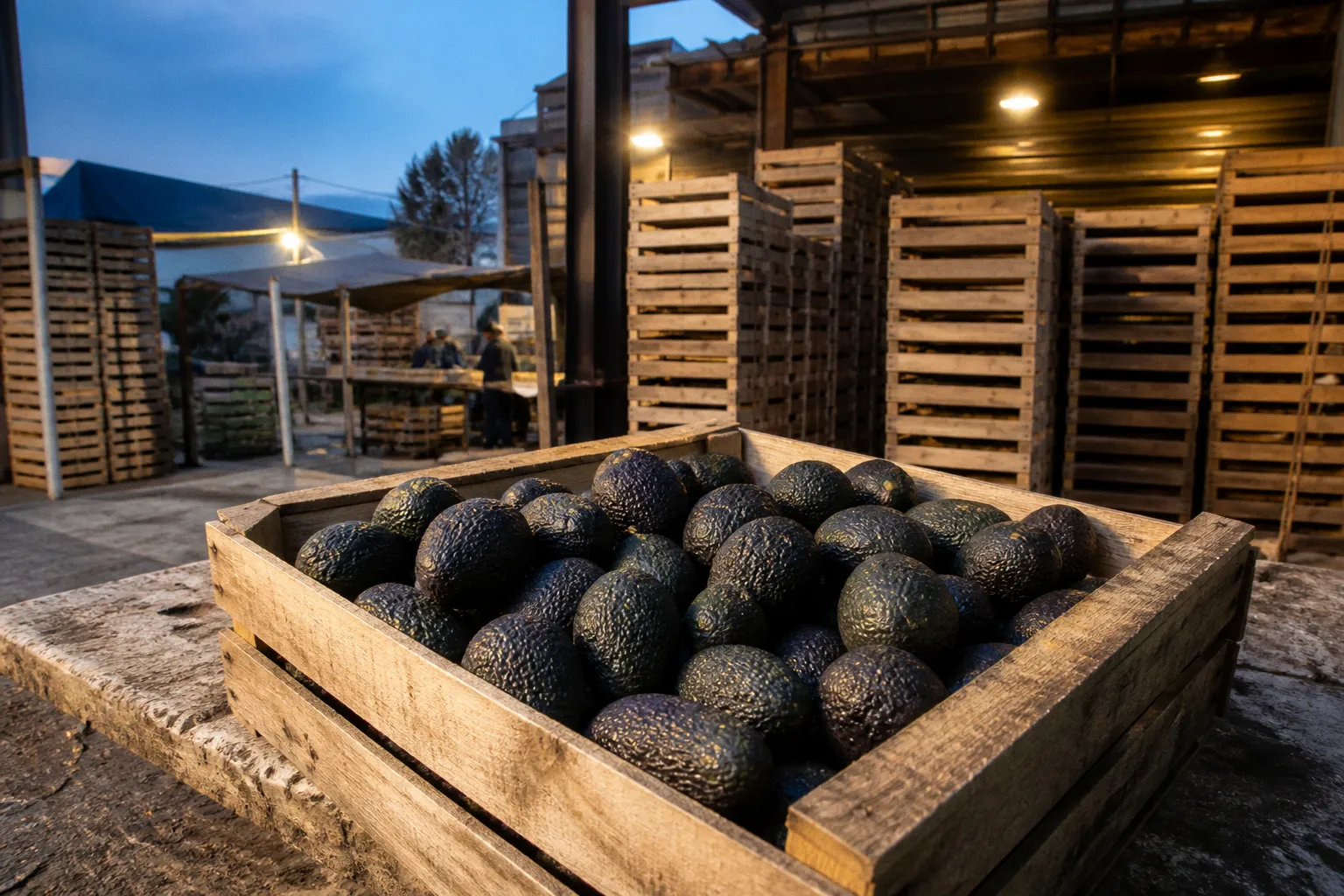
The question is whether each lot can survive harvest, packing, transit, ripening, and border handling without losing eating quality.
The failure points are predictable: fruit picked at inconsistent maturity, field heat left in the load, cold-chain breaks, uncontrolled ethylene exposure, and mixed lots that ripen at different speeds. Fix those points and you improve avocado export quality in Lebanon without relying on one variety, one market, or one shipping route.
Lebanese avocado post-harvest handling must be managed as a sequence. Maturity determines storage potential. Temperature determines respiration. Humidity protects mass and texture. Ethylene determines when the fruit becomes commercially ready. The export plan has to connect all four.
Start with maturity, not softness
A mature avocado should not be selected by softness at harvest. Avocados begin ripening after harvest, once ethylene production is triggered. Fruit that is already soft in the orchard has missed the export window for most supply chains.
The first control point is maturity at picking. For Lebanese coastal orchards, commercial avocado production includes varieties such as Hass, Fuerte, Pinkerton, Ettinger, Reed, Lambhass, and Horshim, grown across elevations from approximately 50 to 400 metres. Those varieties do not move through the same maturity curve. Treating them as one commodity creates avoidable claims, uneven ripening, and rejected cartons.
Dry matter and oil content are the key operating indicators. They are not interchangeable, and they do not produce one universal threshold for every Lebanese cultivar.
A Lebanese post-harvest maturity study recorded:
| Variety | Recorded dry matter | Recorded oil content | Operational implication |
|---|---|---|---|
| Reed | 8.2% | 9.7% | Low maturity indices demand tighter lot control and careful market allocation |
| Fuerte | 28.5% | 21.6% | Higher maturity indices support a different storage and ripening profile |
| Hass, Pinkerton, Ettinger and others | Varied by cultivar and harvest condition | Varied by cultivar and harvest condition | Use variety-specific maturity decisions rather than a single blended rule |
These figures are not a universal release specification. They show the spread inside Lebanese commercial production. Reed and Fuerte can present dramatically different dry matter and oil profiles. If you apply a single minimum to both, you either ship immature fruit or remove saleable fruit from the program.
Your maturity protocol should therefore separate three decisions:
1. Can this fruit enter the export pack?
Confirm cultivar, orchard block, harvest timing, and maturity indicators before blending the lot.
2. Which destination can absorb the lot?
A short regional route and a longer European program do not carry the same maturity risk. The lot needs a transit window, not just a buyer.
3. Will the fruit be sold mature-green or ripened?
Mature-green fruit needs storage discipline and a controlled ripening plan. Ready-to-eat fruit needs a shorter, tighter schedule and a lower storage temperature.
Do not compensate for weak maturity data with longer cooling. Refrigeration slows physiological activity; it does not turn immature fruit into export-quality fruit. If the lot starts with poor maturity uniformity, the cold chain will preserve the problem.
The export decision starts at harvest. Cold storage can slow the clock; it cannot repair a bad maturity call.
Build the lot around the orchard block
Mixed-origin pallets create operational noise. Fruit from different elevations, blocks, cultivars, and harvest dates can have different dry matter levels and different responses to ethylene. Once mixed, the lot becomes difficult to predict.
Keep the following information attached to the pallet or shipment record:
- Cultivar and orchard block.
- Harvest date and harvest sequence.
- Maturity measurements used for release.
- Packhouse intake time.
- Cooling start and completion time.
- Storage temperature and relative humidity.
- Intended destination and transit window.
- Ripening status: mature-green, conditioning, or ready-to-eat.
This is basic traceability, but it also improves commercial control. If one lot performs poorly, you can isolate the cause. Without block-level records, every quality problem becomes a debate about handling, variety, or buyer expectations.
Remove field heat before the cold chain starts
Temperature management is not a warehouse activity. It begins when the fruit leaves the tree.
Avocados continue to respire after harvest. Respiration generates heat, and heat accelerates quality loss. Delays between picking, transport, intake, grading, and cooling consume the same transit window you later try to recover with refrigeration.
For mature-green avocados, standard post-harvest guidance places storage between 5 and 13°C, or 41 and 55°F, depending on cultivar and maturity condition. Relative humidity should remain around 90–95%. Ripe fruit requires a lower range, approximately 2–4°C, or 36–40°F.
The range is deliberately broad because the correct set point depends on the fruit. A mature-green Hass lot and a ripe mixed-variety delivery should not be managed on the same temperature instruction. Use the target as a controlled operating range, not as permission to move the thermostat without regard to cultivar.
The practical cold-chain sequence
1. Harvest into shaded field containers
Do not leave filled bins in direct sun while the crew continues picking. Shade is not a substitute for cooling, but it limits unnecessary heat loading before the fruit reaches the packhouse.
Handle the fruit to prevent impact damage. Bruising may not be visible when the fruit is green and firm. It becomes a commercial defect later, often during ripening when the damaged tissue darkens and softens faster than the surrounding flesh.
2. Move quickly to packhouse intake
The first logistics metric is not warehouse temperature. It is the time between harvest and cooling. Record it. If intake delays are repeated, change the harvest dispatch rhythm rather than asking the cold room to absorb the problem.
A cooperative can improve this with simple controls:
- Stagger picking against truck capacity.
- Avoid filling more field bins than the packhouse can receive.
- Keep trucks assigned to defined orchard routes.
- Separate damaged or over-soft fruit before it enters the export flow.
- Use intake records to identify peak-hour congestion.
3. Cool the fruit uniformly
A cold room reading does not prove that the fruit core has reached the target. Pallet position, carton ventilation, load density, and container airflow all affect cooling speed.
Do not stack cartons so tightly that air cannot circulate. Do not place warm pallets directly against already-conditioned fruit and assume the room will equalize the load. The objective is uniform product temperature across the pallet, not a cold surface with a warm centre.
4. Hold humidity high without creating wet cartons
The 90–95% relative humidity target protects against excessive moisture loss. But condensation, standing water, and wet packaging create their own problems. Keep air movement consistent, avoid unnecessary temperature swings, and manage the room so the fruit is humidified without becoming visibly wet.
5. Protect the temperature through loading and dispatch
The cold chain fails at handoffs. Loading bays, staging areas, customs delays, and open truck doors can erase careful packhouse work.
If the shipment is mature-green, keep it inside the 5–13°C operating range appropriate to the cultivar and maturity condition. If it has entered a ripening program, treat it as a different product. Ripe fruit has a different temperature requirement and a shorter tolerance for uncontrolled delays.
Use ethylene as a schedule, not a rescue treatment
Ethylene treatment is useful because it can synchronize ripening. It is not a tool for correcting immature fruit or repairing poor temperature control.
A standard treatment protocol uses 100 ppm ethylene at 20°C, or 68°F. The exposure period varies with harvest timing:
- Early-season fruit: approximately 48 hours.
- Mid-season fruit: approximately 24 hours.
- Late-season fruit: approximately 12 hours.
The sequence matters. If the fruit is too cold, ethylene response slows. If fruit from different maturity stages is treated together, the lot may not reach the same eating stage at the same time. If the treatment is extended without controlling temperature and lot composition, you increase the risk of uneven softening and overripe units.
Run the ripening room by lot
A ripening room should not operate as a general holding area. Assign each lot a treatment plan before loading the room.
The minimum operating record should include:
- Cultivar.
- Harvest timing: early, mid, or late season.
- Date and time of room entry.
- Fruit temperature before treatment.
- Ethylene concentration.
- Exposure duration.
- Room temperature.
- Release condition.
- Destination and delivery deadline.
The exposure windows are not interchangeable. A late-season lot receiving the early-season treatment duration may move too far ahead of the commercial schedule. An early-season lot given a short treatment may remain uneven and miss the buyer’s ready-to-eat specification.
If-then control is straightforward:
- If the shipment is mature-green and the buyer wants conditioning, then schedule ethylene exposure against the delivery date.
- If the lot contains different cultivars or maturity levels, then separate it before treatment rather than averaging the exposure time.
- If the fruit has experienced a cold-chain interruption, then inspect and reclassify the lot before ripening.
- If the shipment must travel further after treatment, then do not release it at the same softness stage as fruit going directly to market.
- If the fruit is already ripe, then move it to the 2–4°C range and protect it from additional uncontrolled ethylene exposure.
The point is operational: ethylene should create a predictable sales window. It should not create a room full of fruit that looks uniform on day one and collapses at different speeds over the next several days.
Treat ethylene exposure as a timed production step. If you cannot state the release date, the treatment is not under control.
Controlled-atmosphere storage buys time, not flexibility
Controlled-atmosphere storage can slow respiration and ethylene production. For commercial varieties such as Hass, an atmosphere using approximately 2–5% oxygen and 3–10% carbon dioxide can support storage for five to six weeks under the right conditions.
That is a logistics advantage, not a license to extend every shipment to six weeks. Controlled atmosphere works only when the fruit enters storage with suitable maturity, stable temperature, high relative humidity, and intact quality. It cannot neutralize bruising, fungal infection, poor ventilation, or a lot that was harvested outside its commercial maturity window.
Use CA storage when the route requires it
Controlled atmosphere makes the most sense when the export plan has a defined reason for the added control:
- A longer sea or multimodal transit window.
- A destination that requires delayed ripening.
- A market with scheduled retail programs.
- A need to consolidate supply from several harvest periods without releasing all fruit at once.
- A Hass program where extended storage has a clear commercial return.
For short routes or rapidly turning regional markets, conventional cold-chain management may be more efficient. The system has to match the route. Additional technology adds value only if it protects a real transit or sales requirement.
Gas management must stay within the operating envelope
The target atmosphere is not achieved once and forgotten. Oxygen and carbon dioxide levels require monitoring. Gas concentration, temperature, cultivar, loading density, and storage duration interact. A setting that is acceptable for one lot may not be appropriate for another.
Your CA record should show:
- Initial fruit condition.
- Cultivar and lot identity.
- Chamber temperature.
- Oxygen level.
- Carbon dioxide level.
- Storage start date.
- Planned inspection points.
- Intended release date.
- Ripening destination after release.
Schedule inspections before the commercial deadline. Do not wait until the buyer reports a texture problem. If the lot is intended for a ripening program after storage, leave enough time for conditioning, sorting, and delivery. The storage period is only one segment of the route.
Connect Lebanon’s harvest to the destination market
Lebanon’s avocado export markets include Egypt, France, Turkey, Jordan, and Iraq. Those destinations do not represent one uniform demand profile. Transit length, border exposure, buyer ripeness requirements, and distribution speed can differ substantially.
Your shipment plan must start with the destination, then work backward to the orchard.
For shorter regional routes
If the buyer can receive and sell the fruit quickly, prioritize:
- Consistent maturity within each lot.
- Rapid cooling.
- Stable mature-green storage.
- Minimal handling between packhouse and delivery.
- A clearly defined ripening point at destination.
Do not over-process the fruit simply because a technology is available. A short route can be damaged by unnecessary treatment just as easily as a long route can be damaged by insufficient control.
For longer European programs
If the shipment faces a longer transit window, the export plan needs tighter separation between:
- Orchard maturity.
- Packhouse grade.
- Storage condition.
- Shipping condition.
- Arrival condition.
- Final ripening schedule.
Hass may be suitable for controlled-atmosphere storage for five to six weeks under the prescribed conditions, but the program still depends on starting quality. Extended storage should be reserved for lots with documented maturity and clean handling history.
The commercial objective is not to keep fruit cold for as long as possible. It is to arrive with enough remaining shelf life to complete the customer’s selling cycle.
Use the cooperative as the control tower
Small orchards do not need to operate as isolated exporters. A cooperative can standardize the points that individual growers often handle differently:
- Common harvest criteria by cultivar.
- Shared maturity testing.
- Scheduled collection routes.
- Packhouse intake windows.
- Lot coding.
- Shared cold rooms.
- Standard carton ventilation and pallet patterns.
- Consolidated phytosanitary documentation.
- Destination-specific release plans.
This is where cooperative structure directly supports export quality. The value is not only volume aggregation. It is process consistency.
A cooperative that combines immature Reed with high-maturity Fuerte, then puts both through one ripening schedule, has created a quality problem at scale. A cooperative that separates varieties, records maturity, and assigns each lot to a route has created a reliable export program.
The failure modes are operational, not mysterious
Most avocado losses can be traced to a small number of breakdowns. Build the response into the standard operating procedure.
Failure 1: Picking by appearance alone
Green skin colour and fruit size do not establish the full maturity profile. Use variety-specific dry matter and oil-content information, then connect it to harvest timing and destination requirements.
Failure 2: Treating every cultivar as Hass
Hass may dominate export conversations, but Lebanese production includes several commercial varieties. Storage, ripening response, and maturity indices vary. A Hass protocol copied onto Reed or Fuerte without adjustment is not a standard; it is a risk.
Failure 3: Cooling the room instead of the fruit
A room can reach the target temperature while the pallet core remains warm. Measure product temperature through the load, manage airflow, and record cooling performance.
Failure 4: Allowing humidity to drift
Low relative humidity increases moisture loss and can reduce commercial appearance and texture. The target for avocado storage is approximately 90–95% relative humidity. Maintain it without creating condensation and wet packaging.
Failure 5: Using ethylene to fix immature fruit
Ethylene initiates and synchronizes ripening. It does not replace maturity. If the fruit lacks adequate development, treatment can produce soft fruit without the eating quality the buyer expects.
Failure 6: Mixing harvest windows
Early-, mid-, and late-season fruit may require different ethylene exposure periods. Keep the lots separate. The operational difference can be 48 hours versus 24 hours versus 12 hours at 100 ppm and 20°C.
Failure 7: Losing control during dispatch
A correct cold-room set point is irrelevant if pallets wait in heat before loading or if the reefer is opened repeatedly during a delay. Treat staging, loading, customs, and final delivery as part of the cold chain.
Failure 8: No release decision
Every lot needs a defined release condition. Mature-green, conditioning, and ready-to-eat are different commercial states. If the warehouse team cannot identify the state, the buyer will discover the problem first.
A working export protocol for Lebanese avocados
Use this sequence as the operating backbone for a cooperative or export packhouse:
1. Register the orchard block.
Record cultivar, elevation range, harvest timing, grower, and intended market.
2. Set the maturity decision by cultivar.
Use dry matter and oil content as the technical basis. Do not impose one universal threshold across all varieties.
3. Harvest into protected containers.
Limit impact damage and shade filled bins while waiting for transport.
4. Move to packhouse intake without avoidable delay.
Record harvest-to-intake time and identify recurring congestion.
5. Sort by cultivar, condition, and maturity profile.
Do not build mixed lots that cannot be ripened or stored predictably.
6. Cool uniformly.
Apply the appropriate mature-green temperature range, typically 5–13°C depending on cultivar and condition.
7. Maintain 90–95% relative humidity.
Prevent excessive water loss while avoiding condensation and wet cartons.
8. Assign the shipment to a route-specific plan.
Short regional delivery, longer European transit, and controlled-atmosphere storage require different release schedules.
9. Use ethylene only against a dated sales window.
At 100 ppm and 20°C, plan approximately 48 hours for early-season fruit, 24 hours for mid-season fruit, or 12 hours for late-season fruit, subject to lot condition and cultivar response.
10. Move ripe fruit to 2–4°C.
Once fruit is ripe, protect it from temperature abuse and uncontrolled additional ripening.
11. Inspect before dispatch and at destination.
Confirm temperature history, lot identity, ripeness stage, carton condition, and remaining shelf life.
12. Close the loop with the grower and cooperative.
Record claims by cultivar, orchard block, harvest period, and route. Use the results to adjust the next harvest plan.
This is the minimum discipline required to convert harvest volume into dependable export quality. The larger Lebanon’s avocado program becomes, the less room there is for informal handling decisions.
Final position: make predictability the product
Lebanon has already demonstrated that avocado exports can scale sharply. The next stage is not simply more orchards or more cartons. It is repeatability.
A buyer in Egypt, France, Turkey, Jordan, or Iraq is purchasing a delivery condition, not an orchard story. They need fruit that arrives within the agreed maturity window, survives the remaining distribution period, and ripens without a high percentage of hard, shrivelled, bruised, or over-soft units.
That outcome comes from a controlled chain:
- Variety-specific maturity decisions.
- Fast and uniform cooling.
- 5–13°C management for mature-green fruit.
- 90–95% relative humidity.
- 2–4°C handling once ripe.
- Ethylene exposure matched to harvest timing.
- Controlled atmosphere used only where the route justifies it.
- Lot-level records from orchard to destination.
Before the next Lebanese avocado shipment leaves the packhouse, confirm every item:
- Cultivar is identified.
- Orchard block is recorded.
- Maturity data is available.
- Harvest timing is classified.
- Fruit has been cooled uniformly.
- Temperature history is documented.
- Relative humidity is controlled.
- Ripening status is visible on the lot record.
- Ethylene treatment, if used, has a defined duration and release date.
- Destination, transit window, and final customer requirement are aligned.
- Phytosanitary and export documentation is complete.
- The reefer, staging area, and loading sequence are ready.
- The shipment has a named owner at every handoff.
That is how Lebanese avocado post-harvest handling becomes an export system rather than a series of last-minute fixes.