Lebanese avocado export prep: a four-stage farm project
Lebanese avocado export preparation stages begin long before a crate reaches a port.
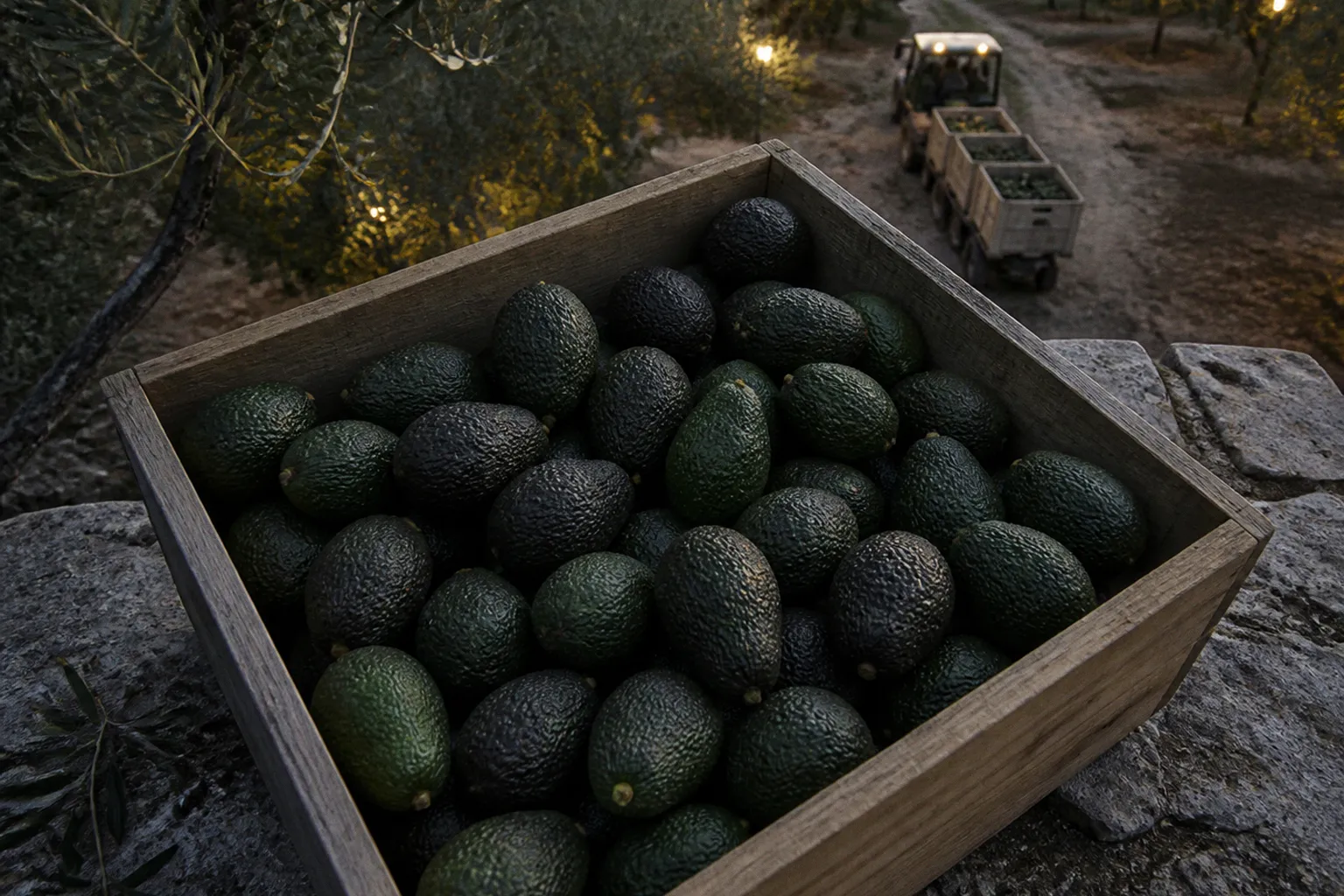
The work starts in the orchard: with a site that can support steady yields, trees managed for consistent fruit size, and a harvest plan that respects the difference between a crisp, well-developed avocado and one that has simply turned dark enough to look ready.
Lebanon’s avocado sector has moved from a largely local and regional trade into a more ambitious export business. In 2021, the country had approximately 1,580 hectares planted with avocado, producing 18,955 tons and exporting 8,884 tons. Export revenue then rose from $433,000 in 2021 to $8.2 million in 2024. Those figures show real momentum, but they also raise the standard for our growers: export success depends on a collective ability to deliver uniform fruit, reliable documentation, and a cold chain that does not lose quality between orchard and buyer.
For a cooperative, this is not one large task handed to one farm. It is a four-stage project shared across growers, field technicians, laboratories, harvest crews, packhouses, transporters, and market partners.
Stage one: prepare the orchard for an export-grade crop
An export program is only as dependable as the orchards feeding it. A packhouse can sort fruit, but it cannot turn weak yields, irregular maturity, or repeated bruising into a consistent commercial line. Orchard management is therefore the first part of Lebanese avocado export preparation stages, even when the export order arrives months later.
Start with the site, not the carton
Lebanese avocado production is concentrated along the coast, where the crop has been cultivated commercially since the 1970s. The coastal growing environment can support several varieties, including Hass, Lambhass, Fuerte, Pinkerton, Ettinger, Reed, and Horshim. Each orchard still needs to be treated according to its own conditions rather than according to a general national recipe.
Site readiness means understanding how water moves through the soil, where trees are exposed to wind, how easily the orchard can be reached during a wet harvest period, and whether fruit can be moved quickly after picking. A productive block that is difficult to access may become a logistical bottleneck precisely when the crop is most valuable.
Before the season, our cooperative teams should map each orchard block and record:
- Variety, tree age, planting density, and expected harvest window.
- Irrigation access and any areas where water stress or poor drainage has appeared.
- Wind exposure, damaged branches, and fruit that may be vulnerable to rubbing.
- Orchard roads, loading points, and the time required to move filled field crates.
- Previous pest, disease, or residue-management concerns.
- The likely destination market, because regional and European buyers may ask for different documentation and specifications.
This kind of mapping is not glamorous, but it gives the cooperative a shared picture of supply. Without it, a buyer may receive fruit from several farms that technically belong to the same order but differ sharply in size, maturity, appearance, or shelf life.
Make uniformity a group responsibility
Avocados are forgiving in the kitchen and demanding in the export chain. A local market may accept a broader range of shapes and sizes, while an international buyer often expects a narrow presentation: similar fruit in the same box, predictable ripening, clean skin, and no obvious bruising or blemishes.
That does not mean every avocado must look identical. It means our growers need agreed grading language before harvest begins. A cooperative can define the commercial classes it will pack, the minimum acceptable external quality, the handling rules for damaged fruit, and the way size will be recorded. The aim is not to punish farms with naturally different production patterns. The aim is to prevent surprises after the fruit has been combined.
Shared field standards should cover:
- Gentle handling whenever fruit is touched or moved.
- Removal of visibly damaged or diseased fruit before it reaches the packhouse.
- Separate identification of orchard blocks and harvest lots.
- Clean, ventilated field containers rather than overloaded sacks or deep piles.
- A clear process for reporting fruit that falls outside the agreed export grade.
For organic avocado export from Lebanon, the same principle applies with additional discipline around approved inputs, records, and separation. Organic status is not created by a label added at the packing stage; it depends on the production history of the orchard and the integrity of the chain that follows it.
Export quality is not made at the last gate. It is built collectively, tree by tree, in the weeks before harvest.
Plan around the varieties we actually grow
Variety affects timing, maturity behavior, packing decisions, and the way fruit travels. Hass is the most recognizable export variety in many markets, but it is not the only commercial opportunity for Lebanese growers. Fuerte, Reed, Pinkerton, Ettinger, Lambhass, and other varieties each bring different qualities to a sales program.
A cooperative should avoid treating the entire avocado harvest as one undifferentiated crop. Instead, it can organize supply by variety and expected maturity period. This helps the packhouse schedule labor, gives buyers more accurate information, and makes laboratory testing more meaningful.
The result is a farm project with a calendar rather than a rush:
1. Register the orchard blocks and varieties.
2. Estimate the harvest windows for each block.
3. Agree on the quality classes and destination markets.
4. Schedule maturity sampling before commercial picking.
5. Reserve labor, crates, transport, and packhouse capacity.
6. Confirm how rejected or downgraded fruit will be handled.
The earlier these responsibilities are shared, the less likely we are to discover a capacity problem when fruit is already hanging in the trees.
Stage two: use maturity testing instead of appearance alone
One of the most common mistakes in avocado export preparation is relying on skin color as the main signal of readiness. External appearance can help with variety identification and visual sorting, but it does not tell us enough about internal development. An avocado can look ready and still have poor eating quality, insufficient dry matter, or an uneven ripening profile.
This is why maturity testing belongs at the center of the export plan.
Dry matter and oil content show what the eye cannot
Laboratories evaluate avocado maturity through indicators such as dry matter, or DM, and oil content, or OC. These measurements help reveal whether the fruit has developed the internal composition required for dependable ripening and acceptable flavor.
The recorded maturity range among Lebanese coastal varieties is broad. Reed has been measured at minimum levels of 8.2% dry matter and 9.7% oil content, while Fuerte has reached levels as high as 28.5% dry matter and 21.6% oil content across harvest stages. These figures are not a universal picking instruction for every orchard or every buyer. They show why variety-specific testing matters: the same visual impression cannot represent the same physiological stage across different cultivars.
A useful sampling program should take fruit from more than one tree and more than one part of the orchard block. Sampling only the most exposed trees can give an overly optimistic result; sampling only fruit from the easiest-to-reach row can hide variation across the block. Our goal is a representative picture that allows the cooperative to decide whether a block is ready, nearly ready, or better left on the tree.
Turn test results into a harvest decision
Laboratory results become useful when they lead to a practical action. The cooperative can connect each test to one of three decisions:
- Ready for a planned harvest: the maturity profile is aligned with the buyer’s specification and the fruit can move through the chain without unnecessary delay.
- Ready only for selected lots: some orchard areas or sizes may be suitable, while others need more time.
- Not ready for export picking: the block should remain under observation and be sampled again rather than harvested to meet a calendar date.
This approach protects both growers and buyers. Picking too early may produce fruit with weak flavor or poor ripening. Picking too late can shorten the commercial window and increase the risk of softness, drop, or handling damage. A calendar is helpful, but a calendar without maturity data is only an estimate.
Build a cooperative testing rhythm
Individual farms may struggle to justify frequent laboratory testing, particularly when harvest volumes are modest or orchards are spread across several areas. A cooperative can make the process more accessible by organizing collective sampling days, using common forms, and sending samples in a planned sequence.
Every sample should remain traceable to:
- The grower and orchard block.
- The variety.
- The sampling date.
- The intended market.
- The test result and the decision that followed.
These records also help us learn from one season to the next. If one block repeatedly reaches suitable maturity earlier than neighboring blocks, the cooperative can adjust labor and transport planning. If a variety shows a wider maturity spread, the packhouse can prepare for more careful lot separation rather than treating the fruit as one uniform intake.
For bekaa valley avocado farming, where supply may be coordinated alongside other agricultural products and transport routes, this scheduling discipline is particularly valuable. The export plan should fit the cooperative’s actual geography, not an imagined farm with unlimited labor and storage.
Stage three: harvest for condition, not just volume
Harvest is where orchard decisions become visible. It is also where good fruit can lose value very quickly. A mature avocado with clean skin and strong internal quality can still arrive at the packhouse bruised, compressed, or overheated if the picking crew is rushing or the field containers are poorly managed.
The harvest objective is simple to say: remove the fruit at the correct maturity and preserve its condition. Achieving it requires a shared protocol.
Separate readiness from convenience
A block should not be harvested merely because labor is available, a truck has arrived, or another farm in the cooperative has started picking. Varieties and orchard blocks mature differently, and the harvest schedule should follow test results and buyer requirements.
Hass, Fuerte, and Reed should not automatically be treated as interchangeable. Their maturity behavior, skin characteristics, and commercial timing can differ. A cooperative that groups them together without clear lot identification may make later sorting and buyer communication more difficult.
Harvest teams need to know:
- Which blocks are approved for picking.
- Which varieties are being collected.
- The required field container and maximum fill level.
- Where fruit should be placed to avoid direct heat and unnecessary waiting.
- Which fruit must be separated immediately because of cuts, decay, severe blemishes, or other damage.
- How the lot will be identified when it leaves the orchard.
A short briefing before each picking day can prevent more loss than a long argument at the packhouse. It should be practical, visual, and repeated whenever the crew moves to a new variety or orchard.
Keep the fruit cool, clean, and traceable
The phrase “avocado harvest packing Lebanon” covers two connected operations: the physical act of picking and the controlled movement of fruit into the packhouse. Neither can be treated as an afterthought.
Field containers should protect fruit from pressure and impact. Overfilled bins create weight on the lower fruit, while rough transfer from tree to container can cause damage that is not immediately visible. Fruit should not be left for long periods in direct sun, especially when transport or intake is delayed.
At intake, the packhouse should record the lot and inspect its condition before fruit from different growers is blended. This is the moment to identify whether damage is linked to a particular block, picking crew, container type, or transport delay. Traceability is not only for responding to a complaint. It is one of the few ways a cooperative can improve without blaming the entire group for every problem.
A practical harvest flow looks like this:
1. Approve the block using maturity information and the buyer’s specification.
2. Brief the crew on variety, handling, container use, and lot identification.
3. Pick selectively and gently, removing fruit without unnecessary pulling, dropping, or abrasion.
4. Move field containers promptly to a protected collection point or packhouse intake.
5. Inspect and register the lot before combining it with other produce.
6. Separate unsuitable fruit early, so it does not travel through the export line.
7. Begin cooling and packing according to the destination program.
The point is not to make harvest complicated. It is to make every handoff clear.
Protect the market value of different grades
Not every avocado will meet an export specification, and that is not a failure of the farm. The cooperative needs a planned use for different quality grades so that growers are not forced to hide defects inside a mixed shipment.
Export-grade fruit may require a clean appearance, suitable size distribution, and sufficient maturity. Fruit with cosmetic blemishes but sound internal quality may have a regional or processing market. Fruit with decay or serious damage should be removed rather than used to increase the apparent volume of a shipment.
This is where collective marketing can create value. One grower may not have enough volume to serve several channels, but a cooperative can sort the crop into clear streams and build relationships with buyers who want different specifications. Middle Eastern destinations—including Egypt, Jordan, Turkey, Saudi Arabia, the United Arab Emirates, Kuwait, and Iraq—remain important markets for Lebanese avocados, alongside European destinations such as France, Italy, the Netherlands, and Spain. A strong export program does not assume that one market will absorb every variety and grade.
Stage four: make the packhouse and cold chain part of the farm plan
The packhouse is not simply a place where avocados are put into boxes. It is where orchard variability is measured, quality is protected, lots are documented, and the shipment becomes legible to an international buyer.
The best packing operation is one that receives fruit with a clear identity and sends it out with a clear specification.
Design the intake around traceability
At arrival, each lot should be associated with the grower, orchard block, variety, harvest date, and maturity record. If fruit from several farms is combined immediately, the cooperative may lose the ability to understand where a problem began.
A disciplined intake routine includes:
- Recording the arrival time and condition of the lot.
- Checking for bruising, cuts, decay, pests, and excessive field heat.
- Confirming the variety and harvest identity.
- Taking representative quality observations.
- Directing fruit into the appropriate sorting and packing stream.
- Keeping records linked to the final carton or pallet information.
The exact equipment and workflow will depend on the scale of the cooperative. The principle remains the same: every movement should preserve quality and information at the same time.
Sort for a buyer’s specification, not an abstract ideal
Sorting is where we turn a diverse harvest into a product a buyer can plan around. It should address size, shape, skin condition, maturity class, and visible defects. The cooperative should agree in advance on what is acceptable for each market, because a standard suited to a domestic wholesale market may not match a European retail program.
Uniformity matters beyond appearance. Buyers need to know how fruit will behave after arrival. If one carton contains a mixture of maturity stages, the customer may experience a frustrating sequence of hard fruit, soft fruit, and fruit that never ripens properly. Laboratory testing, orchard records, and lot separation all contribute to a more predictable result.
Packaging should also protect the fruit rather than merely display it. Boxes need to withstand handling, ventilation needs to be considered, and pallet construction should avoid crushing lower cartons. The packaging format must work with the transport route, not just look attractive when it leaves the packhouse.
Treat the cold chain as a continuous handoff
Cold-chain logistics begin when harvested fruit is moved out of field heat and continue through storage, loading, transport, border procedures, and delivery. A gap at any point can reduce shelf life. For that reason, the cooperative should identify the handoff points where fruit may wait:
- Orchard collection.
- Packhouse intake.
- Sorting and packing.
- Temporary storage.
- Truck loading.
- Port or border transfer.
- Arrival at the importer or distribution center.
Each waiting point needs an owner. If everyone assumes someone else is monitoring the fruit, the cold chain becomes a hope rather than a system.
Lebanese avocado export operations serve both nearby Middle Eastern markets and European destinations, so route planning should reflect the travel time and handling conditions of each destination. A shipment to a close regional market may have a different schedule from one moving through a longer European route. The commercial promise should match what the physical chain can protect.
A cooperative earns trust when the fruit, the paperwork, and the delivery promise all tell the same story.
EU requirements begin in the orchard record
European buyers may ask for a high level of assurance around residue control, traceability, maturity, packaging, and food safety. These requirements cannot be solved by the exporter alone if production records are incomplete or if lots have been mixed beyond recognition.
For fresh avocados entering the European Union, maximum contaminant limits include lead below 0.10 mg/kg and cadmium below 0.050 mg/kg. These are not figures to remember only when preparing a shipment. They shape how the cooperative manages inputs, sampling, orchard histories, and packhouse records throughout the season.
Connect field decisions to compliance
A cooperative preparing for EU markets should keep a clear record of:
- Products applied in each orchard block.
- Application dates, rates, and responsible grower or technician.
- Water and soil concerns that may affect contaminant risk.
- Harvest dates and lot identifiers.
- Laboratory maturity results.
- Any residue or contaminant testing required by the buyer or applicable program.
- Packhouse intake, sorting, packing, and dispatch records.
- Corrective actions when a lot does not meet the agreed specification.
This is practical infrastructure, not bureaucracy for its own sake. If a test result raises a concern, the cooperative needs to know which block and which production history are connected to that lot. Without traceability, a single uncertain result can cast doubt over much more fruit than necessary.
The same discipline supports an organic program, although organic certification and market requirements must be managed according to the applicable certification system and buyer. Organic fruit still needs careful harvesting, clean packing, maturity control, and cold-chain protection. Organic production does not remove the need for operational precision.
Do not confuse compliance with market readiness
Meeting a contaminant limit does not automatically make a shipment attractive to a buyer. A legally compliant avocado can still arrive with inconsistent sizing, poor presentation, weak traceability, or a ripening profile that does not suit the customer’s program.
Our export preparation needs two parallel standards:
1. The compliance standard: the fruit and its records meet applicable safety and market-entry requirements.
2. The commercial standard: the shipment is uniform, well presented, correctly packed, and dependable in delivery.
The strongest Lebanese cooperatives treat these standards as connected. Clean records make it easier to manage quality. Better orchard separation makes sampling more meaningful. More careful harvest handling supports shelf life. Reliable packing improves the buyer’s confidence and gives the cooperative a stronger basis for discussing future orders.
A cooperative timeline that can actually work
A four-stage project becomes manageable when each group knows when its work begins. The following rhythm can be adapted to the varieties, orchard locations, buyer schedules, and available infrastructure of the cooperative.
| Project period | Main cooperative work | Practical output |
|---|---|---|
| Before harvest | Map orchards, varieties, expected volumes, access routes, and production records | A shared supply and risk map |
| Pre-harvest sampling | Collect representative fruit and evaluate dry matter and oil content by variety and block | A harvest-readiness decision |
| Harvest window | Brief crews, control containers, identify lots, and move fruit promptly | Sound, traceable field lots |
| Packhouse intake | Inspect, record, sort, and separate fruit by quality and destination | Defined export and alternative-market grades |
| Packing and dispatch | Protect fruit in suitable cartons, maintain cold-chain handoffs, and complete records | A shipment that is commercially and operationally consistent |
| After delivery | Review buyer feedback, quality issues, delays, and rejected grades | Improvements for the next harvest cycle |
The most useful review is not a search for one person to blame. It asks where the system became uncertain. Did the sample fail to represent the block? Did the truck wait too long? Did two varieties enter the same line? Did a carton specification fail under actual transport conditions? These questions turn one season’s difficulty into the next season’s preparation.
What global growth asks of Lebanese growers
The rise from $433,000 in avocado export revenue in 2021 to $8.2 million in 2024 reflects an expanding opportunity, but growth also exposes every weak connection in the chain. More buyers mean more specifications. More destinations mean more route planning. Larger collective volumes make consistency more visible, not less.
That is why our growers do not need to imitate the largest exporters overnight. We need to make the next shared improvement carefully:
- One clear maturity-testing schedule.
- One agreed lot-identification method.
- One harvest-handling protocol used across participating farms.
- One realistic map of packhouse and transport capacity.
- One honest separation between export-grade, regional-grade, and processing fruit.
- One record system that can follow a carton back to its orchard block.
These steps may look modest beside the scale of global trade, but they are the foundations buyers recognize. An export pipeline becomes durable when a cooperative can repeat its performance, not merely achieve one successful shipment.
Lebanon’s avocado sector has the varieties, the growing history, and the market connections to keep developing. The path forward is not to chase volume while leaving quality to chance. It is to connect orchard readiness, laboratory evidence, careful harvesting, packhouse control, and compliance into one shared project.
When we do that, a Lebanese avocado is no longer only a piece of fresh produce leaving the farm. It becomes the visible result of our collective effort: crisp in promise, sound in handling, traceable in origin, and ready to meet the market with confidence.