Avocado orchard setup: a coastal Lebanon project
In coastal Lebanon, an avocado orchard can fail before the first serious harvest—not because the trees lack warmth, but because the soil holds water too long, the irrigation water carries excess…
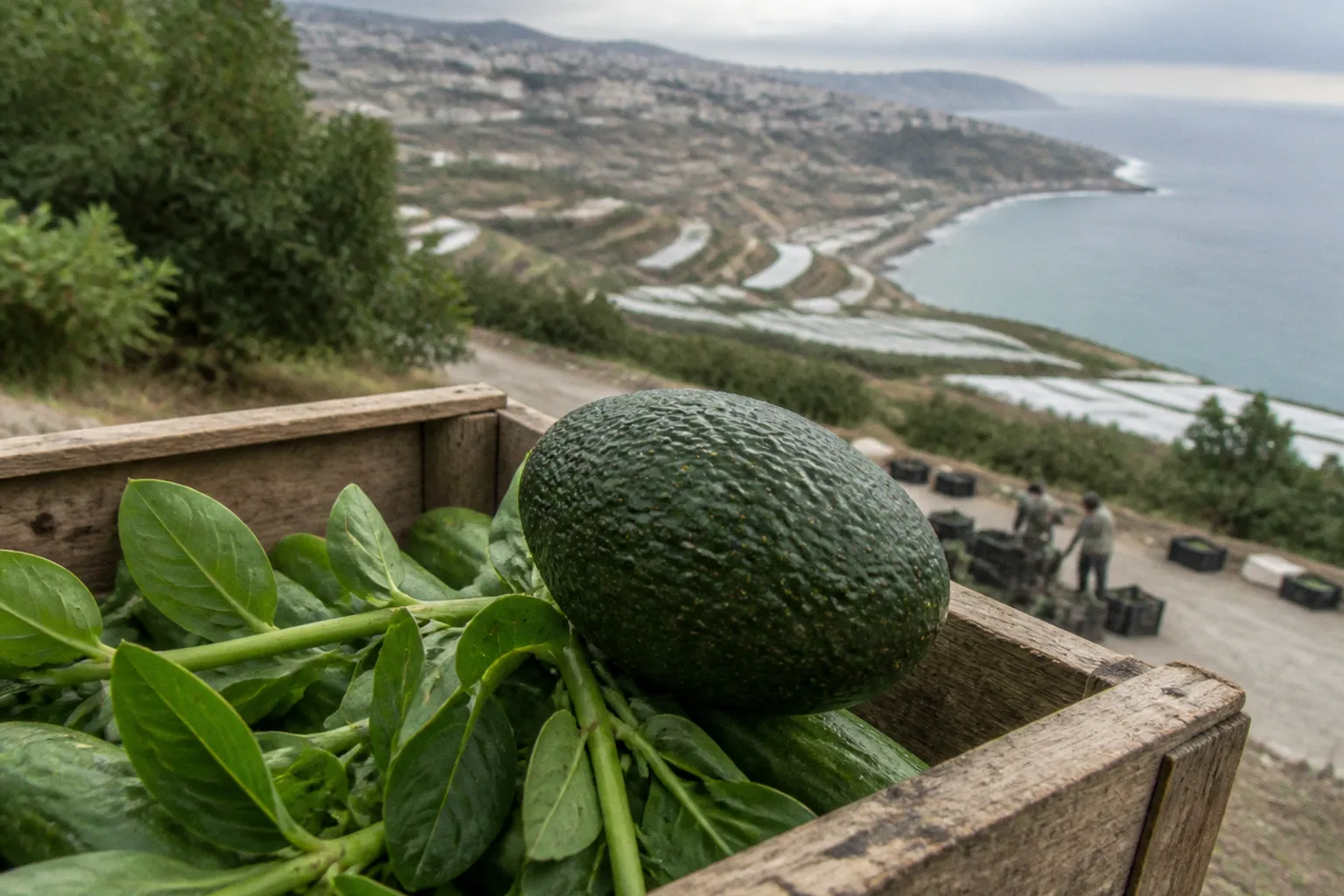
In coastal Lebanon, an avocado orchard can fail before the first serious harvest—not because the trees lack warmth, but because the soil holds water too long, the irrigation water carries excess salts, or the planting material is chosen for appearance rather than for the orchard’s market and climate.
This is the central contradiction of avocado establishment: the crop needs a reliable water supply, yet its roots are unusually intolerant of prolonged saturation. A young tree can look vigorous above ground while its feeder roots are already losing function below the surface. By the time yellowing leaves and branch dieback appear, the problem is often a drainage design made months earlier.
Lebanon has cultivated avocado since the 1970s, mainly along the Mediterranean coast. The crop is no longer experimental. A 2025 study reported approximately 1,580 hectares planted with avocado in 2021, production of 18,955 tons, and exports of 8,884 tons, primarily to European and Gulf markets. More recent trade data recorded 1,909,440 kilograms of Lebanese avocado exports in 2024, with a reported value of about US$6.37 million.
Those figures show a functioning crop and an export pathway. They do not prove that every coastal parcel is suitable, or that planting an orchard automatically creates a profitable enterprise. Establishment still depends on a sequence of physical decisions: site assessment, soil preparation, water management, cultivar selection, planting depth, disease prevention and harvest planning.
The Lebanese avocado orchard establishment stages are best treated as one connected system. A cultivar cannot compensate for poor drainage. A good irrigation system cannot correct saline water indefinitely. A productive tree cannot rescue fruit that reaches the packing line bruised, immature or inconsistent.
Site assessment comes before soil preparation
The first task is not ploughing. It is finding out whether the land can remove excess water without losing the water needed by the crop.
Avocado roots require oxygen as well as moisture. In compacted soil, or in a field with a shallow hardpan, irrigation water can remain around the root zone after the surface appears dry. This creates conditions associated with Phytophthora root rot and other root diseases. The risk is especially serious during the establishment phase, when the tree has a small root system and limited capacity to recover from stress.
A coastal location may offer a suitable Mediterranean climate, but “coastal” is not a soil classification. Within a short distance, one parcel may drain quickly through deep loam while another sits above compacted layers, construction fill or fractured rock that redirects water into low points. Wind exposure, salt spray, frost pockets and the quality of available irrigation water can also vary sharply.
Before choosing trees, inspect the site at several points rather than relying on one soil sample. The assessment should include:
- Soil depth and hard layers. Technical guidance for avocado site selection recommends avoiding hardpan or rock layers within approximately three feet of the soil surface. A shallow restriction can leave the root zone wet after irrigation or rainfall.
- Drainage after rain. Observe where water stands, how quickly it moves away and whether low areas remain saturated longer than the rest of the field.
- Soil texture. Heavy clay can be productive when structurally sound and well drained, but compacted clay is a very different growing medium. It has poor air exchange and becomes difficult to irrigate evenly.
- Water quality. Test salinity and other relevant chemical properties before designing the irrigation programme. A dependable water source is not necessarily a suitable one.
- Wind exposure. Young avocado trees have tender shoots and can suffer mechanical damage, leaf desiccation and fruit scarring in exposed coastal conditions.
- Frost and cold-air movement. A warm regional climate does not eliminate local cold pockets. Low-lying sites can collect cold air even when nearby slopes remain mild.
- Existing disease pressure. An old orchard, neglected citrus block or poorly drained vegetable field may carry pathogens or leave compaction that is not visible from the road.
The most useful soil inspection is often a simple pit dug deep enough to reveal the transition between topsoil and the layers beneath it. Look for a sharp change in colour, roots that stop at the same depth, grey or mottled zones indicating prolonged wetness, and dense layers that resist a spade or soil auger.
An avocado orchard is not established by putting trees into the ground. It is established by giving roots a stable balance of air, moisture and temperature.
Preparing the field without creating a future problem
Soil preparation should correct physical limitations, not simply make the field look cultivated. Deep ripping may help where compaction is confirmed and where the operation can be carried out without creating a smooth, sealed layer beneath the ripped zone. It is not a universal cure for poor drainage. If water has nowhere to leave the field, loosening one layer can move the problem deeper rather than solve it.
On sloping coastal land, erosion control must be considered alongside drainage. Bare soil between rows can lose fine particles during intense rainfall, and those particles are often the fraction carrying organic matter and nutrients. Cover crops or managed ground vegetation can protect the surface, but they must not compete aggressively with young trees for water during dry periods.
Organic amendments should be used according to soil analysis and local availability. Large quantities of immature manure or poorly decomposed compost can create salinity, nitrogen imbalance or temporary oxygen demand as the material decomposes. Soil microbiology matters, but it is not improved by adding any organic material without considering its maturity and chemical composition.
A practical preparation sequence is:
1. Map the field. Mark high and low points, existing drainage routes, access lanes and areas where machinery compacts the soil.
2. Test representative soil zones. Separate samples from visibly different areas rather than blending the entire parcel into one average result.
3. Open inspection pits. Confirm soil depth, structure, rooting restrictions and signs of seasonal saturation.
4. Resolve drainage before planting. Use surface grading, collector drains, raised planting areas or other site-appropriate measures where the assessment identifies a water problem.
5. Design irrigation routes before final layout. Pipes, filtration, valves and access points are easier to install before trees occupy the field.
6. Prepare planting positions without burying the root crown. The goal is a stable, aerated root zone—not a deep hole filled with a different soil texture.
Raised planting areas can be useful in heavier or poorly drained ground, but their value depends on how water moves through the whole field. A mound placed in a basin does not create drainage by itself. It can merely concentrate water around the edges if the surrounding soil remains saturated.
Cultivar selection is a market decision as well as a biological one
The Lebanese avocado industry includes Fuerte, Hass, Pinkerton, Lamb Hass and Reed. Cultivar choice should begin with the intended market and harvest window, then move back to the conditions of the orchard.
Hass is widely recognised in international trade, but recognition alone does not make it the correct choice for every site. A grower needs to consider flowering behaviour, fruit size, skin characteristics, harvest timing, packing requirements, sensitivity to wind and the buying specifications of the target market. Fuerte, Pinkerton, Lamb Hass and Reed can offer different harvest and marketing profiles, but their performance must be assessed in relation to the site rather than ranked in the abstract.
Lebanese cultivar research has also examined Ettinger and Horshim at locations between 158 and 340 metres above sea level. That range is a useful reminder that elevation, exposure and local temperature patterns can influence crop timing even within the same broad coastal region.
Pollination planning deserves attention before ordering trees. Avocado cultivars have flowering behaviour that can support cross-pollination when compatible types overlap in bloom, but the ideal proportion and layout of pollinizer cultivars for a new Lebanese orchard should not be assumed without site-specific evidence. The design should be discussed with a local horticultural adviser or nursery familiar with commercial avocado production, not copied from a diagram developed for another country.
The nursery source is equally important. Commercial trees are normally grafted or budded onto rootstocks. Seed-grown trees may not reproduce the parent cultivar, so a block planted from seed can become highly variable in vigour, fruit quality and harvest behaviour. Certified, correctly labelled grafted trees provide a more reliable starting point and make the orchard easier to manage as a uniform production system.
When comparing planting material, ask for information on:
- scion cultivar and rootstock identity;
- graft union quality and healing;
- tree age and container history;
- signs of root binding or circling;
- disease symptoms in foliage and roots;
- traceability of the nursery material;
- expected compatibility with the planned market and pollination layout.
A large tree is not automatically a better tree. A root-bound specimen may have more visible height but less functional root development after planting. For establishment, a healthy, well-rooted grafted tree with a sound union is usually more valuable than an oversized tree that has spent too long in a restricted container.
Irrigation and drainage must be designed together
Avocado irrigation is often misunderstood because the visible symptom of water stress can arise from either too little water or too much water. A wilted young tree may be dry, but it may also have damaged roots unable to absorb water from a saturated soil profile.
The irrigation system should be installed before or during the first planting year. Its purpose is not simply to deliver a daily amount of water. It must wet the active root zone evenly, allow the soil to re-aerate between irrigation events, and keep water away from the trunk and graft union.
Drip or microirrigation can provide the control needed for young trees, but the layout must change as the root system expands. One emitter beside a newly planted tree may be adequate for initial wetting; it will not define the whole active root zone of a mature tree. The system needs accessible valves, reliable filtration and enough flexibility to add or reposition emitters.
The basic design questions are practical:
- Can the system deliver water evenly at the beginning and end of each row?
- Is filtration adequate for the water source and emitter size?
- Can each irrigation zone be managed according to soil texture and slope?
- Are there pressure differences that leave some trees under-irrigated?
- Can the grower inspect flow and detect blocked emitters?
- Does the design prevent water from wetting the trunk?
- What happens when electricity, pumping capacity or water availability is interrupted?
Water should be monitored through the soil, not only through the clock. A fixed schedule may be convenient, but it ignores weather, canopy size, soil depth and root development. Soil moisture observations, tree condition, recent rainfall and irrigation output should be considered together.
Over-irrigation can reduce oxygen in the root zone and increase disease risk. Under-irrigation can cause leaf drop, weak shoot growth, poor establishment and later problems with fruit size. Rapid changes between severe dryness and heavy watering are also damaging because they create unstable conditions around sensitive roots.
Water quality is a long-term soil issue. Salts introduced with irrigation water can accumulate when rainfall is insufficient to move them below the root zone. The effect depends on water chemistry, soil drainage and irrigation management. A water test taken before planting is not the end of the process; periodic testing is needed where salinity is a concern.
The trunk should remain dry. Irrigation lines positioned against the stem can create a persistently wet collar, especially under mulch or dense ground cover. That small design error can become a disease entry point during the first years of the orchard.
Planting depth determines whether the young tree can breathe
Planting day is often treated as the visible beginning of the orchard, but it is actually the point at which the earlier site decisions become irreversible. A tree planted too deeply may remain alive for a time, then decline as the collar and upper roots lose access to oxygen.
The root ball should remain approximately at the same depth as it was in the container. The root crown should sit above the surrounding soil rather than being buried. After irrigation and settling, the soil should not rise around the graft union or trunk base.
A careful planting protocol looks like this:
1. Moisten the root ball before planting if it is dry. A dry container root ball can repel water after planting, leaving the centre dry while the surrounding soil is wet.
2. Handle the tree by the container or root ball, not by the stem. Damage at the graft union or young trunk can compromise the tree before it begins active growth.
3. Inspect the roots. If roots are circling tightly, address the condition carefully rather than placing the root-bound pattern unchanged into the field.
4. Set the tree at the original depth. Do not bury the crown to make the tree appear more stable.
5. Backfill with the excavated soil unless analysis indicates a specific amendment. A sharply different pocket of soil can hold water or restrict root movement.
6. Firm the soil enough to remove large air gaps, but do not compact it around the root ball.
7. Irrigate the planting zone thoroughly but gently. The first watering should settle the soil without washing it against the trunk.
8. Keep the graft union and collar clear. Mulch can conserve moisture, but it should not be piled against the stem.
9. Stake only where wind requires it. Ties should support the tree without permanently restricting trunk movement.
10. Record each planting block. Cultivar, rootstock, nursery batch and planting date are useful later when growth, disease or harvest timing differs between blocks.
Young trees require close monitoring because their root system occupies only a small volume of soil. Weed competition can be severe, particularly during the dry season. Yet aggressive cultivation close to the trunk can cut shallow roots and create wounds. A controlled weed-free strip, managed ground cover between rows and careful mowing or hand work around the tree are safer than repeated deep disturbance.
Nutrition should follow plant development and soil and leaf analysis rather than a generic high-input programme. Excess nitrogen can produce soft, highly vegetative growth that is more vulnerable to wind and certain pests, while an under-supplied tree lacks the canopy needed to intercept light and support fruit production. The objective is balanced growth: enough new wood and foliage to build the framework, without forcing the tree beyond what its roots can support.
Pruning in the early years should create a stable structure and maintain access for irrigation, scouting and eventual harvest. Severe cuts are rarely a substitute for choosing well-shaped nursery trees and maintaining a disciplined training programme.
Maturity is measured in the fruit, not on the calendar
Grafted avocado trees may begin producing a few fruits at about three years and can reach a full crop at approximately four to five years under suitable conditions. These are useful planning ranges, not promises. Rootstock, graft quality, site conditions, water management, nutrition, wind damage and crop load all affect the pace of orchard development.
The first fruiting years are often more valuable as a period of learning than as a test of maximum yield. A young orchard should reveal which blocks grow evenly, which areas stay wet, where wind affects the canopy and how different cultivars behave under the local conditions. Removing excessive early fruit may sometimes help a small tree establish canopy and root mass, but crop-load decisions should follow the tree’s actual vigour.
Harvest timing is especially important for export-oriented production. Lebanese avocado maturity varies by cultivar, location and altitude. Research has assessed maturity using dry matter, oil content, firmness, titratable acidity, soluble solids and fruit weight rather than calendar dates alone.
This matters because an avocado can reach an acceptable external size before it has developed the internal composition needed for proper ripening. Fruit harvested too early may fail to soften evenly, develop poor eating quality or generate claims from buyers. Fruit left too long on the tree may face quality loss, drop risk, pest exposure or a harvest window that overlaps with competing origins.
A useful harvest programme should connect four observations:
- Block identity. Keep cultivar and orchard location separate in the records.
- Maturity testing. Use objective measures rather than colour or size alone.
- Harvest handling. Minimise drops, compression and sun exposure after removal from the tree.
- Market timing. Match the expected harvest window with buyer specifications, packing capacity and transport routes.
Harvest labour also belongs in the orchard design. Narrow access lanes, steep slopes, weak branch structure and inadequate staging space become expensive during the busiest weeks. A field that is easy to plant may be awkward to harvest. The best layout is not necessarily the one that fits the greatest number of trees; it is the one that allows irrigation, pruning, scouting, picking and fruit movement to happen without damaging the crop.
Spacing should therefore be decided locally. High-density examples from other producing regions may be useful for understanding how tree number changes labour and pruning requirements, but they are not Lebanese standards. The correct density depends on soil vigour, rootstock, cultivar, terrain, machinery, water availability and the intended training system.
Export quality begins in the orchard, but it is protected—or lost—during the hours between picking, packing and cooling.
Connecting orchard practice to export readiness
A coastal orchard intended for international markets should be managed with traceability from its first planting season. Export buyers are not only purchasing a fruit; they are purchasing consistency, documented production and the confidence that the shipment will meet the agreed specification.
Lebanon’s Ministry of Agriculture published a good-agricultural-practices guide for avocado orchards on June 2, 2020. Fresh or dried avocados are classified in the regulatory and trade context under Harmonized System code 08.04.40. The code identifies the product category; it is not itself a cultivation quality standard. The practical work lies in producing records and fruit that satisfy the requirements of the intended market.
An orchard record system should include:
- planting material and rootstock traceability;
- irrigation water tests and system maintenance;
- fertiliser and crop-protection applications;
- pruning and mowing dates;
- disease and pest observations;
- harvest maturity results;
- picking dates by block;
- rejected fruit and the reasons for rejection;
- packing and transport conditions.
This is not administrative decoration. Records help explain why one block produces better fruit than another, why a disease appears after a drainage failure, or why a shipment develops inconsistent ripening. They also give a cooperative the evidence needed to coordinate harvests from several farms without treating every field as identical.
For cooperatives, shared infrastructure may be more valuable than another hectare of trees. A common maturity-testing protocol, calibrated scales, clean harvest crates, sorting space, pre-cooling arrangements and trained quality staff can raise the value of fruit already being produced. The export pipeline is only as strong as its least controlled stage.
The same principle applies to input decisions. A cheaper fertiliser, unverified seedling or improvised irrigation fitting may reduce the establishment bill while increasing the cost of rejected fruit and replacement trees later. Resilience is not a label placed on the project after construction. It is the result of systems that continue to function when rainfall is irregular, water is restricted, labour is scarce or a shipment is delayed.
A seasonal establishment timeline for a Lebanese coastal project
Exact planting months, irrigation volumes, fertiliser rates and tree spacing should be set after local soil, water and climate assessment. A practical timeline can still organise the work without pretending that every Lebanese site follows the same calendar.
Before the first planting season
Complete the field mapping, soil pits and water testing. Identify saturated areas, hard layers, wind-exposed edges and access constraints. Decide whether drainage correction is technically and financially realistic before committing to trees.
At the same time, define the market objective. A domestic wholesale orchard, a cooperative supplying regional buyers and an export-oriented block may require different cultivar mixes, harvest windows and postharvest investment.
During infrastructure preparation
Install or commission the drainage measures and irrigation backbone. Test pressure and distribution across the field before planting. Prepare access roads, water points, storage areas and places where harvested fruit can be kept shaded and protected from impact.
Order grafted trees only when the cultivar, rootstock and nursery traceability are clear. Avoid allowing planting material to sit under water stress or in unsuitable containers while field work is delayed.
At planting
Plant into a settled, well-drained soil profile. Keep the root crown at the correct level and the graft union clear. Irrigate the root ball, inspect the trunk and stake only where wind makes support necessary.
Label blocks immediately. A handwritten note made months later is not a reliable record of cultivar identity or planting date.
Through the first growing cycle
Inspect young trees frequently. Watch for uneven emitter flow, wet collars, wilting despite moist soil, salt accumulation, wind damage and weed competition. Replace failed trees while the block is still young enough to maintain reasonable uniformity.
Build the canopy gradually. Avoid forcing growth with excessive inputs, and use soil or leaf analysis to guide nutrition. The early objective is a healthy root system and balanced framework, not a visually large tree at any cost.
Before the first commercial harvest
Begin maturity observations before the expected harvest window. Separate cultivars and blocks in the records, test fruit objectively and confirm the buyer’s specifications before picking begins.
Review handling: who picks, what containers are used, where fruit is shaded, how quickly it moves to packing and how rejected fruit is recorded. The first commercial season should be treated as a calibration year for the whole orchard-to-market system.
As the orchard matures
Use yield, fruit quality, water use, disease observations and labour requirements to refine the orchard. Reassess blocks rather than applying one programme to the entire farm. A coastal orchard may contain several microclimates, and management that suits a well-drained upper section may be wrong for a lower, heavier area.
The strongest Lebanese avocado project is therefore not the one that plants fastest. It is the one that verifies the site, chooses planting material with a market in mind, protects the root zone, measures maturity and records what the field is actually doing. Avocado can be a valuable coastal crop, but its productivity begins with restraint: do not add trees to a drainage problem, do not treat water as an unlimited input, and do not confuse a promising first canopy with a ready export orchard.