Irrigation filters: choosing the right system for Lebanese water
A 120-mesh filter is the standard starting point for drip irrigation, but it is not a universal solution for Lebanese farms. If your intake is surface water from the Litani River or Canal 900, the real threat is not only sand.
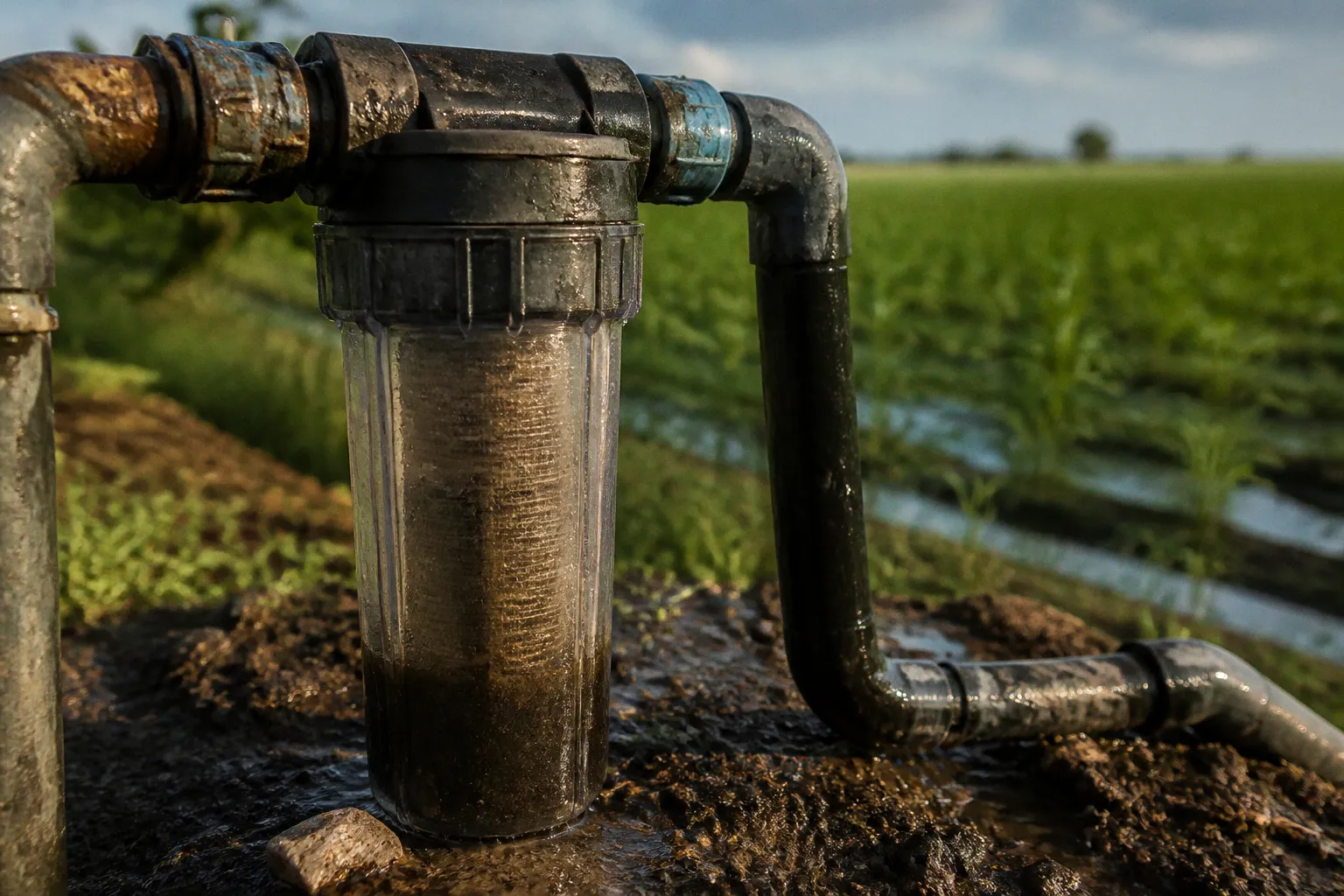
It is algae, organic debris, pathogens, and biofilm that can move through a basic screen filter, accumulate in the network, and shut down emitters fast.
The selection rule is direct: match the filter to the water source, not to the pipe diameter or the lowest quoted price. Clean well water can often run through a screen filter. Algae-heavy river water needs depth filtration—typically disc or sand media filtration—plus a maintenance and disinfection protocol. Coastal groundwater adds a different problem: salinity, fine sand, and mineral deposits.
That is the operating reality behind effective drip irrigation filter selection in Lebanon. The filter is not an accessory at the pump station. It is the control point for flow, crop uniformity, fertigation reliability, and the useful life of every emitter downstream.
Start with the intake: Lebanese water sources do not carry the same risk
Treating all irrigation water as “dirty” is too crude to be useful. You need to identify what is entering the system and how that material behaves under pressure.
Surface water: organic load first
The Litani River and Canal 900 experience severe summer algae proliferation, including cyanobacteria. Agricultural runoff and untreated wastewater increase the organic and biological load. That material does not behave like loose sand.
Sand settles. Algae forms strands, mats, and sticky fragments. Organic particles can pass through or bridge a screen, then collect at the emitter inlet. Once they begin decomposing inside the line, they contribute to biofilm formation. A filter that looks acceptable during a short visual inspection may already be feeding a clogging problem into the field.
The contamination risk is not theoretical. A 2023 study of 10 major Lebanese rivers found that 60% exceeded FAO guidelines for E. coli, while 40% exceeded fecal coliform limits. Separate plant-health evidence has identified viable microsclerotia of Verticillium dahliae in residues from mesh-type irrigation filters in commercial Lebanese orchards. River and canal water can therefore act as both a clogging source and a disease pathway.
If your source is open water, design the filtration train around organic solids and biological contamination. Do not install a basic screen filter and assume the problem is solved.
Well water: sand, rust, and minerals
A clean borehole changes the design. The dominant particles may be sand, rust, and mineral deposits rather than algae. In that case, a screen filter can be a practical first-stage option.
This does not mean every well is clean. Coastal groundwater can carry sand intrusion and salinity. Mineral deposits such as calcium carbonate may accumulate in emitters and filtration components. You need a water sample and an operating observation before selecting the final setup.
If the well produces visible sand, install a separator or appropriate pre-filtration upstream where the system design allows it. If the problem is mineral scale, chemical cleaning may be required later. A screen can capture particles. It cannot correct salinity, dissolve calcium carbonate, or disinfect contaminated water.
Reclaimed or wastewater-affected sources: assume a heavy load
Reclaimed wastewater and eutrophic river water bring high organic loads. These sources need filtration that can retain more than the large particles visible at the intake.
For this duty, sand media filters are usually the strongest option because they retain organic solids through a depth bed rather than relying on a single surface layer. The trade-off is operational: the media must be backwashed regularly, and the backwash cycle needs sufficient water flow and a workable discharge route.
The filter must be selected for the worst day of the water source—not the clearest sample you see at the start of the season.
Why screen filters fail in high-organic environments
Screen filters are simple, accessible, and useful in the correct application. They are also frequently assigned a job they cannot sustain.
A screen captures particles on a mesh surface. With clean well water, that can be exactly what you need. With algae-rich surface water, the screen loads quickly. The pressure differential rises, flow falls, and the operator is forced into repeated manual cleaning. If the cleaning interval is longer than the crop can tolerate, the downstream system receives a fluctuating water supply and uneven fertigation.
The failure sequence is predictable:
1. Algae and organic fragments arrive at the filter.
2. The mesh surface loads rapidly.
3. Pressure loss increases across the filter.
4. Flow to laterals drops or becomes uneven.
5. Operators open the filter manually, remove the debris, and restart.
6. Residual organic matter continues into the network.
7. Biofilm and emitter clogging develop downstream.
Screen filters supplied for agricultural water in Lebanon can be appropriate for clean well water, particularly where the main target is sand or rust. They are not a reliable standalone solution for raw Litani or Canal 900 water during periods of heavy algae growth.
The critical distinction is not whether the screen is rated at 120 mesh. The distinction is whether the water contains a load that will blind the screen before the next cleaning cycle.
Use the pressure differential as an operating signal
Do not manage filtration by calendar habit alone. Install pressure gauges before and after the filter, then track the pressure difference during normal pumping. A rising differential indicates loading. The exact acceptable threshold depends on the filter design and manufacturer instructions, but the operating principle is fixed: rising differential means reduced hydraulic capacity and a maintenance event approaching.
If the pressure differential rises quickly after startup, the issue is not simply “clean the filter more often.” It may indicate that the filter type is wrong for the source. More frequent manual cleaning can keep a weak design running, but it increases labor demand and leaves more room for missed maintenance.
If the pressure differential remains stable but emitters still clog, look downstream. The system may be carrying dissolved minerals, biological material, or particles small enough to pass the selected screen. That is where flushing and chemical treatment enter the protocol.
Disc filters and sand media: the practical upgrade path
For Lebanese farms using surface water, disc and sand media filters solve different parts of the problem.
Disc filters: compact depth filtration
Disc filters use a stack of grooved plastic discs. Water passes through the intersecting grooves, and particles are retained through the depth of the disc pack. This gives the system more capacity for organic matter and algae than a basic screen surface.
Disc filters are widely distributed in Lebanon and offer a practical fit where space, capital, or installation complexity is limited. Standard 3/4-inch to 2-inch disc filters are listed in the approximate range of $16 to $55 by local supplier Unifert, while larger Helix system disc filters in the 2-inch to 3-inch range are listed around $366 to $500. Treat these as equipment references, not a complete project price: valves, pressure gauges, manifolds, installation, spare elements, and drainage can change the total system cost.
Use a disc filter when:
- The source contains moderate organic debris and algae.
- You need compact equipment near the pump station.
- Manual cleaning is acceptable and access is straightforward.
- The hydraulic flow rate matches the filter’s rated capacity.
- You can install a pre-screen or intake protection upstream where necessary.
The disc pack still needs cleaning. It is not a self-cleaning system by default. If the operator cannot reach the filter reliably during summer loading, the installation will underperform regardless of the catalog specification.
Sand media filters: the heavy-load option
Sand media filters are the stronger choice for high organic loads, reclaimed wastewater, and eutrophic river water. Water travels through a media bed, allowing the filter to retain organic solids throughout the bed rather than concentrating all material on a single mesh surface.
The price is operational complexity. You need:
- Correct media depth and grain specification.
- A backwash valve arrangement.
- Adequate flow for effective backwashing.
- A drainage or discharge route.
- A schedule tied to pressure differential and water quality.
- Operators who understand that backwashing is part of normal operation, not an emergency repair.
If the source becomes visibly algae-heavy in summer, sand media filtration should be evaluated before the system begins clogging. Waiting until emitters fail turns a design decision into a crop-protection problem.
Disc versus sand media: make the decision operational
| Parameter | Disc filter | Sand media filter |
|---|---|---|
| Best fit | Clean to moderately contaminated water with organic particles | High organic load, reclaimed wastewater, eutrophic river water |
| Filtration action | Depth filtration through grooved disc stacks | Depth filtration through a media bed |
| Footprint | Compact | Larger and more installation-intensive |
| Cleaning | Manual disassembly or approved cleaning cycle, depending on model | Regular backwashing |
| Main advantage | Practical upgrade from a screen filter | Highest retention of organic solids |
| Main risk | Rapid loading if undersized or poorly maintained | Ineffective backwash if flow and drainage are inadequate |
| Lebanese application | Surface water where compact equipment is preferred | Heavy-load surface water and wastewater-affected sources |
The selection is simple if you state the operating constraint clearly. If labor and space are limited but organic load is moderate, use a properly sized disc system. If organic load is high, prioritize sand media capacity and engineer the backwash system correctly.
Filtration is only one part of clogging control
A filter removes suspended material. It does not eliminate every cause of emitter failure.
Drip systems in Lebanon typically use 120 mesh, equivalent to approximately 130 microns, as a standard filtration level for preventing emitter clogging. That specification is useful, but it says nothing about the chemical or biological condition of the water after filtration.
There are three different clogging categories:
- Physical clogging: sand, rust, algae fragments, and suspended solids.
- Chemical clogging: calcium carbonate, iron deposits, and other mineral precipitation.
- Biological clogging: bacteria, algae, and organic biofilm growing inside the network.
Each requires a different response.
Acid is for mineral deposits
Nitric acid and similar acid-washing protocols can dissolve mineral deposits such as calcium carbonate. This is a chemical descaling action. It does not remove organic algae or destroy every biological contaminant inside the lines.
If the clog is white, hard, and mineral-like, acid treatment may be relevant. If the material is slimy, dark, green, or organic, acid alone is the wrong tool.
Never convert a chemical treatment into an improvised field recipe. Concentration, injection time, compatibility with pipes and emitters, neutralization, and worker protection must follow the product and system protocol.
Oxidants are for organic biofilm
Hydrogen peroxide or chlorine may be used to control organic biofilm and algae in drip lines. The choice depends on water chemistry, crop protocol, equipment compatibility, and the required contact time.
If the source carries biological contamination, filtration does not make the water automatically safe. Secondary disinfection—such as chlorination or UV, where correctly designed—may still be necessary. Do not represent drip irrigation as a complete contamination barrier. It is a delivery method, not a water-treatment plant.
A practical cleaning sequence looks like this:
1. Identify whether the deposit is physical, mineral, or biological.
2. Flush the mainline and laterals to remove loose material.
3. Check pressure and emitter flow at both near and far ends of the field.
4. Apply the appropriate chemical treatment under a controlled protocol.
5. Allow the required contact period.
6. Flush the network thoroughly before returning it to crop operation.
7. Recheck filters, end caps, and representative emitters.
If you skip diagnosis, you will often use acid against algae or chlorine against mineral scale. Both mistakes cost time and can damage the system.
Design for the field, not just the pump station
Lebanon’s drip irrigation systems can reach approximately 85% on-farm water-use efficiency, compared with about 50% for surface irrigation and 70% for sprinkler irrigation. That efficiency depends on maintaining uniform emitter discharge. A blocked filter or contaminated lateral can erase the advantage without any visible failure at the pump.
The filter station needs to be designed around the full network:
- Pump capacity and actual operating flow.
- Pipe diameter and pressure requirements.
- Number and type of irrigation zones.
- Emitter flow rate, including common 4 L/h local drip-line configurations.
- Water source variability between winter and summer.
- Access for cleaning and inspection.
- Availability of backwash water.
- Drainage from filter cleaning.
- Fertilizer injection point and chemical compatibility.
- Spare discs, screens, gaskets, and pressure gauges.
Do not size the filter from the pump nameplate alone. A pump may deliver different flow depending on lift, pipe friction, elevation, and the number of open zones. A filter that is technically connected to a 2-inch line can still be undersized for the actual flow.
If the filter is too small, pressure loss rises and cleaning frequency increases. If it is too large without a maintenance plan, the capital is tied up in equipment that may still be neglected. The correct design is the one that keeps the target flow within the filter’s operating range during the highest expected contaminant load.
Build a two-stage system when the source demands it
For difficult surface water, one filter may not be enough. A practical arrangement can combine intake protection with a primary depth filter and a final disc or screen stage before the irrigation network.
The exact sequence depends on the source and hydraulic design, but the logic is stable:
- Stop large debris before it reaches the pump.
- Remove organic solids with disc or sand media filtration.
- Use a final filter stage to protect the emitters.
- Add disinfection or chemical treatment where biological contamination requires it.
- Flush the network at the end of the lines.
This is more robust than forcing one mesh element to handle leaves, algae, sand, and fine particles simultaneously.
The cost decision: compare downtime, not just equipment
A basic screen filter has the lowest entry cost and may be completely correct for clean well water. The mistake is treating the purchase price as the system cost.
Your real cost includes:
- Filter equipment.
- Installation and valves.
- Pressure gauges.
- Backwash infrastructure where required.
- Replacement elements and gaskets.
- Cleaning labor.
- Pump energy caused by pressure loss.
- Water wasted during flushing.
- Reduced fertigation uniformity.
- Emitter replacement.
- Crop loss from dry zones.
The exact retail price of large sand media systems is often quoted project by project, so do not build a budget around a generic catalog number. Request a complete bill of materials and a hydraulic duty point.
The lower-cost path works if the water is clean and the operator can maintain the filter. It fails if the source is algae-heavy and the farm does not have labor available for frequent intervention.
The higher-capacity path works if the backwash system is engineered and operated. It fails if the media filter is installed without adequate flow, drainage, or maintenance access.
That is the decision framework: pay for filtration capacity where the water demands it, and pay for simplicity where the source allows it.
A field protocol for Lebanese exporters and cooperatives
Cooperatives handling multiple farms should standardize filtration records. A shared protocol prevents each grower from improvising a different response to the same water problem.
Record the following at each irrigation station:
- Water source and intake location.
- Date and season of observation.
- Filter type, mesh or media specification, and nominal diameter.
- Pressure before and after filtration.
- Cleaning or backwash date.
- Visible algae, sand, rust, or sludge.
- Emitter flow at the beginning and end of representative laterals.
- Chemical treatment used, if any.
- Disinfection record where applicable.
- Filter element or disc-pack condition after cleaning.
Use an if-then operating rule:
- If well water is clear and the main issue is sand or rust, then a correctly sized screen filter may be sufficient.
- If surface water shows algae or high organic debris, then move to disc or sand media filtration rather than increasing screen-cleaning frequency indefinitely.
- If the filter loads quickly during summer, then treat the loading rate as a design failure signal, not merely a labor issue.
- If emitters clog while the filter remains clean, then investigate chemical and biological deposits downstream.
- If irrigation water is biologically contaminated, then add an appropriate disinfection step and do not claim filtration alone makes the water safe.
- If mineral scale is present, then use an approved acid-cleaning protocol; do not expect acid to remove algae biofilm.
- If the system cannot be backwashed properly, then do not install a sand media filter until flow and drainage are resolved.
A filter station is successful only when the operator can maintain it at the exact moment the water quality deteriorates.
Mandatory commissioning and compliance checklist
Before the first full irrigation cycle, confirm:
- The water source has been identified as well, surface, reclaimed, or mixed.
- Seasonal algae risk has been considered for Litani, Canal 900, or other open-water intakes.
- The filter matches the contaminant profile rather than the cheapest available specification.
- The system can achieve the required 120-mesh-equivalent protection for the drip network where applicable.
- Pressure gauges are installed before and after the filtration stage.
- The filter can be isolated, opened, cleaned, and returned to service without dismantling the entire station.
- Sand media systems have adequate backwash flow and discharge.
- Disc and screen elements have accessible spares.
- Mainlines and laterals can be flushed at their ends.
- Chemical treatment points are compatible with the irrigation and fertigation layout.
- Acid is reserved for mineral deposits, while oxidizing treatment is used for organic biofilm under a controlled procedure.
- Any water-reuse application is reviewed against the relevant Libnor standards published in 2024.
- Biological contamination is treated as a water-quality issue, not only a clogging issue.
- Near-end and far-end emitter performance has been checked after commissioning.
The correct irrigation filter for Lebanese water is not determined by brand, pipe size, or a single clean sample. It is determined by source behavior, contaminant load, hydraulic duty, and the maintenance capacity of the farm.
Use a screen filter for the job it can handle. Use disc filtration when organic debris makes a basic mesh unreliable. Use sand media when the load is heavy and the farm can support proper backwashing. Add chemical treatment and disinfection when filtration alone cannot control the problem.
That is the operational route to stable drip irrigation: match the barrier to the water, instrument the pressure loss, clean on evidence, and never let a low-cost filter become the most expensive component in the field.