Drip Irrigation Filters: Matching Lebanese Water Sources
A 120-mesh filter is a common starting point for drip irrigation. On a clean groundwater well, it may be enough to keep sand and inorganic debris out of the laterals.
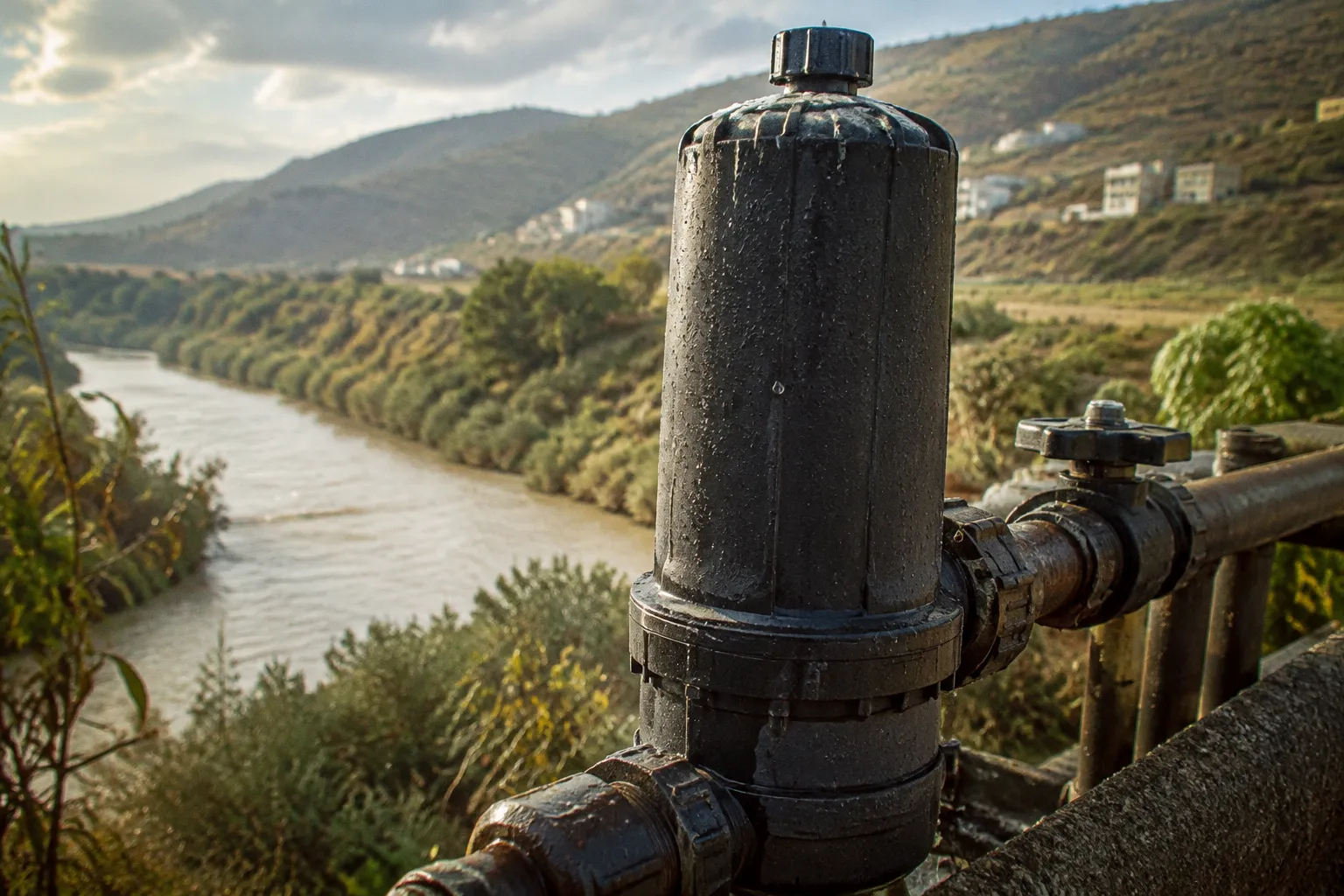
On surface water from the Litani, Canal 900, or another open channel, the same filter can become a liability: algae and biofilm load the screen quickly, while fine organic particles continue toward the emitters.
That is the operational bottleneck. The right irrigation filter types for Lebanon are not selected by crop alone, and not by mesh size alone. They are selected by the water source, the contaminant load, the pressure available for backwashing, and the maintenance protocol that follows filtration.
If you match the filter to the source, you protect emitter flow and reduce unplanned flushing. If you install a standard screen unit on high-organic surface water, expect short cleaning intervals and unstable irrigation uniformity.
Start with the water source, not the catalogue
Lebanese farms commonly work with very different water profiles within the same production region. A deep agricultural well, a river intake, a lined canal, and reclaimed wastewater do not present the same filtration problem.
The first question is not whether the water looks clear in a tank. The question is what reaches the emitter after pumping, storage, heating, and exposure to air.
Groundwater from agricultural wells
Well water is often dominated by inorganic material:
- Sand from the aquifer or poorly developed well.
- Rust and scale from pipes, pumps, and fittings.
- Mineral deposits that may later form inside emitters.
- Occasional fine sediment after pumping resumes or the water table shifts.
For this profile, a screen filter can be the most direct solution. It gives a simple barrier, is easy to inspect, and does not add the footprint or backwash demand of a larger media installation.
But clean-looking well water still needs a chemical assessment. Physical filtration removes particles. It does not dissolve mineral scale. If the water has a tendency to deposit calcium or other minerals, the emitters can clog even when the screen remains clean.
River and open-channel water
Surface water creates a different logistics problem. It carries suspended silt, algae, organic fragments, and biological material that changes with season, temperature, upstream discharge, and storage conditions.
The Litani and Canal 900 are not equivalent to a borehole. A 120-mesh screen may stop larger debris, but high organic loads can blind the mesh surface rapidly. Fine algae and biofilm can either pass through or form a sticky layer that collapses flow across the filter.
This is where disc or sand media filtration becomes the practical upgrade. The filter must capture contamination through depth, not simply place a thin screen in its path.
Reclaimed or mixed water
Reclaimed wastewater needs the strictest process discipline because its risks are not limited to visible solids. Organic loading, biological growth, chemical residues, and fine suspended particles can all affect the drip network.
A filter train may need to combine coarse separation, depth filtration, and chemical treatment. The exact arrangement depends on the water analysis and the reuse process. Do not treat a single mesh rating as a complete solution.
A 2023 evaluation of Lebanese rivers found that surface water sources including the Litani, El Kabir, Kadisha, and Damour exceeded the FAO pH guideline range of 6.0–8.5. That does not mean every intake has the same condition, but it does mean direct agricultural use cannot be treated as a default. Source testing and treatment sit upstream of the filter selection.
A 120-mesh filter is a starting specification, not a Lebanese water-treatment strategy.
Screen filters: the clean-well option
Screen filters work by passing water through a perforated or woven screen that retains particles above the selected opening. They are compact, familiar, and operationally straightforward.
For well water filtration in Lebanese agriculture, that simplicity has real value. A clean screen filter can protect drip lines without forcing the farm into a large backwash system. It is also easier to inspect during a routine irrigation round: isolate the housing, remove the screen, wash it, and check whether the contaminant pattern has changed.
A 120-mesh screen is commonly used as a baseline for drip systems. The equivalent filtration range is roughly around 130 microns, depending on the screen and manufacturer’s specification. That baseline should be treated as a design reference, not an automatic answer.
Use a screen filter if:
- The source is a relatively clean groundwater well.
- The main issue is sand or inorganic debris.
- The organic load is low.
- The farm can inspect and clean the screen regularly.
- The pump and irrigation block do not require a high-volume backwash cycle.
Do not rely on a screen filter if:
- The intake is exposed to algae or floating organic matter.
- The water contains heavy fine silt.
- The screen clogs rapidly after every irrigation cycle.
- Pressure loss rises quickly even when the intake appears clear.
- Emitters show biological slime or recurring organic blockage.
The failure mode is predictable. A screen catches contamination at one surface. Once that surface loads up, pressure falls and flow becomes unstable. If the operator keeps running the system, the filter may deform, bypass may open, or the irrigation block may simply receive inadequate flow.
That is not a filter-quality problem. It is a mismatch between filter technology and source load.
Disc filtration: the operational middle ground
Disc filters use stacks of grooved rings. Water moves through the channels between the discs, and particles are trapped through the depth of the compressed stack rather than on one flat screen surface.
That geometry makes disc filters useful when a screen is too fragile for the source but a full sand media system would be excessive. They are compact and can handle medium organic loads, including algae, more effectively than a simple screen arrangement.
Typical disc filtration ranges run from roughly 20 to 200 microns. A 130-micron configuration is commonly associated with the 120-mesh baseline used in drip irrigation. The number alone does not determine performance: disc surface area, flow rate, pressure, contaminant type, and cleaning method all matter.
Disc versus screen filters in farming
| Parameter | Screen filter | Disc filter |
|---|---|---|
| Best source profile | Clean groundwater | Groundwater with fines or surface water with medium organic load |
| Filtration action | Surface separation | Depth filtration through grooved discs |
| Sand and inorganic debris | Effective when load is moderate | Effective, especially when particles are mixed with fine sediment |
| Algae and biofilm fragments | Can clog the screen quickly | Better suited to medium organic loads |
| Footprint | Compact | Compact, usually with greater dirt-holding capacity |
| Maintenance signal | Visible screen loading and pressure drop | Pressure differential across the disc pack |
| Typical baseline | Around 120 mesh | Commonly around 130 microns, with broader available ranges |
| Main limitation | Surface blinds quickly under organic load | Still requires cleaning and cannot replace chemical treatment |
Disc filtration is a strong choice when the farm’s water quality is variable but not consistently extreme. For example, an irrigation block drawing from a canal may perform well with disc filtration during lower organic-load periods, then require a stronger upstream arrangement when algae blooms or heavy silt events occur.
Use a pressure differential gauge across the filter. Do not wait for emitters to reveal the problem. By then, the network has already lost uniformity.
A practical design review should cover:
- Maximum flow through the irrigation block.
- Normal and peak pressure at the filter inlet.
- Available pressure for flushing or backwashing.
- Disc surface area relative to flow.
- Access for removing and cleaning the disc pack.
- Whether the intake can be isolated during poor water-quality events.
A filter that is correctly rated on paper but undersized for peak flow will produce the same result as the wrong technology: pressure loss, dirty laterals, and repeated intervention.
Sand media filtration: the surface-water workhorse
Sand media filters use layers of sand and gravel to capture heavy loads of organic matter, algae, and fine silt. They are the primary heavy-load option when the source is open surface water and the contaminant profile is too aggressive for a screen or compact disc unit.
The difference is capacity. Instead of forcing all contamination onto a small mesh or disc surface, the media bed distributes capture through a deeper volume. That gives the system more tolerance before flow becomes restricted.
The trade-off is infrastructure. A media system requires more space, a properly designed valve arrangement, backwash capacity, and an operating procedure that staff can follow consistently. It is not a fit-and-forget tank.
Choose sand media filtration when:
1. The source is a river, canal, reservoir, or exposed intake.
Surface water with algae and organic debris needs depth filtration. A single screen filter is not designed for that load profile.
2. Fine silt returns after every cleaning cycle.
If the filter is repeatedly loaded with fine sediment, the media bed can provide greater holding capacity and more stable operation.
3. The farm runs large irrigation blocks.
Higher flow rates and longer irrigation windows increase the cost of frequent manual screen cleaning. A properly sized media system can move maintenance into a controlled backwash routine.
4. The source quality changes through the season.
A river intake may look acceptable for several weeks and then deteriorate after upstream disturbance, heat, or algae growth. The filtration train must tolerate the worst normal operating condition, not just the cleanest sample.
5. Organic contamination is the primary clogging threat.
Sand media is designed for the contamination that blinds surface filters quickly.
A media filter still requires disciplined monitoring. Track inlet and outlet pressure. Record the pressure differential at clean start-up and during operation. If the differential rises faster than the normal pattern, investigate the source and backwash sequence rather than simply increasing pump pressure.
Operating pressure matters. Around 400 kPa is suggested in some filtration setups for reducing turbidity, but the usable pressure depends on the complete hydraulic design: pump curve, elevation, pipe friction, valve arrangement, emitter requirements, and backwash demand. Do not copy a pressure figure without checking the system curve.
Media filtration is not a substitute for intake control
The best sand filter cannot compensate for a badly designed intake. Keep large debris, floating vegetation, and coarse solids out before they reach the media vessel. Protect the pump. Control storage tanks. Prevent settled sludge from being pulled directly into the irrigation line.
If the intake receives a sudden sediment surge, isolate the irrigation network and manage the event upstream. Sending a shock load into the filter will shorten cleaning intervals and destabilize the entire block.
Hydrocyclones: useful before the main filter
Hydrocyclones are designed to separate heavier inorganic particles, especially sand, from the water stream through centrifugal action. They are useful on wells with persistent sand production and can reduce the load reaching a downstream screen, disc, or media filter.
They do not replace fine filtration. They also do not solve algae, biofilm, dissolved minerals, or chemical scale. Treat the hydrocyclone as a pre-separation stage where the source produces heavy sand, not as the final protection for drip emitters.
A common source-specific arrangement looks like this:
- Clean well with limited sand: screen filter may be sufficient.
- Sandy well with recurring solids: hydrocyclone upstream, followed by a screen or disc filter.
- Moderately contaminated canal: coarse intake protection followed by disc filtration.
- Heavy algae and fine silt in surface water: intake protection, sand media filtration, then downstream fine filtration if required.
- Reclaimed or chemically complex water: physical filtration combined with a treatment protocol based on testing.
The correct sequence depends on the measured source. The principle does not change: remove heavy solids early, use depth filtration for organic and fine suspended loads, and protect the emitter with the final filtration stage.
If your filter clogs in hours, the answer is rarely a finer mesh. The answer is usually more filtration depth, better pre-separation, or a missing chemical protocol.
The chemical blockage problem
Mechanical filtration removes suspended particles. It does not remove every cause of emitter failure.
Two blockage categories require separate action:
- Mineral deposits: acid treatment is used to dissolve scale and mineral accumulation inside the irrigation network.
- Organic biofilm: oxidants are used to break down biological material and clear slime inside lateral lines.
The sequence matters. A clean filter does not prove that the laterals are clean. Conversely, chemical treatment does not excuse poor filtration. If the source keeps feeding algae and silt into the system, treatment becomes a recurring emergency rather than a controlled maintenance operation.
Use the water analysis to define the protocol. Avoid improvising acid or oxidant dosing around crop sensitivity, worker safety, fertigation compatibility, and discharge requirements. The irrigation network is part of the farm’s production infrastructure; chemical maintenance needs a written operating procedure.
A workable protocol should define:
- Which symptom triggers inspection.
- Whether the suspected blockage is mineral, organic, or particulate.
- Which treatment is authorized for that condition.
- How the irrigation block is isolated.
- How long the treatment remains in the lines.
- How the system is flushed afterward.
- Who records the result and verifies emitter recovery.
Do not combine treatment products casually. Acid and oxidant programs have different purposes and different handling risks. The operator needs a defined sequence, not a collection of unlabelled containers beside the pump room.
Build the filtration train around the worst normal day
Filter selection often fails because the system is designed around an average water sample. Average conditions do not protect a commercial crop. Your irrigation block must survive the period when the source carries the most problematic normal load.
That does not mean designing for an impossible disaster. It means identifying the operating events that actually occur:
- River algae during hot periods.
- Fine silt after upstream disturbance.
- Sand production when a well pump restarts.
- Organic debris after heavy runoff.
- Mineral deposition during long irrigation cycles.
- Pressure instability when multiple blocks open together.
Then size the equipment and maintenance window around those events.
For Lebanese farms, the source-specific decision can be kept direct:
| Water source or condition | First-line filtration approach | Follow-up control |
|---|---|---|
| Clean deep well | Screen filter around the drip-system baseline | Inspect for sand and monitor mineral scale |
| Well with persistent sand | Hydrocyclone plus screen or disc filter | Remove collected sand and verify downstream pressure |
| Well with fine sediment | Disc filtration | Monitor differential pressure and clean the disc pack |
| Canal or river with medium algae load | Disc filter with protected intake | Plan frequent inspection and biological maintenance |
| Heavy algae, organic matter, and fine silt | Sand media filter | Backwash on pressure differential and maintain intake protection |
| Water with mineral scale risk | Physical filter matched to solids | Add an acid-treatment protocol |
| Water with biofilm risk | Disc or media filtration as source requires | Add an oxidant-based line-cleaning protocol |
The table is a decision aid, not a substitute for source testing. The same river can produce different loads at different intakes. The same well can change after pumping, maintenance, or seasonal drawdown.
What to measure before buying equipment
You do not need a complicated laboratory campaign to eliminate the most common design errors. You do need measurements that connect directly to the irrigation system.
Record:
- Water source and intake location.
- Pump flow at the pressure used for irrigation.
- Inlet and outlet pressure at the filter.
- Pressure differential during a normal irrigation cycle.
- Visible sand, algae, silt, or organic debris.
- Cleaning frequency under current conditions.
- Emitter-flow variation across the block.
- pH and any available water-quality indicators.
- Whether the water is stored before filtration or after filtration.
- Backwash water availability and disposal route.
If the farm is comparing screen and disc filters, run the comparison against the actual flow and source load. A cheaper compact unit can become the expensive option if staff must stop irrigation repeatedly to wash it.
If the choice is between disc and media filtration, calculate the operational cost, not only the purchase price:
- Filter vessel and valves.
- Pumping pressure.
- Backwash water.
- Labour for cleaning and inspection.
- Replacement parts.
- Crop risk from interrupted irrigation.
- Chemical maintenance.
- Space and access around the filtration station.
The least expensive filter is the one that keeps the irrigation block within its intended pressure and flow range with a maintenance schedule the farm can execute.
A mandatory commissioning and compliance check
Before releasing the system into regular production, sign off these points:
- Confirm the source: well, river, canal, reservoir, or reclaimed water.
- Record the water pH and available quality data.
- Confirm the selected filter matches the dominant contaminant: sand, silt, algae, organic matter, or mixed load.
- Verify the filter flow rating against the irrigation block’s peak demand.
- Install pressure gauges before and after the filter.
- Mark the clean differential-pressure reading.
- Test the cleaning or backwash sequence with the actual pump and valve configuration.
- Confirm that the intake excludes coarse debris before water reaches the main filter.
- Inspect the first irrigation cycle for emitter flow and pressure uniformity.
- Write separate procedures for mineral-scale treatment and biofilm treatment.
- Keep acid and oxidant handling instructions visible at the pump station.
- Record every cleaning, backwash, chemical treatment, and abnormal pressure event.
- Reassess the filter choice if the system clogs faster than the expected maintenance interval.
The final decision is straightforward. Use screen filters for clean, predominantly inorganic groundwater. Move to discs when the source carries medium organic or fine-particle loads. Use sand media filtration when surface water brings heavy algae, silt, and organic matter. Add hydrocyclone separation when sand is the upstream problem. Add chemical protocols when the blockage is mineral or biological.
For drip irrigation filters on Lebanese farms, the winning specification is not the finest mesh in the catalogue. It is the filtration train that matches the water source, holds stable pressure, and gives your team a repeatable maintenance protocol.