Hydroponic tank heat: the quick reflective wrap fix
Walk into a greenhouse in the Bekaa Valley at mid-afternoon in July, and the heat is coming from every direction: the metal frames, the concrete paths, the black plastic reservoirs sitting on the ground.
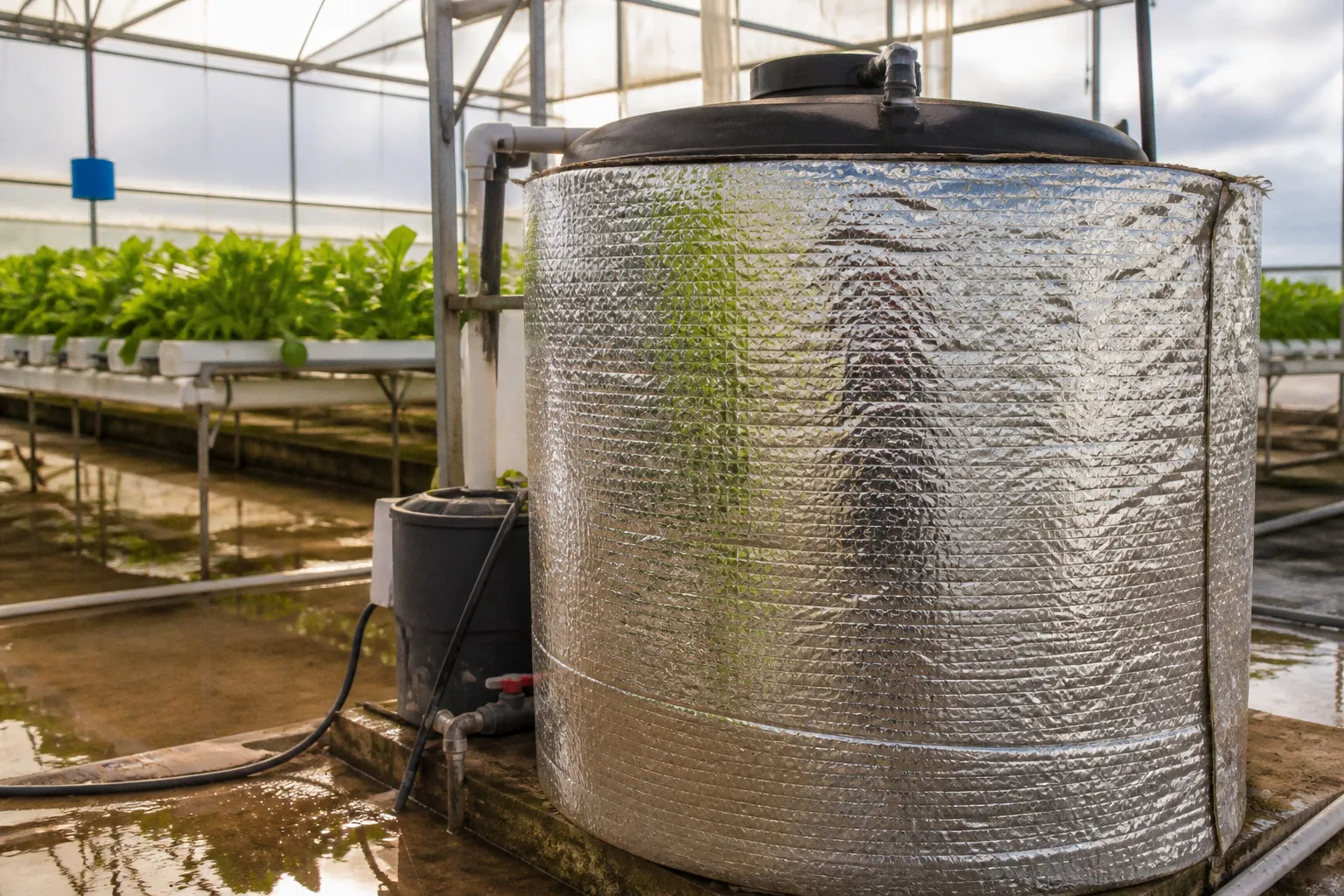
Touch the wall of a nutrient tank that has been absorbing direct sun since morning, and you will pull your hand back. That reservoir may be sitting at 32°C or higher while the nutrient solution inside continues to warm. The plants above can still look healthy. Below the waterline, however, dissolved oxygen is falling and the roots are operating under increasing stress.
For hydroponic growers across Lebanon’s intensive greenhouse belt, this is not a minor comfort issue. Summer temperatures can push unshaded structures well above the conditions in which a reservoir is easiest to manage, while the electricity required for active water chillers may be difficult for a small farm or cooperative to justify. Growers moving from soil-based production often focus first on nutrient mixing, irrigation timing and crop selection. In the hot season, reservoir temperature deserves the same attention.
The answer does not always begin with a chiller. In many systems, the first useful intervention is much simpler: keep direct radiation off the tank and slow the rate at which heat reaches the nutrient solution.
That is what reflective insulation can do.
The physics of heat absorption in hydroponic tanks
A reservoir heats up through three overlapping routes. Understanding them matters because reflective wrap addresses one route particularly well, while insulation and placement deal with the others.
Radiant heat reaches the tank before the air does
Radiant heat is usually the most obvious problem in a greenhouse or outdoor installation. Sunlight strikes the tank directly, and artificial grow lights can also add radiant energy, particularly when the reservoir is positioned close to the fixtures. A dark plastic surface absorbs much of that energy and converts it into heat.
Black polyethylene is popular because it is inexpensive, durable and effective at blocking light. Those are useful properties inside a hydroponic system, where light entering the reservoir can encourage algae. The same dark surface, though, is a poor choice when it is exposed to intense sun. It absorbs radiation instead of reflecting it away.
A white or metallic outer surface behaves differently. It reflects a larger share of incoming radiation before the tank wall can absorb it. The wrap does not make the water cold. It reduces the heat load that the reservoir has to absorb in the first place.
Conduction comes up from below
The second route is conduction: heat moving through materials that are in direct contact with one another. A tank standing on a sun-warmed concrete slab can absorb heat through its base for hours. Bare soil can also become a significant heat source at the surface, especially where the reservoir is exposed to sun and there is little moisture or shading around it.
This is why wrapping only the vertical walls sometimes produces disappointing results. The sides may be protected while the tank floor remains in direct contact with a hot surface. A rigid insulating board beneath the reservoir interrupts that path. It also helps distribute the tank’s weight and reduces pressure points that can damage a plastic base.
Convection keeps the heat moving
The third route is convection. Hot air circulates around the reservoir and transfers heat to the tank wall. In a greenhouse with weak ventilation, the air surrounding the tank may remain hot even when the outdoor temperature has begun to fall.
Reflective material cannot stop convection completely. It can, however, work as part of a wider arrangement that includes shade, air movement and a small gap between the wrap and the tank. The gap is useful because it limits direct contact between the hot outer covering and the tank wall.
The combined effect is easy to see in practice: a dark reservoir exposed to sun may gain several degrees over the course of a day, and the nutrient solution can respond more slowly or more quickly depending on its volume, circulation, the tank’s lid and the temperature of the surrounding structure. Smaller reservoirs usually react faster than larger ones. A tank that is shaded but sitting on hot concrete may behave differently from one that is fully exposed but placed on an insulated platform.
There is no single temperature result that applies to every greenhouse. The point of the wrap is not to promise a fixed reduction. It is to reduce the rate of heat gain and give the rest of the system more time to keep up.
Why nutrient solution temperature dictates root health and oxygen levels
Temperature matters because the root zone is not separate from the water chemistry around it. As water warms, its capacity to hold dissolved oxygen declines. Warm nutrient solution therefore gives roots less oxygen at exactly the time when heat is already increasing their metabolic and physiological stress.
Plant roots need oxygen for aerobic respiration, the process that supports active nutrient uptake and normal root function. When oxygen availability becomes insufficient, roots can lose efficiency, appear weak or discolored, and become less able to recover from other stresses such as salinity swings, poor sanitation or inconsistent irrigation.
Low dissolved oxygen can also increase disease risk, but the relationship is not governed by one universal threshold. The relevant level depends on crop, root-zone design, water movement, aeration, organic load, temperature and the condition of the plants. A reading that is acceptable in one system may be inadequate in another. The same applies to claims about a specific pathogen appearing at a specific oxygen concentration: exact thresholds vary, and pathogen prevalence cannot be reduced to one number.
The practical conclusion is more useful than a false cutoff. As nutrient solution gets hotter and oxygen becomes harder to maintain, the root environment becomes less forgiving. Poorly oxygenated water can impair root performance and may create conditions in which root diseases, including problems associated with Pythium and other pathogens, are more likely to develop. That is a risk statement, not a guarantee of disease and not a universal laboratory threshold.
The useful target is not a magic number. It is a cooler, better-aerated root zone with enough margin to tolerate a hot afternoon without becoming unstable.
Most common hydroponic crops perform more comfortably in moderate solution temperatures than in a hot summer reservoir. Lettuce and many herbs are especially sensitive to heat because their marketable quality declines quickly when growth becomes uneven or bolting begins. Tomatoes, peppers and strawberries may tolerate a wider operating range, but they still depend on healthy, oxygenated roots. Crop choice changes the margin; it does not remove the need for temperature control.
For a Lebanese greenhouse, the realistic objective is often not to hold the nutrient solution at an ideal temperature throughout the entire day without mechanical cooling. It is to prevent unnecessary heat gain, avoid extreme afternoon peaks and preserve enough dissolved oxygen for the roots to keep functioning. Reflective insulation is valuable because it works on that margin.
A thermometer is more useful than visual judgment. Measure the reservoir itself rather than relying only on greenhouse air temperature, and take readings at different points in the day. A tank can be relatively cool in the morning and still become the hottest part of the system by mid-afternoon.
Selecting the right reflective materials: Panda film vs. foil bubble wrap
The best material depends on how much radiant heat the reservoir receives, whether the tank has an irregular shape, how often the covering will be removed and how much durability the installation requires.
Panda film
Panda film, also called black-and-white polyethylene, is a light-blocking plastic sheet with a white side and a black side. Used around a reservoir, the white side faces outward to reflect light and the black side faces inward to block stray light.
It is the practical entry-level option. Agricultural suppliers commonly carry similar sheeting, it can be cut with ordinary tools and it conforms easily to round or irregular tanks. It is also useful when algae prevention is a concern, because the opaque black layer helps keep light away from the reservoir.
Its limitation is that it is mainly a reflective and light-blocking barrier, not a thick insulating layer. It also needs to be protected from tearing, wind and constant rubbing against sharp edges. If the white surface becomes dusty, its reflective performance will decline, so the covering should be kept reasonably clean.
Foil bubble wrap
Reflective foil bubble wrap combines a metallized surface with a layer of air bubbles. The foil reflects radiant heat, while the air layer adds some resistance to conductive transfer. It is usually more substantial than thin plastic film and easier to use as part of a long-term wrap.
This option makes more sense when the tank receives strong direct radiation or when the operator wants a covering that can be removed and reinstalled repeatedly. The material is still not a substitute for thick insulation, and its performance depends heavily on how it is installed. Pressing it tightly against every part of the tank reduces the benefit of the air layer. Leaving a controlled gap is preferable where the structure allows it.
Kitchen aluminum foil
Standard household foil can reflect radiation, but it is a poor permanent solution. It tears, wrinkles and loses its shape quickly. It also offers almost no meaningful insulation by itself. It can be useful as a temporary emergency measure, but it is difficult to secure cleanly around a working farm tank and rarely survives handling for long.
Rigid insulation
Polystyrene or another rigid insulation board does a different job. It is not primarily a reflective surface; it slows heat moving through the base and, if protected, can also be used around the tank walls. A board under the reservoir is often more valuable than an extra loose layer on the sides because it removes direct contact with a hot slab or platform.
The following comparison is more useful than treating one material as universally superior:
| Material | Main function | Strengths | Limitations | Best use |
|---|---|---|---|---|
| Panda film | Reflection and light exclusion | Low cost, easy to cut, suitable for irregular tanks | Little insulation, can tear or degrade | Budget installations and short-to-medium-term protection |
| Reflective foil bubble wrap | Reflection plus a thin air layer | Better suited to strong radiant heat, reusable and durable | Costs more, works best with an air gap | Reservoir sides and lids in bright greenhouses |
| Standard aluminum foil | Reflection only | Cheap and immediately available | Tears easily and provides almost no insulation | Temporary emergency cover |
| Rigid polystyrene board | Conductive insulation | Useful beneath the tank, stable and effective when protected | Does not reflect sunlight and can be damaged if left exposed | Tank base or a complete insulated enclosure |
For many greenhouse hydroponic systems in Lebanon, foil bubble wrap is the more balanced side-covering material. It is not necessarily the cheapest option, but it is easier to maintain than household foil and offers more than a single layer of plastic film. Where budget is tight, panda film with the white side out still represents a meaningful improvement over bare black plastic.
The material should also match the tank. A flexible wrap is convenient around a cylindrical drum, while rigid board is easier to install on a rectangular reservoir with flat sides. The lid deserves the same attention as the walls. If it is a dark surface exposed to sun or grow lights, it can become a major entry point for radiant heat.
Layering techniques for maximum thermal resistance
The strongest low-cost arrangement combines three ideas:
1. Reflect radiant heat away from the reservoir.
2. Interrupt heat transfer through the base.
3. Avoid creating new hot contact points between the covering and the tank.
The installation does not need to look polished, but it does need to be complete. Gaps at the top, exposed corners and an unprotected base can undermine an otherwise sensible wrap.
1. Measure the tank, including access points
Measure the height and circumference of a round tank, or the full perimeter of a rectangular one. Account for the lid, valves, pipes, cables and any section that must remain accessible for cleaning. Leave enough overlap at the seams to prevent the black tank surface from being exposed when the material shifts.
Do not wrap over inspection points that need to be opened regularly. A removable panel or a separate lid cover is more practical than sealing the entire installation and then cutting through it every time the nutrient solution is checked.
2. Wrap the vertical sides
Place the reflective or white surface outward. Secure the wrap with agricultural tape, straps or another fastening method that will not cut into the tank. Avoid relying on staples directly against a plastic reservoir; they can create punctures or sharp points.
The wrap should sit firmly enough not to move in wind or during maintenance, but it should not be compressed so tightly that every part of the reflective layer is pressed against the tank wall. A small air space can improve the arrangement by reducing direct conductive contact.
3. Protect the base
Place a rigid insulation board beneath the reservoir before filling it. The platform must be level and strong enough to support the full tank. A soft or uneven base can stress the plastic, while a board that is too thin or damaged may collapse under load.
If the reservoir sits on a metal frame, inspect the contact points. Metal can conduct heat rapidly, particularly when the frame is exposed to sun. Covering the tank sides while leaving a hot metal shelf in direct contact with the base is an incomplete solution.
4. Add a second layer where the heat load is highest
The top and sun-facing side usually deserve the most attention. A second reflective layer can be added over the first, provided it does not trap moisture against the tank or interfere with access.
On a rectangular tank, a practical assembly may include rigid insulation around or beneath the reservoir, foil bubble wrap outside that layer and a reflective cover over the lid. On a round tank, the same principle can be achieved with a flexible wrap and a separate insulated platform.
The goal is not to create a sealed technical enclosure. It is to combine a reflective outer face with an insulating layer in the places where heat is entering most aggressively.
5. Keep the lid lightproof and removable
Light exclusion is still important. Even a temperature-conscious covering should not allow direct light into the nutrient solution through gaps around the lid. Algae can complicate nutrient management, clog components and make it harder to read the actual condition of the reservoir.
At the same time, the lid must remain easy to remove for checking water level, inspecting roots where applicable, cleaning and measuring temperature. A loose reflective cover that can be lifted during routine work is often better than adhesive applied permanently around every edge.
6. Check for trapped moisture and damaged surfaces
After installation, inspect the wrap periodically. Condensation, fertilizer splashes, dust and tears can reduce its usefulness. Wet material pressed against a tank may create a maintenance problem even if it still reflects sunlight.
Look especially at the lower edge, where irrigation water and soil can collect, and at areas close to pumps, pipes and electrical equipment. The wrap should never obstruct safe electrical access or allow water to pool around connections.
Reflective insulation does not chill your water. It slows the rate at which your water heats up, buying the system more stable hours during the hottest part of the day.
The result will depend on tank volume, starting temperature, solar exposure, air movement, lid design and how much of the reservoir is actually covered. Some installations will see a clear improvement; others will only delay the afternoon peak. That delay can still matter. A reservoir that reaches its maximum temperature later in the day may recover more effectively overnight, especially when shade and aeration are working alongside the wrap.
Managing expectations: when insulation needs a secondary cooling boost
Reflective wrap is often described as if it actively cools the reservoir. It does not. It is a passive barrier. It slows heat transfer but does not remove heat from water that is already too warm.
If the nutrient solution is already at 30°C early in the morning because the greenhouse stayed hot overnight, wrapping the tank will not bring it back to a lower temperature. It may slow the climb later in the day, but the system still needs a way to lose or manage the heat already stored in the water.
This distinction is important in the peak Lebanese summer, particularly in July and August. A greenhouse can remain warm overnight, and insulation can preserve that heat as effectively as it blocks daytime heat. The correct strategy depends on the daily temperature cycle. If the tank is cooling overnight, insulation helps protect it from the next day’s radiation. If the tank never cools, passive wrapping alone is unlikely to keep the root zone within a comfortable range.
Several secondary measures are available, and they do not all cost the same.
Shade the reservoir first
Shade is usually the most effective passive intervention because it prevents direct solar radiation from reaching the tank. Put the reservoir under shade cloth, behind a suitable wall or inside a shaded service area while keeping pumps, pipes and access points practical.
The tank should not be hidden in a stagnant, poorly ventilated corner. Shade reduces radiation; ventilation helps carry heat away from the surrounding air. Both matter. A shaded reservoir exposed to hot, still air can continue to warm, just more slowly.
Move the tank away from hot surfaces
Where structural changes are possible, position the reservoir on an insulated, level platform rather than directly on a sun-heated slab. Semi-burying or burying a tank can also reduce exposure to daytime air temperatures, but the approach requires careful attention to access, leaks, cleaning and groundwater.
The soil is not automatically cold, and a buried tank can be difficult to inspect. This is a site-design decision, not a quick fix to apply without considering maintenance.
Increase aeration and circulation
An air stone and pump can raise dissolved oxygen and improve mixing. That can partially offset the oxygen disadvantage of warm water, but it does not lower the water temperature by itself. Aeration should therefore be treated as support for root health, not as a replacement for thermal control.
Check that the pump is appropriately sized, that tubing remains clear and that the added equipment does not introduce more heat than the system can dissipate. Small pumps usually add less heat than larger equipment, but every installation should be judged by the actual temperature trend.
Use frozen bottles only as a short-term measure
For a small system during a heat spike, frozen water bottles can provide temporary relief. They must be clean, sealed and managed so that they do not contaminate the nutrient solution. The method also requires repeated handling and does not scale well for a cooperative or commercial greenhouse.
It is best understood as an emergency buffer while a more reliable solution is arranged, not as a daily temperature-control plan.
Consider active cooling when the crop and market justify it
A water chiller is the dependable option when the operation needs consistent control through hot days and warm nights. It also brings higher purchase, maintenance and electricity costs. For a small cooperative, the decision should be tied to crop value, production continuity and market commitments rather than to the promise of a perfect temperature.
A high-value crop with strict quality requirements may justify active cooling where a lower-value crop does not. The calculation should include the cost of a failed crop, not only the cost of the equipment.
The most practical sequence for many Lebanese growers is layered:
- Keep the reservoir out of direct sun.
- Place it on a proper insulating base.
- Use panda film or foil bubble wrap with the reflective surface facing outward.
- Cover the lid without blocking routine access.
- Add aeration and maintain good circulation.
- Measure the water temperature at several points in the day.
- Escalate to active cooling only when the readings and crop economics support it.
Do not judge the installation after one morning. Record the reservoir temperature in the early morning, during the hottest part of the afternoon and in the evening for several days. Compare the readings before and after wrapping if possible. The useful question is not whether the wrap feels cool to the touch. It is whether the nutrient solution heats more slowly, peaks lower or recovers more effectively overnight.
If afternoon temperatures remain manageable with shade, insulation and aeration, the passive setup may provide enough margin. If the solution continues to climb sharply or stays hot through the night, the measurements show that the system needs another intervention.
That is the agronomic approach: measure, start with the lowest-cost method that addresses the actual heat path, measure again and escalate only when the data requires it. Reflective wrap is not a silver bullet. It is the first layer of hydroponic reservoir cooling reflective insulation—a simple way to reduce heat absorption, protect dissolved oxygen and give roots a better chance through a Lebanese summer.