Hydroponic reservoir cooling with frozen water bottles
A Bekaa Valley cooperative I visited last August had an NFT lettuce system running with a reservoir temperature in the mid-80s Fahrenheit.
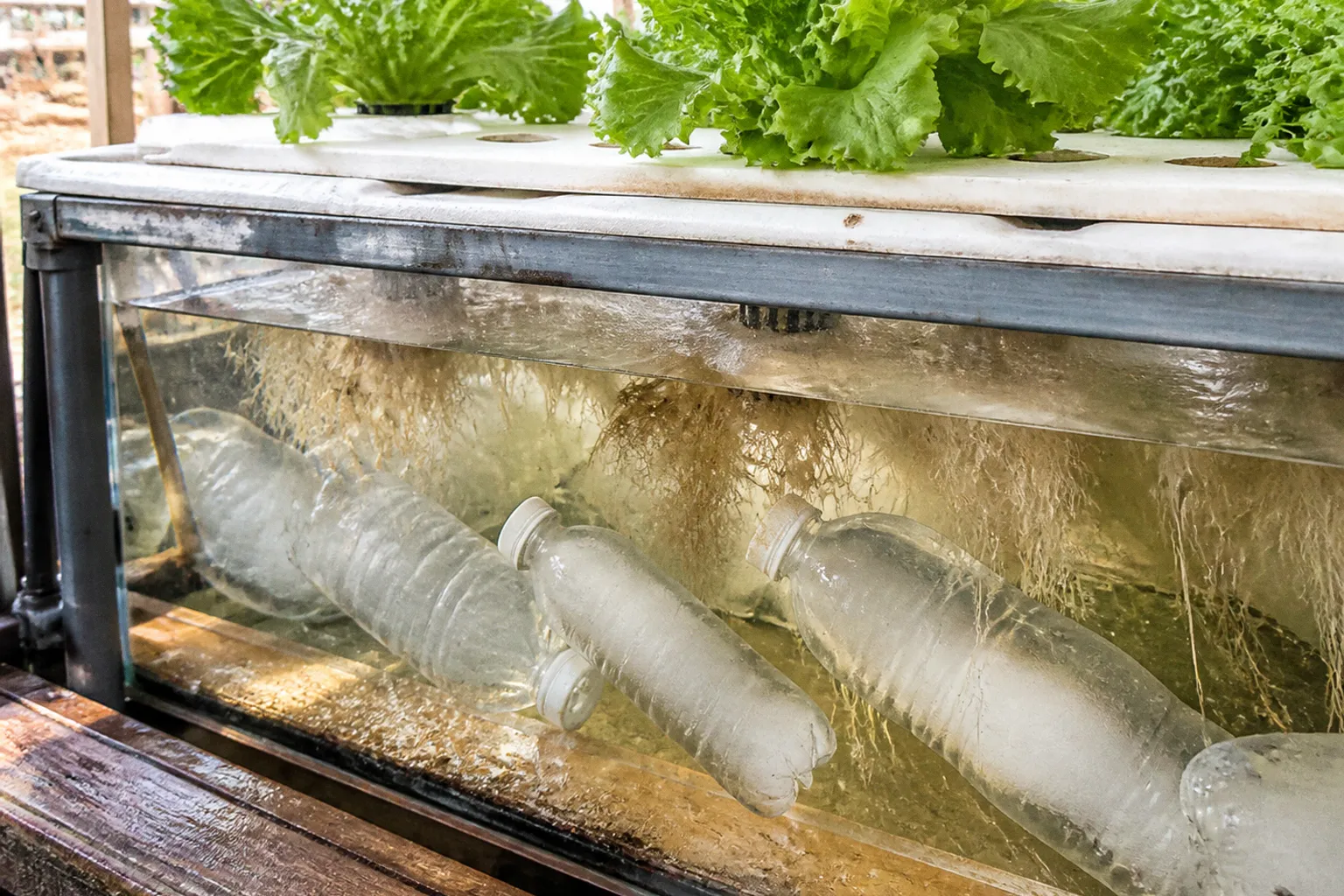
The grower knew something was off — roots were browning, growth had stalled — and his immediate instinct was practical: freeze plastic bottles, drop them in the tank, bring the temperature down.
It is a reflex many small hydroponic operators share, especially across Lebanon’s coastal and inland greenhouses, where summer air temperatures can push well beyond 35°C. The question is not whether frozen bottles cool nutrient solution — they do. The question is whether they cool it in a way the plant’s root system can tolerate, and whether the method can be repeated without creating a second problem.
The distinction matters. A bottle of ice can lower the temperature around it quickly, but hydroponic crops do not grow in a single cold spot. They grow in a recirculating nutrient environment that must remain reasonably stable, oxygenated, and chemically balanced. After watching that Bekaa operation for a season, and talking through alternatives with growers from the South to the Metn, here is what the field experience and the underlying biology actually say about hydroponic reservoir cooling DIY methods.
The Science of Thermal Stress in Hydroponic Systems
Roots do not simply drink nutrient solution; they respire in it. Dissolved oxygen is central to that respiration, and warm water holds less oxygen than cool water. At 68°F (20°C), a well-aerated reservoir can hold around 8–9 mg/L of dissolved oxygen. Push the same reservoir toward 80°F (27°C), and the oxygen available to the root zone falls. Aeration still helps, but it cannot fully cancel the effect of temperature.
Once the solution moves into the low 80s Fahrenheit, the root environment becomes substantially less forgiving. Plants may continue to grow, but the margin for poor aeration, dirty plumbing, restricted flow, or a damaged root system becomes much smaller. This is also the range in which Pythium and other organisms associated with hydroponic root rot become more difficult to control. High temperature does not create every root disease by itself, but it can weaken the conditions that normally help healthy roots resist infection.
A root zone above 80°F is therefore not automatically hypoxic, particularly when the system has effective aeration and good circulation. It is, however, more likely to contain less dissolved oxygen and to place additional stress on the roots. In a poorly aerated or heavily loaded system, that reduced oxygen margin can become a serious problem quickly.
For many common hydroponic crops, the practical target is roughly 68–72°F (20–22.2°C) for the nutrient solution. The acceptable working range is somewhat wider — approximately 65–75°F (18–23°C) for many leafy greens and fruiting crops — but a reservoir that spends long periods above 75°F should be treated as a stress condition rather than a normal operating temperature.
Lebanese summers make that target difficult. A polytunnel in the Beqaa can become extremely hot at midday, while a black plastic reservoir in direct sun absorbs heat from above and from the surrounding air. Even when the crop canopy looks healthy, the solution may be warming throughout the afternoon. By the time the first visible signs appear, the root system may already be operating under reduced oxygen availability.
The biological cost is rarely dramatic at first. Reduced dissolved oxygen slows root metabolism, which affects ion uptake and water movement. That can show up as marginal chlorosis on young leaves, slower extension growth, smaller heads, or uneven development across the same channel. In a fruiting crop, flowers may set less consistently. In lettuce, the grower may simply notice that the crop no longer looks as vigorous as it did in spring.
By the time roots turn brown and slimy, the thermal problem has often been running for days. Cooling the reservoir is not a comfort measure. It is part of maintaining the conditions that allow the root system to take up water and nutrients efficiently.
A root zone above 80°F is not automatically hypoxic, but it is operating with less dissolved oxygen and a smaller margin for error. Cooling the reservoir protects that margin; it does not replace aeration or sanitation.
Temperature, however, is only one part of the root-zone equation. A warm reservoir with strong aeration, clean surfaces, and good circulation may perform better than a cooler reservoir with stagnant corners and a failing air pump. Before reaching for ice, check the basics:
- Is the air pump delivering a consistent stream of bubbles?
- Are air stones clogged with mineral deposits or biofilm?
- Is the return flow mixing the reservoir, or does warm water sit undisturbed?
- Is the tank exposed to direct sun?
- Are roots blocking a channel or restricting circulation?
- Has the nutrient solution become unusually cloudy, foul-smelling, or slimy?
- Is the water level low enough that the pump or air stones are no longer working properly?
A bottle can lower temperature, but it cannot repair poor sanitation or inadequate oxygenation. It is a cooling intervention, not a substitute for a functioning root-zone system.
Mechanics of the Frozen Bottle Method and Nutrient Integrity
The frozen bottle method is appealing precisely because it is accessible. A grower needs no chiller, no plumbing modification, and no additional electrical circuit beyond the freezer already in use. The basic process is straightforward: fill clean, intact PET bottles with water, leave room for expansion, freeze them solid, seal them tightly, and place them in the reservoir.
As the ice melts, it absorbs heat from the surrounding solution. The water inside the bottle changes phase, but it remains separated from the nutrient solution. That separation is the main reason sealed bottles are preferable to loose ice.
Loose ice dropped directly into a nutrient tank eventually becomes part of the solution. The melt water contains no nutrients, so it dilutes the reservoir. The size of the EC and pH change depends on the volume of the reservoir, the amount of ice added, the concentration of the original solution, and how thoroughly the tank is mixed. In a small bucket, even a modest amount of melt water can be significant. In a larger reservoir, the same ice may have a relatively small chemical effect while still providing useful cooling.
That is why there is no universal EC result for an “ice dump.” A reservoir calibrated to a particular EC may experience a barely noticeable change or a substantial dilution, depending on the setup. The correct response is not to guess. Measure EC and pH before adding loose ice, then measure again after the ice has melted and the solution has been thoroughly mixed. Better still, use sealed bottles and avoid adding unconditioned water to the nutrient solution altogether.
The bottle itself also matters. Thin, damaged, or previously stressed plastic can split during freezing. A leaking bottle defeats the purpose of the method and introduces ordinary water into the nutrient tank. Bottles should be washed, rinsed thoroughly, and checked for cracks before they go into the freezer. Do not use containers that have held chemicals, detergents, or materials that could leave residues.
The cooling capacity is governed by simple heat physics, but the practical lesson is more useful than the formula. Water requires a large amount of energy to change temperature, and ice absorbs additional heat as it melts. Cooling a large, hot reservoir is therefore a substantial thermal task. A 40-gallon reservoir, or roughly 151 liters, needs considerable ice to move from the low 80s Fahrenheit down toward the high 60s. That is not a couple of casual bottles; it is a meaningful amount of frozen water that must be prepared, transported, and rotated.
The same method is much more forgiving in a small DWC bucket or a compact NFT holding tank. A grower may be able to prepare enough frozen bottles in advance and monitor the result without turning cooling into a daily production job. As the reservoir grows, the question changes from “Will this bottle cool the water?” to “Can I supply and rotate enough thermal mass every day?”
Where to Place the Bottles
A frozen bottle should never be left pressed directly against the main root mass. The immediate water around the bottle can become much colder than the rest of the reservoir, especially when circulation is weak. Direct contact between a very cold surface and delicate root tissue creates a localized stress point, even if the average reservoir temperature appears acceptable.
Place bottles in the bulk solution, away from net cups, air stones, pumps, and dense root curtains. In a larger system, a separate stock tank or service reservoir can be a better location if the water is mixed before it reaches the root chamber. The aim is to cool the water gradually and evenly, not to create an artificial cold zone.
Bottles should also be secured so they do not obstruct the return line or interfere with the pump intake. A loose bottle can drift into the intake, reduce flow, and turn a temperature intervention into a circulation failure. In a small system, a clean mesh barrier or simple restraint is usually enough.
Do not use a bottle that has developed a cloudy surface, a crack, or a loose cap. The method depends on the bottle remaining a clean heat exchanger. Once it becomes a source of contamination or a mechanical obstruction, its low cost is no longer an advantage.
Cooling Without Compromising Nutrient Management
Frozen bottles change the thermal condition of a reservoir, but they do not change the crop’s nutrient requirements. Continue monitoring EC and pH according to the crop and system. If a bottle leaks, remove it, check the EC, and correct the solution carefully rather than adding concentrated nutrients by instinct.
Temperature readings should be taken from the mixed solution, not directly beside a frozen bottle. A thermometer placed against the bottle will record the coldest local point and tell the grower very little about the water actually reaching the roots. Take readings at a consistent location and time, preferably after the pump or aeration system has mixed the reservoir.
A useful monitoring routine includes:
- Measuring reservoir temperature before the first bottle is added.
- Checking again after the solution has circulated.
- Recording the afternoon peak, when solar heat gain is usually highest.
- Measuring EC and pH after any suspected leak or large water addition.
- Looking at the roots and crop response rather than relying on temperature alone.
- Recording how long bottles remain effective under the actual greenhouse conditions.
That last point is often more valuable than a theoretical calculation. The same set of bottles may last much longer in a shaded, insulated tank than in a black reservoir sitting against a hot greenhouse wall. A grower needs to understand the behavior of the particular installation.
| Parameter | Frozen sealed bottles | Loose ice cubes | Dedicated chiller |
|---|---|---|---|
| Nutrient dilution risk | Low, provided bottles remain sealed | High, because melt water enters the solution | Low |
| Cooling stability | Variable and dependent on rotation | Variable and dependent on rotation | More stable when correctly sized and installed |
| Manual labor | High — bottles must be frozen, moved, and rotated | High — ice must be produced or purchased and added | Lower after installation |
| Main control problem | Uneven cooling and declining effect as bottles melt | Dilution alongside uneven cooling | Sizing, maintenance, and electrical demand |
| Best fit | Small reservoirs and emergency cooling | Short-term emergency use | Larger or production-critical systems |
| Hidden cost | Freezer space and labor | Ice production, handling, and water quality | Equipment, installation, power, and maintenance |
Managing the Yo-Yo Effect and Protecting the Root System
The most underappreciated problem with frozen bottles is not the cooling itself. It is the cycling.
A frozen bottle placed into a warm reservoir will cool the water immediately around it. As the ice melts, the cooling effect declines. If the bottle is then removed and replaced only after the tank has warmed substantially, the plants experience a repeated pattern of cooling and reheating. The exact size and speed of that temperature swing cannot be assumed in advance. They depend on reservoir volume, bottle size, circulation, ambient temperature, insulation, shade, and the timing of each swap.
This is the “yo-yo effect.” It is not a fixed number of degrees. It is a pattern that must be measured in the individual system.
A grower who swaps a small number of bottles frequently may maintain a more even average temperature than one who adds a large number of bottles once a day. But even frequent swaps do not guarantee stability if the reservoir is badly exposed to heat or the water is poorly mixed. The objective is not to create the lowest possible reading immediately after a bottle goes in. The objective is to reduce the afternoon peak and prevent the solution from remaining hot for hours.
Roots adjust to their environment over time. Membrane fluidity, enzyme activity, gas exchange, and osmotic regulation all respond to temperature. Repeated rapid changes can add stress even when no single reading appears catastrophic. The practical symptoms are usually gradual: inconsistent uptake, slower vegetative vigor, uneven head size, or increased vulnerability when another problem appears.
That is why a temperature log is worth keeping. A single reading can reassure a grower while hiding the daily cycle. Record the reservoir temperature at the same points each day — for example, before cooling, during the afternoon peak, and after the evening temperature drop. After several days, the pattern becomes visible. The grower can then decide whether the bottles are actually keeping the solution in a workable band or merely producing brief cold readings.
Avoiding Cold Spots and Flow Problems
Two physical protections matter when running the bottle method.
First, keep frozen bottles away from the root mass. Do not wedge them under net cups or allow them to rest against a dense curtain of roots. Roots need oxygenated, moving solution, not a concentrated cold surface. If a bottle is placed near the pump intake, make sure it cannot block the intake as it floats or shifts.
Second, protect circulation. The reservoir should be mixed by the return flow, an air pump, or both. In a static tank, water around the bottle may cool while water at the opposite end remains hot. This is especially common in long, narrow reservoirs and improvised containers with a single poorly positioned return.
Bottle rotation should be based on observed temperature rather than a universal timetable. In one greenhouse, a bottle may remain useful through much of the working day; in another, the heat load may overwhelm it quickly. The right schedule is the one that reduces the temperature peak without creating a large recovery period between swaps.
A practical rotation system can use two clearly marked groups of bottles: one group in the reservoir and one group freezing. That makes the process easier to manage than moving individual bottles at random. Keep the freezer group clean and separate from food storage where possible. If a cooperative relies on a shared freezer, the method needs an assigned person and a defined storage area; otherwise, bottles disappear into unrelated tasks and the cooling schedule becomes unreliable.
Temperature stability matters more than the lowest temperature recorded. A system that stays reasonably steady is usually easier on roots than one that alternates between cold spots and prolonged heat.
Scaling Limitations: Why Large Reservoirs Require More Than Ice
The thermal demand of a reservoir rises with its volume, but the operational burden rises as well. A small DWC bucket may need only a few bottles and a few minutes of attention. A cooperative running several NFT lines must cool a shared body of recirculating solution, keep it mixed, and repeat the intervention across the hottest part of the day.
At that point, the bottle method becomes a treadmill: bottles freezing overnight, bottles cooling the reservoir during the day, bottles returning to the freezer at night, with little margin for a freezer fault, a power cut, a hot spell, or a worker who cannot make the next rotation.
The practical limit is not defined by one universal reservoir size. It depends on the freezer’s capacity, the number and size of bottles, the starting temperature, the amount of incoming heat, and how quickly the system can transfer that heat into the surrounding air. A well-shaded tank with some insulation may respond reasonably to frozen bottles. A large black tank in direct sun may absorb heat faster than the available bottles can remove it.
There is also a difference between cooling a reservoir once and controlling its temperature throughout a crop cycle. An emergency intervention may be entirely sensible when a pump fails, a heat wave arrives, or a grower discovers an overheated tank in the afternoon. Designing the whole production system around manually frozen bottles is a different decision. It requires labor, freezer space, clean handling, a reliable schedule, and someone responsible for checking whether the method is still working.
For a small farm, those costs may be acceptable. Labor is already organized around daily greenhouse work, and the reservoir may be close to the freezer. For a cooperative, the hidden coordination cost can become more important than the plastic bottles themselves. If several growers share cooling equipment, unclear responsibility can leave one section of the system warm while another receives attention.
A larger installation should therefore compare the bottle method with the cost of reducing heat gain before attempting to remove heat. Shade cloth, reflective covers, white or insulated tank surfaces, and better placement can reduce the amount of cooling required every afternoon. These measures do not produce a dramatic temperature drop in a few minutes, but they make every later cooling method more effective.
The Freezer Is Part of the Cooling System
A frozen-bottle setup is only as reliable as the freezer behind it. If the freezer cannot freeze the required number of bottles between rotations, the system is running on a declining reserve. A bottle that is cold but not fully frozen may provide some cooling, but it will not have the same endurance as a solid block of ice.
Power interruptions are another practical concern. In a hot greenhouse, a cooling plan that depends on continuous freezer operation needs a backup decision. That may mean reducing heat gain with shade, moving bottles between freezers, or accepting that bottles are an emergency measure rather than a complete temperature-control system.
The freezer also consumes electricity, occupies space, and adds handling time. Those costs are easy to ignore because no specialized chiller appears on the invoice. They are still part of the system. When a grower compares a DIY hydroponic nutrient chiller approach with a dedicated unit, the honest comparison includes labor and reliability, not just equipment price.
Passive Cooling Alternatives for Stable Nutrient Environments
Frozen bottles are most useful when they are part of a broader cooling strategy. The cheapest hydroponic cooling solutions often begin by stopping the reservoir from gaining unnecessary heat.
Shade and reflective surfaces
Direct sun on the reservoir is avoidable heat load. Move the tank into shade where the layout permits, or cover it with a material that reflects rather than absorbs solar radiation. A cover should block light without sealing the tank so tightly that heat accumulates or access for inspection becomes difficult.
The same principle applies to exposed pipes. Long lengths of tubing sitting on a hot greenhouse floor can warm the nutrient solution before it reaches the crop. Routing return lines through shade and shortening unnecessary exposed runs can improve the result without changing the pump or nutrient program.
Insulation
Insulation slows heat exchange. It does not actively chill the solution, but it can keep the afternoon heat from reaching the tank as quickly and help preserve the benefit of overnight cooling. The insulation must remain clean, dry, and accessible enough for the grower to inspect the reservoir and detect leaks.
The goal is not to build an elaborate enclosure around every component. Start with the surfaces receiving the strongest solar exposure, then observe whether the daily temperature peak changes. A small improvement in heat retention can reduce the number of frozen bottles needed for the same crop.
Night cooling
In many greenhouse systems, the solution loses heat after sunset. Using that cooler period intelligently can reduce the morning starting temperature. Ventilation, shade management, and keeping the tank away from residual heat sources all contribute.
Night cooling is not a reason to leave the system exposed to contamination or uncontrolled weather. It is a way to avoid carrying the previous day’s heat into the next one. If the reservoir begins the morning cooler, bottles inserted during the afternoon have less thermal work to do.
More effective aeration and circulation
Cooling and oxygenation should be treated as related but separate controls. An air pump does not make a hot reservoir cool, but it helps maintain dissolved oxygen while the temperature remains elevated. Circulation distributes the cooling effect and prevents the reservoir from dividing into hot and cold zones.
Check air stones, airline connections, pump output, return placement, and the condition of filters. Mineral deposits and biofilm can reduce performance gradually, so a system may appear to be aerating while delivering much less air than it did when first installed.
Cooling the source water
Water added during top-up can influence reservoir temperature, but it must be suitable for the crop and used carefully. Very cold water poured into a warm tank can create a short-lived temperature shock and may also alter the nutrient concentration. Water quality, temperature, EC, and pH should be considered together rather than treating top-up water as free cooling.
If the source water is already cooler than the reservoir, adding it during a planned correction may help, but it should not become an excuse to dilute the tank repeatedly without measurement. In a recirculating system, chemical stability is as important as the immediate thermometer reading.
When a chiller becomes the more honest solution
A dedicated chiller is not automatically the right answer for every Lebanese greenhouse. It brings its own requirements: correct sizing, installation, cleaning, electrical demand, and protection from the same heat that affects the reservoir. An undersized unit can run continuously without achieving stable control, while a poorly maintained system can introduce another failure point.
But when a reservoir is large, a crop is high-value, or daily temperature stability is essential, mechanical cooling may be more realistic than an endless bottle rotation. The key advantage is control. A correctly installed chiller can respond to heat continuously rather than waiting for a worker to notice that the bottles have melted.
That does not make frozen bottles obsolete. They remain useful as an emergency backup, a temporary measure during equipment maintenance, or a low-cost option for small systems. They are also a practical way to learn how much heat the installation is gaining before investing in permanent equipment. If a grower records the temperature before and after each bottle rotation, the resulting log becomes useful evidence when evaluating a more stable cooling system.
The sensible order is to reduce heat gain, restore aeration and circulation, and then decide how much active cooling is actually necessary. A bottle placed into a shaded, well-mixed reservoir is doing manageable work. The same bottle placed into an exposed, poorly aerated tank is being asked to rescue the entire root zone.
The practical place of frozen bottles
For small hydroponic systems, frozen bottles can be an effective DIY method for lowering hydroponic reservoir temperature. Their strengths are clear: they are inexpensive to start, easy to understand, and available when a dedicated chiller is not. Sealed bottles also avoid the direct nutrient dilution caused by loose ice.
Their limits are equally clear. Cooling is uneven unless the reservoir is mixed. The effect declines as the bottles melt. Repeated replacement creates a risk of temperature cycling. Leaks can alter EC and pH. Bottles can obstruct pumps or damage roots if placed carelessly. Most importantly, the method scales poorly when the reservoir and crop area become large.
Use the bottles to manage peaks, not to chase an artificially low number. Measure the mixed reservoir, watch the afternoon pattern, and pay attention to roots, flow, aeration, and nutrient readings. If the system needs bottles every day simply to remain within a workable range, that is valuable information: the greenhouse has a heat-management problem that passive measures or a dedicated hydroponic water temperature control system may need to address.
The grower in the Bekaa did not need a complicated theory to know that the tank was too warm. He needed to know whether the quick fix would protect the crop until a better solution was possible. Frozen bottles gave him that bridge, but only after he separated the real cooling effect from the risks of dilution, cold spots, poor oxygenation, and daily temperature swings.
That is the correct role of this method. It is not a magic substitute for a chiller, and it is not useless improvisation. Used with measurement and restraint, it is a workable small-system tool — and a clear signal of when the farm has outgrown it.