Hydroponic algae: a quick hydrogen peroxide fix
A thin green film on the inside of your nutrient tank. A faint musty smell when you lift the lid. Sticky brown patches clinging to the edges of your NFT channels.
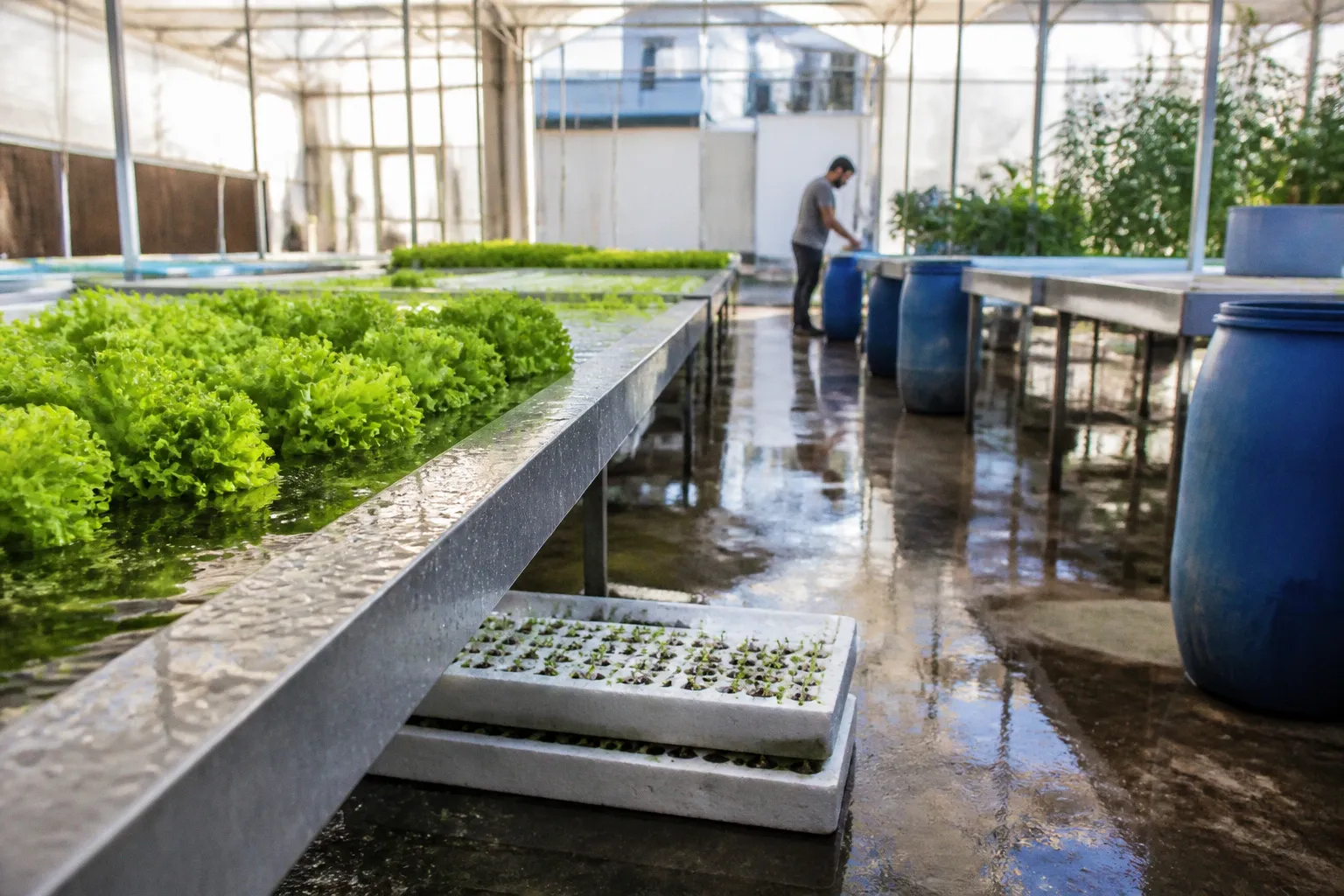
Every grower who has run a hydroponic system long enough recognizes these early signs of algae — and the sinking feeling that comes with them. Algae is not just cosmetic: it pulls dissolved oxygen out of solution, fouls emitters, harbors pathogens like Pythium, and competes with our crops for nutrients. For our cooperatives investing in shared greenhouse space, one unchecked reservoir can set back an entire bench of leafy greens before anyone notices.
This is where hydrogen peroxide earns its keep as a short-term ally. It is fast, it is widely available, and it breaks down into water and oxygen. But — and this matters for every grower working with living biology — it is a tool, not a cure. Used with care, peroxide buys us breathing room while we fix the underlying conditions that invited the bloom in the first place. Used carelessly, it scorches roots and undoes the very microbial partnerships our systems depend on. The rest of this piece is about drawing that line clearly: how much to use, when to apply it, what to watch for, and how our growers can move from reactive cleanups to genuinely algae-resistant systems.
Hydrogen peroxide is a bridge, not a building — it clears the algae so we can rebuild the conditions that keep it from coming back.
The Chemistry of Oxidation in Hydroponic Reservoirs
To use peroxide well, we should understand what it actually does in solution. Hydrogen peroxide, or H₂O₂, is water with an additional oxygen atom. When that extra oxygen finds a target — an algae cell wall, a fungal spore, or dissolved organic matter — it oxidizes the target and the peroxide molecule breaks down into water and molecular oxygen. That release of oxygen can be useful in a hydroponic reservoir, where root zones often run oxygen-starved, especially during warm Lebanese summers when solution temperatures climb and dissolved oxygen drops.
The reaction is broad and non-selective. That is both the appeal and the danger. H₂O₂ attacks algae, but it can also attack the beneficial bacteria and fungi we have worked to cultivate in the root zone — the same organisms that help lettuce and basil access nutrients and resist disease. The practical challenge is to apply enough oxidation to knock back an algae bloom without repeatedly wiping out the microbial community that has to recover afterward.
Peroxide does not behave like a long-lasting algaecide. Its activity falls as it reacts with organic material, biofilm, roots, and microorganisms. In a clean reservoir, it may persist differently than it would in a tank covered with slime and plant debris. That is why the same nominal dose can produce very different results from one greenhouse to another. Water temperature, organic load, circulation, root mass, and the condition of the tank all matter.
A few properties make peroxide attractive in a working hydroponic system. It does not leave the kind of persistent chemical residue associated with some disinfectants, and its breakdown products are water and oxygen. But that does not make every formulation or every application automatically safe. Concentrated peroxide is corrosive and can injure skin, eyes, roots, and foliage. Product grade also matters: a pharmacy product, an agricultural formulation, and a concentrated technical product may have different handling instructions and additives.
In a 15-day study on phenolic foam seedling plates, peroxide applications effectively suppressed algae growth, though researchers noted that high concentrations could inhibit seed germination and harm delicate root radicles. That is a useful warning for propagation work, where the margin for error is narrower than it is in a mature reservoir. A seedling with a small root system has less tissue to absorb the shock and less time to recover before transplanting.
The chemistry therefore gives us a quick intervention, not a blank cheque. Peroxide can reduce the immediate biological load, but it cannot block light, remove nutrient residue from a channel, or repair a leaking lid. Those jobs still belong to system design and routine sanitation.
Calculating Safe Hydrogen Peroxide Dosing Ratios
Numbers matter here. A grower eyeballing a splash into the tank is gambling with roots. The right dose depends on the concentration of peroxide on hand, the actual volume of the reservoir, the severity of the algae problem, and whether the system contains living biology we want to preserve.
The most accessible form for small and mid-sized operations is standard 3% pharmaceutical peroxide — the brown bottle from the pharmacy. For continuous maintenance in a recirculating system, the working range is roughly 3 to 5 mL per gallon of reservoir water, or about 5 to 10 mL per 10 liters applied every 2 to 3 days. This is intended for a light algae film and modest oxygen support, not for pouring into a heavily fouled system and expecting the chemistry to do all the cleaning.
For growers working with stronger concentrations — and many of our cooperatives source 12% and 35% grades from agrotech suppliers because they are more economical at scale — the math shifts dramatically. At 12%, the starting quantity is roughly 1 to 2 mL per 10 liters applied every 3 to 4 days. At 35%, food- or technical-grade, the dose is tiny: approximately 1 to 2 mL per 20 liters for a starting treatment. The reason is simple: concentrated peroxide is caustic on contact and can burn root tips, scorch emerging radicles, and wipe out beneficial microbes almost entirely at the wrong dose.
| Concentration | Typical use | Starting dose | Frequency |
|---|---|---|---|
| 3% H₂O₂, pharmacy grade | Routine reservoir maintenance and light algae suppression | 3–5 mL per gallon, or 5–10 mL per 10 L | Every 2–3 days |
| 12% H₂O₂ | Larger reservoirs and stronger working solutions | 1–2 mL per 10 L | Every 3–4 days |
| 35% H₂O₂, food or technical grade | Heavy bloom or system flush before restart | 1–2 mL per 20 L | Single starting dose, not continuous |
| Diluted plant treatments | Root, seedling-tray, or foliar spot treatment | Approximately 0.5–3%, depending on the application | Targeted treatment only |
These figures are working ranges, not permission to skip the label. Commercial products can differ in formulation, and a label may impose a narrower use pattern than a general hydroponic rule of thumb. Before dosing, confirm the product concentration, calculate the amount required for the actual water volume, and make sure the intended use is allowed for that product and crop.
The plant-safe working window is often described as roughly 0.5% to 3%, depending on whether the grower is flushing the system, treating roots, or spraying foliage. Foliar applications tend to be more dilute, while a system flush can use a stronger solution because contact time is shorter and crops may be removed or isolated. Those are different operations and should not be treated as interchangeable.
A practical habit our growers have adopted is to measure reservoir volume precisely before dosing and start at the lower end of the range when introducing peroxide to a system that already hosts a microbial inoculant. A marked measuring container is better than a cup borrowed from the nutrient room. Record the concentration and volume before adding anything. If the crop shows no stress and the algae pressure remains, the next treatment can be adjusted cautiously. Scorched roots cannot be restored by correcting the arithmetic afterward.
Do not confuse dilution with safety. Adding a small amount of 35% peroxide to a large tank may produce a low final concentration, but the undiluted product can still damage roots or equipment at the point where it enters. Pre-dilution in clean water, careful handling, and even distribution reduce that local shock. Never mix concentrated peroxide with acids, chlorine products, or other cleaning chemicals.
Application Protocols for Different H₂O₂ Concentrations
Knowing the number is half the work. Knowing how to put it into the system without damaging crops is the other half. Across our cooperative greenhouses, three protocols have earned their place through repeated use.
The maintenance protocol is what every grower should default to once the system is balanced. With 3% peroxide at 5 to 10 mL per 10 liters, applied every two to three days during the active growth phase, the aim is to keep a light film from developing into a serious bloom. Add the peroxide to the reservoir after mixing the day’s nutrient solution, and run the recirculation pump long enough to distribute it through the system. Five minutes is a practical minimum for many small recirculating setups, though the actual time depends on pipe length, pump flow, and tank geometry.
Check pH afterward. Peroxide is not a primary pH-control product, but an application can coincide with changes in the solution, and any intervention is a reason to verify the readings rather than assume them. Our leafy greens generally prefer the 5.8 to 6.2 band. EC should also be checked if the reservoir has been topped up, diluted, or partially replaced. A stable pH and EC do not prove that the root zone is healthy, but sudden changes can help identify a problem early.
The flush protocol is for moments when algae has already won the upper hand — when you open a reservoir and find the walls painted green, or when emitters are visibly fouling. In that situation, chemical treatment without physical cleaning is mostly theater. Drain the system, remove as much plant residue and sludge as possible, refill with clean water and the selected diluted peroxide solution, and circulate for a limited period. Growers commonly use 30 to 60 minutes for a flush before draining again, but the crop, product label, and system design should determine the final procedure.
Scrub the tank walls, channels, lids, trays, and accessible pipework separately. Peroxide can reduce organisms in the water; it will not reliably remove an established biofilm from a rough plastic surface. A surviving film can release new fragments and spores as soon as the system returns to normal nutrient conditions. After the flush, rinse where appropriate, refill with fresh nutrient solution, and inspect emitters before returning the system to routine operation.
The seedling protocol is the most delicate. Young roots and germinating seeds are sensitive to oxidation, and a heavy peroxide dose at this stage can set transplants back. For seedling trays on phenolic foam or rockwool, growers in our network have had success with very dilute 3% peroxide sprays — roughly 1 to 2 mL per liter of water — applied as a targeted mist to suppress algae on the tray surface while leaving the root zone as undisturbed as possible. The 15-day phenolic foam study referenced earlier showed algae suppression at moderate concentrations, but germination inhibition at the higher end of the dosing range.
A targeted mist is not the same as saturating every cube. Avoid spraying open roots, flowers, and tender foliage unless the product label specifically permits that use and the dilution has been tested on a small area first. Treat seedlings gently, and do not blanket-spray peroxide over the entire propagation area simply because a few tray surfaces have turned green.
A few rules apply across all three protocols:
1. Never pour concentrated peroxide directly onto exposed roots or foliage. Dilute it first, keep the product away from workers’ skin and eyes, and use suitable protective equipment for the concentration being handled.
2. Never introduce peroxide into a system that contains fish. Aquaponics requires a different toolkit entirely, and peroxide can harm livestock and disrupt the biological filtration on which the system depends.
3. Do not dose a dirty reservoir and call the job finished. Remove plant debris, scrub accessible surfaces, and correct light leaks at the same time.
4. Do not repeat treatments automatically. If roots are browning, growth is slowing, or the reservoir smells different after treatment, pause and investigate rather than increasing the dose.
5. Treat label directions as part of the protocol. The label may specify approved crops, application methods, worker-safety measures, storage conditions, or restrictions that a general hydroponic schedule does not cover.
And never treat peroxide as a one-time cure. If the underlying light and sanitation conditions remain unchanged, algae will return as soon as the oxidative effect has dissipated.
Managing Root Health and Microbial Balance During Treatment
This is where most of the trouble happens, and where our growers have learned the most caution. Hydrogen peroxide is non-selective. It will oxidize algae, but it can also oxidize the Trichoderma, Bacillus, and Pseudomonas species we have worked to establish in the root zone — the beneficials that suppress pathogens and help mobilize nutrients. Overuse, or use at the wrong concentration, can leave a system biologically barren just when crops need that biology most.
The phrase “clean reservoir” can be misleading. A reservoir may look clear while the root zone is under stress, and a temporary increase in dissolved oxygen does not tell us whether the microbial balance has been preserved. Root appearance, new growth, water temperature, pH stability, and the condition of the return lines together give a more useful picture.
Three warning signs suggest that the dose is too high or the cadence too frequent. First, root-tip burn: the bright white, healthy tips of feeder roots turn brown or translucent and stop extending. Second, a sudden drop in dissolved oxygen after dosing, the opposite of what peroxide is supposed to do, which may signal that the peroxide has reacted with a heavy organic load or that the system is struggling to rebalance. Third, a noticeable slowdown in crop growth despite stable EC and pH readings — a sign that the root-zone biology may have been disturbed.
There are less obvious signs as well. A sudden loss of the normal root-zone smell, excessive foaming, or a sharp difference between plants connected to the treated reservoir and plants in an untreated one should all prompt caution. None of these observations alone proves peroxide damage, but together they are reasons to stop escalating the treatment and inspect the system.
The honest answer is that we do not yet have long-term, peer-reviewed data on what continuous low-dose peroxide does to commercial biocontrol products in a living hydroponic system. Growers in our cooperatives who rely on Trichoderma-based products have reported mixed results when peroxide is applied on the same day as a microbial drench. The conservative practice is to separate peroxide dosing and microbial inoculation by at least 24 to 48 hours — peroxide first, beneficials later — giving the oxidation chemistry time to dissipate.
That separation is not a guarantee that every inoculant will survive. It is simply a safer operating principle than mixing both interventions in the same reservoir at the same time. Check the manufacturer’s instructions for the microbial product, because compatibility depends on the organism, formulation, water quality, and timing. If a biological product is central to the production protocol, a small isolated trial is wiser than treating every connected greenhouse at once.
For cooperative groups standardizing protocols across shared houses, dosing should be written into the same log where we track nutrient changes and pH. Record:
- the peroxide concentration and product formulation;
- the calculated reservoir volume;
- the amount added and the time of application;
- water temperature, pH, and EC before and after treatment;
- root appearance and crop growth over the following 24 to 48 hours;
- the timing of any microbial inoculant or biological treatment.
Over a season, the log becomes one of the most valuable documents we own. It tells us, in our own water, climate, crop mix, and greenhouse design, what actually works. It also prevents the familiar cooperative problem in which one grower increases the dose because another house saw a quick improvement under completely different conditions.
Light exclusion, disciplined sanitation, and matched feeding together prevent more algae than any single chemistry ever could.
Beyond Chemical Fixes: Addressing the Root Causes of Algae
Every grower who has fought algae more than once already knows the uncomfortable truth: peroxide is reactive medicine, not preventive medicine. Algae blooms because spores find three things — light, moisture, and nutrients. A hydroponic reservoir provides all three in abundance. Our job is to remove at least one of them consistently, not to rely on a chemical reset every time the film appears.
Light exclusion is the single most effective intervention, and it costs almost nothing compared with repeated crop disruption. Opaque reservoir tanks, light-blocking lids on NFT channels, and dark covers on Dutch bucket systems cut off the photosynthesis that fuels algae growth. Gaps around net pots, inspection ports, drain lines, and float valves deserve attention because a small leak of light can support growth across a wet surface.
This is where the work our growers put in pays back. A one-time investment in blackout tank covers can eliminate much of the algae pressure before chemistry is needed. Run a hand over the inside of a transparent or translucent tank two weeks after a flush and you will see why opaque matters. If the surface feels slick, the solution is not simply another dose: the tank is still providing a place for the bloom to establish.
Nutrient management is the second lever. Algae thrives on the same phosphorus and nitrogen our crops love. Overfeeding — running an EC higher than the crop needs, allowing nutrient concentrate to collect in a shallow channel, or letting spent solution sit in the reservoir for too long — feeds algae as much as it feeds lettuce. Matching feed strength to the growth stage, removing dead leaves, and refreshing solution on a sensible schedule all reduce the nutrient buffet available to algae spores.
Temperature matters too. Keeping reservoirs cool, under roughly 24°C where possible, helps maintain dissolved oxygen and reduces stress on roots. Warm solution does not create algae by itself, but it makes the whole system less forgiving. Oxygen falls more quickly, roots become more vulnerable, and organic material breaks down faster. Shade, insulation, appropriate tank placement, and adequate aeration are infrastructure decisions, not afterthoughts.
Sanitation is the third lever, and it is where cooperative discipline shines. Tools that touch multiple systems — pruning scissors, pH probes, transfer hoses, harvest crates — should be cleaned or wiped down between uses. Plant debris left in channels decomposes and feeds the very biology we are trying to control. Walkways and bench surfaces that stay wet become algae nurseries for the next cycle. A leaking hose connection or overflowing tray can spread the problem from one section to another without anyone noticing.
At the end of a crop cycle, the reset should include more than draining the reservoir. Remove roots and plant residue, clean accessible surfaces, inspect pipework and emitters, and allow equipment to dry where the production schedule permits. Replace damaged or translucent covers rather than taping over the same gap indefinitely. The goal is not spotless equipment for its own sake; it is to remove the combination of light, standing moisture, and organic residue that makes recolonization easy.
The last lever is biological. Some growers in our network are experimenting with microbial inoculants that compete with algae for surface area and nutrients — applied preventively rather than curatively. The early results look promising, though the evidence base is still thin, and we have learned not to promise more than the data supports. Biological products also require their own discipline: clean water, correct storage, compatible inputs, and enough time to establish. They are not a reason to stop monitoring the reservoir.
For our cooperatives bringing hydroponic production online — whether for export-grade lettuce, culinary herbs, or the high-value strawberries a handful of growers are now piloting — algae is one of the first predictable challenges we will face. It is also one of the most teachable. Hydrogen peroxide is a useful tool in that teaching: it acts quickly, gives growers a way to reduce a developing bloom, and can help create time for a proper cleanup. But it should be used according to the product label and applicable local regulations, with attention to crop-use restrictions, worker safety, and any buyer-specific requirements for produce destined for export. Export customers and certification schemes may impose standards that go beyond local rules, so peroxide treatment records and residue or input requirements should be checked before the crop enters a commercial export program.
The real work — the work that builds a reliable greenhouse operation across a full production cycle — is the unglamorous discipline of opaque tanks, fresh solution, clean tools, matched feeding, and patient observation. Peroxide can clear the visible symptom. It cannot replace a reservoir cover, a sanitation routine, or a grower who notices that roots are changing before the crop does.
We will keep sharing what works — and what does not — as our growers put these systems through their paces. Algae will return; it always does. The goal is not a sterile reservoir. It is a living system, kept in healthy balance, where our crops can do what we grow them to do.