Greenhouse pest control with simple sticky traps
A greenhouse can lose crop quality long before a pest population looks dramatic. A few whiteflies resting beneath tomato leaves, a line of aphids around tender cucumber growth, or fungus gnats lifting from damp growing media may seem like a small nuisance.
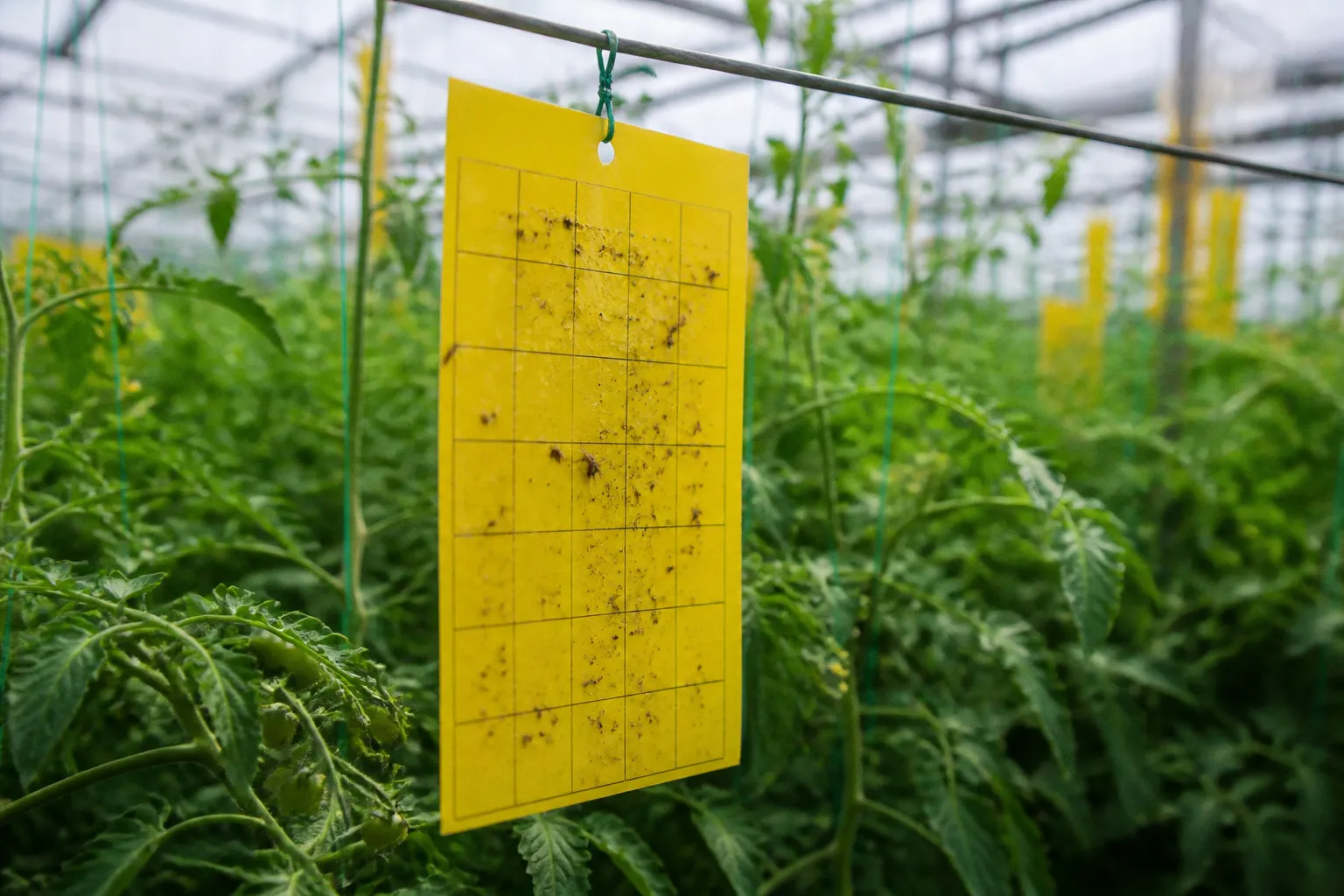
But in a protected structure, where warmth, humidity, and closely planted crops create a continuous food supply, small problems can become a shared harvest problem very quickly.
For our growers, yellow sticky traps offer something particularly valuable: an early view of what is moving through the greenhouse, without immediately reaching for a pesticide. They are inexpensive, pesticide-free, and simple enough to use across a cooperative when everyone follows the same placement and counting method. Used properly, yellow sticky traps for greenhouse pests become more than yellow cards hanging among the plants. They become a common language for deciding when to inspect, where to act, and whether a pest population is actually growing.
They are not a complete pest-control program, and they are not a substitute for looking closely at the crop. Their real strength is in Integrated Pest Management: monitoring flying insects, suppressing some of them, and giving the grower time to respond while the problem is still manageable.
Why yellow sticky traps work so well inside a greenhouse
Many greenhouse pests are difficult to see during a routine walk. Whiteflies gather on the undersides of leaves. Aphids may remain hidden in new growth. Adult fungus gnats move quickly around the surface of damp media, while their larvae remain below. By the time leaves curl, become sticky with honeydew, or show the first signs of sooty mold, the population has already had time to establish itself.
A yellow sticky trap changes the timing of the conversation. Flying adults are attracted to the bright yellow surface and become caught on its adhesive. The trap does not need electricity, spray equipment, or a complicated setting. A grower can hang one at canopy height, mark the date, and return to it during the next crop inspection.
This is especially useful for:
- whiteflies in tomato, cucumber, pepper, and other susceptible greenhouse crops;
- aphids moving between tender shoots and the upper canopy;
- some flying stages of thrips, although blue traps are generally more attractive to thrips;
- fungus gnats and shore flies emerging from or resting near the growing media.
The distinction between pests matters. A yellow card is not a universal answer simply because it is yellow. It is most useful when its color, orientation, and position match the behavior of the insect we are trying to observe.
A trap also provides a record. Standard commercial cards often measure around 10 by 25 centimeters, or approximately 3 by 5 inches, and may include a black grid. That grid is not decoration. It helps us compare one trap with another and follow the direction of pest activity over time. A card with a few scattered whiteflies tells a different story from a card that becomes crowded within several days, even if both are described casually as “some insects.”
The trap is not the decision. It is the evidence that helps our growers make a better decision together.
Placement decides whether the trap sees the crop
The most common mistake with sticky traps is hanging them wherever there happens to be an empty piece of wire. A trap placed too high may collect insects moving near the roof while missing the population feeding in the crop. A trap placed too low may tell us more about the walkway than the plant canopy. As the crop grows, a card that was correctly positioned last week can become irrelevant this week.
For flying pests such as whiteflies and aphids, hang the trap vertically. The bottom edge should be level with the plant canopy or approximately 10 to 20 centimeters above it. The aim is to place the card in the zone where insects are moving around the leaves, not far above the crop where air currents and roof structure shape insect movement differently.
The greenhouse team should adjust the cards as the plants stretch. This is a small task, but it should belong to someone by name or role. In a cooperative greenhouse, “someone will move the traps” usually means that no one will move them until the cards are already too high.
A practical placement routine looks like this:
1. Install cards when the crop is young, before pest pressure becomes visible. Early cards establish a baseline rather than appearing only after damage.
2. Position them at canopy level, with the lower edge even with or 10 to 20 centimeters above the leaves.
3. Place cards near crop entry points and problem areas, such as doors, ventilation openings, dense corners, and sections where seedlings or new plant material arrive.
4. Spread monitoring across the greenhouse, rather than putting every card beside the entrance.
5. Raise or replace cards as the crop develops, keeping the sticky surface active within the crop’s moving zone.
6. Record the location, so that an increase on one card can be connected to a particular bed, variety, or greenhouse section.
Avoid pressing the card into the leaves. Contact with foliage reduces the useful sticky surface and can disturb the plant. It is also wise to keep traps away from areas where workers repeatedly brush against them, because dust, clothing fibers, and plant debris quickly reduce their value.
For pests associated with the growing media, the orientation changes. Fungus gnats and shore flies emerge from or rest around the media surface, so the trap should be placed horizontally at media level or just above the pot rim. Depending on the card design, the sticky side may face down or up. The important point is to intercept the insects where they are moving, rather than treating every pest as a canopy-flying insect.
A simple placement guide
| Pest or monitoring target | Trap orientation | Practical position | What the trap tells us |
|---|---|---|---|
| Whiteflies | Vertical | Canopy level or 10–20 cm above the canopy | Activity of flying adults and changes over time |
| Aphids | Vertical | Within or just above tender plant growth | Movement of winged adults and pressure near new growth |
| Thrips | Usually blue for stronger attraction | Around the canopy, adjusted as plants grow | Flying thrips activity; yellow cards may still catch other insects |
| Fungus gnats | Horizontal | At media level or just above the pot rim | Adult activity emerging from damp media |
| Shore flies | Horizontal | Close to the growing media | Movement around the surface and wet areas |
The trap does not explain everything by itself. If a card is full near the entrance, we still need to inspect the leaves, stems, undersides, and media. Monitoring works best when the card and the plant are read together.
How many traps does a Lebanese greenhouse need?
Trap density is where individual habits become cooperative practice. One card in a large greenhouse may confirm that insects exist, but it cannot show how pressure is distributed. A dense cluster near the door and a clean card at the far end may mean that the crop is facing a local entry point, not a uniform greenhouse-wide outbreak.
For general greenhouse monitoring, a practical starting point is at least one trap per 100 square meters. Specific whitefly monitoring in susceptible crops may call for approximately one trap per 1,000 square feet, while some general recommendations describe a minimum of one trap per 10,000 square feet. These figures are not interchangeable rules for every crop or every greenhouse. They reflect different monitoring purposes and should be treated as a starting framework rather than a local economic threshold.
That distinction matters in Lebanon, where greenhouse size, crop density, ventilation, and management style can vary widely between farms and growing regions. A small, intensively planted tunnel with frequent worker movement may need a different layout from a larger structure with several crop blocks. Our cooperatives should therefore use the published density as a baseline, then improve it through shared records.
A useful approach is to divide the greenhouse into recognizable monitoring zones:
- entrance and loading area;
- ventilation side or open sidewall;
- seedling or nursery section;
- central crop rows;
- dense or humid corners;
- beds with a previous pest history.
Place at least one trap in each meaningful zone when the greenhouse layout is more complex than its area alone suggests. If a cooperative manages several similar structures, use the same numbering system in every one: greenhouse, row or zone, trap number, installation date. That turns scattered observations into a pattern we can discuss at the next team meeting.
For example, a record might show that whiteflies repeatedly appear first on traps near a side ventilation opening. That does not prove the opening is the only source, but it gives the team a place to inspect closely and a reason to review screens, plant movement, and surrounding vegetation. The strength lies in the repeated observation, not in one crowded card.
The cooperative value of a shared trap map
A trap program becomes much more useful when different growers record information in the same way. Agree on a few simple fields:
- date installed;
- greenhouse and zone;
- crop and growth stage;
- trap type and size;
- pest observed;
- approximate count or count category;
- condition of the card;
- action taken after inspection.
Do not create a record so elaborate that nobody maintains it. The purpose is to notice direction: increasing, stable, decreasing, or uncertain. A clear shared record can also help us compare management changes, such as improved ventilation, reduced standing moisture, screened openings, or a shift toward more frequent leaf inspections.
Counting insects without turning monitoring into a full-time job
Sticky cards are useful only if we look at them consistently. Counting every insect on every card may be reasonable when numbers are low, but it quickly becomes tiring when a population rises. The result is often skipped monitoring, which is worse than a simpler method applied faithfully.
When fewer than 50 whiteflies are present on a card, count the entire trap surface. When more than 50 are present, counting approximately 30% of the surface can save time while still giving a useful estimate for comparing cards. The exact counting area should be selected consistently: for example, several grid sections or one clearly defined portion of the card. We should not count the cleanest corner one week and the most crowded section the next.
For each inspection, note:
1. The pest identity, as far as can be determined from the card and plant inspection.
2. The number or count category, using the same method each time.
3. The location, including greenhouse and zone.
4. The date, because a count has little meaning without a time interval.
5. The card condition, especially dust, water, plant debris, or a full adhesive surface.
6. What the leaves and media show, since cards alone do not establish treatment thresholds.
A card that has been hanging for a month may no longer provide the same quality of information as a fresh card. Adhesive life commonly ranges from four to eight weeks, depending on pest levels and greenhouse conditions. Replace cards earlier when they are covered with insects, dust, condensation residue, or debris. A crowded card can still show that pressure is present, but it is a poor instrument for fine comparison.
When pest numbers are high, the purpose of the count is usually to follow the trend rather than produce a perfectly precise total. Is the next card more crowded than the previous one? Is the increase limited to one zone? Did the population decline after sanitation, removal of heavily infested leaves, improved weed control, or another agreed intervention? These questions lead to better decisions than a single impressive number.
What a trap count cannot tell us
A sticky card cannot show how many immature insects are feeding on the crop. It does not reveal whether leaves are already damaged, whether honeydew is accumulating, or whether beneficial insects are active among the plants. It also cannot establish the correct economic threshold for every Lebanese greenhouse crop. Those thresholds depend on the crop, market requirements, crop stage, pest species, and the cost of intervention.
This is where visual inspection remains essential. Turn over leaves. Examine new growth. Check flowers and growing points. Look at the surface of the media for moisture and fungus gnat activity. Walk the entire zone rather than inspecting only the plant beside the card.
For growers supplying demanding fresh-produce markets, this combined approach is especially valuable. A blemish-free pepper or crisp cucumber is not protected by a clean-looking trap if the crop is already under stress. Conversely, a few insects on a card do not automatically justify a broad treatment if the plants are clean and the number is stable.
Using sticky traps as part of organic pest control
Yellow cards fit naturally into pesticide reduction in greenhouses because they allow us to observe before intervening. They can suppress some flying pest activity in enclosed structures, particularly when installed early and used at an adequate density. They are not, however, a strong control method in open fields, where air movement, crop scale, and insect dispersal make the cards far less effective at changing overall pest dynamics.
Inside the greenhouse, our response should remain layered. Sticky traps are one tool within a wider system that can include clean planting material, removal of heavily infested plant parts, sanitation around the structure, weed management, screened openings where suitable, careful irrigation, and biological control where it is available and appropriate.
A cooperative can organize the work around three questions:
What is entering?
Inspect doors, ventilation openings, incoming seedlings, cuttings, tools, and worker movement. A trap near an entry point can help identify timing, but it cannot replace clean handling practices.
What is multiplying?
Whiteflies and aphids may increase in particular crop sections, while fungus gnats often respond to persistently wet media. The trap pattern should be compared with the crop’s moisture, density, and plant health. If one area is repeatedly more crowded, look for the conditions supporting it.
What can be changed without spraying?
Remove plant debris, improve airflow where possible, avoid unnecessary wetness at the media surface, isolate suspicious new material, and inspect affected plants more frequently. When a treatment is considered, the decision should be based on plant inspection and the crop’s agreed management plan, not on a card count alone.
A good monitoring program does not make every insect disappear. It helps us act while the crop still has room to recover.
Protecting beneficial insects while using yellow cards
Yellow sticky traps are non-toxic and pesticide-free, but they are not perfectly selective. Their broad attraction can capture beneficial insects as well as pests, including predatory species that help keep pest populations in check. This is one of the reasons we should use cards thoughtfully rather than covering every available surface with them.
The risk is greatest when traps are placed directly where beneficial insects are being released or where they are actively working in the canopy. If biological control is part of the greenhouse program, coordinate trap placement with the technical adviser or the person responsible for releases. Monitoring cards may still be useful at entrances, along borders, or in selected scouting positions, but their number and location should not undermine the beneficial-insect strategy.
Blue sticky traps are generally more attractive to thrips, and insects can be harder to see and count against a blue surface. If thrips are the central concern, a cooperative may use blue cards for targeted monitoring while retaining yellow cards for whiteflies and aphids. The color should follow the pest question, not habit.
It is also worth checking cards for non-target insects during every inspection. If a trap is catching many beneficials, move it away from the active release area or reduce its use there. We should treat the card as part of an ecological system, not as a harmless object with no consequences beyond the pests we hoped to catch.
Making a simple trap routine work across the cooperative
The best pest-monitoring system is one our growers can maintain during a busy harvest week. It does not require a complicated app or a long technical meeting. It needs clear responsibilities, consistent placement, and enough shared discipline to make observations comparable.
A cooperative can establish a basic weekly rhythm:
- At installation: mark each card with the date and location.
- During the crop walk: inspect the card and several plants around it.
- After counting: record the pest, approximate number, and card condition.
- At the weekly review: compare zones and identify increases, not just the highest single count.
- After action: install a fresh card or maintain the existing one so the next inspection can show whether pressure changed.
For a DIY sticky trap, growers may cut yellow cards to a practical size and apply a suitable non-drying adhesive, but homemade cards should be tested against commercial cards before becoming the cooperative standard. The surface must remain sticky in greenhouse conditions, the color should be reasonably consistent, and the card should be sturdy enough to stay vertical without bending into the leaves. If homemade cards vary widely in size or adhesive, comparison becomes difficult.
Commercial cards with a printed grid make counting easier, particularly when several people share the work. In a small greenhouse, the extra cost may be justified by cleaner records and less disagreement over what “a lot of flies” means. In a larger cooperative system, a consistent card size can simplify purchasing, training, and data comparison.
The goal is not to make every greenhouse identical. It is to make the important observations legible across our growing community.
A practical beginning for the next crop cycle
Before planting, agree on the pest targets and the zones that need monitoring. At planting, place the first cards rather than waiting for damage. As the canopy rises, adjust the cards. During each inspection, pair the card count with a close look at leaves, flowers, stems, and media. Replace cards when the adhesive is exhausted or the surface becomes too dirty to read.
If a card becomes crowded, do not treat the count as a complete diagnosis. Inspect the crop, compare nearby cards, identify whether the increase is localized, and review the non-chemical options available to the team. If a card remains clean but the leaves show pests, reconsider its placement and check whether the insects are soil-associated, hidden in the canopy, or not attracted strongly to that trap color.
This is how a simple tool becomes part of sustainable farming in Lebanon: not through a single clever product, but through repeated small decisions made in common. A yellow card gives us an early signal. A grower’s careful inspection gives it meaning. A cooperative record turns that meaning into coordinated action.
Our greenhouses do not need more guesswork. They need routines that respect the crop, the people growing it, and the living balance around both. With the right placement, sensible density, consistent counting, and protection for beneficial insects, sticky traps can help us reduce unnecessary pesticide use while keeping our harvests crisp, clean, and market-ready.